
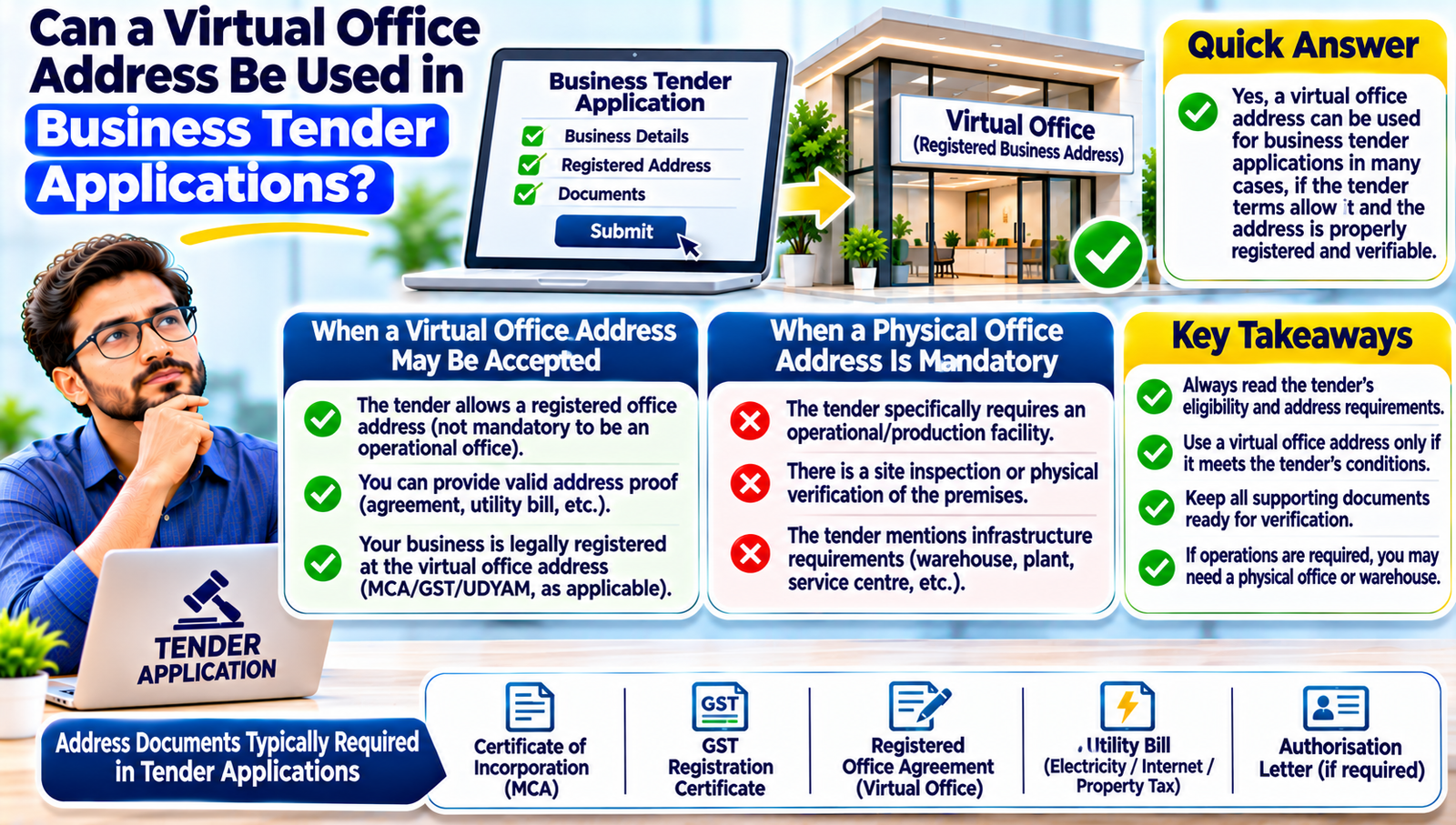
A virtual office can help Indian businesses maintain a professional address without renting a dedicated office. For startups, consultants, service providers and MSMEs, this arrangement may reduce fixed expenses while supporting business registration and correspondence.
However, businesses planning to participate in government or private tenders often face an important question: Can a virtual office address be used in a tender application?
The answer depends on the tender’s eligibility conditions, the type of address requested and the business activities involved.
A valid registered office address may be sufficient for one tender, while another may require a functioning local branch, service centre, warehouse or operational facility.
Understanding these differences before submitting a bid can help businesses avoid documentation problems, eligibility disputes and rejection.
Can You Use a Virtual Office Address for Business Tender Applications in India?
Yes, a virtual office address may be used in business tender applications in India when the arrangement is legitimate, verifiable and permitted by the relevant tender conditions.
However, a virtual office does not automatically satisfy requirements for physical infrastructure, local operations or dedicated premises.
When a Virtual Office Address May Be Accepted
A virtual office may be suitable when the tender requests a valid registered business address or correspondence address without requiring a dedicated operational office.
For example, a consulting company operating remotely may be able to use its legitimate registered office address when bidding for a service contract that does not require local premises.
When a Physical Office Address Is Mandatory
A physical office or operational facility may be necessary when the tender expressly requires a functioning local branch, service centre, warehouse, workshop or similar establishment.
A mailing-only arrangement cannot be represented as an operational facility.
Why Tender-Specific Eligibility Conditions Matter
Every tender has its own eligibility and qualification requirements.
Businesses should review the complete tender document, including amendments, technical specifications, eligibility conditions and supporting-document requirements.
Key takeaway: A virtual office is not automatically prohibited from tender applications, but it is not universally accepted either.
What Are the Business Address Requirements for Tender Applications?
Tender applications may request several types of addresses, each serving a different purpose.
Registered Office Address Requirements
A registered office identifies the statutory address of a company or LLP.
For incorporated entities, this address should correspond with the applicable MCA records.
Correspondence Address Requirements
A correspondence address is used for receiving procurement communications, notices and other documents.
It may differ from the registered office where the tender permits this.
Local Office or Branch Office Requirements
Some tenders require bidders to maintain an office within a specified city, district or state.
The tender may define what qualifies as a local office and when it must be established.
Operational Premises and Infrastructure Requirements
Contracts involving maintenance, installation, logistics, manufacturing or emergency support may require identifiable facilities.
These requirements cannot necessarily be satisfied by a virtual office agreement.
Address Verification During Tender Evaluation
The procuring organisation may request supporting documents, conduct verification or seek clarification.
Business Address Requirements at a Glance
| Address Type | Main Purpose | Can a Virtual Office Be Suitable? |
|---|---|---|
| Registered office | Statutory business identity | Potentially, if legally compliant |
| Correspondence address | Receiving tender communications | Often possible if permitted |
| Local branch office | Local business presence | Depends on the tender’s definition |
| Service centre | Repairs and after-sales support | Mail-only address generally insufficient |
| Warehouse | Storage and distribution | Requires suitable actual premises |
| Manufacturing facility | Production and inspection | Requires appropriate operational infrastructure |
Is a Virtual Office Address Accepted for Government Tenders in India?
Government tender eligibility depends on the procuring authority, applicable procurement rules and the particular bid conditions.
Address Requirements for Central Government Tenders
Central government procurement documents may require registered business information, eligibility declarations and evidence of technical or operational capacity.
The requirements vary according to the procurement.
Address Requirements for State Government Tenders
State government departments and public sector organisations may impose local presence or service infrastructure requirements where relevant to the contract.
Virtual Office Address Eligibility on the GeM Portal
The Government e-Marketplace (GeM) requires sellers to provide relevant business and address information.
However, providing a registered address in a GeM seller profile does not mean that every virtual office arrangement is automatically accepted for every bid.
Sellers must satisfy the applicable platform requirements and the conditions of the individual procurement.
Address Verification in Public Procurement Applications
Verification may involve statutory registration details, premises documents and additional evidence requested by the buyer.
Tender Conditions That May Restrict Virtual Office Use
Restrictions may arise where the tender requires a physical office, locally available personnel, an operational service centre or other facilities.
Important: GeM seller registration and eligibility for a particular GeM bid are separate matters.
Can a Virtual Office Address Be Used for Private Company Tenders?
Private organisations establish procurement requirements according to their commercial needs and internal policies.
Address Requirements in Corporate Procurement
Corporate procurement teams may request a registered address, tax information, banking records and evidence of business operations.
Virtual Office Acceptance for Service-Based Businesses
Remote-first consulting, design, marketing and other service businesses may be able to use a legitimate virtual office address where the buyer does not require dedicated premises.
Physical Office Requirements for Vendors and Contractors
Businesses providing maintenance, manufacturing, installation or logistics services may need suitable physical infrastructure.
Differences Between Government and Private Tender Eligibility
Government procurement is governed by applicable public procurement rules and bid documents.
Private procurement is generally based on contractual requirements, supplier due diligence and applicable law.
In both cases, the buyer’s specific address and operational requirements must be reviewed.
Which Documents Are Required to Use a Virtual Office Address in Tender Applications?
Document requirements depend on the tender and the type of business.
Virtual Office Rental or Service Agreement
The agreement should identify the business, full premises address, permitted use and validity period.
No Objection Certificate (NOC) From the Property Owner
An NOC or other appropriate consent may help establish that the business is authorised to use the premises.
Whether it is mandatory depends on the tender and applicable registration requirements.
Utility Bills and Address Supporting Documents
The authority may request a recent utility bill or other accepted premises evidence.
GST Registration Certificate
A GST certificate may support the business’s declared GST address where registration is applicable.
It does not independently prove that the business has a functioning local office.
Company Incorporation and Registered Office Documents
Companies and LLPs may need incorporation records, statutory identification details and MCA registered office information.
Additional Address Proof Requested by Tender Authorities
The buyer may request further evidence such as premises photographs, inspection reports or local office documentation.
Tender Address Documentation Checklist
| Document | Why It May Be Requested |
|---|---|
| Virtual office agreement | Establishes premises-use terms |
| Owner consent or NOC | Supports permission to use the address |
| Utility bill or accepted address proof | Supports premises verification |
| GST registration certificate | Confirms relevant GST registration details |
| Incorporation certificate | Establishes business identity |
| MCA master data | Supports statutory registered office information |
| Udyam certificate | Supports applicable MSME status |
| Operational premises evidence | Demonstrates facilities where required |
How to Use a Virtual Office Address When Applying for Business Tenders
Businesses should verify address eligibility before submitting a bid.
Step 1: Review Tender Eligibility and Address Conditions
Read the complete tender notice, eligibility criteria, technical requirements and supporting-document checklist.
Step 2: Verify Whether Virtual Office Addresses Are Permitted
Determine whether the tender requires a statutory address, correspondence address or functioning operational premises.
If the wording is unclear, request clarification.
Step 3: Check Consistency Across MCA, GST and Business Records
Confirm that the declared addresses are accurate for their respective purposes.
Different addresses may be legitimate, but discrepancies relating to the same premises should be resolved.
Step 4: Collect Valid Address Proof Documents
Prepare the applicable agreement, authorisation and other required evidence.
Step 5: Complete Tender Registration With Accurate Business Details
Enter the correct legal name, registered address, GST details and other requested information.
Step 6: Respond to Address Verification or Clarification Requests
Provide accurate supporting evidence within the permitted clarification process.
Do not assume that missing mandatory eligibility conditions can be corrected after the bid deadline.
Virtual Office vs Physical Office Address for Tender Applications
The appropriate office arrangement depends on what the tender requires.
Differences in Business Address Documentation
A virtual office agreement may establish permitted address use.
A physical office arrangement may provide additional evidence of occupancy, staff presence and operational facilities.
Cost and Operational Infrastructure Requirements
Virtual offices generally have lower fixed premises costs.
Dedicated offices and operational facilities involve additional expenses but may be necessary for certain contracts.
Address Verification and Inspection Considerations
A physical office may be easier to demonstrate as an operational location when staff, equipment or facilities are required.
Which Office Setup Is Suitable for Different Tender Types?
| Tender Type | Potentially Suitable Arrangement |
|---|---|
| Remote consulting | Virtual office may be suitable |
| Digital marketing services | Virtual office may be suitable |
| Software development | Depends on security and operational conditions |
| Equipment maintenance | May require local service facilities |
| Warehousing and distribution | Requires appropriate storage premises |
| Manufacturing | Requires suitable production facilities |
| On-site support contracts | Depends on local staffing and response requirements |
These examples are illustrative. The individual tender conditions determine eligibility.
Can MSMEs and Startups Apply for Tenders Using a Virtual Office Address?
MSMEs and startups may participate in eligible procurement opportunities, subject to the applicable conditions.
Virtual Office Eligibility for MSME Tender Applicants
MSME status does not automatically establish acceptance of a virtual office address.
The applicant must satisfy the tender’s address and operational requirements.
Address Requirements for Startup India-Recognised Businesses
DPIIT-recognised startups may be eligible for certain procurement benefits under applicable policies.
However, recognition does not remove every tender-specific address or infrastructure requirement.
Tender Participation by Home-Based and Remote Businesses
Home-based and remote businesses may be eligible where the procurement permits their operating model.
When MSMEs May Need a Local Physical Office
A local office may be necessary where the contract requires on-site service, equipment support or other physical operations.
What Are the Risks of Using a Virtual Office Address in Tender Applications?
The main risks arise when the declared address does not satisfy the tender’s actual requirements.
Tender Rejection Due to Mandatory Physical Office Requirements
A bid may be rejected if the tender requires a functioning office and the applicant provides only a mailing address.
Address Mismatch Across Business Registration Documents
Unexplained inconsistencies may lead to clarification requests or verification concerns.
Failure to Complete Physical Address Verification
An applicant may face problems if the declared premises cannot be verified as required.
Missing NOC or Supporting Address Documents
Incomplete documentation may result in a bid being treated as non-responsive where the documents are mandatory.
Incorrect Declaration of Operational Premises
A virtual office should not be described as a warehouse, workshop or staffed service centre unless it genuinely satisfies that description.
Potential Disqualification for Misrepresentation
False or misleading declarations may result in rejection, contractual consequences or other action under applicable procurement rules.
How to Verify Whether Your Virtual Office Address Is Eligible for a Tender
Eligibility should be established from the actual tender documents rather than general assumptions.
Review the Tender Notice and Eligibility Criteria
Read the complete tender and all published corrigenda.
Check Local Office and Site Inspection Clauses
Look for requirements relating to local presence, inspection, staff availability or operational infrastructure.
Confirm Address Proof Requirements With the Tender Authority
Check which documents are accepted and whether premises-use arrangements are subject to restrictions.
Request Written Clarification Before Submitting a Bid
Use the official pre-bid clarification process where available.
A useful question is:
“Does the tender permit a bidder to use a legally registered virtual office address where the bidder has valid premises-use documentation and official correspondence facilities, but no dedicated operational office at that location?”
Maintain Consistent and Verifiable Business Address Records
Ensure each declared address is supported by the appropriate records and reflects its actual purpose.
Common Mistakes to Avoid When Using a Virtual Office Address for Tenders
Several avoidable mistakes can create tender eligibility problems.
Assuming GST Registration Automatically Establishes Tender Eligibility
GST registration confirms a tax registration, not compliance with every procurement condition.
Using a Mailing Address as Proof of Operational Premises
A mail-handling address does not automatically demonstrate a functioning branch, warehouse or service centre.
Ignoring Tender-Specific Local Office Requirements
Read location-based eligibility conditions carefully.
Submitting Expired or Incomplete Address Documents
Ensure that relevant agreements and authorisations remain valid.
Providing Different Addresses Across Tender and Registration Records
Different addresses may be legitimate, but each must be correctly described and supported.
Failing to Check Address Verification Conditions
Understand whether the procuring organisation may inspect premises or request further evidence.
What Should Businesses Check Before Choosing a Virtual Office for Tender Applications?
Businesses intending to participate in tenders should evaluate providers carefully.
Availability of Legally Valid Address Documentation
Confirm that the provider can supply documents appropriate for the intended business use.
Permission to Use the Address for Business Registration
Review whether the agreement permits statutory registration and other declared purposes.
Mail Handling and Official Communication Support
The provider should offer reliable receipt and notification of official communications.
Physical Verification and Inspection Support
Determine what legitimate premises access and verification assistance the provider can offer.
Provider Reliability and Agreement Validity
Review the agreement duration, renewal terms and provider authorisation.
Compatibility With Tender-Specific Requirements
Before purchasing, compare the service arrangement against the requirements of the tenders the business intends to pursue.
A provider’s general claim that an address is suitable for government tenders should not be treated as a guarantee of eligibility.
Frequently Asked Questions
Is a virtual office address legal for tender applications in India?
A virtual office address may be used where the business has legitimate premises-use rights and the tender conditions permit that arrangement. There is no universal rule making every virtual office acceptable for all tenders.
Can I apply for government tenders using a virtual office address?
Potentially, yes. Eligibility depends on the procuring authority’s requirements, the tender documents and whether physical or local operational premises are mandatory.
Does the GeM portal accept virtual office addresses?
GeM requires relevant business and address information, but this does not establish blanket approval for all virtual office arrangements. Sellers should verify current GeM requirements and individual bid conditions.
Is a physical office mandatory for government tender participation?
Not universally. Some tenders may accept a legitimate registered business address, while others require a functioning local office or operational facility.
Can an MSME use a virtual office address for tenders?
Potentially, yes. MSME registration does not automatically waive address or infrastructure requirements specified in the tender.
What address proof is required for tender registration?
Depending on the tender, documents may include a premises agreement, owner consent, utility bill, GST certificate, incorporation documents and additional verification evidence.
Can a tender application be rejected because of a virtual office address?
Yes, if the address fails to satisfy mandatory tender conditions, required documentation is missing or the applicant misrepresents the premises.
Can I use my GST-registered virtual office address for government tenders?
Potentially, but GST registration alone does not establish tender eligibility. The declared address must satisfy the relevant procurement requirements.
How can I verify whether a tender allows a virtual office address?
Review the eligibility clauses, address proof requirements and inspection conditions. Where the requirements are unclear, request written clarification through the official tender process.