
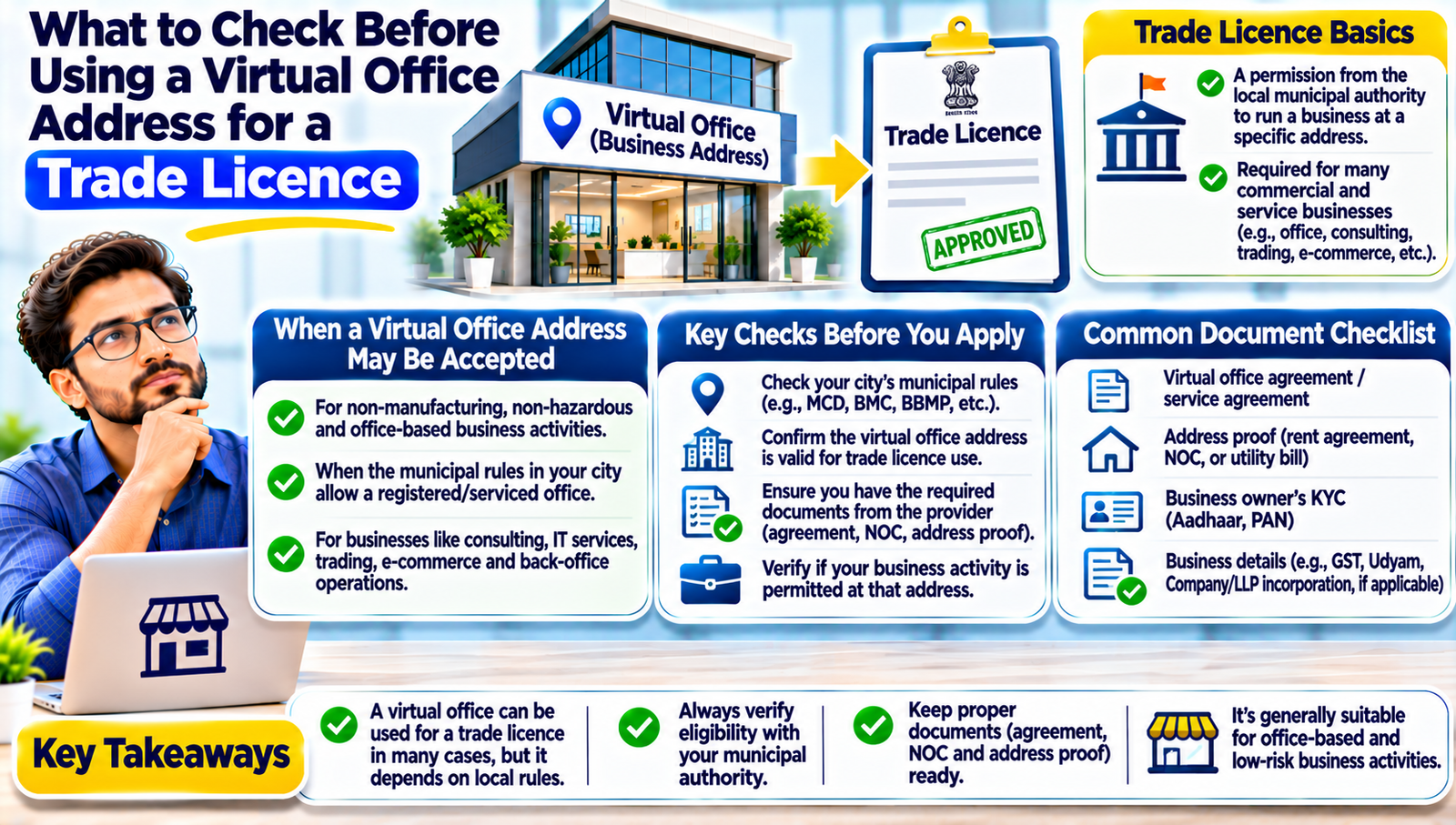
A virtual office can help businesses maintain a professional address without renting a dedicated commercial office. However, using that address for a trade licence in India requires additional checks.
Unlike company incorporation or GST registration, municipal trade licensing often focuses on the premises where a particular business activity is conducted. Local authorities may consider property use, occupancy rights, public safety, business activities and inspection requirements before granting a licence.
For example, a consultant working remotely may have different premises requirements from a restaurant, warehouse or manufacturing business.
A virtual office agreement that supports company registration does not necessarily satisfy municipal trade licence requirements.
This guide explains when a virtual office address may be suitable, what documents businesses should maintain, how local rules differ and what to do if an application is rejected.
Can You Use a Virtual Office Address for a Trade Licence in India?
A virtual office address may be suitable for a trade licence application in India only where the relevant municipal or local authority permits the arrangement for the proposed business activity. Many trade licences relate to actual operating premises, so a correspondence-only address may not qualify.
Businesses should verify the applicable licensing category, permitted property use, premises documents and inspection requirements before applying.
When a Virtual Office Address May Be Accepted
A virtual office may be considered where the relevant licence category permits an administrative or shared-premises arrangement and the applicant has sufficient rights to use the declared address.
However, a provider’s statement that its address is suitable for business registration does not establish trade licence eligibility.
When Physical Business Premises Are Required
Actual operating premises may be necessary for businesses involving food preparation, manufacturing, storage, repairs, customer-facing activities or other operations requiring identifiable facilities.
A virtual mailing address cannot be presented as a working kitchen, factory or warehouse.
Why Trade Licence Rules Differ Across Cities and States
Trade licensing is governed by applicable state legislation, municipal regulations and local procedures.
There is no single nationwide rule establishing whether every virtual office is acceptable for every trade licence.
Difference Between a Registered Business Address and an Operating Location
A registered business address may be used for statutory correspondence.
An operating location is where the relevant business activity actually takes place.
These addresses may differ, but the trade licence application must accurately identify the premises required by the applicable licensing rules.
Quick Eligibility Comparison
| Business Arrangement | Virtual Office Suitability | Main Consideration |
|---|---|---|
| Remote consulting business | May be suitable in some circumstances | Whether a trade licence is required and what premises qualify |
| Digital services company | Depends on local rules | Actual activity and licence category |
| E-commerce business | Depends on operations | Location of stock, fulfilment and business activities |
| Restaurant or commercial kitchen | Mail-only address generally unsuitable | Actual food preparation premises |
| Manufacturing unit | Mail-only address unsuitable | Production premises and applicable approvals |
| Warehouse | Mail-only address unsuitable | Actual storage location |
| Shared office business | Potentially suitable | Occupancy rights, activity and local approval |
What Is a Trade Licence and Which Businesses Need One?
A trade licence is an authorisation issued under applicable local laws for conducting specified business activities.
Purpose of a Trade Licence in India
Trade licensing helps local authorities regulate relevant business activities, premises use, public health, safety and other municipal requirements.
Types of Businesses That May Require a Trade Licence
Depending on the jurisdiction, businesses that may require licensing include shops, restaurants, commercial establishments, storage facilities, workshops and specified service providers.
Not every business activity is subject to identical requirements.
Which Local Authorities Issue Trade Licences?
Licences may be administered by municipal corporations, municipalities, urban local bodies or other competent authorities.
The relevant authority depends on the location and business activity.
Trade Licence vs Shop and Establishment Registration
A trade licence is generally concerned with permission to conduct a specified trade or activity under local municipal rules.
Shop and Establishment registration is governed by the applicable state legislation and may address matters such as establishment registration and employment-related conditions.
One does not automatically replace the other.
Trade Licence vs GST Registration
GST registration concerns obligations under goods and services tax law.
A trade licence concerns the relevant local permission to conduct specified business activities.
Having a GSTIN does not automatically establish eligibility for a municipal trade licence.
What Are the Address Requirements for a Trade Licence?
Trade licence applications may require evidence of the premises where the declared activity will take place.
Registered Office Address vs Actual Business Premises
A company may maintain its MCA registered office at one location while operating a shop, warehouse or other facility elsewhere.
The trade licence application should identify the premises required under the relevant municipal rules.
Commercial Property and Permitted Land Use
The property must satisfy applicable land-use, zoning and activity restrictions.
Commercial use is not automatically permitted at every address described as a business centre.
Occupancy and Business Activity Requirements
The applicant may need to demonstrate lawful occupancy or permission to conduct the declared activity.
Local Municipal Address Verification Rules
Authorities may request property documents, site plans, photographs, declarations or other supporting evidence.
Restrictions on Shared and Virtual Office Addresses
Shared premises may be subject to restrictions relating to occupancy, business activities or multiple establishments.
The applicant should confirm whether the intended arrangement is permissible.
Which Businesses Can Consider a Virtual Office for Trade Licence Applications?
The suitability of a virtual office depends on what the business actually does and what the licensing authority requires.
Consultants and Professional Service Providers
Consultants may operate remotely and use an administrative address.
They should first determine whether their activities require a trade licence and whether the declared premises arrangement qualifies.
Online and Home-Based Businesses
Online businesses may operate from homes, offices or separate fulfilment locations.
The relevant premises should be declared according to actual activities and local rules.
E-commerce and Digital Service Companies
A digital service company may have limited physical infrastructure needs.
An e-commerce seller storing inventory elsewhere may need to disclose or obtain permissions for its actual storage or operating location.
Businesses With Separate Operational Premises
A company may use a virtual office for correspondence while maintaining an independently licensed operating location.
The two addresses should be accurately distinguished.
Businesses That May Require Dedicated Physical Facilities
Food businesses, manufacturing units, repair workshops and other premises-dependent operations generally require suitable actual facilities.
What Documents Are Required When Using a Virtual Office Address for a Trade Licence?
Document requirements vary according to the municipality and business category.
Virtual Office Rental or Service Agreement
The agreement should identify the applicant, complete premises address, permitted use and agreement validity.
A general correspondence agreement may not provide sufficient occupancy rights for trade licensing.
No Objection Certificate From the Property Owner
An NOC or equivalent authorisation may be required where the applicant does not own the premises.
The authorisation should cover the intended business use.
Property Tax Receipt and Utility Bills
The authority may request a property tax receipt, electricity bill, water bill or other accepted premises evidence.
Business Registration and Identity Documents
Applicants may need PAN, incorporation records, partnership documents, identity proof or other business details.
GST Registration Certificate, Where Applicable
A GST certificate may be requested as supporting business information where relevant.
It does not replace mandatory premises documentation.
Additional Documents Required by Municipal Authorities
Depending on the activity, additional documents may include site plans, establishment photographs, fire safety clearances or other permissions.
Document Checklist
| Document | Purpose | Always Required? |
|---|---|---|
| Virtual office agreement | Establishes contractual address use | Depends on arrangement |
| Owner NOC or authorisation | Supports permission to use premises | Depends on local rules |
| Property tax receipt | Supports property identification | Authority-specific |
| Utility bill | Supports address verification | Authority-specific |
| Business incorporation documents | Establishes applicant identity | Entity-specific |
| GST certificate | Supports tax registration details | Where applicable |
| Premises photographs | Shows the declared establishment | Where required |
| Site plan | Identifies premises and occupied area | Where required |
| Fire or other clearance | Supports regulated activities | Activity-specific |
How to Check Whether Your Virtual Office Address Is Eligible for a Trade Licence
Businesses should verify eligibility before paying for a virtual office package intended for licensing.
Step 1: Identify the Relevant Municipal or Local Authority
Determine which authority has jurisdiction over the proposed business premises.
Step 2: Review Trade Licence Requirements for Your Business Activity
Identify the correct licence category and review the applicable requirements.
Step 3: Confirm Whether Shared or Virtual Addresses Are Permitted
Check whether the authority allows the proposed premises arrangement.
Do not assume that acceptance for GST or MCA registration establishes municipal eligibility.
Step 4: Verify Property Use and Address Documentation
Confirm the property’s permitted use, provider authorisation and available occupancy evidence.
Step 5: Check Physical Inspection and Verification Requirements
Determine whether the authority requires premises photographs, site inspection or other verification.
Step 6: Obtain Written Clarification Before Applying
If eligibility is unclear, request clarification through the authority’s official channel.
A useful question is:
“Can an applicant use a shared or virtual office address for the specified trade licence category where the premises are used for administration and correspondence, while the business’s actual operations take place elsewhere?”
Include the business activity and intended address arrangement when requesting clarification.
Can a Virtual Office Address Be Used for Trade Licences in Different Indian Cities?
Trade licence requirements must be assessed separately for each city and the particular municipal jurisdiction.
Trade Licence Requirements in Delhi
The Municipal Corporation of Delhi administers General Trade/Storage licensing for activities within its jurisdiction.
Applicants should check the applicable category, premises documentation and current application procedure.
MCD’s published guidance has included requirements relating to legal occupancy evidence, premises photographs and site plans.
Trade Licence Requirements in Mumbai
Mumbai businesses should review the relevant requirements of the Brihanmumbai Municipal Corporation (BMC/MCGM).
Depending on the activity, the authority may require evidence of possession or occupancy and other relevant permissions.
Trade Licence Requirements in Bengaluru
Businesses in Bengaluru should check the current trade licensing arrangements under the applicable municipal administration.
Requirements may depend on the establishment’s activity, premises and jurisdiction.
Trade Licence Requirements in Chennai
Applicants should consult the Greater Chennai Corporation and identify the appropriate licence category and premises documentation.
Trade Licence Requirements in Hyderabad
Businesses should check the applicable Greater Hyderabad Municipal Corporation trade licensing requirements and confirm the rules for their proposed activities and premises.
Why Municipal Rules Must Be Checked Before Applying
An address arrangement accepted in one jurisdiction may not satisfy another authority’s requirements.
Even within the same city, different business activities may be subject to different conditions.
City-Wise Verification Guide
| City | Relevant Municipal Authority | What to Verify |
|---|---|---|
| Delhi | Municipal Corporation of Delhi or other competent local authority | Trade category, occupancy proof and premises requirements |
| Mumbai | Brihanmumbai Municipal Corporation | Activity-specific licensing and premises evidence |
| Bengaluru | Applicable Bengaluru municipal authority | Current licensing process and permitted premises use |
| Chennai | Greater Chennai Corporation | Licence category and address documents |
| Hyderabad | Greater Hyderabad Municipal Corporation | Trade category, premises evidence and verification |
Note: This table identifies authorities to consult; it does not confirm that virtual office addresses are accepted in any particular city.
How Does Address Verification Work for Trade Licence Applications?
Verification procedures depend on the municipality and licence category.
Document Verification by Municipal Authorities
The authority may review identity documents, premises evidence, ownership information and declared activities.
Physical Inspection of Business Premises
Some licence categories or applications may involve site inspection.
Other processes may rely initially on submitted documents and declarations, with inspection or enforcement checks occurring later.
Checking Whether Business Activities Match the Declared Address
The authority may examine whether the declared premises are suitable for the stated business activity.
Common Reasons for Address Verification Failure
Common issues include incomplete occupancy evidence, incorrect addresses, unsuitable property use or discrepancies between declared and actual activities.
What Happens When Additional Address Proof Is Requested?
The applicant should provide the requested documents within the applicable timeframe.
If the premises arrangement cannot satisfy a mandatory condition, an alternative location may be necessary.
What Are the Risks of Using a Virtual Office Address for a Trade Licence?
Using an unsuitable address may create licensing and operational problems.
Application Rejection Due to Physical Premises Requirements
An application may be rejected if the licence requires actual operational premises and the applicant provides only a mailing address.
Address Mismatch Across Business Records
Unexplained inconsistencies may result in clarification requests or verification concerns.
Incomplete Property Owner Consent or Documentation
An agreement without sufficient premises-use authorisation may fail to satisfy the authority’s requirements.
Restrictions on Commercial Activities at the Property
The property may not be authorised for the intended trade or activity.
Licence Cancellation Due to Incorrect Address Declarations
Incorrect or misleading declarations may lead to cancellation or other consequences under applicable local law.
Problems During Renewal or Municipal Inspections
An address arrangement that cannot be verified may create difficulties during renewal, inspection or compliance checks.
Virtual Office vs Physical Office for Trade Licence Applications
A virtual office and a physical office serve different operational purposes.
Differences in Address Eligibility
A virtual office may provide correspondence and administrative services.
A physical office may provide actual premises where the licensed activity takes place.
Documentation and Property Verification Requirements
Both arrangements require suitable documentation, but a physical premises arrangement may more readily demonstrate actual occupation and operations.
Cost and Operational Considerations
Virtual offices generally involve lower fixed premises expenses.
Physical offices may involve rent, deposits, utilities, maintenance and staffing costs.
Suitability for Service-Based and Premises-Based Businesses
Remote service businesses may have fewer physical infrastructure requirements.
Premises-dependent businesses need suitable facilities for their actual activities.
When a Physical Office Is the Safer Option
A physical office or other operational premises is generally the more appropriate choice when the licence requires demonstrable business activity at the declared address.
| Factor | Virtual Office | Physical Office |
|---|---|---|
| Main function | Address and administrative services | Actual workspace or operations |
| Typical premises costs | Usually lower | Usually higher |
| Dedicated workspace | Often unavailable | Usually available |
| Operational activity | Limited by agreement | Depends on property and approvals |
| Inspection readiness | Depends on actual permitted use | Can demonstrate operations where present |
| Trade licence suitability | Authority- and activity-specific | Also subject to local rules |
| Best suited for | Eligible administrative needs | Premises-based activities |
Common Mistakes to Avoid When Applying for a Trade Licence With a Virtual Office
Businesses should avoid the following errors.
Assuming GST Approval Guarantees Trade Licence Eligibility
GST registration and municipal trade licensing have separate requirements.
Using a Mailing Address as an Operational Address
A mail-only arrangement should not be represented as a functioning business establishment.
Ignoring Municipal Zoning and Property Use Rules
Confirm that the proposed business activity is permitted at the premises.
Submitting Incomplete or Expired Address Documents
Ensure agreements, authorisations and other required documents are current.
Failing to Verify Physical Inspection Requirements
Check whether premises inspection is required before or after licence issuance.
Choosing a Virtual Office Without Checking Local Regulations
Confirm licensing suitability before committing to a long-term service agreement.
What Should You Ask a Virtual Office Provider Before Applying for a Trade Licence?
A provider should be able to explain the services and premises rights included in its agreement.
Is the Address Permitted for My Business Activity?
Ask whether the premises can lawfully support the specific declared activity.
Can the Provider Supply Valid Address Proof and an NOC?
Confirm which documents are available and who is authorised to issue them.
Does the Agreement Permit Trade Licence Applications?
Check whether the agreement expressly permits the intended use.
Is Physical Verification or Inspection Support Available?
Ask about lawful premises access and the provider’s role during verification.
Are There Restrictions on Using the Address for Licences?
Review contractual limitations and property-use restrictions.
What Happens if the Address Is Rejected?
Understand the provider’s refund, cancellation, relocation and documentation policies.
Important: A provider cannot guarantee that a municipal authority will approve a trade licence.
What to Do if Your Virtual Office Address Is Rejected for a Trade Licence
An application rejection should be assessed against the authority’s stated reasons.
Review the Reason for Application Rejection
Check whether the rejection concerns documents, property eligibility, declared activities or another condition.
Correct Missing or Inconsistent Address Documents
Where permitted, submit corrected documents or resolve discrepancies.
Request Clarification From the Municipal Authority
Ask the authority to explain the relevant requirement and available correction or appeal process.
Consider an Eligible Physical or Shared Office Space
If the virtual office does not satisfy mandatory premises conditions, identify a suitable alternative.
Reapply With the Correct Business Premises Details
Complete the appropriate application process using accurate information and supporting evidence.
Do not declare a correspondence-only address as an operational establishment merely to obtain approval.
Frequently Asked Questions
Can I get a trade licence using a virtual office address in India?
Potentially, yes. Eligibility depends on the relevant municipal rules, the business activity and whether the virtual office arrangement satisfies the applicable premises requirements.
Is a physical office mandatory for a trade licence?
Not every licence category has identical premises requirements. However, many activities require an identifiable location where the business actually operates.
Can a virtual office be used for a municipal trade licence?
Only where the competent authority permits the arrangement and the applicant satisfies the relevant conditions.
Is a virtual office address valid for both GST and trade licence registration?
It may be suitable for both in some circumstances, but GST and municipal trade licensing have separate requirements. Approval under one framework does not guarantee approval under the other.
What documents are needed for a trade licence with a virtual office?
Depending on the authority, documents may include a premises agreement, owner consent, utility bill, property tax evidence, business identity records and additional activity-specific permissions.
Can a home-based business use a virtual office for a trade licence?
Potentially, but the authority may require the actual location where the business operates. A separate virtual correspondence address may not replace that requirement.
Do municipal authorities inspect virtual office addresses?
Inspection procedures vary. Some applications may be assessed through documents and declarations, while others may involve physical verification or later inspections.
Can a trade licence application be rejected because of a virtual office address?
Yes. Rejection may occur where the address does not satisfy mandatory premises conditions, required documents are missing or the declared activity cannot lawfully operate from the location.
Does trade licence eligibility vary by city in India?
Yes. Municipal laws, licence categories, property-use restrictions and application procedures vary across jurisdictions.