
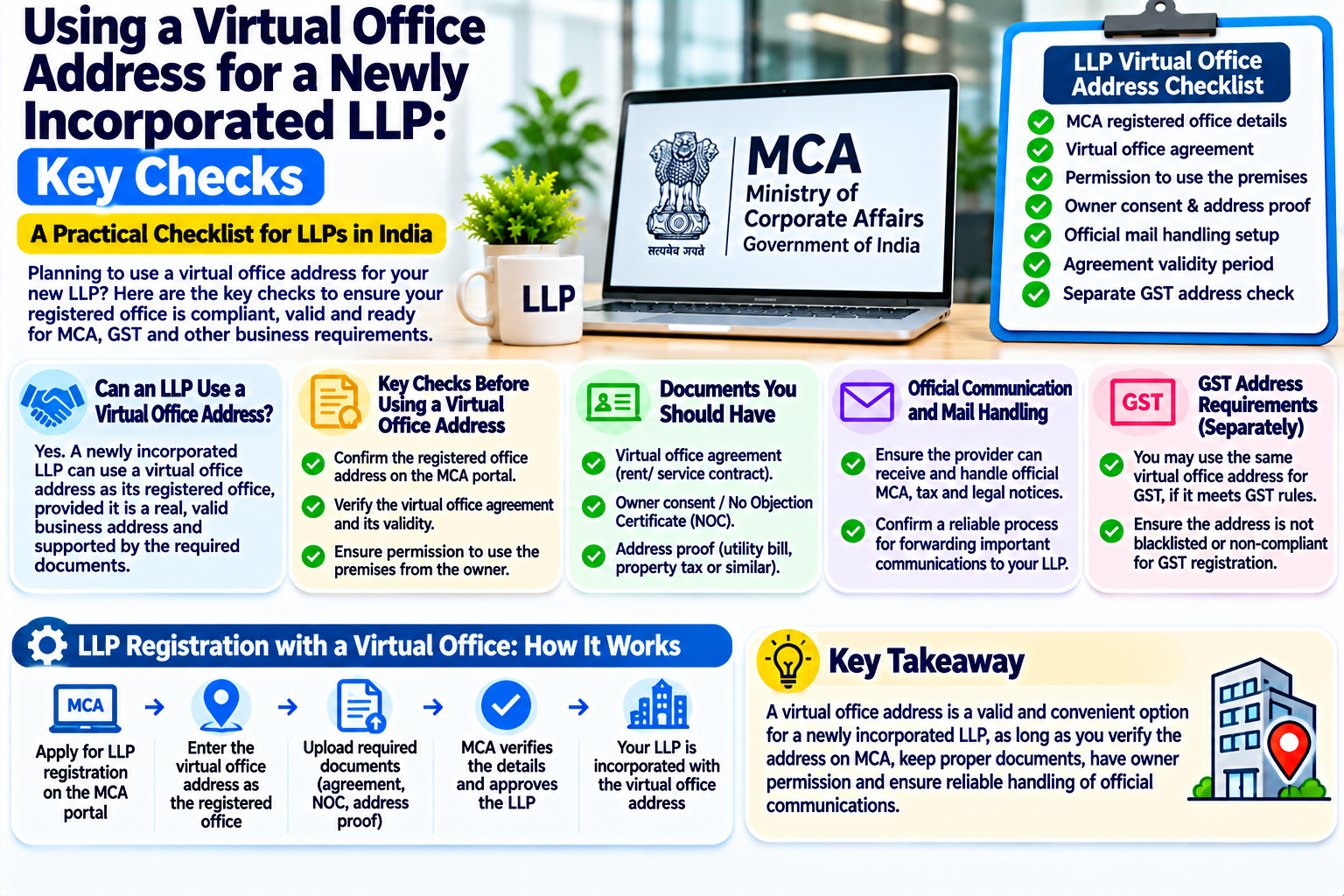
A newly incorporated LLP using a virtual office address should verify that its registered office details are correctly recorded with MCA, supported by valid premises-use documents and suitable for receiving official communications. Designated partners should also check the agreement’s validity, owner authorisation, mail handling arrangements and any separate GST registration requirements.
Registering a Limited Liability Partnership (LLP) is an important step for entrepreneurs starting a business in India. However, completing incorporation does not mean that all registered office and statutory compliance responsibilities are finished.
For LLPs using a virtual office, the first few weeks after incorporation are particularly important. Designated partners should confirm that the registered address is accurate, the virtual office agreement remains valid and official communications can be received without interruption.
The LLP must also complete applicable post-incorporation filings, maintain its statutory records and assess whether separate registrations, such as GST, are required.
This guide explains the essential checks for a newly incorporated LLP using a virtual office address in India.
What Should a Newly Incorporated LLP Check Before Using a Virtual Office Address?
A newly incorporated LLP should verify its registered office details, premises-use permission, address documents and communication arrangements before relying on a virtual office.
Confirm the Registered Office Address on MCA
Check the registered office address recorded in the Ministry of Corporate Affairs (MCA) LLP master data. Ensure it matches the premises the LLP is authorised to use.
Verify the Virtual Office Agreement
Review the service agreement to confirm that it supports the incorporated LLP’s use of the address.
Check Permission to Use the Premises
The LLP should have legitimate permission to use the declared premises as its registered office.
Review Owner Consent and Address Proof
Maintain applicable owner authorisation, occupancy evidence and supporting address documents.
Confirm Official Mail Handling
Ensure the virtual office provider can receive and promptly communicate official notices addressed to the LLP.
Check Agreement Validity
Confirm the agreement’s commencement date, expiry date and renewal provisions.
Review GST Address Requirements Separately
If GST registration is required, assess whether the virtual office satisfies the relevant GST business premises requirements.
Newly Incorporated LLP: Initial Verification Checklist
| Verification Item | What to Check | Priority |
|---|---|---|
| MCA registered office | Correct building, unit, city, state and PIN code | High |
| Virtual office agreement | Valid agreement supporting LLP registered office use | High |
| Premises-use permission | Appropriate owner or operator authorisation | High |
| Address proof | Documents consistent with the declared premises | High |
| Mail handling | Receipt and notification of official communications | High |
| Agreement expiry | Renewal date and termination conditions | High |
| LLP Form 3 | Applicable LLP agreement filing completed on time | High |
| GST address | Separate eligibility and documentation assessment | If applicable |
| Bank records | Correct LLP identity and business address information | If applicable |
Can a Newly Incorporated LLP Use a Virtual Office as Its Registered Address?
Yes, a newly incorporated LLP may use a virtual office address where the arrangement satisfies the requirements applicable to an LLP’s registered office.
Virtual Office Eligibility for LLPs
The LLP Act does not create a separate statutory category called a “virtual office”.
Instead, a virtual office arrangement must satisfy the ordinary registered office requirements applicable to LLPs.
Requirements Under Section 13 of the LLP Act
Section 13 of the Limited Liability Partnership Act, 2008, requires every LLP to have a registered office to which communications and notices may be addressed and where they may be received.
Registered Office vs Operating Location
The registered office is the LLP’s official statutory address.
The operating location is where partners, employees or other business activities may be based.
These addresses may differ, subject to applicable requirements.
Permission to Use the Virtual Office Address
The LLP should have appropriate contractual or other legal rights to use the premises for registered office purposes.
Receiving Official Communications
The arrangement should support reliable receipt of official communications and notices.
When a Virtual Office May Be Suitable
A virtual office may be suitable for consultants, professional service providers, remote-first businesses and small LLPs that do not need a dedicated administrative office.
When a Virtual Office Arrangement May Create Compliance Risks
Risks may arise where the provider cannot establish its authority over the premises, registered office use is not permitted or official correspondence cannot be reliably received.
Key takeaway: An LLP does not necessarily need a dedicated commercial office, but it must maintain a legitimate registered office that satisfies Section 13 and the applicable LLP Rules.
What Is an LLP Virtual Office Address?
An LLP virtual office address is a business address provided under a virtual office arrangement and used as the LLP’s registered office where legally suitable.
Meaning of an LLP Virtual Office Address
It is an identifiable premises address that an LLP is permitted to use for statutory registration and communication purposes.
How Virtual Office Address Services Work
Virtual office providers may offer business address services, mail receipt, mail forwarding, meeting facilities and limited workspace access.
The exact services depend on the agreement.
Registered Office vs Correspondence Address
The registered office is the LLP’s statutory address recorded with MCA.
A correspondence address may be used for other communications, but it does not automatically replace the registered office.
Virtual Office vs Shared Office
A virtual office generally focuses on address and administrative services.
A shared office may also provide physical workspace used by multiple businesses.
Virtual Office vs Coworking Space
Coworking spaces typically offer desks, meeting rooms and shared facilities.
Some coworking providers also offer virtual office and registered address services.
Why Newly Incorporated LLPs Consider Virtual Offices
New LLPs may use virtual offices to reduce fixed office expenses, maintain a professional business address and support remote operations.
How to Verify an LLP Registered Office Address on MCA Records
After incorporation, designated partners should confirm that the registered office information appears correctly in MCA records.
Step 1: Visit the MCA Portal
Open the official Ministry of Corporate Affairs website at https://www.mca.gov.in/.
Step 2: Access LLP Master Data
Locate the MCA service for viewing company or LLP master data.
Portal navigation and authentication requirements may change, so verify the current interface.
Step 3: Search Using the LLP Name or LLPIN
Search using the LLP’s registered name or Limited Liability Partnership Identification Number (LLPIN).
Step 4: Review the Registered Office Address
Check the address displayed in the LLP’s master data.
Step 5: Compare the Address With the Virtual Office Agreement
Verify that the recorded address matches the premises identified in the agreement.
Step 6: Check the PIN Code and Address Details
Review the building number, floor, unit, locality, city, state and PIN code.
Step 7: Identify and Correct Any Discrepancies
If the information is incorrect, review the incorporation documents and determine the appropriate correction or change filing.
MCA master data does not necessarily provide public access to every underlying document.
What Address Proof Documents Should a Newly Incorporated LLP Maintain?
An LLP should maintain documents supporting its legitimate use of the registered office premises.
Virtual Office Service Agreement
The agreement should identify the LLP, provider, address, permitted use and relevant terms.
Property Owner Consent or NOC
Appropriate consent may be required where the premises belong to another person.
Ownership or Occupancy Evidence
Relevant documents may establish the property owner’s rights or the provider’s authority to operate from the premises.
Utility Bill or Other Applicable Address Proof
A recent utility bill or other accepted premises evidence may be required under the applicable MCA form instructions.
Provider Authorisation Documents
Where the virtual office operator is not the owner, review the documents establishing its authority to permit registered office use.
LLP Incorporation and Registration Records
Maintain the incorporation certificate, LLPIN and relevant MCA filing acknowledgements.
Supporting Evidence for Official Verification
Retain correspondence records, premises documents and other relevant evidence that may be needed during lawful verification.
| Document | Purpose |
|---|---|
| Virtual office agreement | Establishes contractual premises-use terms |
| Owner consent or NOC | Supports permission to use the premises |
| Ownership or occupancy evidence | Helps establish property rights and provider authority |
| Accepted utility bill | Supports verification of the premises address |
| Incorporation certificate | Establishes the LLP’s incorporated identity |
| LLPIN | Identifies the LLP in MCA records |
| Filing acknowledgements | Records completed statutory submissions |
| Mail receipt records | Supports correspondence tracking |
What Should an LLP Check in Its Virtual Office Agreement?
A virtual office agreement should clearly support the LLP’s intended registered office use.
Correct LLP Name and Registered Address
Verify that the agreement identifies the correct LLP and complete premises address.
If the agreement was executed before incorporation, review whether the final documentation properly supports the incorporated LLP’s use of the premises.
An updated agreement, confirmation or other appropriate documentation may be necessary.
Permission for LLP Registered Office Use
The agreement should expressly permit the address to be used as the LLP’s registered office.
Agreement Start and Expiry Dates
Check the commencement date, validity period and renewal deadline.
Official Mail Receipt Arrangements
Confirm how the provider receives statutory communications addressed to the LLP.
Mail Forwarding and Notification Terms
Review notification methods, forwarding procedures and applicable service charges.
Provider Responsibilities
Understand the provider’s obligations regarding documentation, correspondence and premises access.
Renewal and Termination Conditions
Check notice periods, renewal terms and circumstances in which the provider may terminate the arrangement.
Address Relocation Clauses
Review what happens if the provider relocates to another building or can no longer offer the original address.
Is Owner Consent or an NOC Required for an LLP Virtual Office Address?
Owner consent helps establish that the LLP is authorised to use the declared premises.
Meaning of Owner Consent
Owner consent is written permission from the property owner or another person authorised to permit use of the premises.
Why Premises Authorisation Matters
The LLP should be able to demonstrate legitimate premises-use rights.
Property Owner vs Virtual Office Provider
The virtual office provider may own the premises or operate them under a lease or another contractual arrangement.
When an NOC or Other Consent Evidence May Be Required
An NOC or equivalent permission document may be required depending on the premises arrangement and applicable filing requirements.
What Information Should the Authorisation Include?
The authorisation should ordinarily identify the person granting permission, the LLP, the complete premises address, the permitted use and the relevant date.
Common Documentation Errors
Common errors include incorrect address details, missing signatures and authorisation issued by someone without sufficient authority.
What to Do if Permission Is Withdrawn
The LLP should promptly determine whether it can continue using the premises.
If the arrangement cannot continue, it should secure an alternative registered office and complete the applicable statutory filings.
How Should a Newly Incorporated LLP Manage Official Communications?
Effective communication arrangements are essential when an LLP uses a virtual office.
Receiving MCA and ROC Correspondence
The virtual office provider should have arrangements to receive official correspondence delivered to the registered office.
Notices Addressed to the LLP
Incoming notices should be correctly identified and associated with the LLP.
Mail Receipt and Acknowledgement
The provider should maintain a reliable process for receiving and acknowledging communications where appropriate.
Prompt Notification to Designated Partners
Designated partners should receive timely notifications when official correspondence arrives.
Secure Mail Forwarding
Mail should be securely stored and forwarded or made available according to the agreement.
Maintaining Correspondence Records
Keep records of received notices, delivery dates, notifications and forwarding actions.
Monitoring Electronic MCA Communications
Designated partners should monitor the LLP’s registered email accounts and relevant MCA communications separately from physical mail handling.
Handling Urgent Statutory Notices
Establish a clear escalation process for notices requiring a response within a prescribed deadline.
What MCA and LLP Compliance Records Should Be Checked After Incorporation?
Registered office verification is only one part of post-incorporation compliance.
LLPIN and Incorporation Certificate
Confirm that the LLP’s registered name and LLPIN are correct.
Maintain a copy of the incorporation certificate.
Registered Office Details in LLP Master Data
Check that the registered office address matches the premises documentation.
Designated Partner Information
Verify the designated partner details and applicable identification information recorded with MCA.
LLP Agreement and Form 3
The LLP agreement governs the rights and duties of partners and the LLP.
Under Section 23 of the LLP Act and the applicable LLP Rules, information concerning the LLP agreement is generally filed through LLP Form 3 within 30 days of incorporation.
Any applicable amendments to the agreement must also be reported through the prescribed process.
Applicable Filing Deadlines
Track incorporation-related deadlines, LLP agreement filing requirements and other statutory obligations.
Registered Office Supporting Documents
Maintain the virtual office agreement, authorisation and relevant address evidence.
Statutory Communication Arrangements
Ensure the LLP can receive communications at its registered office.
Ongoing Annual Compliance Calendar
Prepare a compliance calendar covering applicable annual returns, financial statements, income tax filings and other obligations.
For example, LLP Form 11 and Form 8 have separate filing requirements and should not be confused with registered office change filings.
Does an LLP Need to Update Its Virtual Office Address After Incorporation?
Not every post-incorporation activity requires an address change filing.
When No Address Change Filing Is Needed
If the LLP continues using the same valid registered office and its recorded details are correct, a registered office change filing is generally unnecessary.
Incorrect Address Details in MCA Records
Incorrect incorporation details may require correction through the applicable MCA process.
Moving to Another Virtual Office
If the LLP changes its registered office to another premises, the applicable change procedure must be followed.
Provider Relocation
A provider’s relocation should be reviewed to determine whether the LLP’s registered office has also changed.
Agreement Expiry
An expiring agreement does not automatically mean the address has changed.
However, the LLP must maintain legitimate permission to use its registered office.
Changing Registered Office Within the Same State
A change within the same state generally requires the applicable registered office change filing.
Moving the Registered Office to Another State
Interstate changes may require additional statutory procedures, consents and notices.
When LLP Form 15 Applies
LLP Form 15 is the prescribed form for notifying the Registrar of a change in an LLP’s registered office.
It is not a routine filing required merely because the LLP has recently been incorporated.
How to Change an LLP Virtual Office Address Using Form 15
An LLP changing its registered office must follow the applicable procedure under Section 13 and the LLP Rules.
Step 1: Identify the Type of Registered Office Change
Determine whether the LLP is moving within the same state or to another state.
Step 2: Review Partner and Creditor Requirements
Review the LLP agreement and applicable statutory provisions to identify required partner decisions and creditor consent.
Step 3: Obtain New Premises Documents
Collect the new agreement, relevant authorisation and accepted premises evidence.
Step 4: Prepare the Required Authorisations
Complete any necessary partner approvals or other prescribed requirements.
Step 5: Complete LLP Form 15
Enter the new registered office details and attach the applicable supporting documents.
Step 6: Complete Additional Requirements Where Applicable
Interstate changes may require additional procedures under the LLP Rules, including applicable notices and consents.
Step 7: Submit the Filing
Submit the applicable MCA filing with the prescribed fees and authentication.
Step 8: Verify Updated LLP Master Data
After processing, check that the registered office address is correctly updated.
Important: Form 15 is not necessarily the only requirement for every registered office relocation, particularly when the change involves another state.
Can an LLP Use Its Virtual Office Address for GST Registration?
An LLP may potentially use a virtual office address for GST registration where the arrangement satisfies the applicable GST requirements.
LLP Registered Office vs GST Principal Place of Business
The MCA registered office is the LLP’s statutory address.
The GST Principal Place of Business is the primary business premises declared under the relevant GST registration.
These are separate legal concepts.
When GST Registration Is Required
GST registration depends on the LLP’s activities, turnover, statutory requirements and applicable exemptions.
Virtual Office Address Proof Under GST
The LLP must provide the accepted premises documents required for the relevant GST application.
Premises-Use Rights and Verification
The LLP should have legitimate permission to use the premises for the declared business purpose.
Can MCA and GST Addresses Be Different?
Yes. The MCA registered office and GST business premises may differ where each arrangement satisfies the applicable requirements.
Physical Verification Considerations
GST authorities may verify the declared business premises under the relevant statutory procedures.
When a Virtual Office May Be Unsuitable for GST Purposes
A virtual office may be unsuitable where the declared business activities require facilities, inventory storage or other premises arrangements that the provider cannot support.
Key takeaway: Acceptance of an address in MCA records does not automatically establish its suitability for GST registration.
What Happens if the Virtual Office Agreement Expires During the LLP’s First Year?
A virtual office agreement may expire before the LLP completes its first financial year.
Risks of Losing Premises-Use Permission
An expired agreement may affect the LLP’s continued right to use the premises.
Renewal Before Agreement Expiry
Review renewal requirements and complete the necessary arrangements before expiry.
Maintaining Official Mail Continuity
Ensure that official communications can still be received throughout the transition.
Moving to Another Provider
Verify the new provider’s premises documentation and registered office services before changing addresses.
Updating MCA Records Where Required
If the LLP’s registered office changes, complete the applicable MCA filing.
Updating GST and Bank Records Where Applicable
Review whether the change affects the LLP’s GST business premises or banking records.
Maintaining Evidence of the Transition
Retain the previous agreement, new agreement, correspondence records and applicable filing acknowledgements.
What Are the Common Virtual Office Address Mistakes Made by New LLPs?
New LLPs should avoid assuming that incorporation approval resolves every address-related compliance obligation.
Failing to Verify MCA Master Data
Incorrect address details may remain unnoticed until a communication or verification issue arises.
Using an Address Without Clear Permission
A provider’s general business address service may not establish adequate registered office rights.
Missing or Inconsistent Address Documents
Incomplete documents can create difficulties during future filings or verification.
Assuming the Provider Handles All Statutory Compliance
The virtual office provider may manage correspondence, but the LLP and its designated partners remain responsible for their applicable statutory obligations.
Ignoring Mail Notifications
Missing official notices may lead to compliance problems.
Forgetting Agreement Renewal
Failure to renew may affect continued use of the registered office.
Confusing LLP and Private Limited Company Rules
LLPs are governed primarily by the LLP Act, 2008, and applicable LLP Rules.
Companies follow a separate framework under the Companies Act, 2013.
Assuming MCA Acceptance Guarantees GST Approval
MCA and GST requirements are different and must be assessed separately.
Not Updating Records After Relocation
The LLP must complete the applicable registered office change procedure when its statutory address changes.
How to Choose a Reliable Virtual Office Provider for a New LLP
A suitable provider should support the LLP’s registered office requirements and ongoing correspondence needs.
Registered Office Use Permission
Confirm that the agreement expressly permits LLP registered office use.
Property and Provider Authorisation
Check that the provider has the legal authority to offer the premises for this purpose.
Availability of Supporting Documents
Ask which agreements, authorisations and premises documents the provider can supply.
Mail Handling and Notification Processes
Review how incoming official communications are received and communicated.
Agreement Duration and Renewal Terms
Check the validity period, renewal costs and termination conditions.
Premises Access and Verification Support
Understand the extent of lawful premises access and documentation support available.
Provider Relocation Policy
Review what happens if the provider changes premises.
Transparent Service Terms
Compare the agreement, documentation support, correspondence services and other terms rather than focusing only on price.
First-Year LLP Virtual Office Address Compliance Checklist
Use this checklist to track registered office and related post-incorporation requirements.
| Compliance Check | Status |
|---|---|
| Verify LLP master data | Pending |
| Confirm the registered office address | Pending |
| Match MCA details with the agreement | Pending |
| Confirm premises-use permission | Pending |
| Maintain address proof | Pending |
| Check owner authorisation | Pending |
| Confirm official mail handling | Pending |
| Track agreement expiry | Pending |
| Complete applicable post-incorporation filings | Pending |
| Review GST address requirements | Pending |
| Maintain a compliance calendar | Pending |
| Monitor provider relocation | Pending |
| Update records after address changes | Pending |
| Save filing acknowledgements | Pending |
Final Words
Using a virtual office address can be a practical option for a newly incorporated LLP that does not require a dedicated administrative office.
However, the LLP must maintain a registered office that satisfies Section 13 of the Limited Liability Partnership Act, 2008, and the applicable LLP Rules.
Designated partners should verify the registered office details recorded with MCA, review the virtual office agreement, maintain appropriate premises documents and ensure that official communications can be received.
The LLP should also complete applicable post-incorporation filings, including LLP Form 3, and maintain an ongoing compliance calendar.
If the virtual office arrangement expires or the LLP changes premises, the registered office records should be reviewed and updated where required.
A reliable virtual office arrangement should provide more than a business address. It should support legitimate registered office use, accurate statutory records and dependable official correspondence throughout the LLP’s operations.
FAQs About LLP Virtual Office Addresses
Can a newly incorporated LLP use a virtual office address in India?
Yes, potentially. The arrangement must satisfy the LLP registered office requirements, including legitimate premises-use rights and reliable receipt of official communications.
Is a physical office mandatory for an LLP?
An LLP must have a registered office, but it does not necessarily need a dedicated, independently occupied commercial office.
What documents are required for an LLP virtual office address?
Documents may include a virtual office agreement, applicable owner authorisation, ownership or occupancy evidence and accepted address proof.
Is an NOC required for an LLP registered office?
Appropriate owner or authorised occupant consent may be required depending on the premises arrangement and applicable filing requirements.
How can I check my LLP registered office address on MCA?
Visit the official MCA portal, access LLP master data and search using the LLP name or LLPIN.
Does an LLP need to file Form 15 immediately after incorporation?
No. Form 15 is used for registered office changes. A newly incorporated LLP generally does not need to file it merely because incorporation has been completed and the registered office remains unchanged.
Can an LLP use the same virtual office address for MCA and GST?
Potentially, yes. The premises must independently satisfy the applicable MCA and GST requirements.
What happens if an LLP’s virtual office agreement expires?
The LLP should renew the arrangement or establish another suitable registered office. If its registered office changes, the applicable MCA filing must be completed.
Can two LLPs use the same virtual office address?
Potentially, yes. Each LLP must have legitimate permission to use the premises and independently satisfy the applicable registered office requirements.
How do I change my LLP virtual office address after incorporation?
Complete the applicable registered office change procedure using LLP Form 15, together with any additional requirements relevant to the relocation.