
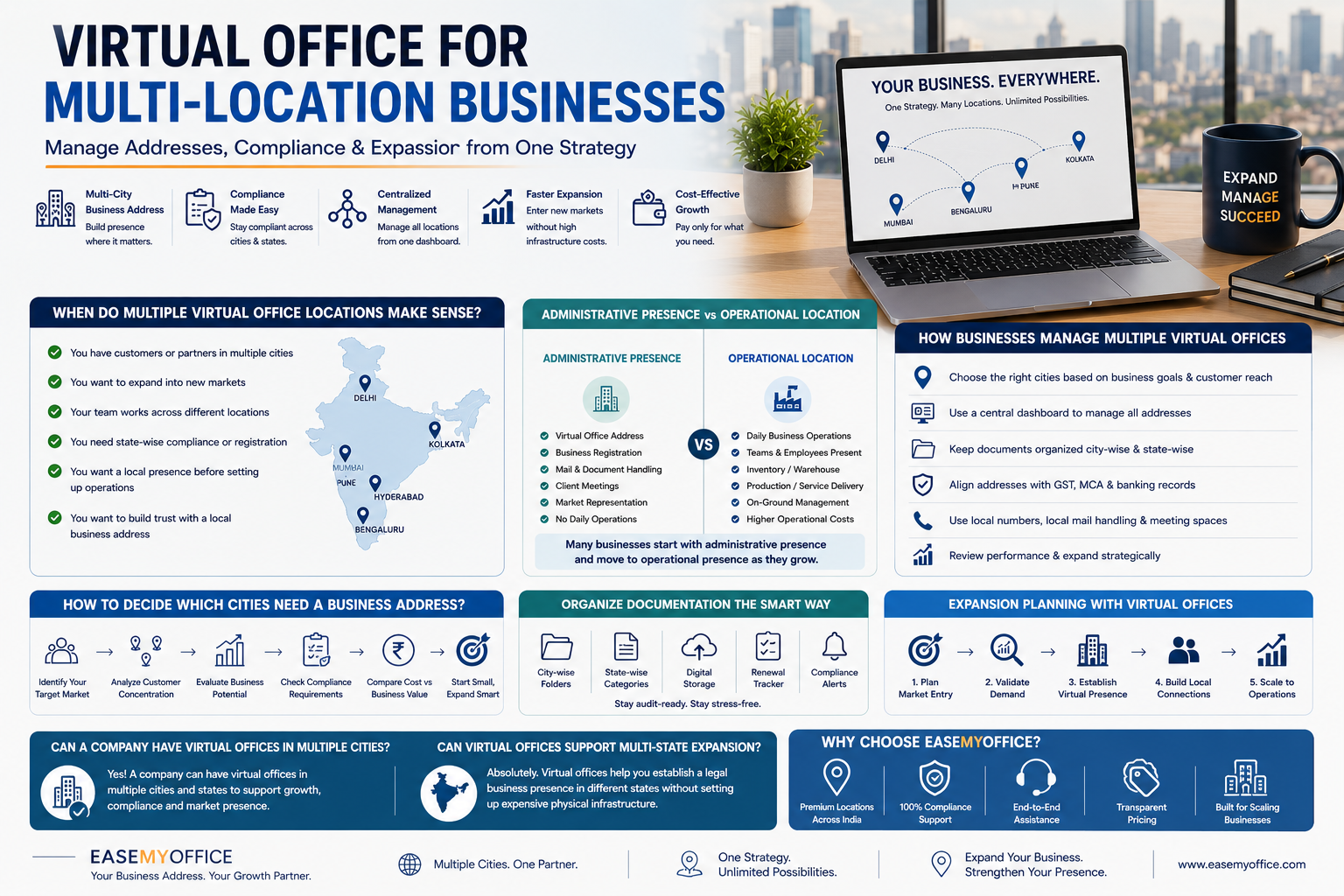
AI Overview: Virtual Office for Multi Location Business
A Virtual Office for Multi Location Business allows companies to establish business presence in multiple cities without automatically committing to a conventional office in every location. This can be useful for companies that operate remotely, serve customers across India, enter new markets or need city-specific business addresses.
The challenge, however, is not simply obtaining multiple addresses.
Once a company operates across several locations, it needs a clear system for managing:
- Which cities require an address
- What each address is being used for
- Supporting documentation
- State-specific requirements
- Business correspondence
- Registration and compliance records
- Renewal dates
- Client and vendor information
- Expansion priorities
A multi-location strategy should therefore distinguish between an administrative/business presence and a physical operational location. A Virtual Office can support certain address-related requirements, but it does not replace premises where a company actually conducts activities that require physical infrastructure.
The best approach is to build a location strategy first and then select Virtual Office locations around genuine business requirements.
Introduction: The Real Problem With Having a Business in Multiple Cities
Expanding into another city sounds simple.
A company might think:
“We have customers in Mumbai. Let’s get a Mumbai address.”
Then:
“We’re getting business in Bengaluru. Let’s add Bengaluru.”
Then:
“We should also have a presence in Delhi NCR.”
Before long, the company has several addresses.
But here’s the problem:
Who is managing them?
A multi-location business may eventually have to keep track of:
- Multiple address documents
- Different service agreements
- Registration information
- Mail and courier arrangements
- Local contact requirements
- Renewal dates
- Internal records
- GST-related information, where applicable
- Customer-facing address information
- Vendor records
- Corporate documentation
At three locations, this may still be manageable manually.
At ten or fifteen locations, poor organization can create unnecessary confusion.
That’s why businesses considering multiple Virtual Offices shouldn’t think of them as isolated purchases.
They should think of them as a location network.
The question isn’t:
“How many Virtual Offices should we buy?”
The better question is:
“Which locations actually support our business strategy, and how will we manage them?”
What Is a Virtual Office?
A Virtual Office provides businesses with access to a professional business address and, depending on the provider and package, additional services such as mail handling, correspondence support and meeting facilities.
It is designed primarily for businesses that need a professional presence without requiring a dedicated office workspace every day.
For a multi-location company, this concept becomes particularly interesting.
Instead of establishing a traditional office in every market, a company may use a combination of:
Virtual Offices + Remote Employees + Client Meeting Facilities + Warehouses/Operational Premises Where Required
This creates a flexible business infrastructure.
However, a Virtual Office should not be confused with:
- A factory
- A warehouse
- A retail store
- A laboratory
- A permanent employee workspace
- A customer service centre
- A production facility
If your business physically operates from a location, you need to ensure that the premises are appropriate for the activity being conducted.
What Does “Multi-Location Business” Actually Mean?
A multi-location business is not necessarily a company with ten physical offices.
It could be a company that has a business presence in several cities while its employees and operations remain distributed.
For example:
Company A
Head office: Delhi
Customers: Delhi, Mumbai, Bengaluru
Employees: Remote
Company B
Head office: Mumbai
Sales presence: Pune, Ahmedabad, Delhi
Operations: Remote
Company C
Registered setup: Bengaluru
Sales markets: Hyderabad, Chennai, Mumbai, Delhi NCR
In each case, the company’s requirements may be different.
Some locations may require only a business presence.
Others may require actual operational infrastructure.
That’s why location planning matters.
Administrative Presence vs Operational Location
This is one of the most important concepts for businesses considering multiple Virtual Offices.
Administrative or Business Presence
This can relate to activities such as:
- Business correspondence
- Professional business address
- Certain registration-related requirements, where permitted
- Client communication
- Mail handling
- Corporate representation
Operational Location
This is where the company actually performs physical business activities.
For example:
- Manufacturing
- Warehousing
- Inventory storage
- Product assembly
- Retail
- Laboratories
- Physical service delivery
- Large onsite teams
A Virtual Office may support the first category in certain circumstances.
It does not automatically satisfy the requirements of the second.
Example
Imagine an electronics distributor expanding from Delhi to Mumbai.
The company may need:
Mumbai business presence: potentially suitable for a Virtual Office depending on its purpose.
Mumbai warehouse: requires an appropriate physical facility.
Using a Virtual Office doesn’t eliminate the need for a warehouse.
This distinction should be made before creating a multi-city expansion plan.
Can a Company Have Virtual Offices in Multiple Cities?
A company can potentially maintain business-address arrangements in multiple cities, subject to the purpose of each address, provider documentation and applicable legal and regulatory requirements.
There is no strategic reason to assume that one company must have only one business presence.
However, multiple locations should have a business justification.
For example:
- Customer concentration
- Sales expansion
- Supplier network
- Market entry
- Regional representation
- Registration requirements
- Corporate contracts
- Business development
The goal should not be:
“Get as many addresses as possible.”
The goal should be:
“Build the right location footprint for the business.”
Why Businesses Need a Multi-City Address Strategy
A growing business can benefit from having a structured approach to locations.
Without one, expansion can become reactive.
Reactive expansion
Customer appears in Mumbai → Get Mumbai address.
New client appears in Bengaluru → Get Bengaluru address.
Distributor appears in Ahmedabad → Get Ahmedabad address.
Another opportunity appears in Hyderabad → Get Hyderabad address.
After two years, management has no clear idea why some locations exist or what each one is being used for.
Strategic expansion
Market research → Identify priority cities → Define purpose → Verify requirements → Select address → Organize documents → Monitor performance → Expand further.
The second approach is much easier to manage.
How to Decide Which Cities Need a Virtual Office
Not every city where you have a customer needs its own address.
Use a scoring framework.
1. Customer Density
Where are your customers concentrated?
If 40% of your B2B customers are in Mumbai, the city deserves more attention than a city where you have two occasional customers.
2. Revenue Contribution
Look at revenue rather than just customer count.
A city with five high-value enterprise customers may matter more than a city with fifty small customers.
3. Sales Pipeline
Consider where your future business is coming from.
If your sales pipeline shows significant growth in Bengaluru, establishing a professional presence may become strategically useful.
4. Supplier Network
Manufacturing, trading and logistics businesses may care about supplier and distribution hubs as much as customer locations.
5. Industry Ecosystem
Certain cities naturally attract particular industries.
For example:
- Bengaluru — technology
- Mumbai — finance, corporate services and commerce
- Delhi NCR — corporate, government and B2B ecosystem
- Hyderabad — technology and life sciences
- Chennai — manufacturing and technology
- Ahmedabad — manufacturing and trading
The best city depends on your industry and objectives.
6. Expansion Cost
Compare the cost of establishing a presence with the expected business opportunity.
A location should have a reasonable strategic justification.
The 3-Tier Location Strategy
Instead of treating every city equally, divide locations into three categories.
Tier 1: Core Markets
These are cities where you already have substantial business.
Examples:
- Major customers
- Large sales teams
- Important suppliers
- Significant revenue
These locations deserve stronger infrastructure.
Tier 2: Growth Markets
These are cities where you’re actively expanding.
You may have:
- Growing sales
- New partnerships
- Increasing enquiries
- Regional representatives
Virtual Offices can potentially provide a flexible business presence while the market develops.
Tier 3: Test Markets
These are locations you’re exploring.
Instead of immediately establishing expensive physical infrastructure, businesses can evaluate the market first.
If the market performs well:
Test → Validate → Grow → Establish stronger infrastructure
If it doesn’t:
Exit with lower fixed costs
This is one of the strongest strategic arguments for flexible business infrastructure.
Documents Required for Multiple Virtual Office Locations
Documentation varies depending on the provider, city and intended use.
A company may need information such as:
- Incorporation documents
- Company PAN
- Director/authorised signatory KYC
- Business registration details
- Authorisation documents
- Address-related documentation
- Agreements
- GST-related documentation, where applicable
- Other premises documentation depending on the intended purpose
The important point is that businesses should create a documentation system rather than storing everything randomly.
How to Organize Documents for Multiple Locations
Imagine you operate in six cities.
Instead of keeping documents in scattered email threads, create a central location register.
Example
| City | Purpose | Agreement | Supporting Documents | Renewal | Status |
| Delhi NCR | Core Market | Available | Complete | Track | Active |
| Mumbai | Core Market | Available | Complete | Track | Active |
| Bengaluru | Growth Market | Available | Complete | Track | Active |
| Hyderabad | Growth Market | Available | Pending | Review | Active |
| Chennai | Test Market | Available | Complete | Track | Active |
| Ahmedabad | Test Market | Available | Complete | Review | Active |
The exact fields should be customized according to the company’s requirements.
The objective is simple:
One location = one complete record.
Create a Master Address Register
Every multi-location business should ideally maintain one master address register.
Include:
- City
- Full address
- Purpose
- Provider
- Start date
- Expiry/renewal date
- Responsible employee
- Supporting documents
- Registration linked to location
- Mail instructions
- Meeting facility availability
- Status
This becomes the company’s central source of truth.
Why a Master Register Matters
Without one, companies can easily make mistakes.
For example:
A business moves to a new address but forgets to update an old invoice template.
A vendor sends an important document to an outdated address.
An agreement expires without anyone noticing.
A team member doesn’t know which address should be used for a particular purpose.
These aren’t necessarily major problems individually.
But across ten locations, small administrative mistakes can become expensive.
Benefits of a Virtual Office Network in India
1. Wider Business Presence
A company can establish a presence in multiple important markets without automatically maintaining full offices everywhere.
2. Lower Fixed Infrastructure Requirements
If your employees are remote, you may not need to pay for dedicated office space in every city.
3. Faster Market Entry
A company can establish a business presence while building its customer base.
4. Better Address Management
With a centralized strategy, the company can assign specific addresses to specific business objectives.
5. Flexible Expansion
Companies can add locations as business requirements develop.
6. Professional Client Experience
A commercial address can support a more established presentation when dealing with clients, vendors and partners.
7. Access to Meeting Facilities
Depending on the provider and plan, companies may be able to use meeting rooms when physical meetings are required.
Multi-State Expansion: What Changes?
Expanding across state borders can introduce additional administrative and compliance considerations.
A business should not assume that:
One Delhi address = all India requirements solved.
Different states, registrations and business activities can involve different requirements.
Before establishing another location, determine:
- Why do we need the location?
- What registration or business purpose is involved?
- Does that purpose require premises?
- What documentation is needed?
- Does the activity actually occur there?
- Does the address arrangement support the intended use?
- What ongoing compliance applies?
This process becomes increasingly important as the number of locations increases.
Can Virtual Offices Support Multi-State Expansion?
They can potentially support certain address-related aspects of expansion, depending on the business model, location and intended purpose.
For example, a remote SaaS company expanding its sales presence may have very different requirements from a manufacturer opening a new production facility.
The SaaS company might need:
- Professional address
- Customer meeting facility
- Business correspondence
- Certain registration-related support
The manufacturer might additionally need:
- Factory
- Storage
- Equipment
- Local employees
- Physical operations
Therefore, the correct question isn’t:
“Can a Virtual Office support expansion?”
It is:
“Which part of our expansion can a Virtual Office support?”
That distinction prevents unrealistic expectations.
When Do Multiple Virtual Office Locations Make Sense?
Multiple locations can make sense when there is a clear reason for each one.
Strong reasons include:
- Entering a high-value market
- Supporting a regional sales strategy
- Serving enterprise customers
- Establishing a presence near important suppliers
- Supporting permitted registration requirements
- Creating client meeting options
- Building a multi-city commercial footprint
Weak reasons include:
- Collecting addresses
- Trying to look bigger than the business actually is
- Buying locations without a business plan
- Assuming more addresses automatically create more credibility
A sophisticated company doesn’t maximize addresses.
It maximizes useful presence.
How Many Virtual Office Locations Does a Business Need?
There is no universal number.
A better formula is:
Number of locations = Number of strategically important markets requiring a business presence
For one business, that could be two.
For another, it could be ten.
Consider this hypothetical company:
Company X
Revenue markets:
Delhi — 30%
Mumbai — 25%
Bengaluru — 20%
Hyderabad — 10%
Other cities — 15%
Instead of opening ten offices, the company might initially prioritize:
Delhi + Mumbai + Bengaluru
Then evaluate Hyderabad.
This creates a more disciplined expansion process.
Virtual Office vs Traditional Office for Multi-City Expansion
| Factor | Virtual Office | Traditional Office |
| Professional address | Yes | Yes |
| Dedicated workspace | Usually no | Yes |
| Remote team support | Excellent | Moderate |
| Multi-city scalability | High | Lower |
| Initial investment | Generally lower | Higher |
| Daily employee workspace | Usually no | Yes |
| Meeting facilities | Depending on plan | Yes |
| Storage | Usually unsuitable | Depending on premises |
| Manufacturing | Not suitable | Appropriate facility required |
| Market testing | Excellent | More expensive |
| Flexibility | High | Moderate |
A multi-location strategy may use both.
For example:
Virtual Offices in 5 cities + Dedicated office in 1 city + Warehouse in 2 cities
Business infrastructure doesn’t have to follow a single model.
Step-by-Step: Building a Multi-Location Virtual Office Strategy
Step 1: Map Your Current Business
List:
- Customers
- Revenue by city
- Employees
- Suppliers
- Partners
- Sales pipeline
- Operational locations
This shows where your business actually has activity.
Step 2: Divide Cities Into Tiers
Use:
Core → Growth → Test
This immediately makes expansion easier to prioritize.
Step 3: Define the Purpose of Every Location
Don’t write:
“Mumbai office.”
Write:
“Mumbai — enterprise sales and client meetings.”
The second description is much more useful.
Step 4: Identify Regulatory Requirements
Determine whether the intended purpose requires specific premises, documentation, registration or compliance.
Step 5: Select Suitable Locations
Compare:
- Business district
- Accessibility
- Address quality
- Documentation
- Services
- Meeting facilities
- Pricing
- Provider support
Step 6: Create a Location File
Create one digital folder or record for every city.
Include all relevant documents.
Step 7: Assign Ownership
Someone should be responsible for each location.
This could be:
- Finance
- Operations
- Compliance
- Administration
- Legal
- Founder/management
Step 8: Create Renewal Reminders
Never rely on memory.
Track:
- Agreement renewal
- Documentation expiry
- Service changes
- Address updates
- Relevant compliance deadlines
Step 9: Review Location Performance
Every six or twelve months, ask:
Is this location still useful?
If not, reconsider it.
A Practical Example: Building a Five-City Network
Consider a fictional B2B software company based in Delhi.
The company wants to expand nationally.
Its target cities are:
- Delhi
- Mumbai
- Bengaluru
- Hyderabad
- Pune
Instead of immediately renting five offices, management develops a location strategy.
Delhi
Category: Core
Purpose: Main business presence
Mumbai
Category: Core
Purpose: Enterprise sales and financial-sector customers
Bengaluru
Category: Growth
Purpose: Technology customers
Hyderabad
Category: Growth
Purpose: New sales market
Pune
Category: Test
Purpose: Market exploration
Now the company knows why every address exists.
This is much more manageable than simply having five unrelated Virtual Office subscriptions.
Common Mistakes in Multi-Location Business Address Management
Mistake 1: Getting Addresses Without a Purpose
Every location should answer:
Why do we need this?
Mistake 2: Treating Every City the Same
Core markets deserve different investment from test markets.
Mistake 3: Mixing Operational and Administrative Addresses
A business should clearly understand which locations support actual operations and which provide business/address services.
Mistake 4: Poor Documentation
Multiple locations mean multiple records.
Without proper organization, compliance administration becomes difficult.
Mistake 5: Forgetting Renewals
A location register should include renewal and review dates.
Mistake 6: Using the Wrong Address for the Wrong Purpose
An address suitable for correspondence may not automatically be suitable for every registration or operational requirement.
Mistake 7: Expanding Too Quickly
More locations aren’t always better.
Build presence where the commercial opportunity justifies it.
How Multi-Location Businesses Can Reduce Administrative Complexity
A simple system can make a major difference.
Use Standard Naming
Instead of:
Mumbai docs final.pdf
Use:
Mumbai_Business_Address_Documents_2026
Clear naming helps teams find documents faster.
Use a Central Spreadsheet or Dashboard
Track:
- Location
- Purpose
- Provider
- Agreement
- Documentation
- Renewal
- Owner
- Status
Create a Standard Location Checklist
Every new city should follow the same process:
Business need → Purpose → Requirement verification → Provider → Documentation → Activation → Internal update → Review
Assign One Internal Owner
Someone should always know:
- Why the location exists
- What documents support it
- When the agreement renews
- What services are included
Pricing Comparison: One Office vs Multiple Virtual Offices vs Traditional Offices
The total cost depends on the provider, city and services.
| Model | Infrastructure Cost | Flexibility | Best For |
| One traditional office | High | Low–Moderate | Single-city teams |
| Multiple traditional offices | Very High | Low | Large established operations |
| One Virtual Office | Lower | High | Single-market remote businesses |
| Multiple Virtual Offices | Moderate | High | Multi-city remote businesses |
| Hybrid model | Variable | Very High | Growing national businesses |
The important metric isn’t just the monthly fee.
Calculate:
Total location cost = Address + Documentation + Meeting facilities + Administration + Travel + Operational infrastructure
If a Virtual Office saves you from maintaining an unnecessary office but your team still requires frequent physical meetings, meeting-room and travel costs should be considered.
A good expansion strategy looks at the complete picture.
Is a Virtual Office Suitable for Every Multi-Location Business?
No.
It is generally more suitable for businesses where physical infrastructure isn’t required in every market.
Potentially suitable:
- SaaS companies
- Consulting firms
- Digital agencies
- Recruitment companies
- Professional services
- B2B service providers
- Remote sales organizations
- Technology companies
- Some trading businesses
May require additional physical premises:
- Manufacturers
- Warehouses
- Retailers
- Restaurants
- Laboratories
- Clinics
- Production businesses
- Inventory-heavy companies
The solution should follow the operational model.
Why Choose Vo Spaces?
For businesses building a multi-city presence, the provider relationship becomes more important as the number of locations increases.
With one location, managing the provider may be straightforward.
With five or ten, businesses benefit from a more organized approach.
When evaluating Vo Spaces or any Virtual Office provider, consider:
- Number of available cities
- Commercial address quality
- Documentation provided
- Intended address usage
- Mail handling
- Meeting-room availability
- Customer support
- Agreement terms
- Pricing structure
- Multi-location management
- Renewal process
The ideal provider should fit into your company’s expansion system rather than creating another administrative burden.
A business should also confirm the specific services and documentation available for each location before purchasing.
Frequently Asked Questions
1. Can a company have Virtual Offices in multiple cities?
Potentially, yes. A company can maintain multiple business-address arrangements where they serve a genuine business purpose and comply with applicable requirements.
2. How do businesses manage multiple Virtual Offices?
The best approach is to create a centralized location register containing each address, purpose, provider, documentation, responsible person and renewal date.
3. Can Virtual Offices support multi-state business expansion?
They can support certain address-related aspects of expansion depending on the business, state, purpose and applicable requirements.
They do not replace physical premises required for operational activities.
4. How should a company choose multiple Virtual Office locations?
Consider customer concentration, revenue, sales pipeline, industry ecosystem, supplier network, expansion plans and the specific purpose of each location.
5. How should businesses organize multiple addresses?
Create a master address register and separate documentation folder for every location.
Each address should have a defined purpose and internal owner.
6. Is a Virtual Office legal in India?
A properly structured Virtual Office arrangement can be legitimate when used for permitted purposes and supported by appropriate documentation.
The suitability of a particular address depends on how it will be used.
7. Can a Virtual Office be used for GST registration?
It may be possible where the premises arrangement and documentation satisfy applicable GST requirements.
Businesses should verify the specific address and intended registration before proceeding.
8. What documents are required?
Requirements vary according to provider, location and intended use.
They may include incorporation documents, PAN, KYC, authorisation documents, agreements and premises-related documentation.
9. How much does a Virtual Office cost?
There is no single price.
Costs depend on city, location, provider, contract duration and services such as meeting-room access or mail handling.
10. Is a Virtual Office suitable for startups?
Yes, especially for remote-first startups that need professional business presence while keeping fixed infrastructure costs controlled.
11. Can I open a bank account using a Virtual Office?
It may be possible depending on the bank and account type, but banks have their own KYC and verification requirements.
A Virtual Office should not be treated as a guarantee of bank-account approval.
12. Can freelancers use Virtual Offices?
Yes. Freelancers and independent professionals may use Virtual Office services when they need a professional business presence.
13. Which city is best for a Virtual Office?
There is no universal answer.
Choose locations based on your customers, industry, expansion plans and business requirements.
Common commercial hubs include Delhi NCR, Mumbai, Bengaluru, Hyderabad, Chennai, Pune and Ahmedabad.
14. How quickly can I get documents?
The timeline depends on the provider, selected location, KYC process and package.
Always confirm the expected processing timeline before purchasing.
15. Is a Virtual Office better than a coworking space?
They serve different purposes.
A Virtual Office primarily provides business presence and address-related services, while coworking provides physical workspace.
The Multi-Location Business Address Checklist
Before adding another city, ask:
Business Need
- Do we actually have customers here?
- Is revenue growing here?
- Is the sales pipeline strong?
- Are important suppliers or partners located here?
Purpose
- Why do we need the address?
- Is it for business correspondence?
- Client meetings?
- Registration?
- Regional presence?
Compliance
- What requirements apply?
- Does the particular address support the intended purpose?
- What documentation is available?
Operations
- Do we need actual employees here?
- Do we need storage?
- Do we need equipment?
- Do we need a warehouse?
Financials
- What will the location cost?
- What business opportunity does it support?
- Is a Virtual Office enough?
- Would coworking or a dedicated office be more appropriate?
Management
- Who owns this location internally?
- Where are the documents stored?
- When does the agreement expire?
- How will the location be reviewed?
If these questions cannot be answered, the company probably isn’t ready to add the location.
The Right Way to Think About Multi-City Expansion
A multi-city strategy isn’t about collecting addresses.
It’s about building business infrastructure around opportunity.
Think of your company as having three layers.
Layer 1: Business Presence
Where you need to be represented.
Virtual Office
Layer 2: Human Presence
Where your employees need to work.
Coworking/Dedicated Office
Layer 3: Operational Presence
Where your physical business activity happens.
Warehouse/Factory/Store/Laboratory/Operational Facility
These three layers don’t always need to exist in the same location.
That’s the strategic advantage of flexible business infrastructure.
Summary
A Virtual Office for Multi Location Business can help companies create a professional presence across multiple cities without automatically taking on the cost and complexity of traditional offices everywhere.
But the real value comes from having a strategy behind those locations.
Businesses should:
- Identify their strongest markets.
- Divide cities into core, growth and test markets.
- Define the purpose of every address.
- Distinguish administrative presence from operational premises.
- Verify documentation and applicable requirements.
- Maintain a centralized address register.
- Assign responsibility for every location.
- Track renewals and documentation.
- Review whether each location continues to justify its cost.
- Upgrade to physical infrastructure when the business genuinely needs it.
A company with five addresses but no management system can create unnecessary complexity.
A company with five strategically selected addresses, organized documentation and clear objectives can build a much more efficient expansion framework.
The goal isn’t to have a Virtual Office everywhere.
The goal is to have the right business presence in the right markets at the right stage of growth.
Final Takeaway
The future of business expansion isn’t necessarily:
One company → One headquarters → One office in every city.
For many modern businesses, it can look more like:
Central Management → Remote Teams → Strategic Business Addresses → Flexible Meeting Infrastructure → Operational Facilities Where Required
This hybrid model allows companies to separate where they work from where they need to be present.
For businesses expanding across India, that distinction can make location planning more flexible and cost-conscious.
A well-managed Virtual Office network can become one part of that strategy—but it should always be built around genuine commercial requirements, proper documentation and applicable compliance.
Don’t collect locations. Build a location strategy.