
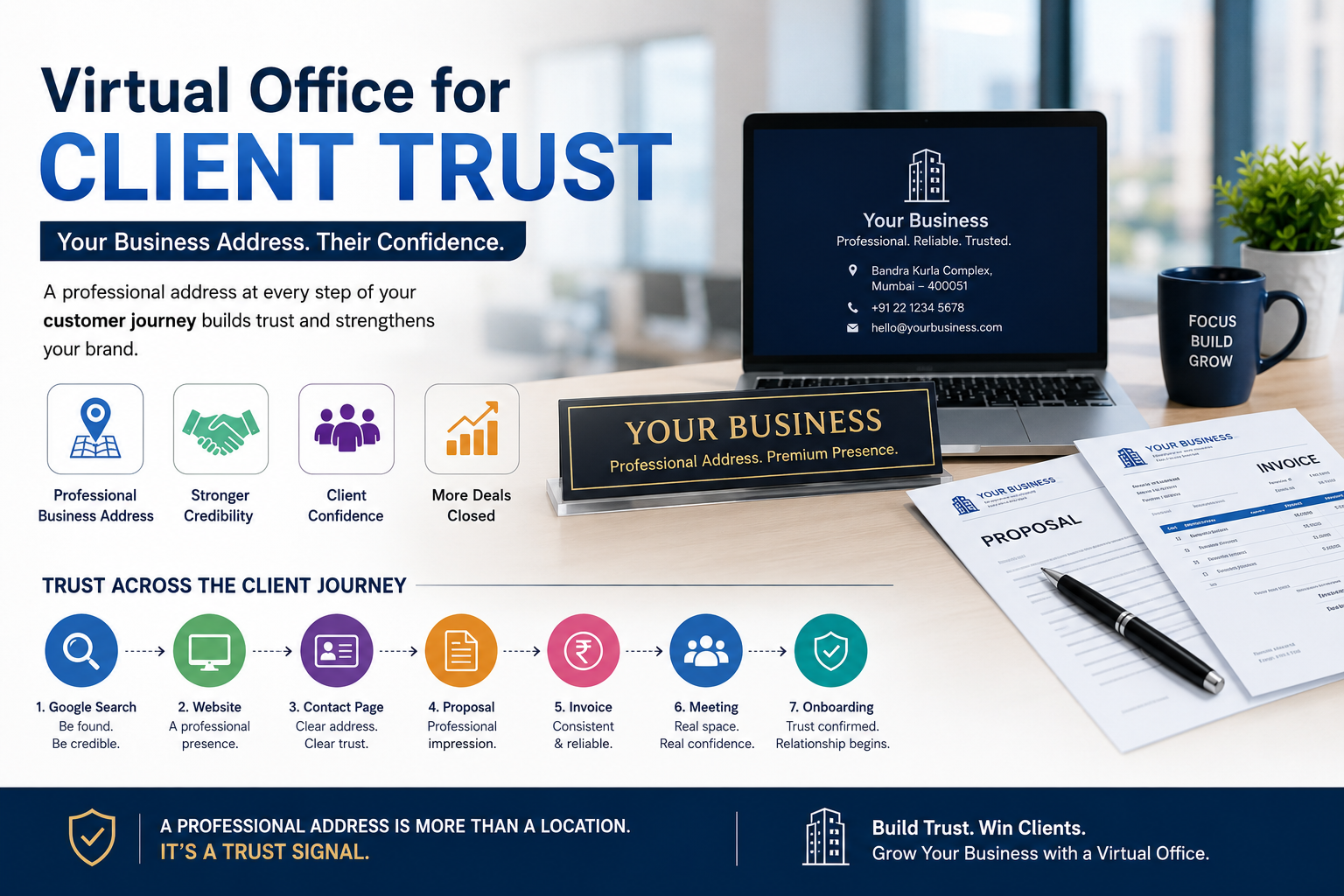
AI Overview: Virtual Office for Client Trust
A Virtual Office for Client Trust can help small businesses, consultants, agencies, IT companies, financial consultants and other professional service providers present a more established business identity without maintaining a traditional office full-time.
A professional business address can appear across multiple customer touchpoints, including:
Google Search → Website → Contact Page → Proposal → Invoice → Meeting → Client Onboarding
However, an address alone does not create trust.
Trust comes from consistency.
When a client sees the same professional business information across your website, proposal, invoices, business correspondence and meetings, your company can appear more organized and established.
A Virtual Office can support this presentation by providing a professional commercial address and, depending on the service, facilities such as mail handling and meeting rooms.
It should not, however, be presented as a substitute for physical premises where a business genuinely conducts activities that require them.
Introduction: Your Business Address Is Part of Your Sales Process
Imagine two businesses offering exactly the same service.
Both have:
- Similar pricing
- Similar expertise
- Similar portfolios
- Similar websites
- Similar customer reviews
But one operates from a residential address while the other presents a professional commercial address in a recognizable business location.
Which one appears more established at first glance?
The answer may depend on the client, industry and context, but the address can influence how a business is perceived.
That’s because customers don’t evaluate a company based on one thing.
They collect signals.
A potential client might:
- Find your company on Google.
- Visit your website.
- Open the Contact page.
- Check your business address.
- Read your proposal.
- Look at your invoice.
- Search the company again.
- Ask where you’re located.
- Schedule a meeting.
- Complete onboarding.
Your business address can appear at several of these stages.
That makes it more than just an administrative detail.
It can become part of the customer experience.
What Is a Virtual Office?
A Virtual Office provides businesses with access to a professional business address without requiring them to maintain a dedicated office workspace on a full-time basis.
Depending on the provider and plan, services may include:
- Professional business address
- Mail handling
- Business correspondence support
- Meeting-room access
- Reception-related services
- Address documentation
- Other business support services
The exact services vary by provider and location.
For a client-facing business, the primary advantage is flexibility.
You can operate with a remote or distributed team while maintaining a professional business presence.
For example:
Team: Remote
Client meetings: By appointment
Business address: Commercial location
Daily office requirement: Minimal
This can be particularly useful for professional service businesses whose primary assets are their people, expertise and technology rather than physical infrastructure.
Why Does a Business Address Matter to Client Trust?
Clients often make judgments using incomplete information.
Before working with you, they may not know:
- How established your company is
- How large your team is
- How long you’ve been operating
- Whether you’re reliable
- Whether you’ll still be available six months from now
- Whether you’re dealing with a legitimate business
They therefore use visible signals.
These signals can include:
- Website quality
- Professional email
- Reviews
- Portfolio
- Case studies
- Social presence
- Business registration information
- Communication quality
- Physical/business address
A professional address is only one signal.
But when combined with other credible signals, it can contribute to a more complete business presentation.
The Customer Journey: Where Your Business Address Creates Trust Signals
This is where a client-facing Virtual Office becomes particularly interesting.
Instead of asking:
“Does a professional address improve my brand?”
Ask:
“Where does my business address appear throughout my customer’s decision-making process?”
Let’s follow the journey.
1. Google Search: The First Impression
A prospective customer may discover your company through:
- Google Search
- Google Maps
- Industry directories
- Social media
- Referrals
- Online advertisements
At this stage, the customer knows almost nothing about you.
They’re trying to answer a simple question:
“Is this company worth contacting?”
Your online presence needs to provide enough confidence to move them to the next step.
Where applicable, a consistent business location and business information can contribute to that overall presentation.
But businesses should ensure that any public listing accurately represents their business and complies with the relevant platform’s requirements.
2. Your Website: The Address Becomes More Visible
After discovering you, many prospects visit your website.
One of the most visited pages for service businesses is the Contact page.
A typical Contact page may include:
Company Name
Business Address
Phone Number
Working Hours
Map or Location Information
A professional commercial address can make this section feel more complete.
Compare:
Contact us at [personal residential address]
with:
Corporate Office
Business District
Mumbai, Maharashtra
The second presentation may feel more aligned with a company serving corporate customers.
But remember:
Professional presentation should never mean misrepresentation.
If you operate remotely, you don’t need to pretend that dozens of employees work at the address.
Instead, position the address accurately according to the services and arrangement you actually have.
3. Contact Page: The “Are They Real?” Moment
Some prospects never consciously think about the address.
Others do.
This is especially true when:
- The contract value is high.
- The client is a large company.
- The service involves confidential information.
- The client is making an advance payment.
- The engagement is long-term.
- Vendor onboarding is involved.
The customer may ask:
“Where is your office?”
If you can provide a professional business address and explain your operating model clearly, the conversation can continue with fewer uncertainties.
4. Proposal: Moving From Interest to Evaluation
Once a lead becomes serious, you may send:
- Business proposals
- Quotations
- Pitch decks
- Statements of work
- Service agreements
Your business address may appear in these documents.
Now the address is no longer merely part of your website.
It becomes part of your formal business identity.
A consistent address across:
Website + Proposal + Agreement + Invoice
creates a more organized impression.
This consistency matters.
5. Invoice: Trust at the Transaction Stage
The invoice is one of the most important documents in the customer journey.
By this point, the client has already decided to do business with you.
Your invoice may contain:
- Legal/business name
- Address
- Tax details where applicable
- Contact information
- Invoice number
- Payment information
- Service details
A professional business address can contribute to the overall appearance of a formal business transaction.
It doesn’t guarantee payment or trust.
But it can reinforce the idea that the client is dealing with an organized business.
6. Client Onboarding: Professionalism Becomes Operational
After signing the agreement, larger clients may have their own onboarding process.
They might request:
- Company information
- Business address
- Tax information
- Registration details
- Bank information
- Contact details
- Authorized signatory information
- Supporting documents
This is where consistency becomes extremely important.
If your website says one address, your proposal another, and your invoice a third, questions can arise.
A well-managed business address strategy helps keep your company information consistent.
7. Client Meeting: When You Actually Need a Physical Space
A Virtual Office doesn’t mean you never meet clients.
You might occasionally need a professional environment for:
- Sales presentations
- Investor discussions
- Interviews
- Contract meetings
- Strategy sessions
- Client reviews
- Partner meetings
Depending on the provider, meeting rooms may be available when required.
This creates a useful model:
Remote work most of the time → Professional meeting space when necessary
Instead of paying for an entire office for 365 days, a business can potentially use physical workspace only when the situation requires it.
Who Should Use a Client-Facing Virtual Office?
A Virtual Office can be particularly relevant to businesses where credibility, presentation and client communication matter.
Consultants
Management consultants, business advisors and independent professionals often work remotely.
Their primary asset is expertise rather than physical infrastructure.
A professional address can support their corporate presentation.
Digital Marketing Agencies
Agencies may have:
- Remote designers
- Freelance developers
- Content teams
- Account managers
- Sales representatives
A dedicated office may not be required every day.
IT Companies
Small technology companies can operate with distributed teams while presenting a professional business identity to enterprise customers.
Financial Consultants
Professional financial and advisory businesses may benefit from maintaining a structured business presence.
Any regulatory or licensing requirements applicable to the specific financial activity must still be satisfied separately.
B2B Service Providers
Companies selling services to other businesses often encounter vendor onboarding and procurement processes.
A clear business address can become part of their formal business profile.
Professional Services
Examples include:
- Legal support businesses
- HR consultants
- Recruitment firms
- Accounting professionals
- Training companies
- Business coaches
- Research firms
- Design consultancies
Requirements differ by profession, so businesses should verify any industry-specific rules.
Documents Required for a Virtual Office
The exact documentation depends on:
- Provider
- City
- Service package
- Intended usage
- Business structure
- Registration requirements
Commonly requested information may include:
- Business registration documents
- PAN
- Identity/KYC documents
- Authorisation documents
- Company details
- Agreement
- Premises-related documentation
- GST-related documents where applicable
Before purchasing, ask the provider exactly what documentation will be supplied and whether it supports your intended use.
Benefits of a Virtual Office for Client Trust
1. Creates a More Professional Business Presentation
A commercial business address can make your company information look more complete and structured.
2. Supports Remote Business Models
You can maintain a professional presence without requiring your entire team to work from an office.
3. Strengthens Document Consistency
The same address can potentially be used across eligible business materials.
4. Helps During Client Conversations
When prospects ask where your business is based, you can provide a clear business location.
5. Supports Premium Positioning
For consulting, technology, agency and professional service businesses, the right commercial location can complement a premium brand presentation.
6. Provides Meeting Flexibility
Where meeting rooms are included, you can bring clients into a professional environment when necessary.
7. Reduces Unnecessary Office Costs
If your business doesn’t require daily workspace, a traditional office may represent an unnecessary fixed expense.
Professional Business Address vs Residential Address
| Factor | Residential Address | Professional Business Address |
| Business presentation | Basic | More corporate |
| Privacy | Lower | Potentially higher |
| Client perception | Depends on context | Often more business-oriented |
| Remote-work compatibility | High | High |
| Corporate positioning | Limited | Stronger |
| Meeting facilities | Usually unavailable | Depending on provider |
| Business correspondence | Personal environment | Business environment |
A residential address isn’t inherently unprofessional.
Millions of businesses begin from home.
The question is whether it remains suitable as the business grows.
When Should a Small Business Consider a Professional Address?
There is no universal revenue threshold.
Instead, look for signals.
You may want to consider one when:
You’re attracting larger clients
Enterprise customers may expect more formal business information.
Your current address is creating privacy concerns
Using your home address publicly may not be ideal.
You’re entering a premium market
A commercial location can complement your positioning.
You’re expanding into another city
A local business presence may support your market strategy.
You’re receiving more business correspondence
A dedicated business address can separate business administration from personal life.
Your business has outgrown its “home business” image
Your operations may remain remote even as your business presentation becomes more corporate.
Pricing Comparison: Traditional Office vs Virtual Office
The cheapest solution isn’t always the best solution.
Compare the overall infrastructure requirement.
| Factor | Traditional Office | Virtual Office |
| Dedicated workspace | Yes | Usually no |
| Business address | Yes | Yes |
| Monthly fixed cost | Higher | Generally lower |
| Remote team compatibility | Moderate | High |
| Meeting facilities | Included | Depending on plan |
| Maintenance | Required | Usually handled by provider |
| Utilities | Additional/Included | Usually not applicable |
| Flexibility | Lower | Higher |
| Best for | Daily office teams | Remote/client-facing businesses |
For a company with ten employees working remotely, paying for a large office simply to have a business address may not be financially efficient.
A Virtual Office can separate those two requirements.
What Makes a Business Address Look Credible?
Not every address creates the same impression.
When selecting a professional business address, consider:
Location
Is it situated in a recognizable commercial area?
Accessibility
Can clients and partners reach it reasonably easily?
Documentation
Does the provider supply appropriate documentation for your intended business use?
Consistency
Can you maintain consistent business information across your channels?
Meeting Facilities
Can you access a professional meeting environment when necessary?
Provider Support
Does the provider help manage correspondence and address-related requirements?
Transparency
Can you accurately explain how the location is used?
The last point is especially important.
Trust is built through transparency, not appearances alone.
Can Clients Verify a Company’s Address?
Yes, clients may independently verify business information.
Depending on the company and situation, they may:
- Search the business online
- Check maps
- Visit the location
- Ask for documents
- Request company registration information
- Ask for tax details
- Conduct vendor verification
- Request a physical meeting
Businesses should therefore avoid treating a Virtual Office as a way to conceal the true nature of their operations.
Instead, use it as a legitimate business infrastructure solution where appropriate.
Does a Professional Address Guarantee Client Trust?
No.
This is an important distinction.
A professional address can be a trust signal, but it cannot compensate for:
- Poor service
- Fake reviews
- Unclear contracts
- Bad communication
- Missing documentation
- Unprofessional proposals
- Missed deadlines
- Weak customer support
Think about trust as a formula:
Trust = Address + Reputation + Communication + Proof + Consistency + Delivery
The address is only one component.
The Trust Stack for Modern Businesses
A strong client-facing business should build multiple trust signals.
1: Basic Identity
- Company name
- Professional email
- Business address
- Phone number
2: Proof
- Portfolio
- Case studies
- Reviews
- Testimonials
- Certifications where relevant
3: Business Documentation
- Registration information
- Tax details where applicable
- Contracts
- Proper invoices
4: Human Interaction
- Professional sales process
- Clear proposals
- Video calls
- Client meetings
5: Delivery
- Meeting deadlines
- Providing quality
- Maintaining communication
- Supporting the client after purchase
A Virtual Office primarily strengthens the first layer.
The remaining layers must come from the business itself.
Step-by-Step: How to Build a Trust-Focused Business Presence
Step 1: Define Your Target Client
Are you targeting:
- Individuals?
- Startups?
- SMEs?
- Enterprise companies?
- International customers?
Your address strategy should reflect your audience.
Step 2: Choose Your Business Location
Look for a location that makes sense for your target market.
For example, a B2B company targeting corporate clients may prefer a recognized commercial district.
Step 3: Select a Suitable Virtual Office Plan
Compare:
- Address services
- Documentation
- Mail handling
- Meeting rooms
- Contract duration
- Support
- Pricing
Step 4: Standardize Your Business Information
Create one master business profile.
Use the same approved information across:
- Website
- Proposals
- Invoices
- Email signatures
- Company profiles
- Business documents
Step 5: Upgrade Your Client-Facing Materials
Update:
- Proposal templates
- Company profile
- Pitch deck
- Invoice
- Letterhead
- Email signature
Don’t simply add an address.
Make the entire presentation consistent.
Step 6: Build Verification Assets
Add legitimate trust signals such as:
- Client testimonials
- Case studies
- Team information
- Portfolio
- Company documentation where appropriate
Step 7: Prepare for Physical Meetings
If your clients occasionally need face-to-face meetings, know how and where those meetings can be conducted.
Why Choose Vo Spaces?
For a client-facing company, the Virtual Office provider should be evaluated beyond just the monthly price.
Consider:
- Address quality
- Location
- Documentation
- Mail handling
- Meeting-room availability
- Customer support
- Agreement terms
- Service transparency
- Multi-city availability
- Renewal process
Vo Spaces can be positioned as part of a broader business-presence strategy rather than simply an address provider.
For a company serving clients across different markets, having access to professional locations can make it easier to build a consistent presence while retaining a remote-first operating model.
However, businesses should always confirm the exact services, documentation and permitted uses available at the selected location before subscribing.
Frequently Asked Questions
1. Does a professional business address improve customer trust?
It can contribute to a professional first impression, particularly when combined with strong branding, documentation, reviews and consistent communication. It is not a guarantee of trust.
2. Do clients verify a company’s address?
Some clients do, especially during high-value transactions, vendor onboarding or enterprise procurement. Verification may include online searches, document requests or physical checks.
3. What makes a business address look credible?
A suitable commercial location, accurate documentation, consistent business information and transparent representation can all contribute to credibility.
4. Should small businesses use a commercial address?
They may consider one when they need a professional business presence, want greater privacy or are increasingly dealing with corporate clients.
5. Can a Virtual Office help premium service businesses?
Yes. Consultants, agencies, technology companies and other professional service businesses may use Virtual Office services to complement a premium business presentation.
6. Is a Virtual Office legal in India?
A properly structured Virtual Office arrangement can be legitimate when used for permitted purposes and supported by appropriate documentation. The exact suitability depends on the service, location and intended use.
7. Can a Virtual Office be used for GST registration?
It may be possible when the premises arrangement and documentation satisfy applicable GST requirements. Businesses should verify the specific location and documentation before applying.
8. What documents are required?
Requirements vary by provider and purpose but may include business registration documents, PAN, KYC, authorization documents, agreements and premises-related documentation.
9. How much does a Virtual Office cost?
Pricing varies by city, location, provider, duration and services. Plans that include additional services such as meeting-room access may cost more.
10. Is a Virtual Office suitable for startups?
Yes. It can be useful for remote startups that want a professional business presence without committing to a full-time office.
11. Can I open a bank account using a Virtual Office?
It may be possible depending on the bank and account type, but banks conduct their own KYC and verification. A Virtual Office does not guarantee bank-account approval.
12. Can freelancers use Virtual Offices?
Yes. Freelancers and independent consultants may use them when they want a more professional business presence or prefer not to publish their residential address.
13. Which city is best for a Virtual Office?
The best city depends on your customers, industry and expansion plans. Major business hubs such as Delhi NCR, Mumbai, Bengaluru, Hyderabad, Chennai, Pune and Ahmedabad may be relevant depending on the target market.
14. How quickly can I get the documents?
Processing times depend on the provider, location, KYC process and selected package. Confirm the expected timeline before subscribing.
15. Is a Virtual Office better than a coworking space?
They solve different problems.
A Virtual Office focuses primarily on business presence and address-related services, while coworking provides physical workspace.
A remote company may use a Virtual Office and book coworking or meeting space only when needed.
The Client Trust Checklist
Before sending your next proposal, review your customer-facing business presence.
Google/Search
- Is your business information accurate?
- Is your company information consistent?
Website
- Does your Contact page look professional?
- Is your business address clearly presented?
- Are your phone and email details visible?
Proposal
- Does your proposal include consistent company information?
- Is your business identity clearly explained?
Invoice
- Does the invoice match your other business documents?
- Are the required business and tax details accurate?
Client Meeting
- Do you have a professional environment available when required?
Onboarding
- Can you provide legitimate business documentation when requested?
Reputation
- Do you have testimonials?
- Do you have case studies?
- Can clients verify your work?
The goal is to ensure that every touchpoint tells the same story.
7 Ways to Turn Your Business Address Into a Trust Signal
1. Use It Consistently
Don’t use five different versions of your business location.
2. Pair It With Proof
Address + testimonials is stronger than an address alone.
3. Keep Your Website Updated
Outdated information creates uncertainty.
4. Use Professional Documents
Your proposals and invoices should match your overall business identity.
5. Be Transparent About Your Operating Model
If your team is remote, say so.
Remote doesn’t mean unprofessional.
6. Offer Real Meeting Options
If clients want face-to-face interaction, provide a legitimate solution.
7. Deliver on Your Promises
Ultimately, the strongest trust signal is performance.
A premium address may get you through the door.
Your work keeps the client.
Summary
A Virtual Office for Client Trust should not be viewed simply as a way to make a small business “look bigger.”
Its more practical role is to help create a consistent and professional business presence across the customer journey.
That journey can begin with:
Google Search
and continue through:
Website → Contact Page → Proposal → Contract → Invoice → Client Meeting → Onboarding
At each stage, customers look for signals that answer one fundamental question:
“Can I trust this business?”
A professional commercial address can contribute to that answer.
But it works best when combined with:
- Strong website presentation
- Professional communication
- Accurate business information
- Legitimate documentation
- Reviews and testimonials
- Clear proposals
- Professional invoices
- Accessible meeting options
- Reliable service delivery
For consultants, agencies, IT companies, financial consultants, B2B service providers and other remote-first businesses, a Virtual Office can therefore become part of a broader client-acquisition and credibility strategy.
The objective isn’t to create an illusion of a large company.
It’s to create a professional, consistent and trustworthy business experience.
Final Takeaway
Your business address may occupy only one line on your website.
But that one line can appear throughout the customer journey.
Search → Website → Proposal → Invoice → Meeting → Onboarding
That’s why choosing a business address should be treated as more than an administrative decision.
Choose a location that fits your target customers.
Choose documentation that supports your legitimate business requirements.
Keep your information consistent.
Be transparent about how you operate.
And then let your service quality do the rest.
A professional address can create the first signal of trust. Your business must earn everything that comes after it.