
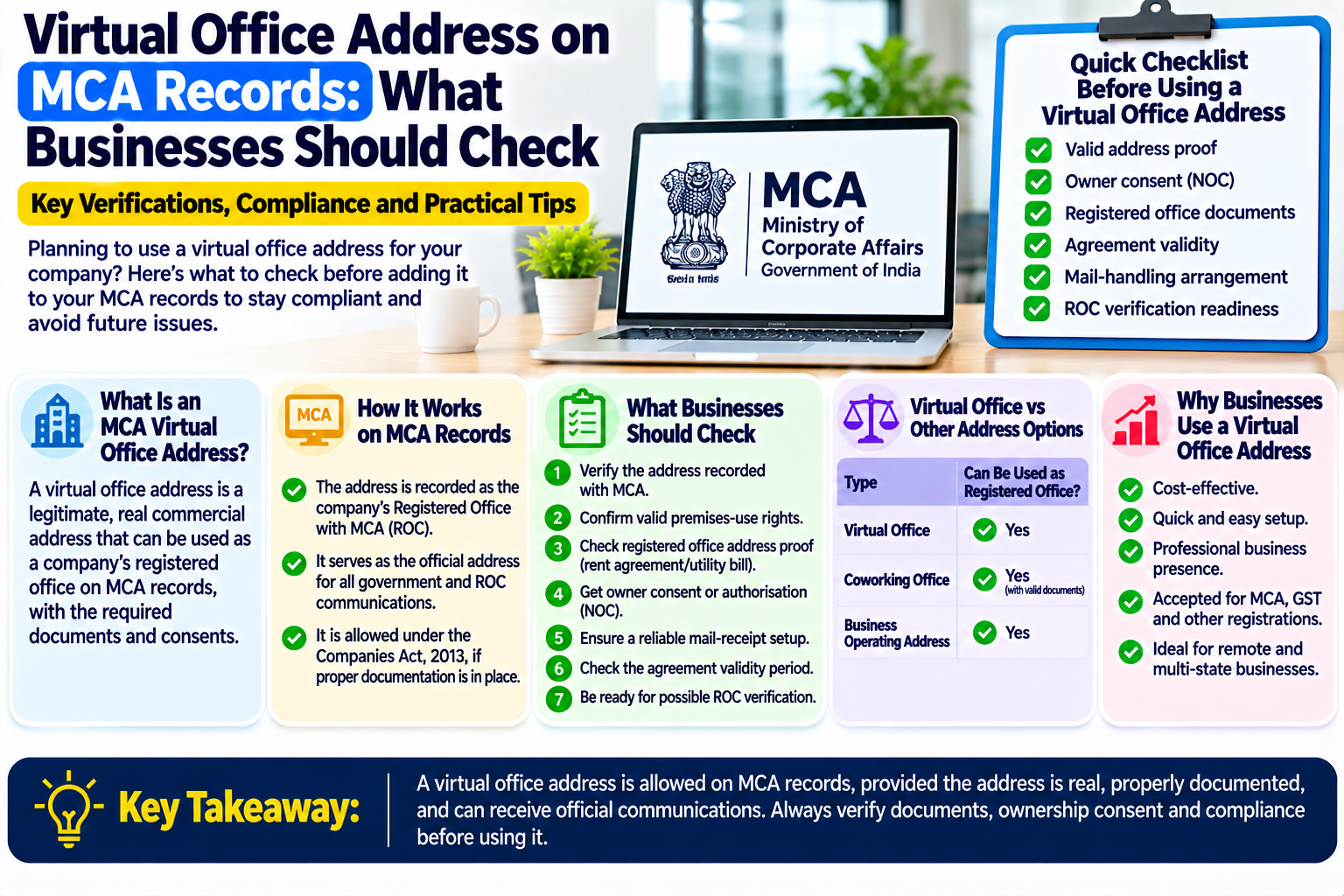
A virtual office address can offer businesses a registered office arrangement without requiring them to maintain a conventional dedicated office. However, using a virtual office address on MCA records involves more than obtaining a business address and signing a service agreement.
Under Section 12 of the Companies Act, 2013, a company must maintain a registered office capable of receiving and acknowledging official communications and notices.
Businesses using virtual offices should therefore verify the premises-use rights, supporting documents, owner authorisation, correspondence arrangements and accuracy of the address recorded with the Ministry of Corporate Affairs (MCA).
This guide explains what companies should check before using a virtual office address for MCA registration, how to verify company master data, when Form INC-22 may be required and how to prepare for Registrar of Companies (ROC) verification.
What Should Businesses Check Before Using a Virtual Office Address on MCA Records?
Before using a virtual office address as a company’s registered office, confirm that the arrangement satisfies the relevant company law requirements.
Verify the Address Recorded With MCA
Check whether the registered office address shown in MCA company master data matches the address actually used by the company.
Verify the building number, floor, unit, locality, city, state and PIN code.
Confirm Valid Premises-Use Rights
The company should have legitimate permission to use the premises as its registered office.
A basic mail-forwarding subscription does not necessarily establish adequate premises-use rights.
Check Registered Office Address Proof
Review the ownership or occupancy documents, relevant premises agreement and accepted utility evidence required for the applicable MCA filing.
Verify Owner Consent or Authorisation
Where the company does not own the property, confirm that the person authorising its use has the necessary rights.
Confirm Official Mail Receipt Arrangements
The premises should have reliable arrangements for receiving and acknowledging official communications.
Check Agreement Validity
Verify that the virtual office agreement is active and covers the intended period of registered office use.
Review ROC Verification Readiness
Ensure that the declared premises can be identified and that the provider can support lawful verification of the company’s registered office arrangement.
What Is an MCA Virtual Office Address?
An MCA virtual office address is a virtual office provider’s premises address used by a company as its registered office and recorded in MCA company records.
Meaning of a Virtual Office Address
A virtual office generally provides access to a business address and related services, such as correspondence handling, without requiring a conventional dedicated office.
How a Virtual Office Can Function as a Registered Office
A virtual office arrangement may support registered office use when the company has legitimate premises-use rights and the address satisfies the applicable Companies Act requirements.
MCA Registered Office vs Business Operating Address
The MCA registered office is the company’s statutory address.
Its operating address is where employees, management or business activities may be located.
The two addresses can differ.
Virtual Office vs Coworking Office
A virtual office typically focuses on address and business support services.
A coworking office usually provides physical workspace, although some coworking providers also offer registered office arrangements.
Why Businesses Use Virtual Office Addresses
Businesses may choose virtual offices to reduce fixed office expenses, establish an administrative presence or support remote operations.
What MCA Actually Records About a Company’s Address
MCA company master data generally identifies the company’s registered office address and other corporate particulars.
It does not necessarily identify the address as a virtual office or independently certify every commercial term of the provider agreement.
Can a Virtual Office Address Be Used as a Company’s Registered Office in India?
A virtual office address may be used where the underlying arrangement satisfies the applicable legal requirements.
Registered Office Requirements Under Section 12
Section 12 requires a company to have a registered office capable of receiving and acknowledging communications and notices within 30 days of incorporation and at all times thereafter.
Whether a Physical Office Is Mandatory
The Companies Act does not impose a universal requirement that every company maintain a dedicated, independently occupied commercial office.
However, the registered office must correspond to legitimate, identifiable premises and satisfy statutory requirements.
Receiving and Acknowledging Official Communications
The company must ensure that official communications can be received and acknowledged at its registered office.
Premises-Use Rights and Address Verification
Appropriate ownership, occupancy or authorisation documents should support the company’s use of the address.
When a Virtual Office Arrangement May Be Suitable
It may be suitable for remote-first businesses, consultants, startups and companies that do not require a dedicated administrative office.
Why a Mail-Only Address May Create Compliance Risks
A mail-only service may be inadequate where the company lacks sufficient rights to use the premises or cannot meet statutory correspondence requirements.
Why MCA Acceptance Cannot Be Guaranteed
Acceptance depends on the documents, legal arrangement, filing requirements and any verification undertaken by the authorities.
Important: A provider’s statement that an address is suitable for MCA registration should not be treated as a guarantee of approval.
How to Check a Virtual Office Address on MCA Company Master Data
Businesses can review their registered office information using the official MCA website.
Step 1: Visit the MCA Website
Open https://www.mca.gov.in/.
Step 2: Find the Company Master Data Service
Locate the MCA service for viewing company or LLP master data.
The exact navigation and authentication requirements may change as the MCA portal is updated.
Step 3: Search Using the Company Name or CIN
Enter the company’s Corporate Identity Number (CIN) or use the available company search facility.
Step 4: Review the Registered Office Address
Find the registered office address displayed in the company’s master data.
Step 5: Compare the Address With the Virtual Office Agreement
Check whether the recorded address corresponds to the premises identified in the agreement.
Step 6: Verify the PIN Code and Other Address Details
Compare the building, floor, locality, city, state and PIN code.
Minor formatting differences may not necessarily indicate a legal problem, but material inconsistencies should be investigated.
Step 7: Investigate Any Discrepancies
If the registered office details are incorrect, review the company’s filings and determine whether a correction or address change filing is necessary.
Not every supporting filing document is necessarily publicly accessible through MCA master data.
What Address Proof Documents Should Businesses Verify for MCA Records?
Registered office documentation should establish the company’s legitimate use of the premises.
Virtual Office Service Agreement
The agreement should identify the company, provider, premises and permitted registered office use.
Ownership or Occupancy Evidence
Check the ownership or occupancy documents supporting the provider’s rights over the premises.
Owner Consent or No Objection Certificate
Appropriate permission may be required where the company relies on premises owned or occupied by another person.
Recent Utility Bill Where Required
For registered office verification under Rule 25 of the Companies (Incorporation) Rules, 2014, the relevant utility bill must not be older than two months.
Supporting Premises-Use Documents
Additional agreements or authorisations may be necessary where the virtual office operator is not the property owner.
Consistency Between Documents
The documents should identify the same premises without material discrepancies.
Additional Evidence for ROC Verification
Maintain relevant correspondence records, premises agreements and filing acknowledgements in case verification or clarification is required.
| Document | What Businesses Should Verify |
|---|---|
| Virtual office agreement | Company name, address and registered office permission |
| Ownership or occupancy evidence | Legal rights relating to the premises |
| Owner authorisation or NOC | Authority to permit company use |
| Utility bill | Accepted type, premises address and recency |
| Provider agreement | Services, responsibilities and validity |
| MCA filing acknowledgement | Filing reference and processing status |
| Mail receipt records | Evidence of correspondence handling |
What Should a Virtual Office Agreement Include for MCA Compliance?
A well-drafted agreement helps establish the company’s rights and the provider’s responsibilities.
Correct Legal Entity Details
The agreement should identify the company accurately.
For a company being incorporated, the agreement should appropriately address the proposed entity and the applicable execution arrangements.
Complete Registered Office Address
Include the full premises address, including unit or floor details where relevant.
Permission to Use the Address as a Registered Office
The agreement should clearly permit use of the address for company registration and statutory correspondence.
Agreement Start Date and Expiry Date
Record the commencement date, validity period and renewal conditions.
Mail Receipt and Communication Arrangements
Specify how official correspondence will be received, acknowledged and communicated to the company.
Provider Responsibilities
Clarify the provider’s obligations concerning mail handling, premises access and documentation support.
Renewal and Termination Terms
Review renewal deadlines, notice periods and circumstances allowing termination.
Address Change and Relocation Clauses
Understand what happens if the provider changes premises or can no longer offer the original address.
How Important Is Owner Consent or an NOC for a Virtual Office Address?
Owner authorisation helps demonstrate that the company has permission to use the declared premises.
Meaning of Owner Authorisation
Owner authorisation is evidence that the relevant property owner or authorised occupant permits the company to use the address.
Why Premises Permission Matters
Without legitimate permission, the company may struggle to establish its right to use the address during filing or verification.
Property Owner vs Virtual Office Provider
The virtual office provider may own the property or operate it under a lease or other arrangement.
Where the provider is not the owner, its authority to permit registered office use should be verified.
When an NOC or Other Consent Evidence May Be Required
Consent documentation may be necessary where the company relies on premises owned or occupied by another person.
The exact evidence depends on the applicable filing and legal arrangement.
What Details Should Be Included?
An NOC should ordinarily identify the authorising person, company, full premises address, permitted use and relevant date.
It should be properly signed.
Common Authorisation Mistakes
Common errors include incorrect property details, missing signatures and permission issued by someone without sufficient authority.
What to Do if Permission Is Withdrawn
The company should promptly assess whether it can continue using the premises.
If not, it should arrange a compliant alternative and complete the necessary MCA filings.
How Does ROC Verify a Virtual Office Registered Address?
The ROC may verify a company’s registered office under the applicable Companies Act provisions.
ROC Registered Office Verification
Verification helps determine whether the registered office satisfies statutory requirements.
Section 12(9) Physical Verification
Section 12(9) permits physical verification where the Registrar has reasonable cause to believe that the company is not carrying on business or operations.
Checking Whether the Company Can Be Located
Verification may examine whether the declared address can be identified and whether the company has a genuine registered office arrangement.
Reviewing Premises-Use Documents
Relevant agreements, authorisations and supporting evidence may be examined.
Receiving and Acknowledging Communications
The registered office should have reliable arrangements for receiving and acknowledging official notices.
Potential Consequences of Verification Problems
Problems may lead to clarification requests, statutory penalties or further proceedings where the applicable conditions are met.
In certain circumstances, Section 12(9) permits initiation of action under Chapter XVIII concerning removal of a company’s name from the register.
Such action is not automatic.
Preparing for Registered Office Verification
Maintain current premises documents, accurate MCA records, appropriate signage and effective communication procedures.
What Mail Handling Arrangements Should a Virtual Office Provide?
Reliable mail handling is essential for maintaining a functional registered office.
Receiving Official MCA and ROC Communications
The provider should have arrangements to receive official correspondence addressed to the company.
Identifying Mail Addressed to the Company
Incoming mail should be correctly identified and associated with the intended company.
Prompt Notification of Received Correspondence
The provider should notify the company quickly when official documents arrive.
Secure Mail Storage and Forwarding
Mail should be stored securely and forwarded or made available according to the agreement.
Maintaining Delivery and Receipt Records
Keep records of when correspondence was received and how the company was notified.
Escalating Urgent Government Notices
Time-sensitive notices should be communicated promptly to the designated company contact.
Monitoring Electronic MCA Communications Separately
Companies should monitor MCA-related electronic communications and registered email accounts independently of the virtual office provider.
What Happens if the Virtual Office Address on MCA Records Is Incorrect?
Incorrect registered office details can create communication and compliance problems.
Address Spelling or PIN Code Errors
Incorrect locality names or PIN codes may cause delivery difficulties.
Incorrect Building or Unit Details
Missing or inaccurate unit details can make the premises difficult to identify.
Address Mismatch With Supporting Documents
Material differences between MCA records and the premises agreement may require clarification or correction.
MCA Records Showing an Old Address
A company may have relocated without completing the required registered office change filing.
Government Communications Sent to the Wrong Location
Official correspondence may continue to reach an outdated address.
When a Registered Office Change Filing Is Required
Where the registered office has changed, the company must complete the applicable statutory process.
Section 12(4) generally requires notice of a registered office change to be given to the Registrar within 30 days.
How to Correct Address Discrepancies
Review the underlying records, identify the nature of the error and complete the appropriate MCA correction or change process.
How to Update a Virtual Office Address on MCA Records
The procedure depends on the location and nature of the registered office change.
When a Registered Office Amendment Is Necessary
An amendment is generally required when the company changes the situation of its registered office.
Changes Within the Same Local Limits
A move within the same city, town or village limits generally follows a simpler process than a move outside those limits.
Changes Outside Local Limits
Moving outside the local limits may require additional corporate approvals and filings under Section 12.
Interstate Registered Office Relocation
Moving the registered office from one state to another involves a more extensive statutory process, including applicable approvals.
Preparing Updated Address Documents
Collect the new premises agreement, relevant authorisation and accepted utility evidence.
Filing INC-22 and Other Applicable Forms
Submit Form INC-22 and any additional forms required by the specific relocation.
Checking Updated MCA Master Data
After processing, verify the revised registered office address.
Updating Other Business Records
Review GST, banking, contractual and other records that may need updating.
For a detailed procedure, see the related article: How to Change a Company Registered Office Address After Incorporation.
What Happens When a Virtual Office Agreement Expires or the Provider Relocates?
A virtual office agreement must remain consistent with the company’s actual registered office arrangement.
Risks of Using an Expired Address Agreement
An expired agreement may raise questions about whether the company still has permission to use the premises.
Renewing the Existing Virtual Office
Complete renewal arrangements before the agreement expires.
Provider Relocation to a Different Property
If the provider moves to another building, the company should determine whether its registered office has also changed.
Maintaining Continuity of Official Correspondence
Arrange continued receipt and forwarding of government communications during any transition.
When MCA Address Records Need Updating
Where the company’s registered office location changes, the applicable MCA amendment process should be completed.
Transferring to Another Virtual Office Provider
Verify the new provider’s documentation and registered office services before terminating the previous arrangement.
Documents to Retain After the Change
Retain the old agreement, termination records, new premises documents, relevant approvals and filing acknowledgements.
What Are the Common MCA Virtual Office Address Compliance Mistakes?
Businesses should avoid assuming that every address service automatically meets registered office requirements.
Using an Address Without Valid Permission
A company should not use premises without appropriate legal rights or authorisation.
Incomplete or Inconsistent Address Proof
Missing documents and address discrepancies can cause filing or verification problems.
Assuming Every Virtual Office Is Suitable for Registration
Providers may offer different services and premises arrangements.
Ignoring Agreement Expiry
Failure to renew an agreement may undermine the company’s continued right to use the premises.
Failing to Update MCA Records
A company should not continue showing an old registered office after a change without completing the applicable filings.
Unreliable Government Mail Handling
Delayed or lost correspondence can lead to missed statutory deadlines.
Confusing MCA Registered Office With GST PPOB
MCA registered office requirements and GST business premises requirements are separate.
An address accepted for one purpose is not automatically accepted for the other.
Ignoring ROC Verification or Notices
Official communications should be reviewed and addressed within the applicable deadlines.
How to Choose a Virtual Office Provider for MCA Registered Office Use
Choosing a provider should involve more than comparing monthly or annual fees.
Confirm Registered Office Use Is Permitted
Ask whether the agreement explicitly permits use of the address as a company’s registered office.
Check Premises Documentation
Review the relevant ownership, occupancy and address documents.
Verify Owner or Operator Authority
Confirm that the provider has the legal authority to grant the required premises-use rights.
Review Mail Handling Procedures
Understand how official communications are received, recorded and forwarded.
Check Address Stability
Consider whether the provider is likely to maintain the same premises throughout the agreement.
Understand Agreement Renewal Terms
Review the validity period, renewal charges and termination provisions.
Evaluate Verification Support
Ask what documentation and lawful premises access support the provider can offer if verification occurs.
Compare Services Beyond Price
Evaluate documentation quality, communication reliability, provider responsiveness and agreement terms.
MCA Virtual Office Address Compliance Checklist
Use this checklist before using a virtual office address for incorporation or ongoing registered office compliance.
| Compliance Check | Status |
|---|---|
| Check the registered office address on MCA | Pending |
| Verify company name and CIN | Pending |
| Match the address with the service agreement | Pending |
| Confirm premises-use rights | Pending |
| Review owner authorisation | Pending |
| Maintain applicable address proof | Pending |
| Check agreement validity | Pending |
| Confirm mail receipt and forwarding | Pending |
| Verify official communications can be acknowledged | Pending |
| Review ROC verification readiness | Pending |
| Track provider relocation | Pending |
| Complete required address amendments | Pending |
| Maintain filing acknowledgements | Pending |
| Review compliance periodically | Pending |
Final Words
Using a virtual office address on MCA records can be a practical arrangement for businesses that do not require a dedicated administrative office.
However, the company must still satisfy the registered office requirements under the Companies Act, 2013.
Before selecting a virtual office, verify the provider’s premises-use authority, supporting address documents, owner permission, agreement validity and official mail-handling arrangements.
Businesses should also regularly review their MCA company master data and complete the applicable filings whenever the registered office changes.
A reliable virtual office arrangement should provide more than an address. It should support the company’s legal right to use the premises and its continuing statutory communication obligations.
FAQs About MCA Virtual Office Addresses
Can a virtual office address be used for MCA company registration?
Potentially, yes. The arrangement must satisfy the applicable registered office requirements, including legitimate premises-use rights, address documentation and the ability to receive and acknowledge official communications.
Is a virtual office address legally acceptable as a registered office in India?
A virtual office arrangement may be acceptable if it complies with Section 12 of the Companies Act and other applicable requirements. Acceptance is not automatic.
How can I check my company’s registered office address on MCA?
Visit the official MCA website, locate the company master data service and search using the company’s name or CIN.
What documents are required for a virtual office address on MCA records?
Depending on the arrangement and filing, documents may include a premises agreement, ownership or occupancy evidence, owner authorisation and an accepted recent utility bill.
Is an NOC required for a virtual office registered address?
Owner authorisation may be necessary where the company uses premises owned or occupied by another person. The precise documentation depends on the arrangement and applicable MCA filing requirements.
Can ROC physically verify a virtual office address?
Yes. The Registrar may cause physical verification under Section 12(9) where the statutory conditions are satisfied.
What happens if my virtual office agreement expires?
The company should assess whether it still has permission to use the premises. If the arrangement cannot continue, it should establish a compliant alternative and complete any necessary filings.
How do I change my virtual office address on MCA records?
Complete the applicable registered office change procedure, generally involving Form INC-22 and any additional approvals or filings required for the particular relocation.
Can two companies use the same virtual office address on MCA?
Potentially, yes, where each company has legitimate premises-use rights and independently satisfies the registered office requirements.
Can my MCA registered office address differ from my GST business address?
Yes. The MCA registered office and GST Principal Place of Business are separate concepts. Each address must independently satisfy the applicable legal requirements.