
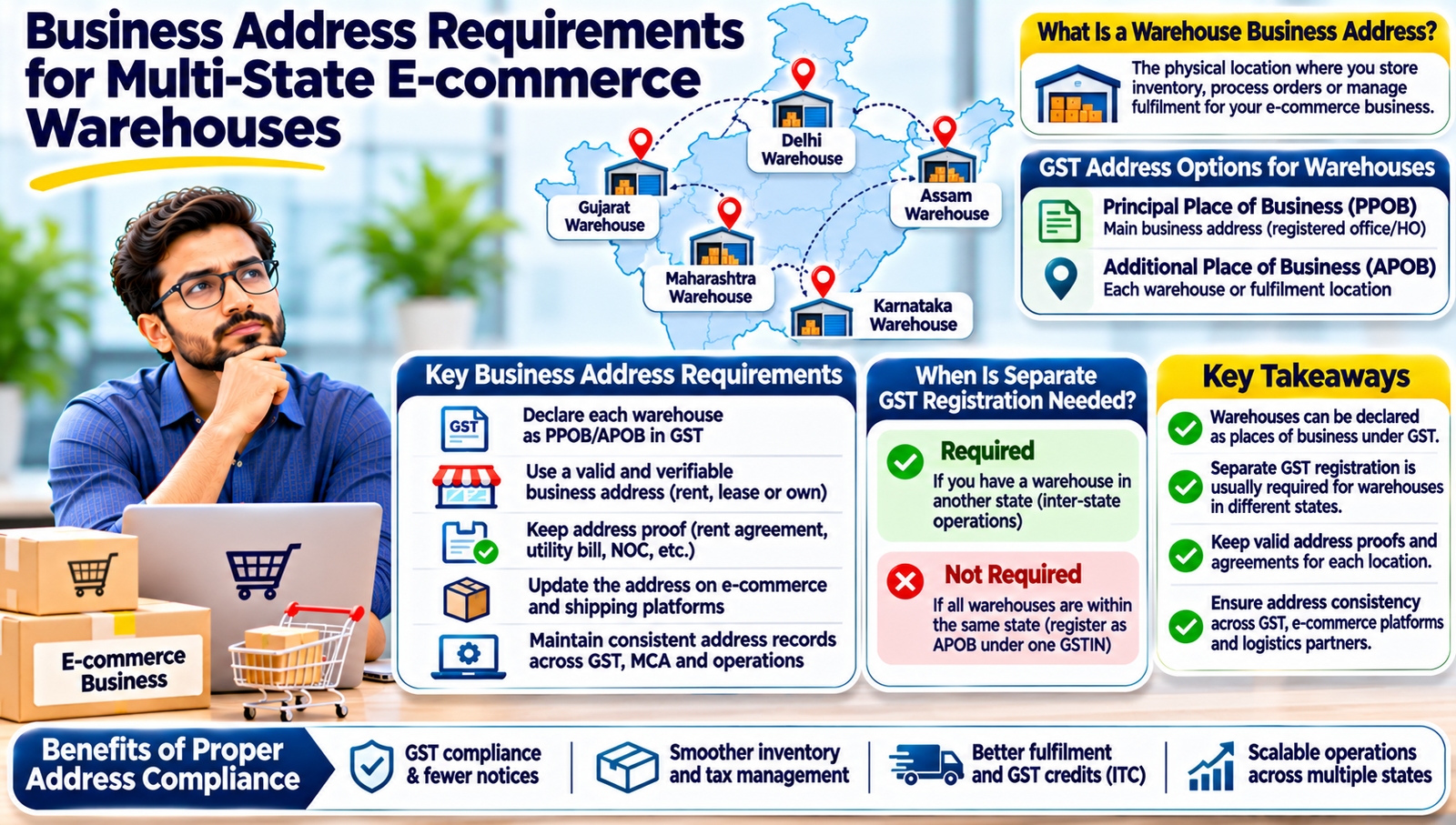
E-commerce businesses storing inventory in warehouses across multiple Indian states must assess GST registration and business premises declaration requirements for each location. Warehouses may qualify as places of business under GST, and operations in another state may require separate registration. The correct treatment depends on inventory ownership, business activities, contractual arrangements and applicable GST provisions.
For example, a D2C brand may have its registered office in Delhi, store products in a Gurugram warehouse and fulfil orders through third-party logistics (3PL) centres in Maharashtra and Karnataka.
Although these locations belong to the same business network, they do not automatically fall under one GST registration.
Each warehouse must be assessed according to its activities, the seller’s rights over the premises, the ownership of inventory and the applicable state-wise GST provisions.
This guide explains the warehouse business address requirements in India, including PPOB, APOB, GST registration, 3PL warehouses, address proof and interstate stock transfers.
What Business Address Is Required for E-commerce Warehouses in Multiple States?
E-commerce sellers must identify their business premises and assess GST registration obligations in every state where they operate.
Why Warehouse Address Requirements Matter
Warehouse addresses help establish where inventory is stored, managed and dispatched.
Accurate declarations also support GST verification, inventory records and movement documentation.
Registered Office vs Warehouse Business Address
A company’s registered office is its statutory address recorded with the Ministry of Corporate Affairs.
A warehouse business address identifies premises used for inventory storage or fulfilment.
These locations may differ.
GST Principal Place of Business (PPOB)
The PPOB is the principal business premises recorded under a GST registration.
A qualifying warehouse may serve as a PPOB depending on the business arrangement.
GST Additional Place of Business (APOB)
An APOB is another qualifying business premises declared under the relevant state GST registration.
Warehouses Located in Different States
Warehouses in different states require separate assessment because GST registration is generally state-specific.
When Separate GST Registration May Be Required
Separate registration may be necessary where warehouse activities create registration liability under the applicable GST provisions.
What Is a Warehouse Business Address in E-commerce?
A warehouse business address identifies the premises where goods are stored, handled or dispatched.
Meaning of Warehouse Business Address
It is the physical location associated with the storage or fulfilment of inventory.
Warehouse vs Registered Office Address
The registered office serves statutory company law purposes.
The warehouse supports inventory and logistics activities.
Warehouse vs Billing Address
A billing address identifies the relevant party on an invoice.
A warehouse address identifies the physical inventory location.
Warehouse vs Fulfilment Centre
A warehouse primarily stores goods.
A fulfilment centre may also handle picking, packing, labelling, dispatch and returns.
Owned Warehouse vs Third-Party Warehouse
An owned warehouse is controlled by the seller.
A third-party warehouse is operated by a separate logistics provider under a contractual arrangement.
Why Warehouse Addresses Matter for GST Compliance
Warehouse addresses may affect business premises declarations, state-wise registration, inventory accounting and goods movement documentation.
What Are the GST Address Requirements for E-commerce Warehouses?
GST law recognises several types of business premises, including certain locations used for storing goods.
Definition of Place of Business Under GST
Section 2(85) of the CGST Act defines place of business and includes a place where a taxable person stores goods, supplies or receives goods or services, or maintains books of account.
Warehouse as a Business Premises
A warehouse may qualify as a place of business when it is used for the taxpayer’s relevant business activities.
Principal Place of Business Requirements
The taxpayer must declare an appropriate PPOB under its GST registration.
Additional Place of Business Requirements
Other qualifying premises within the relevant state may need to be declared as APOBs.
Warehouse Address Documentation
Documents should support the taxpayer’s ownership, occupancy or legitimate use of the premises.
State-Wise GST Registration Considerations
Businesses must assess whether their warehouse activities require registration in another state.
Maintaining Accurate Warehouse Records
Inventory, dispatch, returns and location records should remain consistent with actual operations.
Does Every Warehouse Need to Be Registered as an Additional Place of Business?
Not every warehouse is automatically classified as an APOB.
The correct treatment depends on the business arrangement.
When a Warehouse May Qualify as an APOB
A warehouse may qualify as an APOB when it is an additional business premises under the taxpayer’s state GST registration.
Warehouse as a Principal Place of Business
A warehouse may instead be declared as the PPOB where it is the taxpayer’s principal business location in that state.
Multiple Warehouses Within the Same State
Qualifying additional warehouses within one state may generally be declared under the relevant GSTIN.
Warehouses in Different States
A warehouse in another state cannot simply be added as an APOB under a GSTIN issued in the original state.
Third-Party Warehousing Arrangements
The treatment of a 3PL warehouse depends on inventory ownership, contractual rights and actual activities.
Why Not Every Warehouse Has the Same GST Treatment
Different arrangements may involve dedicated storage space, shared fulfilment facilities or independent logistics services.
How to Assess Warehouse Registration Requirements
Review the following factors:
- Who owns the inventory?
- Who controls or uses the premises?
- Where are goods stored and dispatched?
- What rights does the seller have under the agreement?
- Does the arrangement create registration liability in the state?
Do E-commerce Sellers Need Separate GST Registration for Warehouses in Different States?
GST registration is generally state-specific.
However, the registration obligation must be assessed under the applicable provisions.
How State-Wise GST Registration Works
A GSTIN identifies a registered taxpayer in a particular state or union territory.
When Warehouse Operations Trigger Registration
Registration may be required when the seller’s warehouse operations and supplies create liability under GST law.
Can One GSTIN Cover Warehouses Across India?
No. A GSTIN issued in one state does not automatically cover qualifying business premises across India.
Warehouses Used for Taxable Supplies
Warehouses involved in taxable supplies require careful assessment of the relevant registration and invoicing requirements.
Interstate Inventory Storage and Dispatch
Storing and dispatching goods from another state can affect registration, place-of-supply and stock transfer treatment.
Distinct Persons Under GST
Under Section 25(4) of the CGST Act, separately registered establishments of the same person are treated as distinct persons.
Registration Exceptions and Special Circumstances
Some business arrangements require closer legal analysis, particularly where the warehouse operator independently provides logistics services.
What Documents Are Required for a Warehouse Business Address Under GST?
The documents depend on whether the premises are owned, rented or operated by a third party.
Warehouse Ownership Documents
Where the seller owns the warehouse, appropriate ownership evidence may be required.
Rent or Lease Agreement
A valid agreement may establish the seller’s right to occupy or use rented premises.
Owner Consent or NOC Where Applicable
Owner consent may be relevant where the premises are used with permission.
Utility Bill or Other Accepted Premises Evidence
Accepted utility bills, property records or other prescribed documents may support address verification.
Warehouse Service Agreement
A warehouse service agreement can describe the storage and fulfilment services provided.
Third-Party Logistics Agreement
A 3PL agreement should clarify inventory ownership, storage arrangements, dispatch responsibilities and the seller’s premises-use rights, where applicable.
Authorised Signatory Documents
GST applications may require authorised signatory details and supporting records.
Additional Documents for Address Verification
Authorities may request further evidence under applicable verification procedures.
| Warehouse Arrangement | Common Supporting Documents |
|---|---|
| Owned warehouse | Ownership evidence and accepted premises proof |
| Rented warehouse | Rent or lease agreement and applicable address evidence |
| Shared warehouse | Relevant agreement, premises-use authorisation and supporting proof |
| 3PL warehouse | Logistics agreement, inventory records and applicable premises evidence |
| Marketplace fulfilment centre | Seller agreement, fulfilment documentation and relevant address evidence |
How to Register a Warehouse Address Under GST
The procedure depends on whether the taxpayer needs a new state registration or an amendment to an existing registration.
Step 1: Identify the State and Warehouse Activities
Record the warehouse location and the activities performed there.
Step 2: Assess GST Registration Requirements
Determine whether the business must obtain a GSTIN in that state.
Step 3: Determine PPOB or APOB Classification
Identify whether the warehouse is the principal or an additional qualifying business premises.
Step 4: Prepare Warehouse Address Documents
Collect the relevant agreement, ownership or occupancy evidence and supporting documents.
Step 5: Access the GST Portal
Visit https://www.gst.gov.in/.
Step 6: Apply for Registration or Amendment as Applicable
Submit a new state registration application where required, or amend an existing registration for qualifying premises in the same state.
Step 7: Enter Warehouse Address Details
Provide the complete address, PIN code and applicable premises information.
Step 8: Upload Supporting Documents
Attach the required evidence in the prescribed format.
Step 9: Complete Verification and Submission
Complete the applicable electronic verification and submit the application.
Step 10: Monitor Application Status
Track the application and respond to any lawful clarification requests.
How to Add Multiple Warehouses as APOBs Under GST
Multiple qualifying warehouses within the same state may be declared under the relevant GST registration.
Adding Warehouses Within the Same State
Identify each additional warehouse and assess whether it qualifies as an APOB.
Updating Existing GST Registration
Use the applicable registration amendment workflow on the GST portal.
Warehouse Address Proof Requirements
Provide the prescribed premises documents.
Adding New Warehouses
Update the relevant registration details when new qualifying premises are added.
Removing Closed Warehouse Locations
Remove or amend the relevant APOB details when a declared warehouse is no longer used.
Maintaining Updated Warehouse Records
Keep agreements, inventory records and registered premises details consistent.
Why an APOB in Another State Requires Separate Analysis
An APOB is recorded under a particular state GST registration.
A warehouse in another state requires assessment of separate registration liability rather than being added under the original state’s GSTIN.
What Are the GST Address Rules for Third-Party Logistics (3PL) Warehouses?
3PL arrangements require particular attention because the seller and warehouse operator are different entities.
How 3PL Warehousing Works
A 3PL provider may store inventory, process orders, pack goods and arrange dispatch.
Seller-Owned Inventory Stored at a 3PL
Inventory may remain legally owned by the seller while being physically stored by the logistics provider.
3PL Provider’s GSTIN vs Seller’s GSTIN
The provider’s GSTIN identifies the logistics business.
It does not automatically replace the seller’s registration obligations.
Warehouse Address Declaration
The seller should assess whether the 3PL premises qualify as its place of business under the relevant arrangement.
3PL Agreement and Premises-Use Rights
The agreement should clarify the seller’s rights, storage arrangement and the services provided.
Inventory Movement and Dispatch Records
Maintain accurate records of goods received, stored, transferred, dispatched and returned.
Multi-State 3PL Warehouse Networks
A seller using 3PL facilities across several states should assess each arrangement separately.
Common Compliance Mistakes
Mistakes include assuming the 3PL provider’s GSTIN covers the seller, failing to review state-wise registration and maintaining incomplete inventory records.
How Do Warehouse Address Requirements Apply to Amazon and Flipkart Sellers?
Marketplace fulfilment arrangements may involve inventory stored at facilities operated by the platform or its logistics partners.
Marketplace Fulfilment Centres
Marketplace fulfilment centres may provide storage, packing and dispatch services.
Seller-Owned Inventory at Marketplace Warehouses
The seller may retain ownership of goods while the fulfilment provider handles physical operations.
State-Wise GST Registration Considerations
Sellers should assess whether inventory storage and fulfilment activities create registration liability in the relevant state.
Marketplace Address Documentation
The platform may provide fulfilment agreements or other documents relevant to the seller’s compliance assessment.
Fulfilment Centre Address vs Seller’s Registered Address
The fulfilment centre address may differ from the seller’s registered office or administrative address.
Stock Transfer and Invoicing Requirements
Inventory transfers and sales must be documented under the applicable GST provisions.
Marketplace Policies vs GST Law
Marketplace onboarding policies do not replace statutory GST registration requirements.
Can a Virtual Office Be Used as the GST Business Address While Inventory Is Stored in a Warehouse?
A virtual office may support certain administrative business arrangements, but it does not automatically replace warehouse-related obligations.
Administrative Address vs Physical Inventory Location
An administrative office and inventory storage location may be different premises.
Virtual Office as a Declared Business Premises
A virtual office may qualify as a declared premises where the arrangement satisfies applicable GST requirements.
When a Virtual Office May Be Suitable
It may be suitable for certain administrative or correspondence functions.
Warehouse Address Declaration Requirements
A qualifying warehouse may still need to be declared separately.
Virtual Office Agreement and Address Proof
The agreement and supporting evidence should establish legitimate premises-use rights.
Physical Verification Considerations
GST authorities may verify the declared premises under applicable procedures.
Why a Virtual Office Cannot Automatically Replace Warehouse Registration
A virtual office address does not change where inventory is physically stored or where business activities occur.
How Do GST Invoicing and Stock Transfers Work Across Multiple Warehouses?
Inventory movement between warehouses must be assessed according to the relevant GST registrations and transaction structure.
Inventory Transfers Between Warehouses
Transfers within the same GST registration may be treated differently from transfers between distinct persons.
Transfers Between Different State GSTINs
Transfers between separately registered establishments may qualify as supplies under GST.
Distinct Persons Under GST
Section 25(4) treats separately registered establishments of the same person as distinct persons.
Interstate Stock Transfer Invoicing
Applicable taxable transfers between distinct persons require appropriate invoicing and GST reporting.
E-Way Bill Requirements
E-way bills may be required for goods movement where the applicable rules and thresholds are met.
Input Tax Credit Considerations
Input tax credit eligibility depends on the relevant provisions, documentation and restrictions.
Warehouse-Wise Inventory Reconciliation
Reconcile inventory receipts, transfers, sales, returns and closing stock for each warehouse.
What Happens When an E-commerce Seller Opens a Warehouse in Another State?
Opening a warehouse in a new state requires advance compliance planning.
Assessing New State GST Registration
Review whether the new arrangement creates registration liability.
Selecting the Warehouse Business Address
Choose premises suitable for the intended storage and fulfilment activities.
Preparing Premises Documents
Collect the applicable ownership, occupancy or service agreements.
Applying for Registration Where Required
Complete the relevant GST registration process before conducting activities that require registration.
Updating Marketplace and Logistics Details
Update fulfilment arrangements, marketplace records and operational systems.
Planning Interstate Inventory Movement
Determine the applicable invoicing and movement documentation for transferring stock.
Maintaining Warehouse-Wise Records
Track inventory, dispatches, returns and other warehouse activities.
What Are the Common Warehouse Business Address Compliance Mistakes?
Avoid the following errors.
Using One GSTIN Without Reviewing State-Wise Requirements
A GSTIN issued in one state does not automatically cover all warehouse operations across India.
Failing to Declare Applicable Warehouse Premises
Qualifying premises should be declared where required.
Confusing PPOB With APOB
The PPOB is the principal registered business premises, while an APOB is an additional qualifying location.
Using the 3PL Provider’s GSTIN Instead of the Seller’s
The provider’s GSTIN does not automatically satisfy the seller’s obligations.
Incorrect Warehouse Address Proof
Incomplete agreements and inconsistent premises details can create verification problems.
Treating a Virtual Office as a Substitute for Inventory Premises
An administrative address does not automatically replace warehouse declaration requirements.
Missing Warehouse Closure Amendments
Closed or relocated declared premises should be updated through the applicable registration process.
Incorrect Interstate Stock Transfer Documentation
Transfers between distinct persons may require tax invoices, GST reporting and movement documentation.
How to Manage Warehouse Address Records Across Multiple States
Businesses operating several warehouses should maintain a centralised address and compliance register.
Maintain a State-Wise Warehouse Register
Record each warehouse’s complete address, state, PIN code and operating status.
Map Warehouses to Relevant GSTINs
Identify the GST registration associated with each declared premises.
Track PPOB and APOB Classification
Maintain accurate classification records for qualifying business premises.
Store Warehouse Agreements and Address Proof
Keep digital copies of agreements, authorisations and supporting documents.
Monitor Agreement Expiry Dates
Track lease and logistics agreement renewals.
Maintain Inventory and Dispatch Records
Record goods received, transferred, dispatched and returned.
Review New and Closed Warehouse Locations
Update business records and GST registration details when warehouse arrangements change.
Conduct Periodic GST Address Compliance Checks
Review warehouse locations, state registrations and operational records periodically.
Multi-State E-commerce Warehouse Address Checklist
| Compliance Requirement | Status |
|---|---|
| Identify every warehouse location | Pending |
| Confirm inventory ownership | Pending |
| Review warehouse activities | Pending |
| Assess state-wise GST registration | Pending |
| Determine PPOB/APOB classification | Pending |
| Collect applicable premises documents | Pending |
| Verify 3PL agreements | Pending |
| Update GST registration details | Pending |
| Maintain state-wise GSTIN records | Pending |
| Review interstate stock transfers | Pending |
| Check e-way bill requirements | Pending |
| Update marketplace details | Pending |
| Maintain warehouse-wise inventory records | Pending |
| Review warehouse closures and relocations | Pending |
Final Words
Multi-state warehouse operations can help e-commerce businesses improve fulfilment coverage, delivery speed and inventory distribution.
However, businesses must carefully assess the GST implications of storing and dispatching goods from different states.
The correct treatment depends on inventory ownership, the nature of the warehouse arrangement, the seller’s business activities and applicable registration provisions.
A warehouse may qualify as a PPOB or APOB, while operations in another state may require separate GST registration.
Businesses should maintain accurate premises documents, 3PL agreements, inventory records and state-wise GST information.
The key to compliant multi-state warehousing is understanding where the business operates, which GST registration applies and how inventory moves between locations.
FAQs About Warehouse Business Addresses
Does an e-commerce warehouse need a separate GST registration?
Not necessarily. A warehouse may be declared under an existing state GST registration, while operations in another state may require separate registration depending on the applicable provisions.
Can I use one GSTIN for warehouses in multiple states?
No. A GSTIN is state-specific and does not automatically cover qualifying business premises across different states.
Is a warehouse considered an additional place of business under GST?
A qualifying warehouse may be declared as an APOB when it is an additional business premises under the relevant state registration.
What address proof is required for warehouse GST registration?
Documents may include ownership evidence, a rent or lease agreement, applicable owner consent, accepted premises proof and relevant warehouse service agreements.
Can an e-commerce seller use a 3PL warehouse address for GST registration?
Potentially, depending on the seller’s actual activities, premises-use rights and applicable GST requirements.
Do Amazon and Flipkart sellers need GST registration in warehouse states?
They may need separate state registration depending on inventory ownership, fulfilment arrangements and the applicable GST provisions.
Can I use a virtual office address while storing inventory in another warehouse?
Potentially, but the virtual office must satisfy applicable premises requirements, and the warehouse may require separate declaration or registration.
How do I add a warehouse address to my GST registration?
Where the warehouse qualifies as an APOB within the same state, use the applicable GST registration amendment process.
What happens if I move inventory to a warehouse in another state?
Assess the new state’s registration requirements and the GST treatment of the inventory transfer before moving the stock.
How do I remove a closed warehouse from my GST registration?
Use the applicable GST registration amendment workflow to remove or update the declared APOB details.