
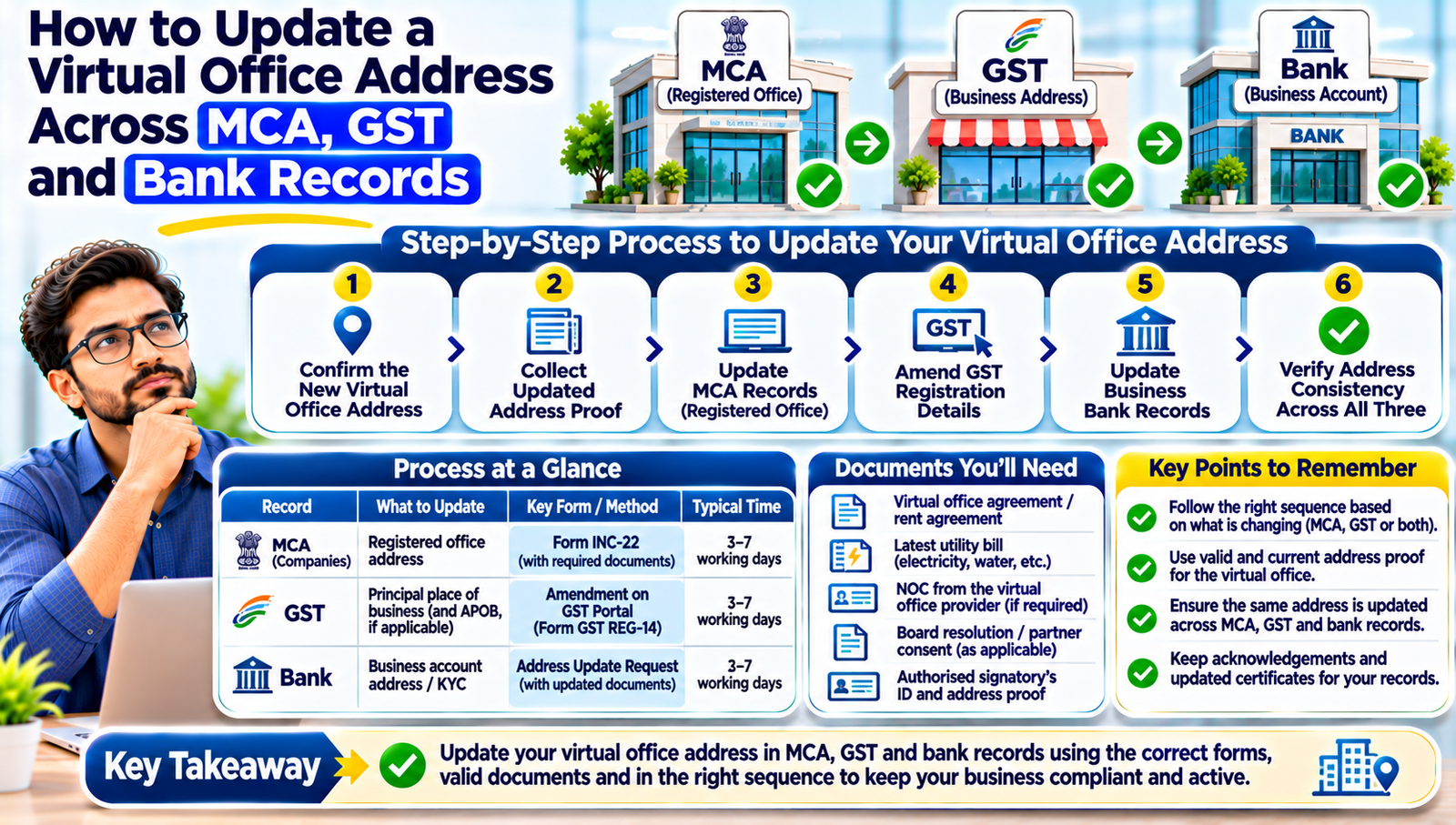
To update a virtual office address across MCA, GST and bank records in India, first secure valid documents for the new premises. Complete the applicable MCA registered office filings, amend GST registration details and submit the bank’s address update or KYC request. Finally, verify that each record reflects the correct address and retain supporting acknowledgements.
Changing a virtual office provider or relocating to another business address may seem straightforward. However, the address recorded with the Ministry of Corporate Affairs (MCA), Goods and Services Tax (GST) authorities and your business bank may serve different legal purposes.
A private limited company, for example, may use a virtual office in Delhi as its registered office, a warehouse in Haryana as its GST business premises and a separate correspondence address for banking.
Changing one address does not necessarily mean all three records must be changed.
The correct process depends on which address is moving, whether the business is a company or LLP, and whether the relocation crosses state boundaries.
This guide explains how to update a virtual office address across MCA, GST and business bank records, including required documents, filing procedures, verification and common mistakes.
How Do You Update a Virtual Office Address Across MCA, GST and Bank Records?
Start by identifying which statutory and business records actually need amendment.
Confirm the New Virtual Office Address
Verify the new provider, full premises address, permitted business use and agreement validity.
Check the building number, floor, locality, city, state and PIN code.
Collect Updated Address Proof
Prepare the new virtual office agreement, applicable owner authorisation and accepted premises evidence.
Update MCA Records Where Applicable
If the company’s or LLP’s registered office changes, complete the relevant MCA procedure.
Amend GST Registration Details
If the declared GST Principal Place of Business (PPOB) or Additional Place of Business (APOB) changes, assess the applicable GST registration amendment.
Update Business Bank Account Records
Inform the bank of changes to the registered, operating or correspondence address, as applicable.
Verify Address Consistency Across All Three Systems
Check that each system reflects the correct address for its declared purpose.
Virtual Office Address Update Process at a Glance
| Record | When an Update Is Needed | Typical Process |
|---|---|---|
| MCA – Company | Company’s registered office changes | Applicable corporate approvals and INC-22 filings |
| MCA – LLP | LLP’s registered office changes | LLP Form 15 and applicable procedures |
| GST | Declared PPOB or APOB changes | Core amendment or new state registration, as applicable |
| Business bank | Address recorded by the bank changes | Address change request and applicable KYC |
| Other records | Address relevant to that registration changes | Update through the respective authority |
Important: There is no universal requirement to update MCA before GST or vice versa. The appropriate sequence depends on the records being changed and the documents each authority requires.
When Does a Business Need to Update Its Virtual Office Address?
An address update may become necessary whenever the business loses access to its existing premises or changes the location used for statutory purposes.
Moving to a New Virtual Office Provider
Changing providers may involve moving to a different building, unit or city.
If the statutory address changes, the relevant records should be updated.
Existing Virtual Office Agreement Expiry
An expired agreement may affect the business’s permission to continue using the premises.
Renew the agreement or arrange a suitable replacement before the existing arrangement ends.
Virtual Office Provider Relocation
If the provider relocates, determine whether the company’s declared premises have also changed.
A provider moving to another property does not automatically update the business’s statutory records.
Changing the Company’s Registered Office
A company changing its registered office must comply with the applicable provisions of the Companies Act, 2013.
Changing the GST Principal Place of Business
If the business changes its declared PPOB, a GST registration amendment may be required.
Correcting an Incorrect Business Address
Incorrect building details, PIN codes or outdated addresses may need correction through the appropriate process.
Updating the Address After Business Expansion
Opening another office, warehouse or branch may create additional registration or address declaration requirements without necessarily changing the original registered office.
Which Business Records Need Updating After a Virtual Office Address Change?
Businesses should review all records where the previous address appears.
MCA Registered Office Records
For companies and LLPs, check whether the statutory registered office has changed.
GST Registration Certificate
Review the PPOB and APOB details recorded under each relevant GSTIN.
Business Bank Account Records
Check the registered address, business address and correspondence address maintained by the bank.
PAN and Income Tax Records, Where Applicable
Determine whether the relevant PAN or income tax profile details require updating.
Shops and Establishments Registration, Where Applicable
Review the applicable state registration if the establishment address changes.
Udyam Registration, Where Applicable
MSMEs should review whether their Udyam details need updating.
Business Licences and Permits
Check industry-specific registrations, local licences and other permissions.
Invoices, Contracts and Website Contact Details
Update business documents and public-facing information where the old address is no longer appropriate.
What Documents Are Required to Update a Virtual Office Address?
Document requirements differ between MCA, GST and banks.
New Virtual Office Service Agreement
The agreement should identify the relevant business entity, full address, permitted use and validity period.
Owner Consent or No Objection Certificate
Appropriate owner or authorised occupant consent may be required depending on the premises arrangement.
Utility Bill or Accepted Premises Evidence
An accepted utility bill or other prescribed premises document may be needed.
Check the specific recency and document requirements for each filing.
Property Ownership or Occupancy Documents
These may help establish that the provider has legitimate rights over the premises.
Company or LLP Authorisation Documents
Corporate approvals, partner decisions or authorised signatory documents may be necessary.
MCA Filing Documents
Depending on the change, documents may include INC-22, LLP Form 15, applicable resolutions, approvals and filing acknowledgements.
GST Address Amendment Documents
Prepare the relevant premises agreement, ownership evidence or consent documents required for the GST amendment.
Bank KYC and Address Change Documents
Banks may request a signed application, statutory registration documents, premises proof, authorised signatory identification and corporate authorisation.
| Document | MCA | GST | Bank |
|---|---|---|---|
| Virtual office agreement | Where applicable | Where applicable | Subject to bank policy |
| Owner consent | Where required | Where required | If requested |
| Utility or premises proof | As prescribed | As prescribed | Subject to KYC requirements |
| Company or LLP authorisation | As applicable | As applicable | Often relevant |
| Updated statutory registration | Filing outcome | Filing outcome | May be requested |
| Address change request | Applicable MCA form | Applicable GST amendment | Bank-specific request |
The table indicates possible document categories, not a universal mandatory list.
How to Update a Virtual Office Address on MCA Records
A company must follow the applicable registered office change procedure under the Companies Act, 2013.
Step 1: Identify the Type of Registered Office Change
Determine whether the company is moving:
- Within the same city, town or village limits
- Outside those local limits but within the same state
- Between Registrar jurisdictions
- From one state to another
These situations may involve different approvals and filings.
Step 2: Review Required Corporate Approvals
Determine whether a board resolution, special resolution, Regional Director approval or another statutory step is necessary.
Step 3: Prepare the New Address Proof
Collect the applicable premises agreement, owner authorisation and accepted address evidence.
Step 4: Determine Whether Form INC-22 Is Required
Form INC-22 is generally used to notify the Registrar of a company’s registered office change.
Under Section 12(4) of the Companies Act, notice of a registered office change is generally required within 15 days of the change, subject to the applicable statutory provisions.
Step 5: Complete Additional Filings Where Applicable
More complex relocations may require other forms, approvals or changes to the company’s constitutional documents.
Step 6: Submit the Applicable MCA Forms
Use the official MCA portal to complete the relevant filings with the prescribed attachments and fees.
Step 7: Track Filing Status
Monitor the application and respond to any clarification or resubmission request.
Step 8: Verify Updated Company Master Data
After the filing is processed, check the registered office address displayed in MCA company master data.
For a more detailed procedure, refer to How to Change a Company Registered Office Address After Incorporation.
How to Update an LLP Virtual Office Address on MCA
An LLP follows the Limited Liability Partnership Act, 2008, and the applicable LLP Rules.
LLP Registered Office Requirements
Section 13 of the LLP Act requires an LLP to maintain a registered office to which communications and notices may be addressed and where they may be received.
LLP Form 15 for Registered Office Changes
LLP Form 15 is used for notifying the Registrar of a change in an LLP’s registered office.
Partner Consent and Other Applicable Requirements
Review the LLP agreement and applicable rules to determine the required partner decisions or consents.
Interstate LLP Address Changes
Moving an LLP’s registered office between states may involve additional procedures, including applicable creditor consent, public notices and filings.
Preparing Shared or Virtual Office Documents
Collect the new agreement, premises evidence and relevant owner or operator authorisation.
Filing and Verification
Submit Form 15 with the required supporting documents and complete the applicable authentication process.
Checking Updated LLP Master Data
After processing, verify the revised address through MCA LLP master data.
Note: LLP Form 15 and company Form INC-22 are different filings under different legal frameworks.
How to Change a Virtual Office Address in GST Registration
A change to a declared GST business premises generally requires an amendment of core registration details.
Step 1: Log In to the GST Portal
Visit https://www.gst.gov.in/ and sign in using the relevant GST registration credentials.
Step 2: Identify the Relevant Registration Amendment
Navigate to the registration amendment service for core fields.
Step 3: Select the Principal Place of Business or Additional Place of Business
Identify the declared business premises requiring amendment.
Step 4: Enter the New Address Details
Enter the complete address and other requested premises information.
Check the state, district and PIN code carefully.
Step 5: Upload Applicable Address Proof
Attach the required agreement, ownership evidence, consent or other accepted documents.
Step 6: Complete Verification and Submission
Complete the required declaration and electronic verification.
Step 7: Track Amendment Status
Monitor the application reference number and respond to any clarification request.
Step 8: Download the Updated GST Registration Certificate
After the amendment is approved, download the updated registration certificate and verify the address.
Important: Changing the PPOB or APOB is a core amendment that generally requires tax officer approval. It is not treated as an automatically approved non-core change.
Can You Change Your GST Business Address to Another State?
An existing GSTIN cannot simply be amended to move its registered business premises into another state.
GST Registration Is State-Specific
GST registrations are generally issued for a particular state or union territory.
Why Interstate Address Changes Need Separate Assessment
Moving business operations into another state may create new registration obligations.
When New State Registration May Be Required
A new registration may be required where the business becomes liable to register in the destination state.
Whether Existing Registration Needs Cancellation
The existing registration may need cancellation if the business ceases operations requiring registration in the original state.
This should be assessed separately rather than assumed.
Inventory and Place of Business Considerations
Review warehouses, inventory ownership, dispatch activities and other business premises in both states.
Updating Invoices and GSTIN Details
Where a new GST registration applies, ensure that invoices and relevant records use the correct GSTIN.
Avoiding Incorrect Interstate Amendments
Do not attempt to change the state of an existing GST registration through an ordinary PPOB address amendment.
How to Update a Virtual Office Address in a Business Bank Account
Banks follow their own procedures within the applicable RBI KYC framework.
Step 1: Check the Bank’s Address Update Policy
Contact the bank or review its official account servicing instructions.
Step 2: Identify Registered, Business and Correspondence Addresses
Determine which address fields are maintained for the account.
Step 3: Prepare the Address Change Request
Complete the bank’s prescribed request form or online process, where available.
Step 4: Submit Applicable KYC Documents
Provide the documents required by the bank for the relevant entity and address type.
Step 5: Provide Corporate Authorisation Where Required
A company or LLP may need an authorised signatory declaration, board resolution or partner authorisation.
Step 6: Complete Additional Bank Verification
The bank may perform further checks based on its policies and risk assessment.
Step 7: Confirm the Updated Address
Obtain confirmation that the relevant address has been changed.
Step 8: Review Account Statements and Communications
Check that future statements, correspondence and other account records reflect the appropriate address.
Note: A bank may request additional verification or decline particular documents if they do not satisfy its KYC requirements.
Should You Update MCA, GST or Bank Records First?
The sequence depends on which address is changing and what supporting evidence is available.
When MCA Records Should Be Updated First
If a company’s registered office is changing and the bank requires updated MCA information, completing the relevant MCA filing first may simplify the bank update.
When GST Address Changes Can Be Handled Separately
A GST business premises change may be independent of the MCA registered office.
For example, changing a warehouse or PPOB does not automatically mean the company’s registered office has changed.
Why Banks May Request Updated Statutory Records
Banks may use MCA, GST or other registration documents to verify business particulars.
Dependencies Between Address Updates
Identify which documents are required by each authority before deciding the filing order.
How to Avoid Record Mismatches
Use consistent address details in documents relating to the same premises.
Recommended Sequence for Private Limited Companies
Where the registered office and GST business premises are both changing, a practical approach is:
- Secure the new premises and supporting documents.
- Complete the applicable MCA approvals and filings within the statutory deadline.
- Submit the relevant GST amendment within its applicable deadline.
- Update the bank’s address records and KYC information.
- Verify all records after processing.
Some steps may proceed in parallel.
Recommended Sequence for LLPs
Follow the same general coordination approach, replacing the company registered office procedure with the applicable LLP Form 15 process.
Handling Delays in One System
Maintain filing acknowledgements and explain pending statutory amendments to the other institutions where necessary.
Do not delay a legally required filing merely because another system has not finished processing.
What Happens if MCA, GST and Bank Addresses Do Not Match?
Different addresses are not automatically non-compliant.
The important question is whether each record accurately reflects the address declared for its specific purpose.
Reasons for Address Mismatches
Differences may arise from relocation, incomplete updates, incorrect data entry or legitimately separate business premises.
When Different Addresses Are Legitimate
A company may maintain a registered office in one location, a GST PPOB elsewhere and a separate banking correspondence address.
Each arrangement must independently satisfy its applicable requirements.
Bank KYC Verification Issues
Incorrect or unsupported address information may delay bank verification or servicing requests.
GST Address Verification Concerns
An incorrect declared business premises may create issues during GST verification or compliance review.
Missed Official Communications
Outdated correspondence arrangements can result in missed notices and important communications.
Problems During Business Due Diligence
Unexplained discrepancies may create questions during vendor onboarding, financing or other business checks.
How to Resolve Incorrect or Outdated Records
Identify the purpose of each address, confirm the correct information and submit the relevant corrections.
How Long Does It Take to Update a Virtual Office Address?
Processing time varies by authority, application type and verification requirements.
MCA Filing and Processing Time
MCA processing depends on the applicable form, approvals and whether clarification is required.
GST Amendment Processing Time
GST core amendments are subject to the applicable approval process.
Bank Address Verification Time
Banks have different internal procedures and verification requirements.
Factors That Cause Delays
Delays may arise from incomplete documents, inconsistent addresses, pending approvals or additional verification.
Missing Documents and Clarifications
Authorities or banks may request further evidence before processing the update.
How to Track Pending Requests
Use the applicable MCA or GST acknowledgement and the bank’s service request reference.
Planning Address Changes Before Agreement Expiry
Begin the transition before the existing virtual office agreement ends.
This helps maintain continuity of premises-use rights and official correspondence.
What Happens if You Do Not Update Your Virtual Office Address?
Failing to update relevant records may create statutory and operational risks.
MCA Registered Office Compliance Risks
A company that fails to report a registered office change may face consequences under Section 12 of the Companies Act.
GST Registration Discrepancies
Incorrect business premises information may create amendment and verification concerns.
Bank KYC and Correspondence Issues
Outdated bank records may delay servicing requests and important communications.
Missed Government Notices
Official correspondence may continue to reach the previous address.
Problems With Expired Address Agreements
An expired agreement may affect the business’s right to use the declared premises.
Potential Penalties and Regulatory Action
Consequences depend on the relevant law, nature of the default and applicable procedure.
Steps to Correct an Existing Default
Establish valid premises-use rights, submit overdue amendments, retain acknowledgements and respond to outstanding notices.
What Are the Common Mistakes When Updating a Virtual Office Address?
Avoid these common address change errors.
Updating Only MCA but Not GST
If the GST business premises also changes, the relevant GST registration must be reviewed.
Forgetting to Notify the Bank
Bank records may continue to show an outdated business or correspondence address.
Using an Expired Virtual Office Agreement
Ensure the company or LLP has current permission to use the premises.
Submitting Inconsistent Address Documents
Different building numbers, units or PIN codes can cause verification problems.
Using Incorrect Premises Details
Check the exact address before submitting any application.
Assuming MCA Approval Guarantees GST Acceptance
MCA and GST operate under separate legal frameworks.
Ignoring Interstate GST Registration Requirements
A GSTIN cannot simply be moved from one state to another through an ordinary address amendment.
Failing to Check Updated Records
Always confirm the final information after processing.
How to Manage Business Correspondence During a Virtual Office Address Change
A coordinated transition helps prevent missed communications.
Keep the Old Address Accessible During Transition Where Possible
Maintain lawful access to the old premises while completing the change.
Notify the Existing Virtual Office Provider
Inform the provider about the planned termination or relocation.
Arrange Mail Forwarding
Request forwarding of correspondence where the agreement permits it.
Monitor MCA and GST Communications
Continue checking registered email accounts and official portals.
Notify the Bank of Important Correspondence Changes
Ensure the bank knows where to send relevant communications.
Update Business Partners and Vendors
Inform customers, suppliers and service providers when their records require the new address.
Maintain Records of Received Notices
Retain correspondence logs and acknowledgements during the transition.
Virtual Office Address Change Checklist for Indian Businesses
Use this checklist to coordinate updates across different systems.
| Action | Status |
|---|---|
| Confirm the new virtual office address | Pending |
| Verify provider authorisation | Pending |
| Collect updated address documents | Pending |
| Review existing agreement expiry | Pending |
| Determine MCA filing requirements | Pending |
| Complete MCA address updates | Pending |
| Amend applicable GST registration details | Pending |
| Update bank KYC records | Pending |
| Review PAN and other registrations | Pending |
| Update business invoices and contracts | Pending |
| Arrange official mail forwarding | Pending |
| Verify all updated records | Pending |
| Save filing acknowledgements | Pending |
| Maintain a central address register | Pending |
Final Words
Updating a virtual office address involves more than replacing an old address with a new one.
Businesses must first identify which legal and operational records are affected.
A company’s MCA registered office, GST business premises and bank correspondence address may legitimately differ, provided each record is accurate and satisfies its applicable requirements.
Before making changes, secure valid premises documents, review the relevant filing procedures and plan the transition carefully.
Companies should follow the applicable Companies Act requirements, LLPs should follow the LLP Act and GST registrations should be updated according to their state-specific rules.
The best approach is to coordinate every required update, maintain reliable official correspondence and verify the completed records rather than assuming that changing one registration automatically updates the others.
FAQs About Updating a Virtual Office Address
How do I change my virtual office address on MCA records?
Determine the type of registered office relocation, complete the applicable corporate approvals and submit Form INC-22 with any other required filings. Verify the updated company master data after processing.
Can I update my virtual office address online through the GST portal?
Yes, where the declared GST business premises changes within the scope of an existing state registration, the relevant core amendment can generally be submitted online.
What documents are required to update a business bank account address?
Banks may require an address change request, updated statutory documents, premises evidence, authorised signatory identification and corporate authorisation. Requirements vary by bank.
Should I update MCA or GST first after changing my virtual office?
It depends on which addresses are changing and whether one institution requires updated records from another. Complete each applicable filing within its statutory deadline.
Can my MCA registered office and GST business address be different?
Yes. They are separate legal concepts and may differ when each address meets the relevant requirements.
Can I change my GST business address from one state to another?
An existing GSTIN cannot simply be amended to move to another state. The business must assess new state registration requirements and the treatment of its existing registration.
Is Form INC-22 required for every registered office address change?
Form INC-22 is generally used for company registered office changes, but additional approvals and filings may be necessary depending on the type of relocation. LLPs use a different process.
How do I update an LLP registered office address?
An LLP generally files Form 15 with the applicable documents and approvals. Interstate relocations may involve additional requirements.
What happens if my virtual office agreement expires before I update my records?
The business may lose permission to use the premises, creating correspondence and compliance risks. Arrange a valid alternative, complete the necessary filings and address any existing default.
Can a bank reject a virtual office address during KYC verification?
A bank may decline the submitted documents or request additional evidence if the arrangement does not satisfy its applicable KYC requirements.