
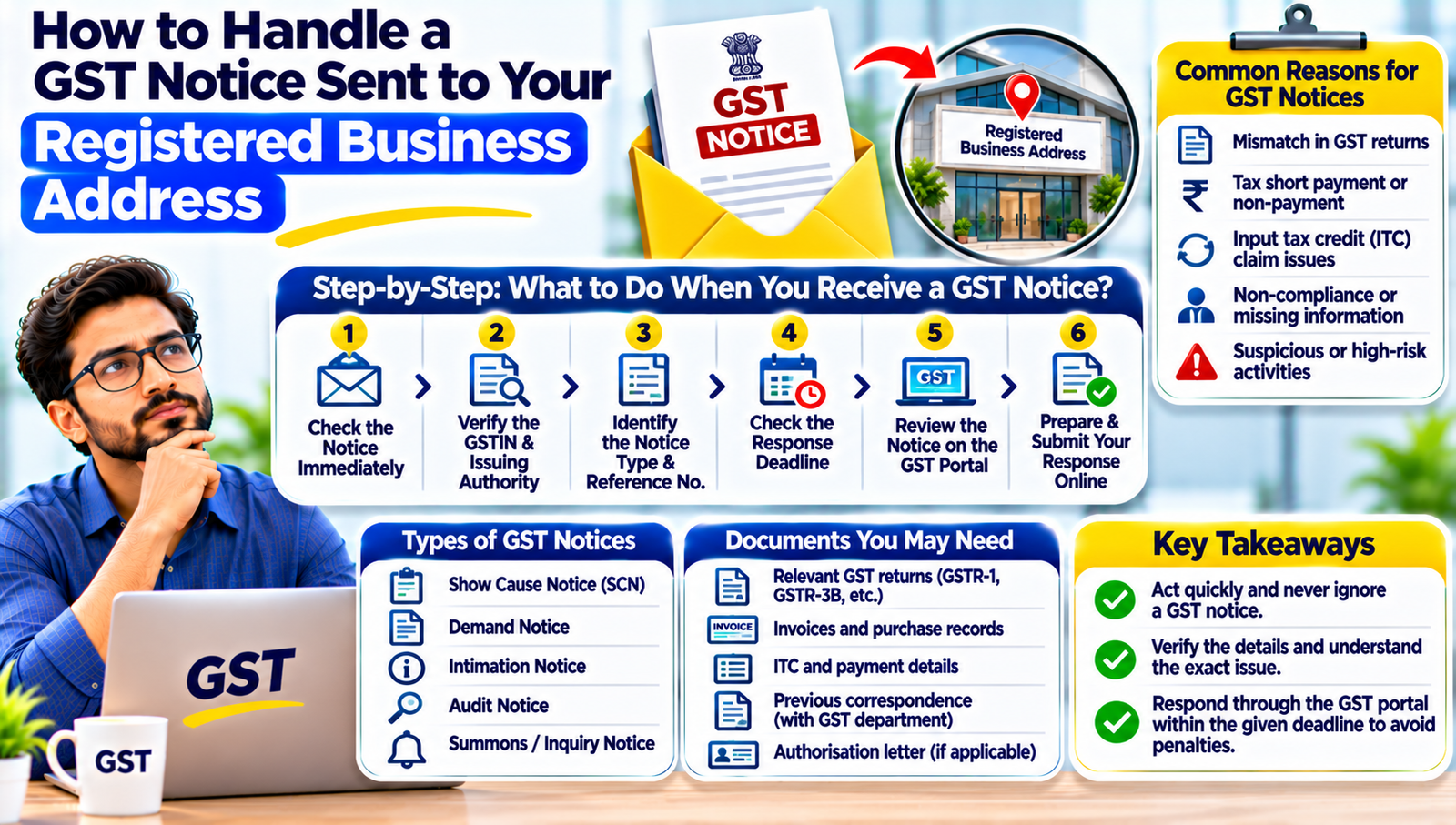
Receiving a GST notice at your registered business address can be concerning, particularly when it involves tax discrepancies, registration issues or a request for supporting documents.
However, not every GST notice indicates a penalty or serious violation. Some notices request clarification, while others relate to pending returns, registration verification, tax demands or compliance proceedings.
The most important step is to verify the notice and respond within the applicable deadline.
Under Section 169 of the Central Goods and Services Tax (CGST) Act, 2017, GST authorities can serve notices through several legally recognised methods, including physical delivery, registered email and the GST portal.
This means businesses must monitor both their registered premises and electronic communications.
This guide explains how to handle a GST notice sent to your business address, verify its authenticity, respond through the GST portal and avoid missing future notices.
What Should You Do When a GST Notice Arrives at Your Business Address?
When a GST notice arrives, review it immediately rather than waiting until the next return-filing date.
Check the Notice Immediately
Open the notice and examine its contents as soon as it is received.
Identify whether it requests information, requires a formal reply, proposes action or communicates an order.
Verify the GSTIN and Issuing Authority
Check whether the notice contains your correct GSTIN, legal business name and issuing authority.
Identify the Notice Type and Reference Number
Look for the notice form, reference number, relevant legal provision and nature of the issue.
These details help determine the correct response procedure.
Check the Response Deadline
Find the deadline mentioned in the notice.
Different proceedings have different statutory requirements, so do not assume every GST notice allows the same number of days.
Review the Notice on the GST Portal
Log in to the official GST portal and check the relevant notices, orders or application workflow.
Collect Relevant Documents
Gather the documents connected to the issue, such as returns, invoices, address proof, agreements or bank records.
Respond Through the Prescribed Process
Submit the response through the applicable portal workflow or other legally prescribed channel.
Retain the acknowledgement and supporting evidence.
What Is a GST Notice and Why Is It Sent to a Business Address?
A GST notice is an official communication issued under the applicable GST law.
Meaning of a GST Notice
A GST notice may require a taxpayer to provide information, explain discrepancies, comply with registration requirements or respond to proposed tax action.
Why GST Authorities Issue Notices
Authorities may issue notices to verify compliance, investigate discrepancies or initiate proceedings permitted under GST law.
Registered Business Address Under GST
The registered business address is part of the taxpayer’s GST registration particulars.
It helps authorities identify and communicate with the business.
Physical Notices vs Electronic Notices
GST communications may be served physically or electronically through methods recognised under Section 169.
Common Reasons Businesses Receive GST Notices
Common reasons include non-filing of returns, registration discrepancies, input tax credit issues, mismatched records and address verification concerns.
Why Accurate Business Contact Details Matter
Incorrect addresses, inactive email accounts and outdated contact details can cause businesses to miss important communications.
Which Business Address Can GST Authorities Use to Send Notices?
GST authorities may use legally recognised service methods and addresses associated with the taxpayer.
Principal Place of Business (PPOB)
The PPOB is the principal business location specified in the GST registration certificate.
It is an important address for official correspondence and verification.
Additional Place of Business (APOB)
An APOB is another qualifying business location declared under the relevant GST registration.
Depending on the circumstances, notices or verification communications may relate to activities conducted at an APOB.
Registered Office vs GST-Registered Business Address
A company’s MCA registered office and GST PPOB are separate legal concepts.
They may be located at the same premises or at different addresses.
Address Recorded on the GST Portal
The business should ensure that the address details recorded in its GST registration remain accurate.
Business Address vs Residential Address
Service of a notice depends on the legally permitted methods and relevant facts.
A business should not assume that only its commercial office can be used for every form of service.
Notices Sent to Authorised Representatives
Section 169 recognises service through specified persons, including authorised representatives and other persons identified in the provision.
What Happens When a Business Operates From Multiple Locations?
Businesses with multiple offices or warehouses should maintain reliable communication arrangements and monitor their GST registration details.
How Are GST Notices Legally Served Under Section 169?
Section 169 of the CGST Act establishes the recognised methods for serving GST notices and other official communications.
Meaning of Service of Notice Under GST
Service refers to legally communicating a notice, order or other prescribed document to the relevant person.
Direct Delivery and Delivery Through Authorised Persons
A notice may be served directly or through specified persons, including authorised representatives, in accordance with Section 169.
Registered Post, Speed Post and Courier
The law recognises certain postal and courier methods for serving notices.
Service Through Registered Email
A notice may be sent to the email address provided at registration or subsequently amended.
Service Through the GST Portal
Making a notice available on the common GST portal is a recognised method of service under Section 169.
Alternative Service Methods Where Applicable
Where applicable, the law also provides for publication in a newspaper or affixing a notice at specified locations.
When a GST Notice May Be Considered Served
The legally relevant service date depends on the method used and the applicable statutory provisions.
Why Physical Non-Receipt Does Not Always Invalidate Service
A taxpayer may not receive a paper notice but may still have been legally served through email or the GST portal.
Important: Businesses should not assume that a notice is invalid merely because no physical letter arrived.
What Types of GST Notices May Be Sent to Your Registered Address?
Different GST notices require different responses.
GST Registration Clarification Notices
A notice such as Form GST REG-03 may request clarification or additional information relating to a registration application.
Notices Related to Registration Cancellation
Form GST REG-17 may be used to initiate cancellation proceedings in applicable circumstances.
Return Non-Filing Notices
Form GSTR-3A may be issued for failure to furnish applicable returns.
Return Discrepancy Notices
Form GST ASMT-10 may be used to communicate discrepancies identified during scrutiny of returns.
Input Tax Credit-Related Notices
Authorities may raise questions about input tax credit claims, invoices, supplier compliance or related transactions.
Tax Demand and Show Cause Notices
Demand proceedings may involve notices issued under applicable provisions, including Sections 73 or 74 for periods to which those provisions apply and Section 74A for relevant later periods.
GST Audit and Scrutiny Communications
Businesses may receive communications seeking records, explanations or reconciliation information.
Physical Verification-Related Communications
Authorities may examine whether declared business premises exist and support the registered activities.
| Notice or Form | Common Purpose | Typical Action |
|---|---|---|
| GST REG-03 | Registration clarification | Submit required clarification |
| GST REG-17 | Proposed registration cancellation | Respond to cancellation grounds |
| GSTR-3A | Return non-filing | Address return-filing default |
| GST ASMT-10 | Return scrutiny discrepancy | Explain or address discrepancy |
| GST DRC-01 | Summary of show cause notice in applicable demand proceedings | Review allegations and respond |
| GST DRC-01A | Pre-notice communication in applicable cases | Review and respond where appropriate |
The exact procedure depends on the notice, legal provision and tax period.
How to Verify Whether a GST Notice Is Genuine
Businesses should verify a GST notice before submitting documents or making payments.
Check the GSTIN and Legal Business Name
Confirm that the notice identifies the correct taxpayer.
Identify the Issuing GST Authority
Review the department, officer designation and jurisdiction mentioned in the notice.
Verify the Reference Number or DIN Where Applicable
Check the reference number, RFN or Document Identification Number (DIN), as applicable.
The presence or absence of a DIN must be assessed under the relevant issuing authority’s rules and exceptions.
Check the Notice on the GST Portal
Log in directly to the official GST portal rather than following an unfamiliar email link.
Review the Relevant Notice Section and Form
Identify the statutory provision and form used.
Identify Suspicious Links or Payment Requests
Be cautious of messages requesting payments through personal bank accounts, unfamiliar websites or unverified payment links.
Contact the Appropriate GST Office When Necessary
If the notice cannot be verified, contact the relevant GST authority through official channels.
How to Check GST Notices on the GST Portal
The GST portal provides access to many notices and related proceedings.
Step 1: Visit the Official GST Portal
Open https://www.gst.gov.in/.
Step 2: Log In With Your Business Credentials
Use the taxpayer’s authorised login credentials.
Step 3: Open Notices and Orders
Navigate to Services → User Services → View Notices and Orders, where available.
Some communications appear within separate application-specific or proceeding-specific sections.
Step 4: Locate the Relevant Notice or Communication
Search for the notice using the available reference, date or proceeding details.
Step 5: Download the Notice and Attachments
Save the notice and all supporting attachments.
Step 6: Review the Notice Date and Response Deadline
Identify the applicable deadline and any hearing or document submission requirements.
Step 7: Identify the Appropriate Response Workflow
Use the response process associated with that notice.
Not every notice is answered through the same GST portal screen.
How to Reply to a GST Notice Sent to Your Business Address
A proper reply should address the actual issue raised in the notice.
Step 1: Identify the Issue Raised in the Notice
Read each allegation, discrepancy or information request carefully.
Step 2: Review the Applicable Legal Provision
Check the relevant GST provision and procedural rules.
Step 3: Confirm the Response Deadline
Determine the last date for submission and whether any lawful extension may be available.
Step 4: Collect Supporting Records
Gather invoices, returns, reconciliations, agreements and other relevant documents.
Step 5: Prepare a Clear Written Explanation
Explain the facts, address each issue and refer to supporting evidence.
Avoid unrelated explanations.
Step 6: Submit the Reply Through the Prescribed Channel
Use the applicable portal workflow or other prescribed submission method.
Step 7: Upload Relevant Supporting Documents
Attach documents in the required format.
Step 8: Save the Acknowledgement or Submission Reference
Retain the acknowledgement, ARN or other submission evidence.
Step 9: Monitor Further Notices or Hearing Requirements
Check for additional clarification requests, hearing dates and final orders.
Practical tip: For complex tax demands, cancellation proceedings or disputed liability, obtain advice from a qualified GST professional before filing the response.
What Documents May Be Required to Respond to a GST Notice?
The documents depend on the subject of the notice.
GST Registration Certificate
The certificate confirms the registered taxpayer’s details.
Business Address Proof
Address proof may be relevant to registration or premises verification issues.
Rental or Lease Agreement
A rental agreement can help establish the right to use the declared premises.
Owner Consent or NOC Where Applicable
Consent documents may support the business’s legitimate premises arrangement.
Tax Invoices and Purchase Records
Invoices may be necessary for sales, purchases and input tax credit disputes.
GST Returns and Reconciliation Statements
Returns and reconciliations help explain reported tax positions.
Bank Statements and Transaction Evidence
Bank records may be relevant where authorities question payments or transactions.
Inventory and Business Operation Records
Stock and operational records can help establish the nature and location of business activities.
Relevant Correspondence and Previous Submissions
Retain earlier notices, replies, acknowledgements and official communications.
What Happens if a GST Notice Is Sent to Your Old Business Address?
A notice sent to an old address requires immediate attention.
Why GST Notices May Reach an Outdated Address
The business may have relocated without updating its GST registration or correspondence arrangements.
GST Registration Address Amendment Requirements
Changes affecting registered business premises should be updated through the applicable GST amendment procedure.
Can a Notice Sent to an Old Address Still Be Valid?
Potentially, yes.
The validity of service depends on Section 169, the method used and the relevant circumstances.
How to Check Whether the Notice Was Legally Served
Review postal records, portal availability, registered email delivery and other relevant evidence.
What to Do if the Response Deadline Has Passed
Check whether an order has been issued and obtain advice on any available extension, appeal, rectification or other remedy.
Updating the GST Portal After Relocation
Complete the relevant registration amendment and verify the updated particulars.
Preventing Future Notices From Going to the Wrong Address
Arrange mail forwarding during relocation and maintain current contact details.
What if You Never Received the GST Notice Physically?
Physical non-receipt does not necessarily mean that the notice was not legally served.
Check Electronic Notices and Registered Email
Review the GST portal and the registered email account.
Review Service Methods Under Section 169
Identify whether another legally recognised service method was used.
Verify Whether the Notice Was Uploaded to the Portal
Check the relevant proceeding and notice records.
Check Delivery and Correspondence Records
Review courier tracking, postal receipts, office mail logs and correspondence records.
What to Do When the Response Period Has Expired
Determine the current stage of proceedings and assess available legal remedies.
When to Seek Professional Legal Assistance
Seek advice promptly where there is a disputed service date, significant tax demand, cancellation order or expired appeal period.
How to Improve Notice Monitoring
Assign responsibility for checking portal communications and maintaining a notice register.
How to Handle GST Notices at a Virtual Office Address
Businesses using virtual office arrangements should have reliable procedures for handling government correspondence.
How GST Notices May Reach a Virtual Office
Physical notices may be delivered to the declared premises through legally recognised methods.
Mail Receipt and Notification Arrangements
The provider should have clear procedures for receiving and notifying the business about incoming correspondence.
Role of the Virtual Office Provider
The provider may assist with mail receipt and forwarding under the service agreement.
However, the taxpayer remains responsible for its own GST compliance.
Forwarding Physical GST Correspondence
Arrange prompt scanning or forwarding of official correspondence.
Maintaining Proof of Delivery and Receipt
Retain delivery records, mail logs and notifications.
Why Businesses Must Monitor the GST Portal Separately
Electronic service may occur without any physical notice being delivered to the virtual office.
What Happens When a Virtual Office Contract Expires?
The business should assess whether its GST registration address needs updating and ensure continued access to official correspondence.
How to Prevent Missed Government Notices
Choose a provider with reliable mail handling, maintain current contact details and check the GST portal regularly.
What Happens if You Ignore a GST Notice?
Ignoring a GST notice can have serious consequences depending on the proceedings.
Missed Response Deadlines
Failure to respond may result in the proceedings continuing without the taxpayer’s explanation.
Ex Parte Decisions Where Legally Permitted
Authorities may make decisions based on available records where the law permits.
GST Registration Suspension or Cancellation Risks
Registration-related proceedings may lead to suspension or cancellation where the statutory conditions are satisfied.
Tax Demand, Interest and Penalty Exposure
Demand proceedings may result in tax, interest and penalties where legally applicable.
Further Proceedings and Recovery Actions
Unresolved liabilities may lead to additional proceedings or recovery measures after the applicable legal requirements are met.
Available Remedies Depend on the Notice and Order
The taxpayer’s options depend on the proceeding, applicable provision, order and statutory deadlines.
Why Prompt Action Matters
Early action allows the business to gather evidence and respond before its procedural options become limited.
How to Change Your GST Address to Avoid Missing Future Notices
Businesses should update their GST registration when relevant address particulars change.
When a Business Address Amendment Is Required
An amendment may be necessary when the PPOB or another declared business premises changes.
Principal Place of Business Address Changes
PPOB changes generally require a core amendment under the applicable GST process.
Additional Place of Business Updates
Under the revised October 2026 registration process, APOB amendments are generally handled as non-core amendments through online validation.
Preparing New Address Proof
Collect the relevant ownership, tenancy, consent or premises-use documents.
Submitting a Registration Amendment
Log in to the GST portal and complete the applicable registration amendment workflow.
Updating Registered Email and Contact Details
Ensure that the registered contact information remains current and follow the prescribed process for changes requiring authentication.
Confirming the Updated Registration Details
Verify the updated GST registration information after the amendment is processed.
Best Practices for Managing GST Notices and Official Correspondence
Businesses should establish a consistent notice management process.
Monitor the GST Portal Regularly
Check relevant notices and proceedings frequently.
Keep Registered Email and Mobile Details Updated
Maintain access to the registered contact details.
Maintain Reliable Mail Collection
Ensure someone is responsible for collecting physical correspondence.
Assign Responsibility for GST Communications
Designate an employee or authorised professional to monitor notices.
Maintain a Notice Tracking Register
Record each notice’s reference number, issue date, service date, subject and status.
Record Response Deadlines and Submission Details
Maintain clear records of filing deadlines and actual submissions.
Keep Digital Copies of All Notices
Store notices, replies, attachments and acknowledgements securely.
Review Address Changes and Office Contracts
Monitor premises agreements, relocations and provider contract expiry dates.
GST Notice Response Checklist
| Action | Status |
|---|---|
| Verify the notice | Pending |
| Confirm the GSTIN and issuing authority | Pending |
| Identify the notice type | Pending |
| Check the service date and deadline | Pending |
| Review the GST portal | Pending |
| Collect supporting documents | Pending |
| Prepare a relevant response | Pending |
| Submit through the correct channel | Pending |
| Save submission evidence | Pending |
| Track further proceedings | Pending |
| Update incorrect address details | Pending |
| Establish future notice monitoring | Pending |
Final Words
Receiving a GST notice at your registered business address does not automatically mean your business has committed a violation.
However, every notice should be reviewed carefully because it may contain a statutory response deadline or require specific action.
Verify the notice, identify the legal issue, collect the relevant documents and submit the response through the prescribed process.
Businesses should also monitor electronic GST communications, maintain accurate registration details and ensure reliable mail handling at their declared premises.
The best way to avoid problems with GST notices is to respond promptly, preserve evidence and keep your business address and contact information accurate.
FAQs About GST Notices Sent to Business Addresses
Can GST authorities send a notice to my registered business address?
Yes. Section 169 recognises several methods of serving GST notices, including specified forms of physical delivery.
What happens if a GST notice is sent to my old address?
The validity of service depends on the method used and the relevant facts. Check the GST portal and obtain professional advice if a deadline has passed.
Is a GST notice valid if I never received it physically?
It may be. GST notices can be legally served through registered email or the GST portal without physical delivery.
How can I check whether a GST notice has been issued against my GSTIN?
Log in to the official GST portal and review the relevant notices, orders and proceedings.
Can GST notices be served through email or the GST portal?
Yes. Both methods are recognised under Section 169 of the CGST Act.
How many days do I have to reply to a GST notice?
There is no single deadline for every GST notice. The applicable period depends on the notice type, statutory provision and directions contained in the communication.
What documents are required to respond to a GST notice?
Documents depend on the issue and may include GST registration details, invoices, returns, reconciliation statements, address proof and other supporting records.
Can a GST notice be delivered to a virtual office address?
Yes, where the virtual office is a relevant declared premises and service is made through a legally recognised method. The taxpayer must also monitor electronic communications.
What happens if I miss the deadline to respond to a GST notice?
The proceedings may continue, and an adverse order may be issued where legally permitted. Available remedies depend on the case and applicable deadlines.
How do I update my GST business address to receive future notices?
Log in to the GST portal and complete the applicable PPOB or APOB registration amendment. Ensure that the new address and registered contact details are accurate.