
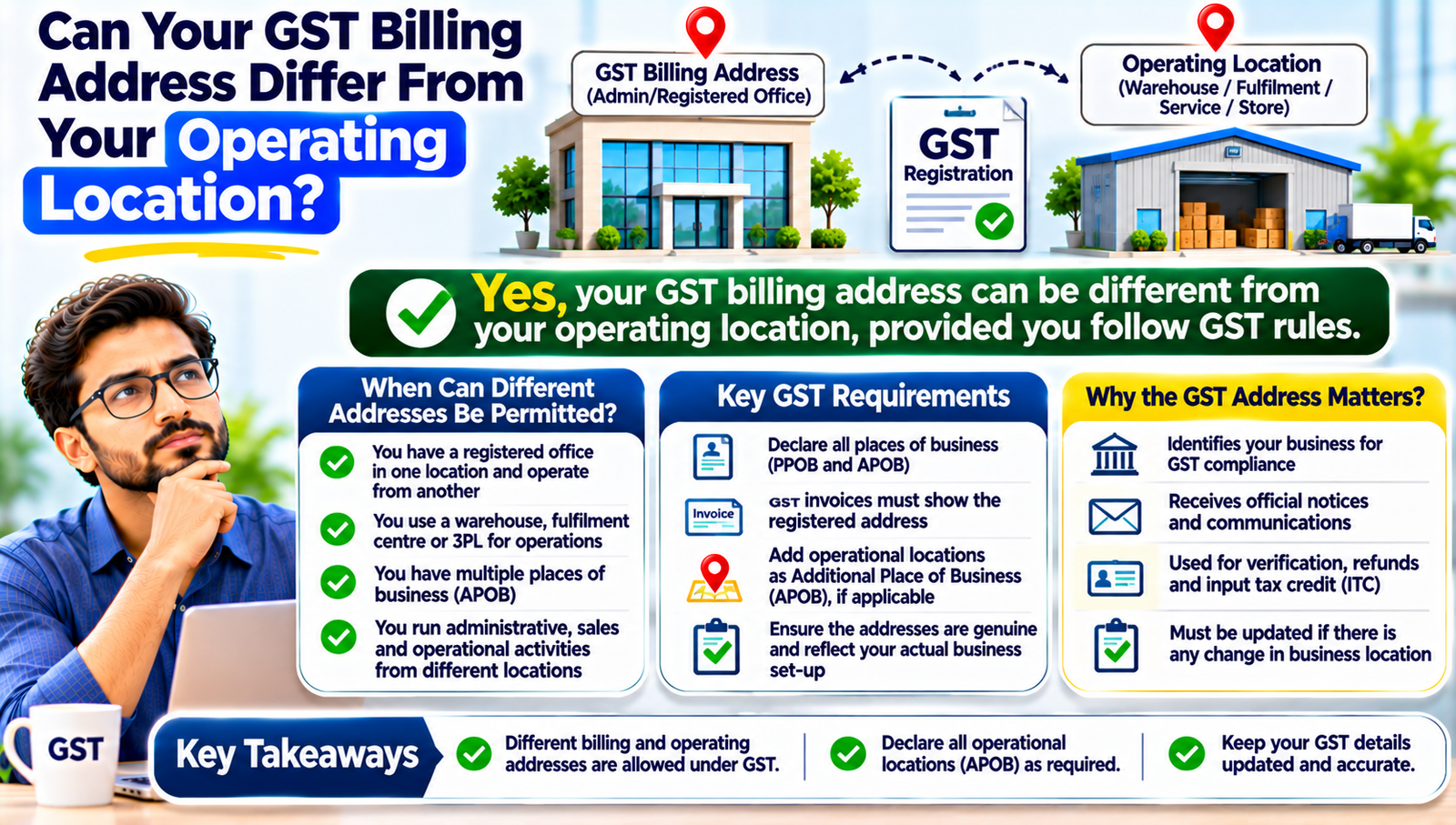
A business may have different billing, administrative and operating locations under GST. However, the addresses must reflect genuine business arrangements, and locations that qualify as places of business must be declared as required. GST invoices must also contain the prescribed supplier and recipient details. Using a different billing address does not remove registration or address-disclosure obligations.
For example, an e-commerce company may manage billing from its registered office while storing inventory at a separate warehouse. Similarly, a service business may operate from a coworking space while maintaining its administrative office elsewhere.
The important distinction is between the address shown on an invoice, the business premises registered under GST and the location where goods or services are actually supplied.
This guide explains the GST billing address rules in India, including Principal Place of Business (PPOB), Additional Place of Business (APOB), invoice requirements, virtual offices, warehouses and address amendments.
Can Your GST Billing Address Be Different From Your Operating Address?
Yes. Different addresses may be used where they reflect the business’s genuine arrangements and comply with applicable GST rules.
When Different Addresses May Be Permitted
A business may have a central billing office, a separate administrative location and additional operating premises.
For example, a company may maintain its principal office in Delhi and a warehouse in Gurugram. However, because the locations are in different states, it must also assess the relevant state-wise GST registration requirements.
Why the GST Registration Address Matters
GST registration identifies the taxpayer’s declared business premises and relevant state jurisdiction.
The registered locations must accurately reflect the business’s activities.
When an Operating Location Must Be Declared
An operating location may need to be declared when it qualifies as a place of business under GST.
This can include offices, warehouses and other qualifying business premises.
Can Businesses Issue Invoices From a Different Office?
A business may prepare invoices through a central accounting team or billing system.
However, the invoice must contain the prescribed supplier particulars and the correct GSTIN for the relevant supply.
Why Billing and Operating Addresses Should Not Be Confused
The location where an invoice is prepared does not automatically determine the correct GST registration, place of supply or business premises declaration.
What Is a GST Billing Address?
A GST billing address is a commonly used business term describing address information associated with an invoice or billing account.
Meaning of GST Billing Address
In everyday business use, it may refer to the supplier’s invoicing address or the customer’s billing address.
The meaning depends on the context.
Supplier Address vs Customer Billing Address
The supplier address identifies the business issuing the invoice.
The customer billing address identifies the recipient of the goods or services.
These are separate details.
GST Billing Address on Tax Invoices
Rule 46 of the CGST Rules, 2017 specifies the particulars required on GST tax invoices, including the supplier’s name, address and GSTIN.
GST Registration Address vs Invoice Address
The GST registration records the taxpayer’s declared business premises.
The invoice identifies the supplier and recipient for a particular transaction.
The details should be accurate and consistent with the relevant registration and supply.
Is GST Billing Address a Separate Registration Category?
No.
GST billing address is not a separate statutory registration category equivalent to PPOB or APOB.
Why Accurate Billing Information Matters
Incorrect billing information can cause invoice discrepancies, customer disputes, accounting errors and GST compliance problems.
What Is the Difference Between a GST Billing Address and an Operating Address?
A billing address and operating address may serve different purposes.
Purpose of a Billing Address
A billing address is used to identify the relevant party on invoices and other billing documents.
Meaning of an Operating Location
An operating location is a premises where the business conducts activities such as administration, sales, production, storage or fulfilment.
Principal Place of Business (PPOB)
The PPOB is the principal business location specified in the taxpayer’s GST registration certificate.
Additional Place of Business (APOB)
An APOB is another qualifying business location declared under the relevant GST registration.
Registered Office Address Under Company Law
A company’s registered office is its official statutory address recorded with the Ministry of Corporate Affairs.
It is not automatically identical to the GST PPOB.
When Billing and Operating Locations Are the Same
A small business may issue invoices and conduct operations from the same premises.
When They May Be Different
A business may centralise billing while maintaining separate warehouses, branches or service locations.
| Address Type | Main Purpose | GST Consideration |
|---|---|---|
| Supplier invoice address | Identifies the supplier on the invoice | Must comply with Rule 46 |
| Customer billing address | Identifies the recipient | Required according to invoice rules |
| Operating address | Location of business activities | May need PPOB/APOB declaration |
| PPOB | Principal GST business premises | Recorded in GST registration |
| APOB | Additional business premises | Declared where applicable |
| MCA registered office | Company’s statutory legal address | Separate from GST address classification |
| Shipping address | Physical delivery destination | Relevant to invoice and movement documentation |
What Address Must Appear on a GST Tax Invoice?
GST tax invoices must contain the prescribed particulars under Rule 46 of the CGST Rules.
Supplier Name, Address and GSTIN
A tax invoice must contain the supplier’s name, address and GSTIN.
A business should not substitute an unrelated correspondence address simply because it is convenient.
Recipient Name and Address Requirements
For registered recipients, Rule 46 generally requires the recipient’s name, address and GSTIN or UIN, as applicable.
For unregistered recipients, the required particulars depend on the transaction and applicable rules.
Billing Address vs Shipping Address
The billing address identifies the recipient for invoicing purposes.
The shipping address identifies where the goods are delivered.
These addresses may differ.
Place of Supply and State Information
Place-of-supply information is required in specified circumstances, including interstate supplies.
The correct treatment depends on the applicable provisions of the IGST Act.
Bill-To and Ship-To Transactions
In a bill-to and ship-to arrangement, goods may be delivered to one person or location at the direction of another person.
The invoice and place-of-supply treatment must reflect the actual transaction.
Multiple Business Locations and Invoice Address Details
Businesses operating from multiple locations must use the correct supplier details and state GSTIN for the relevant supply.
Common GST Invoice Address Errors
Common errors include using the wrong GSTIN, outdated supplier details, incorrect recipient information and inconsistent delivery addresses.
Can a Business Use Its Registered Office as the GST Billing Address While Operating Elsewhere?
Potentially, yes, provided the invoice particulars and GST registration arrangements are correct.
Registered Office vs GST Principal Place of Business
The registered office is maintained under company law.
The GST PPOB is recorded under the taxpayer’s GST registration.
When the Registered Office Is Also the PPOB
A company may use the same premises for its registered office and GST PPOB.
When Business Operations Take Place at Another Location
Separate operating premises may need to be declared as APOBs or under another applicable GST registration.
Declaring Additional Business Premises
Qualifying additional offices, warehouses and other locations should be assessed for declaration.
Maintaining Accurate GST Registration Details
The taxpayer must maintain correct premises and registration particulars.
Common Compliance Risks
Risks arise when businesses use an incorrect state GSTIN, fail to declare qualifying premises or display misleading invoice details.
Can Your GST Billing Address and Warehouse Address Be Different?
Yes. A business may issue invoices from an office while storing or dispatching goods from another location.
Office Address vs Inventory Storage Location
An administrative office may manage accounting and customer orders.
A warehouse may store and dispatch inventory.
Warehouse as an Additional Place of Business
A qualifying warehouse within the same state may need to be declared as an APOB.
Third-Party Logistics (3PL) Warehouses
Using a third-party logistics provider does not automatically eliminate the seller’s address declaration obligations.
Dispatch Location vs Invoice Address
The location from which goods are dispatched may differ from the address shown for the supplier on the invoice.
The transaction must still comply with invoicing and goods movement requirements.
Interstate Warehousing and GST Registration
Inventory stored in another state may create separate state registration obligations depending on the actual arrangement.
E-Way Bill and Movement Documentation
Goods movement documentation should reflect the applicable dispatch, delivery and transport particulars.
Maintaining Warehouse and Inventory Records
Businesses should maintain accurate records of stock storage, movement, dispatch and returns.
Can E-commerce Sellers Use Different Billing and Operating Addresses?
E-commerce businesses frequently use separate administrative and fulfilment locations.
GST Billing Address for Online Sellers
Online sellers must use the correct GSTIN and supplier particulars on their invoices.
Shopify and D2C Business Models
A Shopify or direct-to-consumer business may manage orders from one office while dispatching goods from another premises.
Amazon and Flipkart Seller Address Considerations
Marketplace sellers must assess GST registration requirements and the relevant platform’s onboarding and fulfilment policies.
Seller Office vs Fulfilment Centre
The seller’s office may manage billing and customer support, while a fulfilment centre stores and dispatches inventory.
Dropshipping Supplier Address vs Seller Address
A dropshipping supplier’s premises do not automatically become the seller’s business address.
The seller’s registration and invoice responsibilities depend on the actual commercial arrangement.
Multi-State E-commerce Operations
Businesses with operations in multiple states should assess their state-wise registration obligations.
Marketplace Requirements vs GST Requirements
Marketplace policies and statutory GST requirements are separate.
Compliance with one does not automatically establish compliance with the other.
Can You Use a Virtual Office as Your GST Billing Address?
A virtual office may potentially support legitimate business address arrangements, depending on the premises rights and actual activities.
How Virtual Office Address Services Work
Virtual office providers may offer business address arrangements, mail handling, meeting facilities and access to shared workspaces.
Virtual Office as a Declared Business Premises
A virtual office may qualify as a declared business premises where the arrangement satisfies the applicable GST requirements.
Virtual Office vs Mail-Only Address
A genuine premises-use arrangement is different from a service that only receives and forwards mail.
Genuine Business Use and Premises Rights
The business should have legitimate permission to use the specified premises.
Address Proof and Supporting Documents
Applicable agreements, consent documents and property evidence may be required.
Physical Verification Considerations
GST authorities may verify declared premises under applicable procedures.
When a Separate Operating Location Must Be Declared
A qualifying warehouse, office or other business premises may need separate declaration even when the business uses a virtual office as its PPOB.
Why Virtual Office Providers Cannot Guarantee GST Approval
A provider cannot guarantee registration merely by supplying an address, agreement or NOC.
Approval depends on the applicant’s compliance with GST requirements.
Does a Different Operating Location Need to Be Added as an APOB?
An operating location may need to be declared as an APOB when it qualifies as an additional place of business under the relevant GST registration.
What Qualifies as an Additional Place of Business?
An additional qualifying premises used for business activities may be declared as an APOB.
When an Office May Need APOB Registration
A second office used for regular business activities within the same state may require APOB declaration.
Warehouses and Storage Premises
Warehouses where the taxpayer stores goods can fall within the GST definition of a place of business.
Shared and Coworking Locations
Shared premises may qualify where the business has legitimate premises-use rights and conducts relevant activities there.
Operating Locations in the Same State
Qualifying additional locations within the same state may generally be declared under the existing GSTIN.
Operating Locations in Different States
A GSTIN issued in one state does not automatically cover business premises in another state.
When Separate State Registration May Be Necessary
Separate registration may be required where the business becomes liable to register in another state under the applicable GST provisions.
Can the Billing Address and Shipping Address Be Different Under GST?
Yes. Billing and shipping addresses may differ where the transaction and documentation are correctly structured.
Meaning of Bill-To and Ship-To
The bill-to party is the person to whom the supply is invoiced.
The ship-to address is the location where the goods are delivered.
Common E-commerce Delivery Scenarios
For example, a customer may purchase a product for delivery to a family member at another address.
Third-Party Delivery Arrangements
A buyer may direct a supplier to deliver goods to another person or location.
GST Place-of-Supply Considerations
Section 10(1)(b) of the IGST Act contains provisions relevant to certain bill-to and ship-to transactions involving goods.
The correct application depends on the actual transaction.
Invoice and E-Way Bill Address Details
Invoice and transport documentation should accurately identify the relevant parties and delivery arrangements.
Why Customer Shipping Addresses Are Not Automatically Business Premises
A customer’s delivery address does not automatically become a place of business of the seller.
How to Change or Correct Your GST Billing Address
The correct procedure depends on whether the problem concerns an invoice or the taxpayer’s GST registration.
Identify Which Address Needs Correction
Determine whether the issue involves supplier invoice details, customer information, PPOB or APOB.
Correcting an Invoice Address
Invoice corrections must follow the applicable GST invoicing, credit note, debit note and reporting provisions.
A business should not assume that every invoice can simply be edited after issuance or reporting.
Changing the Principal Place of Business
A PPOB change generally requires a registration amendment.
For most registrations, PPOB changes remain core amendments requiring officer approval.
Adding or Editing an Additional Place of Business
Under the October 2026 GST amendment changes, APOB amendments are treated as non-core amendments and processed through online validation.
Accessing Registration Amendment on the GST Portal
Visit www.gst.gov.in, log in and open the relevant registration amendment service.
Uploading Applicable Address Documents
Submit the prescribed premises evidence and supporting documents.
Tracking the Amendment Status
Monitor the amendment and respond to any applicable verification requirements.
Updating Accounting and Billing Software
After completing the necessary corrections, update invoice templates, ERP records and other billing systems.
What Documents Are Required to Update a GST Business Address?
The required documents depend on the nature of possession and the premises arrangement.
Owned Premises Documents
Ownership or accepted property evidence may be required.
Rental or Lease Agreement
A valid agreement may establish the taxpayer’s right to occupy rented premises.
Owner Consent or NOC Where Applicable
Owner consent may be necessary where the premises are used with permission.
Utility Bill or Other Accepted Premises Evidence
Utility bills, property tax records or other accepted documents may support address verification.
Shared Office Documentation
Shared workspace agreements should accurately describe the premises and permitted use.
Virtual Office Agreement and Supporting Proof
The relevant agreement, consent and property evidence should support the declared business use.
Additional Documents Requested During Verification
Authorities may request further supporting evidence under applicable procedures.
What Happens if Your GST Billing Address Does Not Match Your Operating Location?
A difference between the two addresses is not automatically a violation.
The important question is whether the registration and invoice details are accurate.
When an Address Difference Is Legitimate
A business may have a central office and separate operating premises that are correctly declared.
When the Difference Indicates Incorrect Registration Details
Problems arise when qualifying premises are omitted or inaccurate information is recorded.
GST Invoice Compliance Issues
Incorrect supplier particulars or GSTIN details may create invoice compliance problems.
Address Verification and Clarification Requests
Authorities may request evidence supporting the declared premises.
Risks of Undeclared Business Premises
Failure to declare qualifying business locations can create compliance and verification issues.
Incorrect State or GSTIN Usage
Using a GSTIN from the wrong state may result in incorrect tax treatment and reporting.
How to Correct Address Discrepancies
Identify the affected records, complete the applicable amendment or invoice correction process and update business systems.
What Are the Common GST Billing Address Mistakes?
Avoid the following errors.
Confusing Customer Billing Address With Supplier Address
These are different invoice particulars.
Using an Outdated GST Registration Address
Review registration details after relocation.
Failing to Declare Additional Operating Premises
Assess offices, warehouses and other qualifying locations.
Using a Virtual Mailbox as Business Premises Without Proper Rights
A mail-only arrangement does not automatically establish a compliant business premises.
Incorrect Billing and Shipping Details
Check recipient and delivery information before issuing invoices.
Using the Wrong State GSTIN
Use the correct registration for the relevant supply.
Ignoring Warehouse Address Requirements
Warehouse and fulfilment arrangements may create additional declaration obligations.
Not Updating Accounting Software After Address Changes
Outdated invoice templates can continue generating incorrect documents even after a registration amendment.
GST Billing and Operating Address Compliance Checklist
| Requirement | Status |
|---|---|
| Identify the supplier’s GST registration address | Pending |
| Confirm the Principal Place of Business | Pending |
| List all operating locations | Pending |
| Assess APOB requirements | Pending |
| Review state-wise GST registration | Pending |
| Verify premises-use rights | Pending |
| Maintain applicable address proof | Pending |
| Check tax invoice address particulars | Pending |
| Review bill-to and ship-to information | Pending |
| Update registration details where required | Pending |
| Keep accounting and business records consistent | Pending |
| Monitor address changes | Pending |
Final Words
A GST billing address can differ from a business’s operating location, but the difference must reflect a genuine and compliant business arrangement.
The address used for invoicing should not be confused with the Principal Place of Business, Additional Place of Business or customer delivery address.
Businesses operating from multiple offices, warehouses or fulfilment centres should review their premises declarations and state-wise GST registration requirements.
They should also ensure that invoices contain the prescribed supplier and recipient particulars.
The key is not whether every address is identical, but whether each address is accurate, properly documented and used in accordance with GST requirements.
FAQs About GST Billing Addresses
Can my GST billing address be different from my business address?
Yes, depending on the context. However, supplier invoice particulars must comply with GST rules, and qualifying business premises must be declared where required.
Is the GST billing address the same as the registered office address?
Not necessarily. The MCA registered office and GST business premises are separate legal concepts.
Can I use my registered office address for GST billing while operating elsewhere?
Potentially, provided the supplier details are correct and the actual operating premises are declared as required.
Can my GST billing address and warehouse address be different?
Yes. An office and warehouse may have different addresses, but the warehouse may need to be declared as an APOB or under another applicable GST registration.
Can the billing and shipping addresses be different on a GST invoice?
Yes. Bill-to and ship-to arrangements are permitted where the invoice and place-of-supply treatment comply with applicable rules.
Do I need to register my operating location as an APOB?
You may need to declare it as an APOB if it qualifies as an additional place of business under your existing state GST registration.
Can I use a virtual office as my GST billing address?
Potentially, where the arrangement supports genuine business use and satisfies applicable GST requirements. A mail-only service is not automatically sufficient.
How do I change my GST billing address on the GST portal?
If the registered PPOB or APOB needs changing, use the relevant GST registration amendment process. Correcting an invoice address is a separate matter.
What happens if my GST invoice address does not match my registered business address?
A mismatch is not automatically unlawful, but it should be reviewed to ensure the invoice contains accurate supplier particulars and the registration records correctly reflect the business premises.
Can a business use different GST billing addresses in different states?
A business may operate through different state registrations and premises. It must use the correct state GSTIN and prescribed supplier details for each relevant supply.