
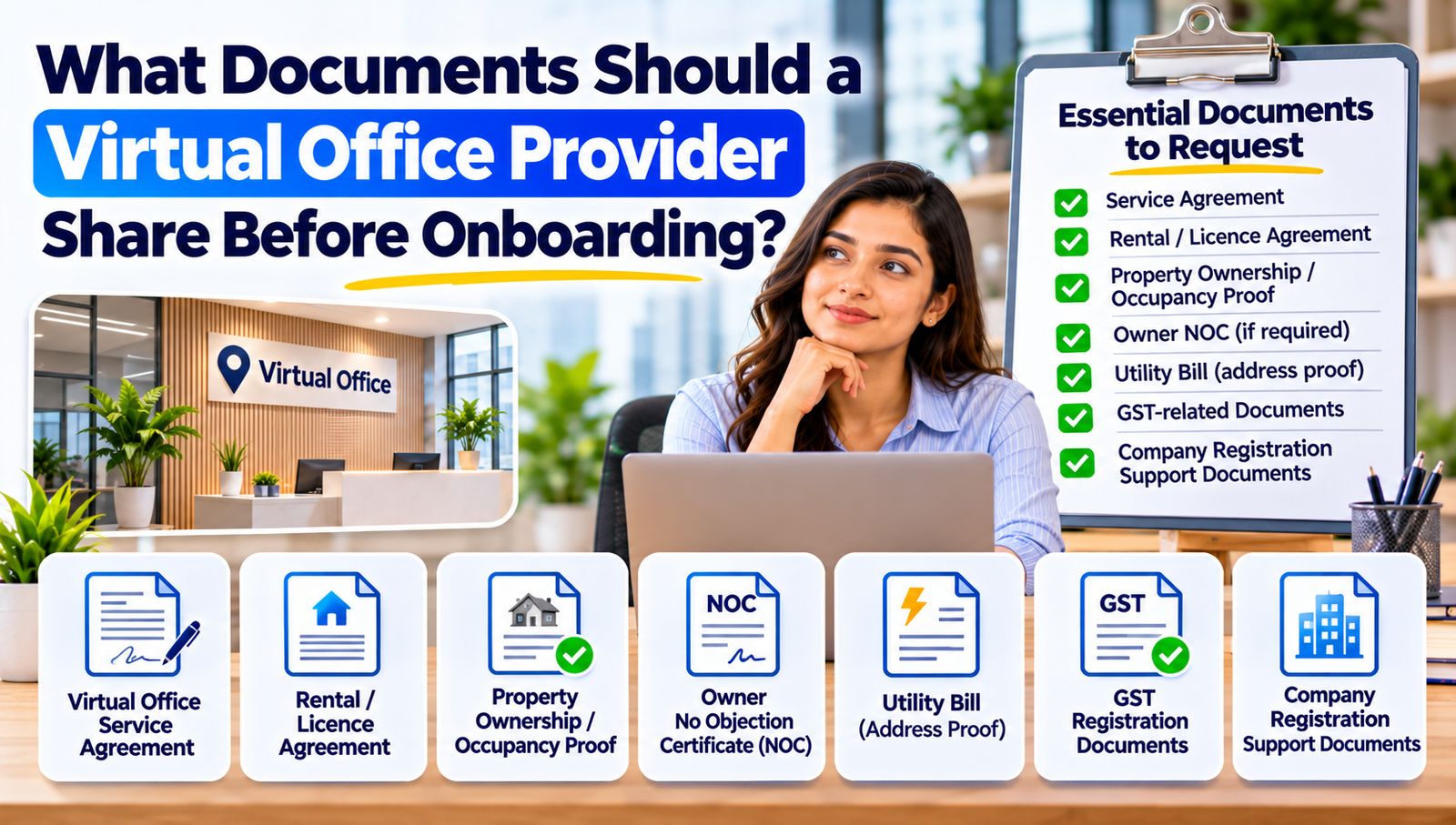
Choosing a virtual office provider involves more than comparing locations and monthly prices. Before signing an agreement or paying for a package, businesses should understand which documents the provider can supply and what those documents actually establish.
A virtual office may be used for business correspondence, mail handling, administrative activities or, where the arrangement meets applicable requirements, GST and company registration.
However, different services require different documentation.
A provider offering a mailing address may not necessarily have the authority or supporting documents needed for a business to declare the same premises as its principal place of business under GST.
This makes it important to verify virtual office provider documents before onboarding.
Businesses should review the service agreement, premises evidence, applicable owner consent, address proof and the provider’s legal identity. They should also confirm whether the proposed arrangement supports their intended business activities.
This guide explains which documents to request, how to verify them and what to do when a virtual office provider cannot supply the necessary evidence.
What Documents Should a Virtual Office Provider Share Before Onboarding?
The documents required depend on the services being purchased and the business’s intended use of the address.
Essential Documents to Request Before Signing
At a minimum, request a copy of the proposed service agreement, complete premises address, provider identity details and a written description of the services included.
Where the arrangement involves registration-related address rights, ask for the relevant premises documentation.
Documents for Business Address and Mail Handling Services
For correspondence services, review the mail-receiving authorisation, courier-handling terms, notification procedures and forwarding arrangements.
Additional Documents for GST Registration
GST-related arrangements may require evidence establishing the applicant’s legitimate right to use the declared premises.
The documents depend on whether the premises are owned, rented, shared or used with consent.
Additional Documents for Company Registration
Company registration may require registered-office address proof, applicable owner authorisation and supporting premises documents.
Why Documentation Requirements Vary by Business Use
A mailing address, shared workspace and registered-office arrangement do not necessarily provide identical rights.
The most important question is whether the documents support the specific business use described in the agreement.
Why Is It Important to Verify Virtual Office Provider Documents?
Document verification helps businesses identify avoidable legal, administrative and service-related risks.
Confirming the Address Is Genuine
The documents should correspond to an identifiable physical property.
A provider’s website listing alone is not sufficient proof of the premises arrangement.
Establishing the Right to Use the Premises
Businesses should confirm that the provider has appropriate authority to grant the advertised services and address-use rights.
Avoiding GST and MCA Documentation Issues
Incomplete or inconsistent documents can lead to registration objections or clarification requests.
Preventing Agreement and Ownership Disputes
A provider may occupy rented premises or operate through a partner.
Businesses should understand whether that arrangement authorises the services being offered.
Ensuring Reliable Business Correspondence
An appropriate agreement should explain how official notices and other correspondence are received and delivered.
Understanding the Provider’s Legal Responsibilities
The contract should identify the provider’s obligations, service limitations and responsibilities for supplying documents.
What Are the Essential Documents a Virtual Office Provider Should Share?
The following documents form a practical onboarding checklist.
Virtual Office Service Agreement
The agreement should describe the address, permitted uses, services, charges and contract terms.
Rental or Licence Agreement, Where Applicable
Where relevant, an agreement may establish the customer’s right to use the premises for the stated purpose.
The appropriate document depends on the legal structure of the arrangement.
Property Ownership or Occupancy Proof
Request suitable evidence establishing the premises and the provider’s relationship with the property.
Owner No Objection Certificate (NOC), Where Required
An NOC or consent letter may be necessary for particular consent-based or shared premises arrangements.
Utility Bill or Other Accepted Address Proof
A relevant electricity bill or other accepted document can help establish the premises address.
Provider Business Identity and Contact Details
Verify the provider’s legal name, contact information and applicable registration details.
Invoice and Payment Documentation
Obtain a clear quotation, applicable tax invoice and payment receipt.
Essential Document Checklist
| Document | What It Helps Establish | When to Review |
|---|---|---|
| Service agreement | Rights and obligations | Before signing |
| Rental/licence agreement | Applicable premises rights | Before registration use |
| Ownership/occupancy evidence | Property relationship | During verification |
| NOC/consent | Relevant authorisation | Where required |
| Utility/address proof | Premises identity | Before submission |
| Provider identity | Contracting entity | Before payment |
| Invoice/receipt | Commercial transaction | At payment |
Not every document will be required for every service. The correct combination depends on the premises arrangement and intended use.
What Should You Check in a Virtual Office Rental or Service Agreement?
A service agreement is one of the most important documents because it defines what the provider is contractually offering.
Correct Provider and Customer Details
Check that the legal names and relevant details of both parties are accurate.
Complete Property Address
The agreement should identify the actual premises, including the building, unit, locality, city, state and PIN code.
Permitted Use of the Address
Confirm whether the agreement permits business correspondence, GST registration-related use, MCA registered-office use or other activities.
Agreement Validity and Renewal Terms
Review the commencement date, duration, renewal conditions and notice periods.
Services Included in the Package
Confirm whether the package includes mail receiving, forwarding, document support, meeting rooms or other facilities.
Registration Documentation Responsibilities
Identify which documents the provider agrees to supply and whether updates are included.
Cancellation and Refund Conditions
Understand the circumstances under which the agreement may be terminated and whether refunds are available.
Additional Charges and Service Limitations
Check for fees relating to documentation, courier forwarding, renewals, meeting rooms or other services.
Why Is an NOC Important for a Virtual Office Address?
An NOC may help establish that the relevant person has consented to a specified use of the premises.
What Is a No Objection Certificate?
A No Objection Certificate is a written statement indicating that the issuer does not object to a particular use of the property.
Who Is Authorised to Issue an NOC?
The appropriate issuer depends on the ownership, occupancy and contractual arrangements.
An NOC should come from someone with the necessary authority.
When Is an NOC Required?
The requirement depends on the registration process and premises arrangement.
It should not be assumed that every virtual office customer requires the same NOC.
How to Check the NOC Against Property Documents
Compare the property address, issuer details, applicant information and permitted use.
Common NOC Errors and Mismatches
Common problems include:
- Incorrect building or unit number
- Inconsistent applicant name
- Unclear issuer authority
- Different premises details
- Inadequate description of the permitted use
What to Do if the Provider Cannot Supply Appropriate Consent
Ask whether another legally appropriate form of evidence is available.
If the arrangement requires consent that cannot be established, avoid relying on unsupported documentation.
What Property Ownership and Address Proof Should You Request?
Property documents help verify that the advertised address corresponds to genuine premises.
Property Tax Receipt or Other Ownership Evidence
Relevant ownership-related documents may help establish the property and its owner.
Electricity Bill or Accepted Utility Proof
A recent utility bill or other accepted premises document may support address verification.
Rental or Lease Agreement
Where the provider occupies rented premises, review whether the arrangement supports the services offered.
Landlord Authorisation
Additional permission may be relevant where the provider offers third-party address-use rights.
Documents for Shared or Sub-Licensed Premises
Shared premises may involve different legal arrangements.
The documents should establish the relevant rights rather than rely only on the provider’s description.
Matching the Address Across Supporting Documents
Check that the building name, unit number, street, locality and PIN code are consistent.
What Documents Should a Virtual Office Provider Share for GST Registration?
GST registration requires accurate information about the declared place of business.
Proof of the Right to Use the Declared Premises
The applicant should have a legitimate right to use the premises for the declared purpose.
Rental Agreement or Applicable Consent Documentation
Depending on the arrangement, a rental agreement, licence, consent letter or other relevant evidence may be appropriate.
Supporting Property or Utility Documents
Accepted premises documents may be needed to support the application.
Documents for Shared Business Premises
Shared arrangements require genuine supporting evidence establishing the applicant’s use of the location.
Principal Place of Business Requirements
The declared principal place of business should accurately reflect the applicant’s actual business arrangement.
Physical Verification and Document Consistency
GST authorities may conduct physical verification where permitted under applicable law and rules.
Documents should accurately reflect the actual premises.
Why Document Availability Does Not Guarantee GST Approval
A complete document package does not automatically establish eligibility.
GST registration depends on the applicant’s circumstances and applicable requirements.
What Documents Are Needed for Company Registration Using a Virtual Office?
A company’s registered office must meet the applicable requirements under the Companies Act, 2013.
Registered Office Address Proof
Relevant premises documents may be required to establish the registered office.
Owner Authorisation or Consent
Where applicable, obtain the appropriate authorisation to use the premises.
Relevant Utility Bill
An accepted utility document may be required under the relevant MCA filing procedure.
Supporting Premises Agreement
The agreement should establish the company’s permitted use of the address.
Registered Office Verification Requirements
Section 12 of the Companies Act requires a company to maintain a registered office capable of receiving and acknowledging official communications and notices.
The applicable verification and filing requirements must also be met.
MCA Documentation and Filing Considerations
The required forms and documents depend on whether the address is declared during incorporation or updated later.
How Company Registration Requirements Differ From GST
GST and MCA registration serve different purposes and have different statutory requirements.
A document accepted for one process should not automatically be assumed sufficient for the other.
What Documents Should Be Provided for Mail Handling and Business Correspondence?
Mail handling is a core service offered by many virtual office providers.
Mail Receiving Authorisation
The agreement should establish whether the provider is authorised to receive correspondence on behalf of the customer.
Courier Acceptance Terms
Check which courier types and deliveries are accepted.
Mail Forwarding Agreement
Confirm forwarding methods, charges and service coverage.
Notification and Collection Procedures
Ask how customers are notified when correspondence arrives.
Identity Verification Requirements
Providers may require customer identity or business verification before releasing correspondence.
Handling of Confidential Business Documents
Review how sensitive documents are stored, accessed and forwarded.
Service Limitations and Additional Charges
Check whether there are limits on parcel size, storage duration or forwarding frequency.
How Can You Verify Virtual Office Documents Before Onboarding?
Follow a structured process before signing the agreement.
Step 1: Confirm the Provider’s Legal Identity
Verify the legal name and relevant business details of the contracting provider.
Step 2: Verify the Physical Office Address
Check the complete location and request a premises visit or live walkthrough where practical.
Step 3: Check Ownership and Occupancy Rights
Review appropriate evidence showing who owns or controls the premises.
Step 4: Match Details Across the Agreement, NOC and Address Proof
Check that the relevant names and address details are consistent.
Step 5: Confirm the Intended Business Use Is Permitted
Explain whether you need correspondence services, GST-related use or an MCA registered office.
Step 6: Review Validity, Renewal and Termination Terms
Check the agreement’s duration and the conditions under which services may end.
Step 7: Obtain Clarification About Missing Documents
Request written explanations and appropriate evidence for any unresolved issue.
Step 8: Retain Copies of Final Signed Documents
Keep the executed agreement, supporting documents, invoices and relevant correspondence.
What Are the Warning Signs of Incomplete or Unreliable Virtual Office Documentation?
Certain warning signs justify further investigation.
Provider Refuses to Share Basic Premises Details
A provider should be able to establish that the advertised premises exist and that it has appropriate authority.
Sensitive documents may be shared through controlled verification, but the provider should offer credible evidence.
Agreement Does Not Identify the Correct Address
An incomplete or inconsistent address can create uncertainty about the actual premises.
Missing or Unauthorised Owner Consent
Where consent is required, it should come from an appropriately authorised person.
Expired or Inconsistent Supporting Documents
Outdated or contradictory evidence may need correction.
Unclear Rights to Use the Premises
The agreement should not leave the intended use ambiguous.
Guaranteed GST or MCA Approval Claims
Providers cannot guarantee approval irrespective of statutory requirements.
Pressure to Pay Before Reviewing Material Terms
Avoid committing funds without understanding the contractual arrangement.
No Clear Process for Official Mail or Notices
Unreliable mail handling can create compliance and operational problems.
What Questions Should You Ask Your Virtual Office Provider Before Paying?
Ask the provider to answer these questions in writing.
Which Documents Are Included in the Package?
Request a complete list of documents supplied.
Are GST or MCA Documentation Services Available?
Confirm the scope of support and whether additional fees apply.
Who Owns or Controls the Premises?
Understand the provider’s legal relationship with the property.
Can the Address Be Used for My Intended Business Activity?
Explain the actual activity and registration purpose.
Will Documents Be Provided Before or After Payment?
Confirm the delivery schedule and any conditions.
Are Document Updates Included During Renewal?
Check whether renewed agreements and updated premises evidence are included.
What Happens if the Address Is Not Suitable?
Review the provider’s obligations and any replacement or refund provisions.
Are There Additional Documentation or Verification Charges?
Ask for the complete price before making payment.
What Should You Do If a Virtual Office Provider Does Not Share the Required Documents?
Do not assume that missing documents can be resolved after registration.
Identify Which Documents Are Missing
Determine whether the issue concerns the service agreement, premises evidence, consent or another requirement.
Request a Written Explanation
Ask why the document is unavailable and what alternative evidence can be supplied.
Check Whether Alternative Proof Is Acceptable
The applicable registration procedure may allow different documents depending on the premises arrangement.
Avoid Signing an Agreement With Material Unresolved Issues
Do not rely on verbal assurances where essential address-use rights remain unclear.
Seek Professional Advice for GST or MCA Requirements
A qualified professional can assess complex registration questions.
Compare Other Providers With Transparent Documentation
Consider alternatives where the provider cannot establish the required premises arrangement.
How to Choose a Virtual Office Provider With Transparent Documentation
The right provider should offer a clear and verifiable service arrangement.
Verifiable Physical Premises
The location should be genuine and identifiable.
Clear Address-Use Rights
The agreement should establish what the customer is authorised to do.
Complete and Consistent Agreements
The contract and supporting documents should contain accurate information.
Appropriate GST and MCA Documentation Support
Providers should explain which registration-related documents are available without guaranteeing approval.
Reliable Mail Handling
Correspondence procedures should be clearly documented.
Transparent Fees and Renewal Policies
Customers should understand the total cost and renewal obligations.
Responsive Customer Support
The provider should answer documentation questions promptly and clearly.
Provider Comparison Checklist
| Evaluation Factor | What to Confirm |
|---|---|
| Physical address | Genuine and verifiable |
| Provider identity | Clear legal entity |
| Premises rights | Appropriate authorisation |
| Service agreement | Complete and accurate |
| NOC/consent | Available where required |
| Address proof | Consistent premises details |
| GST/MCA support | Clearly defined |
| Mail handling | Reliable procedures |
| Pricing | Transparent charges |
| Cancellation | Clear terms |
Final Words
Checking virtual office provider documents before onboarding helps businesses understand whether an address is genuine, appropriately authorised and suitable for their intended purpose.
The most important documents generally include the service agreement, relevant premises evidence, applicable consent documentation and accepted address proof.
For GST or company registration, businesses should also confirm that the arrangement meets the relevant legal requirements.
A useful pre-onboarding sequence is:
Verify the provider → Check the premises → Review address-use rights → Examine supporting documents → Confirm permitted use → Review contract terms → Make payment
A transparent provider should be able to explain the services being offered, the documents available and the limitations of the arrangement.
FAQs About Virtual Office Provider Documents
What documents should a virtual office provider give before onboarding?
A provider should share the proposed service agreement, complete premises details, relevant business identity information and applicable supporting documents for the intended service.
Is an NOC mandatory for every virtual office?
No. Whether an NOC is required depends on the premises arrangement and the applicable registration or documentation requirements.
What address proof is required for a virtual office?
Accepted evidence may include relevant ownership, occupancy, utility or consent documents, depending on the intended use.
Can a virtual office provider share documents for GST registration?
Yes. A provider may supply relevant premises documents where it has appropriate authority. However, document availability does not guarantee GST approval.
What documents are needed for company registration with a virtual office?
Applicable documents may include registered-office address proof, premises authorisation, utility evidence and a supporting agreement, depending on the MCA filing requirements.
Should I check the rental agreement before paying for a virtual office?
Yes. Review the address, permitted use, duration, charges, cancellation conditions and provider obligations before paying.
How can I verify a virtual office provider’s property documents?
Compare the premises details across documents, verify the provider’s relationship with the property and seek clarification about inconsistencies.
What if a virtual office provider refuses to provide an NOC?
First establish whether an NOC is required for the proposed arrangement. If necessary authorisation cannot be demonstrated, consider another provider.
Can GST registration be rejected even if the provider shares documents?
Yes. GST approval depends on the applicant’s actual circumstances, the validity of the premises arrangement and compliance with applicable requirements.
Are virtual office documentation requirements the same across India?
GST and company-law requirements operate under national frameworks, but the required evidence can vary with the premises arrangement, filing purpose and applicable state-specific or local requirements.