
AI Overview
A Virtual Office for Market Testing allows businesses to establish a professional presence in a new city without immediately committing to a full-time physical office. It can be useful during the early stages of geographic expansion, when a company is still evaluating customer demand, sales potential and operational requirements.
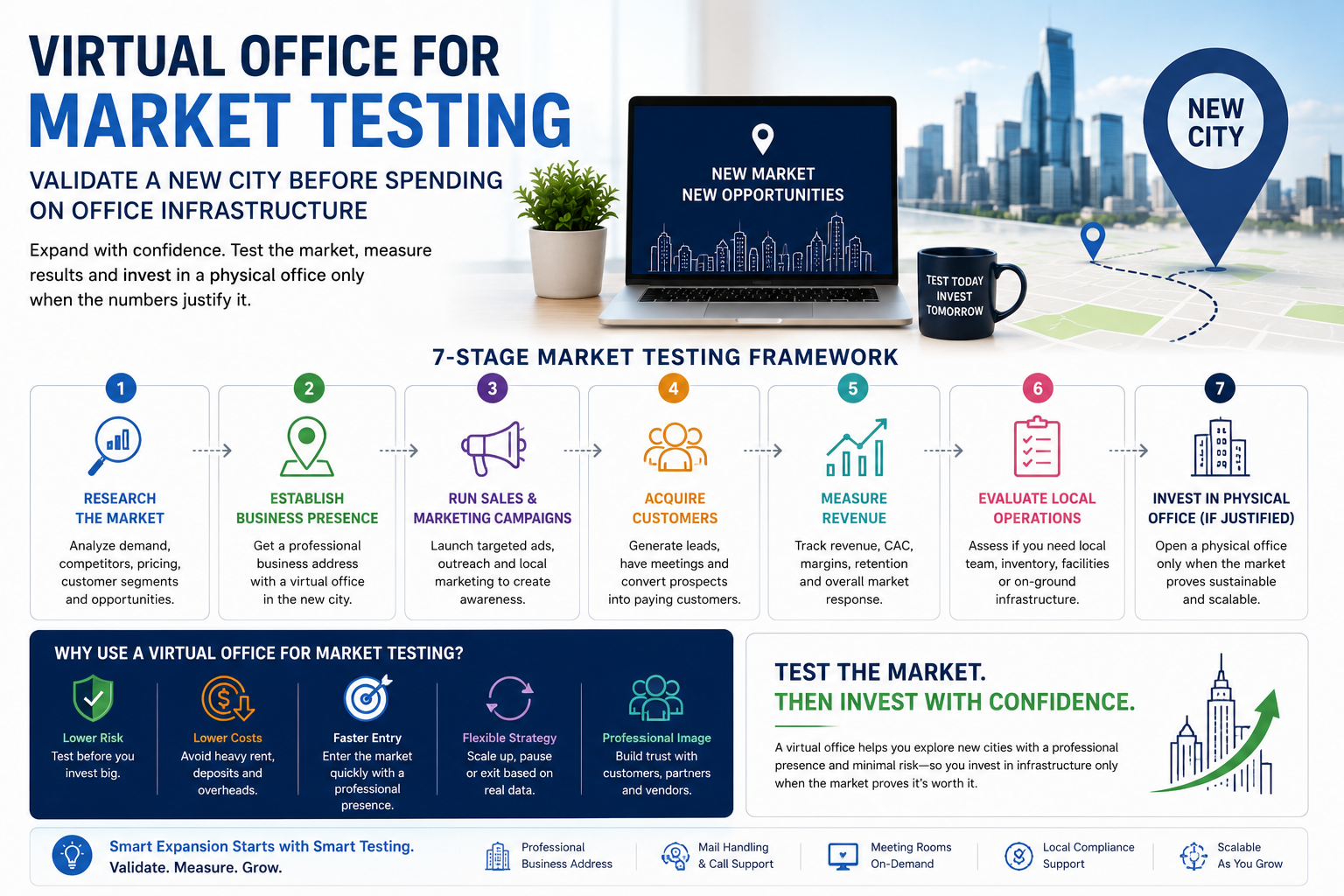
A practical market-testing strategy can follow seven stages:
Research the market → Establish business presence → Launch sales and marketing → Acquire customers → Measure revenue → Evaluate operations → Invest in physical infrastructure when justified.
The objective is not simply to save office rent. The larger benefit is reducing the risk of making a major infrastructure decision before there is enough evidence that a city deserves one.
Introduction: Should You Really Open an Office in a New City?
Expanding into a new city sounds straightforward.
You identify the market, rent an office, hire employees, launch marketing and start selling.
But there is a problem.
- What if the market doesn’t respond?
- What if customers take longer to acquire than expected?
- What if competitors are already stronger?
- What if your sales team doesn’t need a permanent workspace?
- What if the city generates leads but not enough revenue to justify a full office?
A traditional expansion model can force a company to make an infrastructure decision before it has enough market information.
Rent, deposits, furniture, utilities, employees, maintenance and other operating expenses can begin before the first meaningful customer is acquired.
For this reason, businesses are increasingly looking at a different question:
Can we test the city first and build infrastructure later?
This is where a Virtual Office for Market Testing can fit into a broader city expansion strategy.
Instead of immediately creating a complete physical branch, a business can establish a professional address where appropriate, keep its team distributed, conduct local sales and marketing activities, and measure whether the market produces enough commercial traction.
If the results justify investment, the company can move toward a physical location.
If they don’t, the business can reconsider the market without being tied to a large office commitment.
What Is a Virtual Office for Market Testing?
A Virtual Office is a service that provides businesses with access to a professional business address and, depending on the package, additional office-related services such as mail handling or meeting facilities.
When used for market testing, the concept becomes more strategic.
The company isn’t saying:
“We need an office because we have already succeeded in this city.”
Instead, the company is asking:
“Can we establish a credible business presence while we determine whether this market deserves a larger investment?”
For example, imagine a company based in Delhi that wants to explore Bengaluru.
Instead of immediately renting a permanent office, it could:
- Research Bengaluru’s target customers.
- Establish an appropriate business presence.
- Launch a city-specific sales campaign.
- Have salespeople meet prospects locally.
- Track leads and conversions.
- Measure revenue and customer acquisition costs.
- Evaluate whether a permanent office is actually necessary.
The virtual office becomes part of the testing infrastructure, not the entire expansion strategy.
Why Market Testing Should Come Before Office Expansion
Opening an office is an investment.
Testing a market is an experiment.
Those are two different decisions.
A business may have confidence that a city looks attractive on paper, but market data can tell a different story.
A city might have:
- Large population
- Strong commercial activity
- High business density
- Attractive customer demographics
- Significant competitors
Yet the company’s specific product may still fail to gain traction.
Market testing helps answer practical questions such as:
- Are customers interested?
- How expensive is customer acquisition?
- How quickly do prospects convert?
- What price points work?
- Which customer segment responds best?
- How strong is local competition?
- Does the company need local employees?
- Do customers actually expect a physical office?
- How much revenue can the city realistically generate?
These answers are often more valuable than simply having a prestigious office address.
The 7-Stage Virtual Office Market Testing Framework
A structured approach makes city expansion easier to evaluate.
Stage 1: Research the Market
Before spending money on infrastructure, understand the city.
Research:
- Target customers
- Industry concentration
- Competitors
- Local pricing
- Demand patterns
- Search behaviour
- Business districts
- Distribution requirements
- Hiring availability
- Customer expectations
Don’t confuse market size with market opportunity.
A huge city isn’t automatically the right city for your business.
The objective is to identify whether enough customers exist who are willing to pay for your specific product or service.
Stage 2: Establish Business Presence
Once a city looks promising, establish an appropriate business presence.
A professional business address can be useful when you need a city-specific point of contact or address-related business documentation.
This can be particularly relevant for:
- B2B companies
- Consultants
- Agencies
- SaaS companies
- Manufacturers
- Service providers
- Distributors
- Professional firms
However, the address should accurately represent the arrangement.
A Virtual Office should not be presented as a fully operational branch if the business does not actually maintain such operations there.
The specific use should also comply with applicable registration, tax and platform requirements.
Stage 3: Run Sales and Marketing Campaigns
Now test the market commercially.
Your sales and marketing teams can target the city without requiring everyone to work from a permanent local office.
Examples include:
Digital Marketing
Run campaigns specifically targeting the new city.
Measure:
- Impressions
- Clicks
- Leads
- Cost per lead
- Qualified leads
- Customer acquisition cost
Outbound Sales
Build a database of potential customers and conduct city-specific outreach.
Track:
- Contact rates
- Meetings
- Proposals
- Conversions
- Revenue
Local Partnerships
Identify:
- Distributors
- Resellers
- Business partners
- Industry associations
- Local service providers
Events and Networking
Attend relevant conferences, exhibitions and business events to understand the local market directly.
This gives the business something a physical office cannot provide by itself:
real market feedback.
Stage 4: Acquire Customers
The next step is turning market interest into actual revenue.
Leads are useful.
Customers are better evidence.
During the testing period, measure:
- Number of paying customers
- Average order value
- Repeat purchases
- Customer acquisition cost
- Sales cycle length
- Gross margin
- Customer retention
- Revenue per customer
A city with 1,000 leads and no meaningful sales may be less attractive than a city with 100 highly qualified prospects and strong conversion rates.
This is why market testing should focus on commercial outcomes rather than vanity metrics.
Stage 5: Measure Revenue and Unit Economics
Revenue tells you whether customers are buying.
Unit economics tells you whether the business model works.
Consider:
Customer Acquisition Cost (CAC)
How much does it cost to acquire one customer?
Average Revenue Per Customer
How much revenue does each customer generate?
Gross Margin
How much remains after direct costs?
Customer Lifetime Value
How valuable is the customer over the relationship?
Payback Period
How long does it take to recover acquisition costs?
These numbers help determine whether the market deserves additional investment.
Stage 6: Evaluate Local Operations
Once sales traction becomes visible, ask a second question:
Does the business actually need physical infrastructure?
This is where many expansion strategies become unnecessarily expensive.
A business may discover that:
- Salespeople work effectively from home.
- Client meetings happen at customer premises.
- Teams only need meeting rooms occasionally.
- Operations are handled centrally.
- Logistics can be managed through third-party partners.
- Employees don’t need permanent desks.
In such a case, a traditional office may not yet be necessary.
On the other hand, the market may reveal genuine operational requirements.
For example:
- Large local team
- Inventory
- Equipment
- Warehousing
- Frequent customer visits
- Local service operations
- Regulatory requirements
- Regular in-person collaboration
Those circumstances may justify physical infrastructure.
Stage 7: Open a Physical Office Only When Justified
The final decision should be based on evidence.
Consider opening a physical office when:
- Revenue is consistently growing.
- Customer demand is predictable.
- The local team has reached meaningful size.
- Employees genuinely need workspace.
- Client meetings happen frequently.
- Operational requirements demand premises.
- The expected return justifies the additional fixed costs.
The key principle is simple:
Don’t rent infrastructure to prove that a market exists. Test the market first, then build infrastructure around proven demand.
Who Should Use a Virtual Office for Market Testing?
This strategy can work particularly well for businesses that can sell or operate remotely.
SaaS Companies
Software companies can enter new cities without immediately establishing local development offices.
A virtual business address can support the company’s broader commercial presence while sales teams test demand.
Digital Agencies
Marketing, SEO, web-development and creative agencies can acquire customers across different cities while keeping production teams centralized or remote.
Consultants
Management consultants, financial consultants and business advisors can travel to clients when necessary rather than maintaining permanent offices in every market.
B2B Companies
Companies selling products or services to other businesses can establish city-level presence while their sales teams visit prospects and customers.
Manufacturers and Suppliers
Industrial companies may want to understand demand in a region before creating a dedicated sales branch.
Professional Service Firms
Recruitment firms, HR consultants, accounting businesses and similar service companies can explore regional demand without immediately taking on a permanent lease.
Documents Required for a Virtual Office
The documentation depends on the provider, location and intended use.
Commonly requested or supplied documents can include:
- Identity/KYC documents
- PAN
- Business registration documents, where applicable
- Address-related documentation
- Virtual Office agreement
- NOC, where applicable
- Premises-related documents
- Authorization documents
The exact requirements should be confirmed before purchasing.
If you intend to use the address for a specific registration or verification process, check that process separately.
A Virtual Office agreement is not automatically proof that every authority or platform will accept the address for every purpose.
Benefits of Using a Virtual Office for Market Testing
Lower Expansion Risk
The biggest advantage isn’t simply cheaper rent.
It is the ability to delay a major infrastructure commitment until market evidence exists.
Faster Market Entry
A business may be able to establish its intended business presence more quickly than setting up an entire office.
Lower Fixed Costs
A traditional office can involve:
- Deposit
- Rent
- Furniture
- Internet
- Electricity
- Maintenance
- Office equipment
- Administrative costs
A Virtual Office can reduce the infrastructure required during the initial testing phase.
Flexible Strategy
If the city performs well, the business can expand.
If performance is weak, it can reassess its strategy without being locked into a large office commitment.
Professional Presence
A suitable commercial address can give the business a formal city-level presence when used accurately and appropriately.
Meeting Facilities When Required
Some Virtual Office plans provide access to meeting rooms or workspace.
This can be useful when a remote team occasionally needs a professional place to meet clients.
Virtual Office vs Physical Office for Market Testing
| Factor | Virtual Office | Physical Office |
| Initial commitment | Lower | Higher |
| Permanent workspace | Usually no | Yes |
| Suitable for market testing | High | Moderate |
| Fixed overhead | Lower | Higher |
| Remote team support | Strong | Less necessary |
| Client meetings | Plan dependent | Available |
| Infrastructure | Limited | Full |
| Flexibility | High | Lower |
| Best use | Testing and early expansion | Proven market operations |
Neither option is universally better.
A physical office is valuable when the business actually needs physical infrastructure.
A Virtual Office can be valuable when the company primarily needs business presence while validating demand.
Pricing Comparison
The financial difference becomes clearer when you compare the entire cost structure.
| Expense | Market Testing with Virtual Office | Traditional New Office |
| Address | Included in plan | Included |
| Security deposit | Usually lower | Often substantial |
| Monthly rent | Generally lower | Higher |
| Furniture | Usually unnecessary | Required |
| Utilities | Limited/plan dependent | Additional |
| Internet setup | Usually unnecessary | Required |
| Maintenance | Provider dependent | Business responsibility |
| Meeting space | May be available | Included in premises |
| Expansion flexibility | High | Lower |
| Exit cost | Generally lower | Potentially higher |
Actual Virtual Office pricing varies by city, location, provider and package.
Businesses should compare the total service rather than selecting an option solely because it has the lowest advertised price.
How to Decide Which City to Test
Not every city deserves the same level of investment.
Create a simple city scoring model.
For every potential location, score:
Market Demand
How many potential customers exist?
Competitive Intensity
How difficult will it be to acquire customers?
Customer Value
How much can the average customer contribute to revenue?
Acquisition Cost
How expensive will sales and marketing be?
Operational Complexity
Can the business serve the market remotely?
Talent Availability
Will local employees be required?
Logistics
How easily can products or services reach customers?
Strategic Importance
Could the city become an important regional hub?
The result can be converted into a simple expansion score.
For example:
Market Demand + Customer Value + Strategic Importance − Acquisition Cost − Operational Complexity
The exact formula can vary, but the principle is useful:
Choose cities based on evidence, not prestige.
How to Know When a Virtual Office Should Become a Physical Office
There is no universal revenue number at which every business should rent an office.
Instead, look for signals.
Signal 1: Your Local Team Is Growing
If employees increasingly need shared workspace, a permanent office may become practical.
Signal 2: Clients Expect Frequent Meetings
If customers regularly need face-to-face meetings, dedicated premises may improve operations.
Signal 3: Revenue Is Predictable
One good month isn’t enough.
Look for consistent commercial performance.
Signal 4: Operations Require Premises
Inventory, equipment, service delivery or other physical activities may require a real operational location.
Signal 5: Office ROI Makes Sense
Calculate whether the additional revenue or operational benefit is likely to justify the office cost.
The right time to upgrade is when the office becomes an operational asset, rather than simply a symbol of expansion.
Common Mistakes When Testing a New Market
Renting Too Early
A company sees a promising city and immediately signs a long lease.
The problem?
Market assumptions haven’t been tested.
Measuring Only Leads
Lead volume doesn’t equal market demand.
Track qualified leads, conversions and revenue.
Choosing a City Because It Looks Premium
A prestigious business district may look impressive, but it doesn’t automatically produce customers.
Treating an Address as a Branch Office
A business address and an operational office are not necessarily the same thing.
Use the address accurately in business communications and registrations.
Ignoring Platform Requirements
Different platforms and authorities can have different address and verification rules.
Always check the relevant requirements before using a Virtual Office for a specific purpose.
Expanding Too Many Cities at Once
Testing ten markets simultaneously can make results difficult to interpret.
A smaller number of carefully selected markets can provide cleaner data.
How to Build a Low-Risk City Expansion Strategy
A practical strategy can look like this:
Month 1: Research
Study customers, competitors, pricing and demand.
Month 2: Establish Presence
Set up the appropriate business address and supporting documentation.
Month 3: Launch
Start targeted advertising and outbound sales.
Month 4–5: Acquire
Generate qualified leads and convert customers.
Month 6: Measure
Review CAC, revenue, margins, retention and sales cycles.
Month 7: Decide
Choose between:
Scale → Continue testing → Pause → Exit → Build physical infrastructure
This approach makes expansion a measurable business decision.
Why Choose the Right Virtual Office Provider?
When market testing, the address is only one part of the equation.
Look for a provider that offers clarity around:
- Location
- Documentation
- Agreement terms
- Mail handling
- Meeting-room availability
- KYC process
- Permitted uses
- Renewal
- Customer support
Most importantly, ask the provider what the address can actually be used for.
If your objective involves registration, taxation, marketplace onboarding or another formal verification process, confirm the requirements before subscribing.
A good provider should help you understand the service rather than making unrealistic guarantees.
Frequently Asked Questions
1. Can a Virtual Office help test a new market?
Yes. A Virtual Office can provide a professional business presence while a company tests sales, customer demand and local commercial opportunities without immediately establishing a full-time office.
2. How can businesses enter a new city with low risk?
Start with market research, establish an appropriate business presence, run targeted sales and marketing campaigns, measure customer acquisition and revenue, and invest in physical infrastructure only when justified.
3. Should I open a physical office immediately?
Not necessarily. If your business can operate remotely and doesn’t require permanent premises, testing the market first may be more practical.
4. When should a Virtual Office become a physical office?
Consider upgrading when revenue is consistent, the local team requires permanent workspace, customers need frequent meetings, or operational activities genuinely require dedicated premises.
5. Can startups test demand before renting an office?
Yes. Remote-first startups can use a Virtual Office as part of a broader market-validation strategy, provided the intended use complies with relevant requirements.
6. Is a Virtual Office legal in India?
A legitimate Virtual Office arrangement can be used for permitted business purposes. The specific use must comply with applicable laws and the requirements of the relevant authority.
7. Can a Virtual Office be used for GST registration?
It may be possible where the premises arrangement and documentation satisfy applicable GST requirements. Businesses should verify the current requirements applicable to their specific circumstances.
8. What documents are required?
Documents vary by provider and purpose. They may include KYC documents, PAN, business registration documents, address proof, a Virtual Office agreement and NOC or premises-related documentation where applicable.
9. How much does a Virtual Office cost?
Pricing depends on the city, location, provider, contract duration and services included. Compare the complete package rather than looking only at the headline price.
10. Is a Virtual Office suitable for startups?
Yes. It can be useful for startups that need a professional business presence but don’t yet require a permanent office.
11. Can I open a bank account using a Virtual Office?
A Virtual Office may support address-related documentation where accepted, but banks conduct their own KYC and verification procedures. Approval is not guaranteed.
12. Can freelancers use Virtual Offices?
Yes, freelancers and independent professionals can use Virtual Office services where appropriate and permitted.
13. Which city is best for market testing?
There is no universal answer. The right city depends on customer demand, competition, acquisition cost, customer value, logistics, talent and strategic importance.
14. How quickly can I get documents?
Processing time depends on the provider, location and KYC process. Confirm the expected timeline before subscribing.
15. Is a Virtual Office better than a coworking space?
They solve different problems. A Virtual Office primarily provides business presence and address-related services, while coworking provides physical workspace. A market-testing company may use either or both.
Market Testing Checklist
Before entering a new city, ask:
Market
- Have we identified our target customer?
- Have we studied competitors?
- Is there evidence of demand?
- Have we researched local pricing?
Sales
- Can our existing team serve the city?
- Do we need local salespeople?
- What is our expected customer acquisition cost?
- How long is the sales cycle?
Business Presence
- Do we need a city-specific business address?
- What documents are required?
- Is the selected address appropriate for the intended purpose?
- Have relevant registration and verification requirements been checked?
Financials
- What is the expected revenue?
- What is the expected margin?
- What would a physical office cost?
- At what point would an office investment become worthwhile?
Expansion
- Are customers asking for a local presence?
- Does the local team need workspace?
- Are operations becoming location-dependent?
- Does the market justify permanent infrastructure?
Summary
A Virtual Office for Market Testing is best understood as an expansion tool rather than simply a low-cost replacement for a traditional office.
Its strategic value comes from allowing a company to separate two decisions:
“Should we enter this market?”
and
“Should we build permanent infrastructure here?”
Those decisions don’t have to happen at the same time.
A business can research a city, establish an appropriate professional presence, launch targeted sales and marketing, acquire customers, measure revenue and evaluate operational requirements before committing to a permanent office.
The seven-stage framework is:
1. Research the market
2. Establish business presence
3. Run sales and marketing campaigns
4. Acquire customers
5. Measure revenue and unit economics
6. Evaluate local operations
7. Open physical infrastructure only when justified
This approach can be particularly useful for remote-first startups, SaaS companies, agencies, consultants, B2B companies, manufacturers and professional service providers.
The important distinction is that a Virtual Office doesn’t prove that a market will succeed.
The market does.
Customer conversations, sales, conversions, revenue and sustainable unit economics provide the evidence.
The Virtual Office simply gives the business a flexible way to establish presence while collecting that evidence.
Final Takeaway
Before spending heavily on a new city, test the market before testing your office budget.
A professional business address can support the early expansion stage, while remote teams, salespeople and digital campaigns do the actual market validation.
Once the numbers demonstrate that a city has enough demand, customers and operational potential, a physical office can become the next logical investment.
Until then, keeping infrastructure flexible can give businesses something extremely valuable:
the freedom to change their expansion strategy when the market data says they should.