
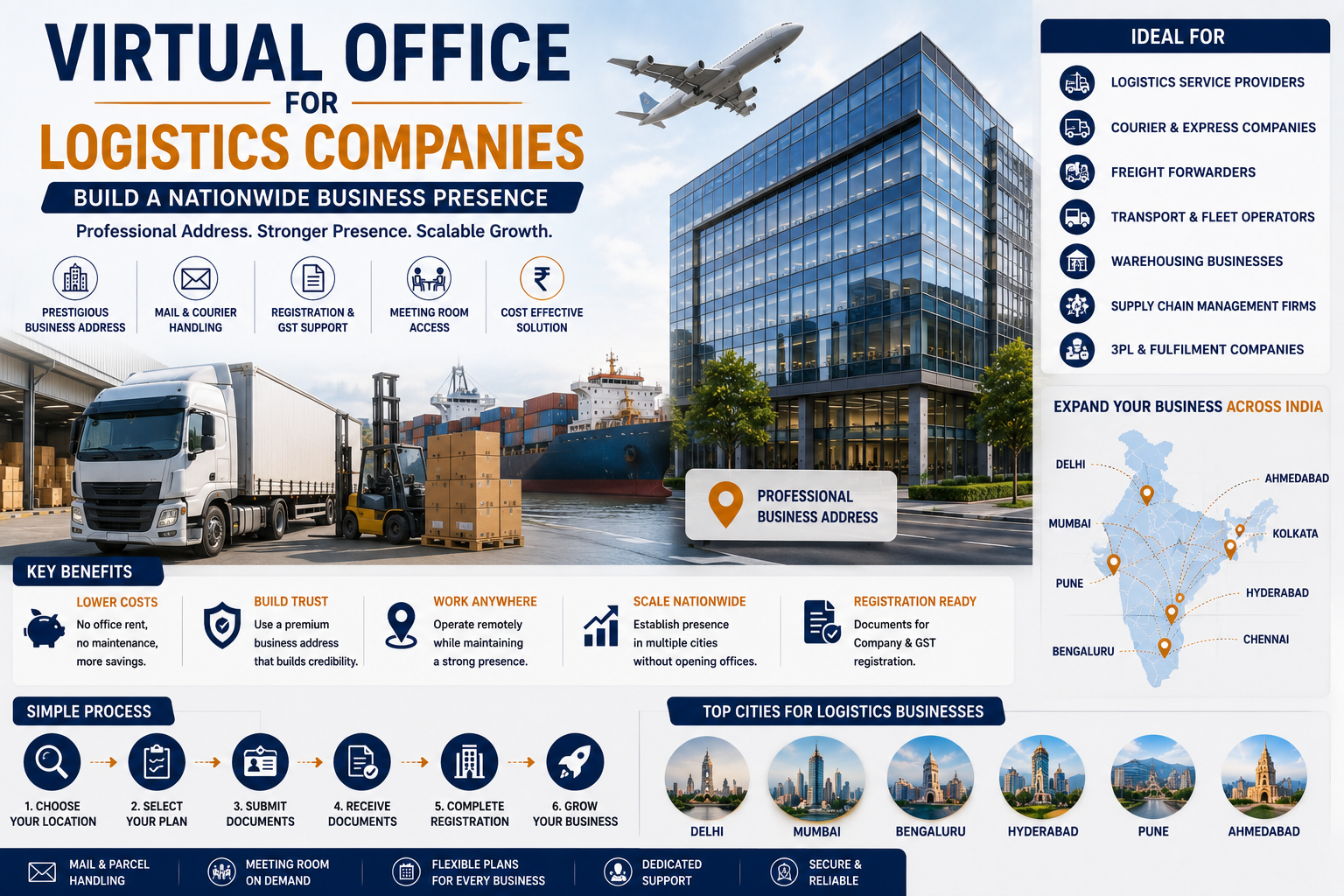
AI Overview
A Virtual Office for Logistics Companies provides a professional business address and office-related services without requiring a logistics business to maintain a traditional office at every location where it operates or wants to establish a presence.
For logistics businesses, this can be particularly useful because operations are often distributed across warehouses, fulfilment centres, transport hubs, client locations, and delivery networks. The administrative or corporate presence does not always need to match the physical location of every operational activity.
A Virtual Office can potentially support business expansion, correspondence, selected registration requirements, and professional presence. However, it does not replace an actual warehouse, depot, fleet yard, fulfilment centre, or other premises where logistics operations physically take place.
This distinction is particularly important for GST and logistics businesses because GST rules recognize places such as warehouses and godowns as places of business in relevant circumstances.
Introduction: Logistics Is About Movement—Your Office Doesn’t Have to Be
The logistics industry operates differently from most traditional businesses.
A logistics company may have:
- A corporate team in Delhi
- Customers in Mumbai
- A warehouse in Haryana
- Delivery operations in Pune
- Transport partners in Ahmedabad
- A fulfilment centre in Bangalore
- Sales representatives travelling across India
Yet the company doesn’t necessarily need a fully staffed corporate office in every city.
This creates an interesting business challenge.
A logistics company wants to look local, serve local customers and build a market presence, but opening a conventional office every time it enters a new market can quickly increase fixed costs.
This is where a Virtual Office for Logistics Companies can become part of a broader expansion strategy.
Instead of immediately investing in furniture, reception, utilities, long-term leases and unused office space, a logistics business can establish an appropriate professional business address first and invest in operational infrastructure only when actual demand justifies it.
What Is a Virtual Office?
A Virtual Office is a business service that provides access to a professional commercial address and selected office services without requiring a company to maintain a dedicated full-time office at that location.
Depending on the provider and plan, services can include:
- Professional business address
- Business correspondence
- Mail and courier handling
- Registration documentation
- NOC or consent documentation
- Rent or lease documentation
- Meeting-room access
- Reception support
- Multi-city address options
The exact services vary by provider and location.
For a logistics company, the important distinction is:
A Virtual Office can support the administrative and corporate side of the business, while actual logistics operations still require suitable physical infrastructure wherever goods are stored, processed, dispatched or received.
Can Logistics Companies Use Virtual Offices?
Yes, logistics companies can use Virtual Office services for appropriate business purposes, provided the premises and documentation satisfy the requirements applicable to that purpose.
A Virtual Office can be useful for:
- Corporate presence
- Business correspondence
- Market expansion
- Selected registrations
- Client communication
- Sales operations
- Administrative functions
- Occasional meetings
But it should not be represented as a substitute for operational infrastructure.
For example:
A Virtual Office can potentially represent:
Corporate / administrative presence
A warehouse represents:
Storage and handling of goods
A depot represents:
Operational logistics infrastructure
A fleet yard represents:
Vehicle and transportation infrastructure
These functions should not be confused.
Why the Logistics Industry Is Well Suited to Flexible Office Models
Logistics businesses are inherently distributed.
A traditional office-based company might have most employees working from one location.
A logistics business can have people spread across:
- Warehouses
- Distribution centres
- Transport hubs
- Client facilities
- Airports
- Ports
- Railway terminals
- Delivery routes
- Home offices
- Regional offices
This means office utilization can be surprisingly low.
A logistics company might have ten employees in a city but only need a meeting room a few times per month.
Paying for a large permanent office in that situation can be inefficient.
A Virtual Office allows the business to separate:
Business presence
from
daily workspace.
Who Should Use a Virtual Office for Logistics?
1. Logistics Startups
New logistics companies often need to preserve cash during their early stages.
Instead of spending heavily on office infrastructure, founders can prioritize:
- Fleet partnerships
- Technology
- Customer acquisition
- Delivery networks
- Warehousing
- Employees
- Insurance
- Working capital
A Virtual Office can provide a professional corporate address without requiring the same upfront investment as a traditional office.
2. Courier Companies
Courier companies may have delivery personnel and operational hubs without needing a large customer-facing office in every city.
A Virtual Office can support the administrative side while operational facilities handle the actual movement of parcels.
3. Freight Forwarders
Freight forwarding companies coordinate shipments between customers, carriers, ports, airports and other logistics partners.
Their employees may spend significant time communicating with clients and transportation providers rather than sitting inside a conventional office.
4. 3PL Companies
Third-party logistics providers often operate warehouses and fulfilment facilities.
Their corporate presence can be separate from the locations where customers’ goods are physically stored.
5. Transport Companies
Transport companies may operate fleets across several states.
A professional business address can support expansion while vehicles and transport operations remain distributed.
6. Supply Chain Consultants
Supply chain management firms may operate primarily through client sites and remote teams.
They can use a Virtual Office to establish a formal corporate presence while maintaining flexible operations.
7. Logistics Technology Companies
Technology-enabled logistics businesses may provide:
- Fleet management software
- Route optimization
- Delivery management
- Warehouse management systems
- Shipment tracking
- Logistics marketplaces
These companies may not need traditional offices in every market.
8. Warehousing Businesses
Warehousing companies can use flexible business infrastructure for corporate functions while maintaining physical warehouses where inventory is actually stored.
Virtual Office vs Logistics Facility
This is one of the most important distinctions for logistics businesses.
| Requirement | Virtual Office | Physical Logistics Facility |
| Business address | Yes | Yes |
| Corporate correspondence | Yes | Yes |
| Client meetings | Depending on plan | Yes |
| GST-related documentation | Potentially, subject to requirements | Yes, where applicable |
| Warehouse operations | No | Yes |
| Goods storage | No | Yes |
| Fleet parking | No | Yes |
| Parcel sorting | No | Yes |
| Fulfilment | No | Yes |
| Dispatch operations | No | Yes |
| Daily logistics staff | Usually no | Yes |
A Virtual Office should therefore be viewed as one layer of business infrastructure, not the entire logistics infrastructure.
Can a Virtual Office Be Used for GST Registration?
This is a major question for logistics companies.
The answer depends on the specific premises, documentation and nature of the registration.
The GST portal’s current document checklist identifies several possible documents for proving a principal or additional place of business, including:
- Property tax receipt
- Municipal khata copy
- Electricity bill
- Rent/lease agreement
- Consent letter
- Government-issued documents.
GST rules also recognize the principal place and additional places of business, and GST registration certificates identify these locations.
For logistics businesses, however, there is an additional consideration.
A warehouse, godown or other place where goods are stored can itself qualify as a place of business under the GST framework.
Therefore, a logistics company should not assume that a Virtual Office automatically replaces its warehouse or operational premises for GST purposes.
The correct approach is to determine:
- Where the business is actually operating
- Where goods are stored
- Which premises need GST registration
- Whether a particular Virtual Office is suitable for the intended registration
- What supporting documentation is available
Can Logistics Companies Expand Across India Without Opening Branch Offices?
Potentially, yes—but the answer depends on what “branch office” means in the specific situation.
A company may establish a business presence in a city without immediately opening a conventional staffed office.
For example:
Delhi logistics company
↓
Enters Mumbai market
↓
Establishes appropriate business presence
↓
Acquires customers
↓
Uses third-party logistics partners
↓
Builds shipment volume
↓
Adds warehouse/depot when commercially justified
This is different from claiming that a Virtual Office can replace every operational requirement.
If a company actually stores goods, operates vehicles, employs staff at a location, or performs other regulated/physical activities there, the relevant premises and compliance obligations must be addressed separately.
Benefits of a Virtual Office for Logistics Companies
1. Lower Corporate Office Costs
Traditional office expenses can include:
- Rent
- Security deposit
- Furniture
- Electricity
- Internet
- Maintenance
- Reception
- Security
- Housekeeping
- Office equipment
A Virtual Office can reduce the cost of maintaining corporate office infrastructure.
2. Faster Market Entry
A logistics company can test demand in a new city before making a major real-estate commitment.
This creates a simple expansion principle:
Enter first. Validate demand. Invest later.
Instead of opening a full office before winning customers, the company can establish an appropriate business presence while focusing resources on sales and operational partnerships.
3. Multi-City Expansion
Suppose a logistics startup operates from Delhi and wants to target:
- Mumbai
- Bangalore
- Hyderabad
- Pune
- Ahmedabad
Opening five traditional offices immediately could be expensive.
A multi-location Virtual Office strategy can potentially create a broader corporate footprint while the company determines which markets deserve deeper investment.
4. Professional Business Image
Large customers often prefer dealing with businesses that appear structured and established.
A professional commercial address can contribute to the company’s overall presentation across:
- Website
- Business documents
- Invoices
- Proposals
- Email signatures
- Corporate profiles
But credibility should always be backed by genuine operations and service quality.
5. Better Capital Allocation
Instead of putting early-stage capital into office interiors, logistics companies can allocate more money toward:
- Fleet
- Technology
- Warehousing
- Delivery personnel
- Insurance
- Marketing
- Customer acquisition
- Route optimization
- Tracking systems
This can be particularly valuable during expansion.
6. Supports Remote Administrative Teams
A logistics company may have:
- Sales staff working remotely
- Customer service teams
- Finance employees
- Technology teams
- Operations managers
- Founders travelling frequently
They may not need a permanent office desk for every person.
7. Better Privacy
Small logistics companies often begin from home or shared spaces.
Using a separate business address can help create a clearer separation between:
Founder / personal address
and
Business address.
8. Occasional Meeting Facilities
When a logistics company needs to meet:
- Corporate clients
- Vendors
- Investors
- Transport partners
- Suppliers
a meeting room can be more appropriate than a café or home office.
Where the Virtual Office plan includes meeting-room access, this can provide additional flexibility.
9. Supports a Lean Expansion Strategy
A logistics business can scale infrastructure according to actual demand.
Instead of:
Office → Warehouse → Fleet → Customers
the business can potentially use:
Customers → Volume → Partnerships → Infrastructure
This reduces the risk of investing too early.
Best Cities for Logistics Companies in India
There is no single “best” city for every logistics company.
The right city depends on your:
- Customer base
- Transport network
- Warehouse strategy
- Industrial clients
- E-commerce exposure
- Import/export activity
- Regional expansion plans
However, several major commercial and logistics markets can be strategically important.
Delhi NCR
Delhi NCR is a major business and consumption market and can be relevant for:
- E-commerce logistics
- Retail distribution
- B2B transportation
- Warehousing
- FMCG logistics
- Northern India expansion
Gurgaon, Noida, Faridabad and surrounding industrial areas can also be relevant depending on the business model.
Mumbai
Mumbai can be attractive for:
- Freight forwarding
- Import/export businesses
- Financial and corporate clients
- E-commerce
- Retail distribution
- Western India expansion
Bangalore
Bangalore is particularly relevant for:
- Technology-enabled logistics
- E-commerce
- SaaS logistics companies
- Startup ecosystems
- Southern India distribution
Hyderabad
Hyderabad can be useful for:
- Technology businesses
- Pharmaceuticals
- E-commerce
- Southern and central India connectivity
- B2B logistics
Pune
Pune is relevant for:
- Manufacturing logistics
- Automotive supply chains
- Industrial transportation
- E-commerce
- B2B distribution
Ahmedabad
Ahmedabad can be strategically relevant for:
- Manufacturing
- Textiles
- Pharmaceuticals
- Trading
- Industrial supply chains
- Western India logistics
How to Choose a Virtual Office Location for a Logistics Company
Don’t choose a location simply because the building looks impressive.
Evaluate:
1. Customer Proximity
Are your target customers located nearby?
2. Business Ecosystem
Are there manufacturers, retailers, exporters or e-commerce companies in the region?
3. Transportation Connectivity
Does the location make sense within your broader logistics network?
4. Documentation
Can the provider supply the documentation required for your intended purpose?
5. Expansion Potential
Could the same location remain useful as the business grows?
6. Meeting Facilities
Will you need to meet customers or partners there?
7. Mail Management
How will important business correspondence be received and handled?
Documents Required for a Logistics Virtual Office
The exact documentation depends on the business structure and intended use.
Common documents may include:
Company
- Certificate of Incorporation
- Company PAN
- Director KYC
- Authorized signatory details
- Corporate documents where applicable
LLP
- LLP incorporation certificate
- LLP agreement
- Partner KYC
- Authorized signatory information
Partnership
- Partnership deed
- PAN
- Partner KYC
- Authorization documents
Proprietorship
- PAN
- Aadhaar/accepted KYC
- Photograph
- Business details
Premises Documentation
Depending on the purpose and arrangement:
- Rent/lease agreement
- Consent letter
- NOC
- Utility bill
- Property-related documentation
- Other supporting documents
GST’s official checklist specifically includes rent/lease agreements and consent letters among possible proofs for principal and additional places of business.
Step-by-Step Process
Step 1: Define Your Objective
Determine whether you need the Virtual Office for:
- Corporate presence
- GST
- Company registration
- Mail handling
- Market entry
- Client meetings
- Multi-city expansion
Step 2: Identify the City
Choose based on your customers and expansion strategy.
Step 3: Select the Appropriate Plan
Compare:
- Address-only services
- Registration packages
- Mail handling
- Meeting-room access
- Duration
- Renewal
- Multi-city options
Step 4: Verify the Address
Confirm:
- Full address
- Commercial nature
- Permitted use
- Documentation
- Accessibility
- Provider’s support process
Step 5: Complete KYC
Submit your company and identity documents.
Step 6: Receive Documentation
Obtain the documentation included in the package.
Step 7: Complete Relevant Registrations
Where appropriate, use the documents for the intended registration.
Remember that registration is ultimately subject to the requirements and review of the relevant authority.
Step 8: Build Actual Logistics Operations
If the market gains traction, invest in:
- Warehouse
- Depot
- Fleet
- Delivery network
- Local employees
- Sorting infrastructure
based on actual demand.
Virtual Office vs Traditional Branch Office
| Factor | Virtual Office | Traditional Branch |
| Setup Cost | Lower | Higher |
| Fixed Rent | Lower | Higher |
| Dedicated Staff | Usually not required | Usually required |
| Corporate Address | Yes | Yes |
| Daily Operations | Limited | Yes |
| Client Meetings | Depending on plan | Yes |
| Warehouse Capability | No | Only if specifically equipped |
| Fleet Operations | No | Possible with suitable premises |
| Market Testing | Excellent | Expensive |
| Multi-City Strategy | Flexible | Costly |
| Best For | Corporate presence | Full local operations |
Virtual Office vs Coworking Space
A logistics company should understand that these services have different purposes.
Virtual Office
Best when you need:
- Business address
- Registration support
- Mail handling
- Corporate presence
- Occasional meetings
Coworking
Best when you need:
- Daily desk
- Internet
- Workspace
- Meeting rooms
- Team environment
Warehouse
Best when you need:
- Inventory storage
- Picking
- Packing
- Dispatch
- Receiving
A logistics company may actually need all three, depending on its business model.
Pricing Comparison
Virtual Office pricing varies based on:
- City
- Address quality
- Duration
- Documentation
- Registration requirements
- Meeting facilities
- Mail handling
- Provider
Instead of comparing only monthly prices, calculate the total cost of each model.
| Cost Component | Virtual Office | Traditional Office | Warehouse |
| Monthly rent | Lower | Higher | Higher |
| Security deposit | Usually lower | Often higher | Can be substantial |
| Furniture | Minimal | Required | Operational setup |
| Utilities | Limited | Required | Required |
| Maintenance | Minimal | Required | Required |
| Storage | No | No | Yes |
| Daily workspace | Usually no | Yes | Operational |
| Corporate address | Yes | Yes | Yes |
The important point is that Virtual Office and warehouse costs should not be compared as substitutes. They solve different business problems.
How Logistics Startups Can Use Virtual Offices Strategically
Imagine a new freight-forwarding company launching in Delhi.
The founder doesn’t know whether the Mumbai market will generate enough business to justify a permanent office.
Instead of immediately taking a long-term lease, the company could:
Phase 1 — Market Testing
Establish appropriate business presence.
Phase 2 — Sales
Acquire customers and partners.
Phase 3 — Shipment Volume
Measure actual demand.
Phase 4 — Local Operations
Use third-party facilities where commercially appropriate.
Phase 5 — Infrastructure Investment
Open a dedicated office, depot or warehouse only after volume justifies it.
This is a much more controlled expansion model.
What a Virtual Office Cannot Replace
A responsible logistics business should understand the limits.
A Virtual Office generally cannot replace:
- Warehouse
- Godown
- Distribution centre
- Sorting facility
- Fleet yard
- Loading/unloading facility
- Fulfilment centre
- Physical operational staff
- Required licences or permits
If your company actually performs those activities at a location, make sure the premises and registrations reflect the real business activity.
GST materials explicitly recognize warehouses and godowns within the concept of a place of business in relevant circumstances.
Common Mistakes Logistics Companies Should Avoid
Mistake 1: Treating a Virtual Office as a Warehouse
A business address does not give you storage capacity.
Mistake 2: Choosing an Address Without Checking Documentation
Documentation should be evaluated before purchase.
Mistake 3: Assuming One Address Covers Every State
GST registration is state-based where registration is required, and the principal place of business must be located in the state where the registration is sought.
Mistake 4: Ignoring Actual Operations
If goods are physically stored somewhere, consider the applicable requirements for that location.
Mistake 5: Expanding Too Quickly
Don’t open ten offices simply because you want nationwide coverage.
Test demand first.
Mistake 6: Selecting Only on Price
A cheap address with weak documentation or poor support may create more problems than it solves.
Why Choose Vo Spaces?
For logistics businesses, a Virtual Office provider should be evaluated on more than the address itself.
Vo Spaces can be positioned as a flexible office infrastructure partner for logistics companies seeking to establish professional business presence across multiple commercial markets.
Depending on the selected plan, relevant features may include:
Professional Business Address
Maintain a commercial address for your corporate presence.
Registration Documentation
Access the documentation included with the chosen plan for appropriate business purposes.
Mail & Courier Handling
Receive business correspondence while your team remains distributed.
Meeting Facilities
Meet clients, vendors and partners in a professional environment where available.
Multiple Locations
Support expansion into additional markets as your business grows.
Flexible Model
Avoid committing immediately to a conventional office when your operational requirements are still developing.
The key advantage is flexibility: build the corporate layer first, then add physical logistics infrastructure where the market actually demands it.
Frequently Asked Questions
1. Can logistics companies use Virtual Offices?
Yes. Logistics companies can use Virtual Offices for appropriate corporate, administrative, correspondence and other permitted purposes, subject to applicable requirements.
2. Can a Virtual Office be used for GST registration?
It may be possible if the specific premises and documentation satisfy GST requirements. The GST portal lists several acceptable categories of proof for principal and additional places of business, including rent/lease agreements and consent letters.
3. Can a logistics company operate a warehouse from a Virtual Office?
No. A Virtual Office should not be treated as a substitute for a physical warehouse or godown.
4. Can logistics companies expand nationwide without opening branch offices?
They may be able to establish business presence in multiple cities without immediately opening conventional offices, but actual operational and regulatory requirements must still be addressed wherever the business physically operates.
5. Which cities are best for logistics companies?
Delhi NCR, Mumbai, Bangalore, Hyderabad, Pune and Ahmedabad can all be strategically important, depending on the company’s customers, industry and logistics network.
6. Is a Virtual Office legal in India?
A properly structured Virtual Office arrangement can be legitimate when used for permitted purposes and supported by appropriate documentation.
7. What documents are required?
Requirements vary, but may include KYC, incorporation documents, rent/lease documents, consent letters, NOCs and premises-related documents.
8. How much does a Virtual Office cost?
Prices vary by city, provider, duration and services. It generally costs less than maintaining a full traditional office.
9. Is a Virtual Office suitable for logistics startups?
Yes. It can help startups establish a professional business presence while directing early capital toward operations, technology, sales and customer acquisition.
10. Can I open a bank account using a Virtual Office?
A bank may accept a Virtual Office address depending on its KYC and account-opening requirements. Always confirm with the specific bank before relying on the address.
11. Can courier companies use Virtual Offices?
Yes, for suitable corporate and administrative purposes. However, physical courier handling and sorting operations require appropriate operational facilities.
12. Can freight forwarders use Virtual Offices?
Yes. Freight forwarders can consider Virtual Office services for corporate presence and selected business requirements while maintaining appropriate operational arrangements for shipments.
13. Can freelancers use Virtual Offices?
Yes. Independent logistics consultants, freight brokers and supply-chain professionals can consider them where appropriate.
14. How quickly can I get the documents?
Processing time depends on the provider, KYC verification, location, documentation and selected package.
15. Is a Virtual Office better than coworking?
Neither is universally better. A Virtual Office is primarily for business presence and address services, while coworking is designed for regular physical workspace.
Summary
A Virtual Office for Logistics Companies can be a useful part of a modern expansion strategy.
It can help logistics businesses:
- Establish a professional business presence
- Enter new markets with lower fixed office costs
- Support eligible registration requirements
- Maintain business correspondence
- Conduct occasional meetings
- Protect founder privacy
- Operate distributed teams
- Test new markets before committing to permanent offices
- Build a multi-city corporate footprint
But logistics businesses must understand the difference between corporate presence and operational infrastructure.
A Virtual Office does not replace:
- Warehouses
- Godowns
- Depots
- Fleet yards
- Fulfilment centres
- Sorting facilities
- Physical logistics operations
Instead, it can complement them.
Final Conclusion
The future of logistics is increasingly distributed.
Customers can be in one city, warehouses in another, vehicles on the road, employees working remotely and technology coordinating everything from a central platform.
There is little reason for the corporate office model to remain unnecessarily rigid.
A Virtual Office for Logistics Companies can give businesses the flexibility to establish a professional presence in strategic markets while investing heavily in physical infrastructure only where it generates operational value.
The smartest approach is not:
“Open an office in every city.”
It is:
“Build presence where needed, validate demand, and invest in physical infrastructure when the numbers justify it.”
For logistics companies pursuing nationwide growth, that distinction can mean the difference between expanding efficiently and carrying unnecessary overhead across every new market.