
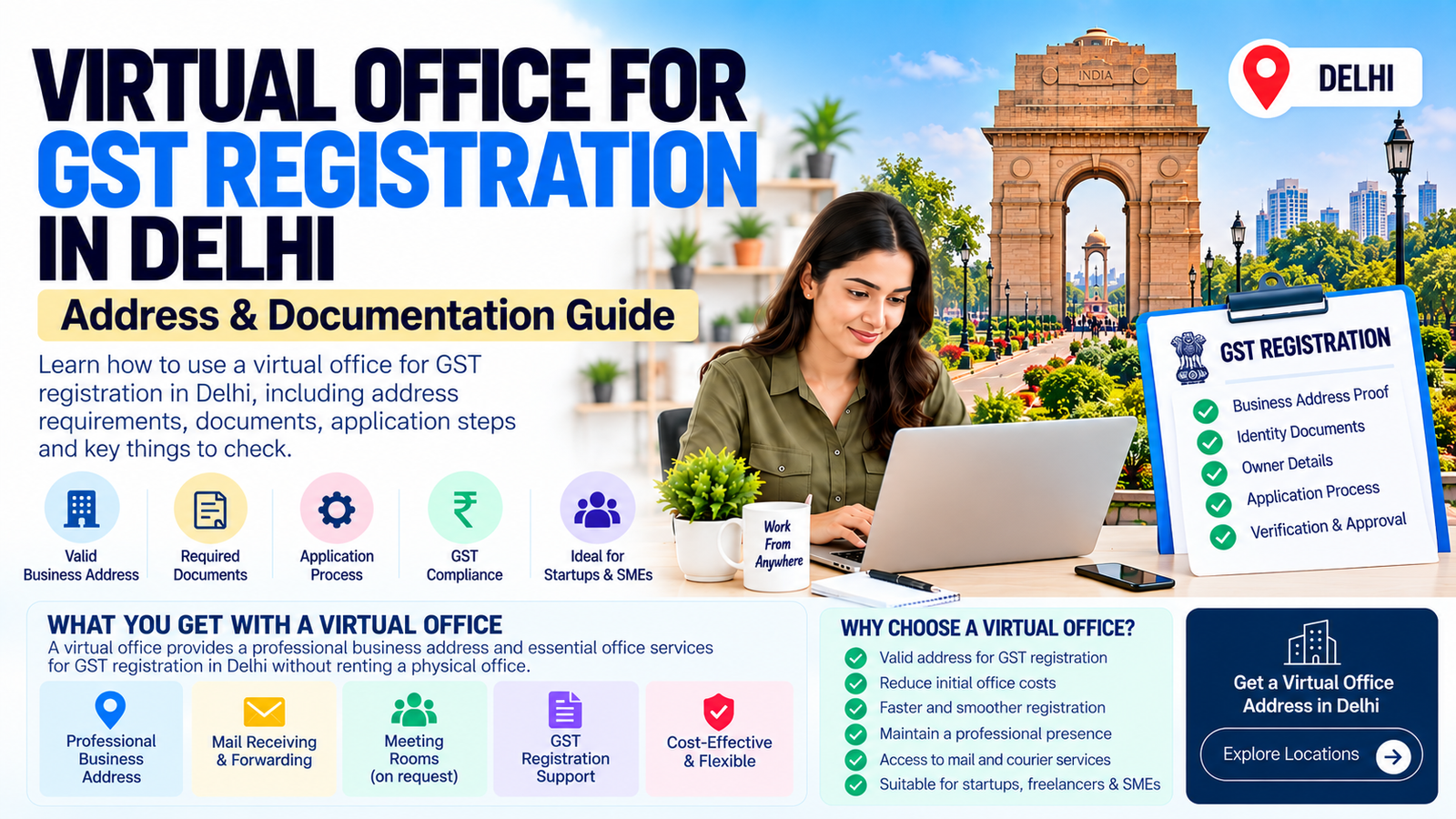
A virtual office for GST registration in Delhi can help businesses obtain an address arrangement without renting a dedicated full-time office. However, the premises must meet applicable GST requirements, and the applicant must provide suitable documents establishing the right to use the address.
For startups, ecommerce sellers, consultants and remote businesses, this can be a cost-effective option. But a virtual-office subscription does not automatically guarantee GST registration.
This guide explains address requirements, documentation, application steps, costs and verification considerations.
Can You Use a Virtual Office for GST Registration in Delhi?
Yes, a suitable virtual-office arrangement may be used for GST registration in Delhi, provided the declared place of business and supporting documentation satisfy the applicable requirements.
GST law does not establish a separate registration category called a “virtual office”. Instead, businesses must declare their principal place of business and any applicable additional places of business.
The important consideration is whether the applicant has a legitimate arrangement to use the premises for the declared business purpose.
For example, a Delhi-based ecommerce business may not require dedicated office desks every day. It may instead use premises made available under a suitable agreement, provided the arrangement and documents meet GST requirements.
However, an address used only for receiving letters should not automatically be treated as an eligible place of business.
Key takeaway: A virtual-office arrangement may support GST registration, but the actual premises, permitted use and documentation matter more than the service name.
What Is a Virtual Office for GST Registration?
A virtual office for GST registration is a commercial service providing access to an address associated with physical premises, along with documentation intended to support a GST registration application.
Depending on the provider and plan, services may include:
- A business address in Delhi
- An agreement covering use of the premises
- Owner consent or NOC, where applicable
- Supporting address documents
- Mail receiving and notifications
- Meeting rooms or coworking facilities
- Assistance with address-related documentation
These services vary between providers.
A basic virtual business-address plan may offer only correspondence handling. A GST-focused plan is generally designed around additional premises documentation.
Before purchasing, ask the provider to explain exactly what rights the agreement grants and which documents will be supplied.
Who Can Use a Virtual Office for GST Registration in Delhi?
Several types of businesses may consider a suitable virtual-office arrangement.
Startups
Early-stage businesses often want to minimise fixed costs while establishing their operations.
A virtual office may provide an address arrangement without the expense of a dedicated office.
Ecommerce Sellers
Online sellers may operate through marketplaces, websites, warehouses and fulfilment partners.
They may consider virtual-office arrangements for appropriate administrative premises, while separately declaring other places of business where required.
Freelancers and Consultants
Independent professionals who work remotely may need an address for GST registration when registration is applicable to their business.
Remote-First Businesses
Distributed companies may not need daily physical workspace but may still require a declared place of business.
Businesses Expanding into Delhi
Companies operating in other states may consider establishing a Delhi business presence.
However, obtaining a Delhi address alone does not automatically establish eligibility for a separate Delhi GST registration. The actual business operations, registration obligations and applicable GST rules must support the application.
What Are the Address Requirements for GST Registration in Delhi?
For GST registration, an applicant must provide accurate information about its declared place of business.
The address should be identifiable and supported by appropriate documentation.
Important considerations include:
Real premises: The declared address must correspond to an actual, identifiable location.
Right to use: The applicant should have an appropriate basis for using the premises for the declared business purpose.
Accurate details: Building number, floor, unit, locality, PIN code and other address details should be consistent.
Supporting documents: The premises arrangement must be supported by documents applicable to its occupancy or use category.
Verification: The declared address may be subject to scrutiny or physical verification under applicable procedures.
For GST purposes, the principal place of business is generally the location specified as such in the registration application.
A business may also need to declare additional places of business, depending on its operations.
For example, a seller using a virtual-office arrangement for administrative functions and a separate warehouse for inventory should assess whether the warehouse must be declared as an additional place of business.
What Documents Are Required for Virtual Office GST Registration in Delhi?
Documentation depends on the legal arrangement under which the premises are used.
Common address-related documents may include the following.
1. Agreement for Use of Premises
An appropriate agreement may establish the business’s right to use the address.
The agreement should accurately describe the arrangement and permitted use.
2. No Objection Certificate or Consent Letter
Where applicable, an owner or authorised person’s consent may support the use of the premises.
An NOC is not a universal standalone requirement for every occupancy category. Its necessity depends on the arrangement and applicable documentation rules.
3. Utility Bill or Address Proof
An electricity bill, municipal record or other accepted document may help establish the premises address.
The exact acceptable document depends on the relevant GST documentation requirements.
4. Business and Applicant Documents
Depending on the entity type, the application may also require:
- PAN and business details
- Identity details of promoters or partners
- Authorised-signatory information
- Constitution-of-business documents
- Other applicable registration information
Before purchasing a virtual-office plan, request a written list of all premises documents included.
Important: A provider’s standard package may not include every document required for your particular application.
How to Apply for GST Registration Using a Virtual Office in Delhi
The GST registration application is generally completed through the official GST portal.
Step 1: Confirm Registration Requirements
Determine whether GST registration is required or appropriate for your business.
This depends on factors such as business activities, turnover, supplies and applicable statutory provisions.
Step 2: Select Suitable Premises
Choose a virtual-office arrangement that genuinely supports your intended business use.
Step 3: Collect Address Documents
Obtain the relevant agreement, consent documents where applicable and supporting premises proof.
Check consistency across all documents.
Step 4: Start the GST Application
Visit the official GST portal and begin the new registration process.
Complete the initial taxpayer information and obtain the Temporary Reference Number (TRN) where applicable.
Step 5: Complete Form GST REG-01
Enter the required business information, including the principal place of business.
Declare any additional places of business where applicable.
Step 6: Upload Supporting Documents
Upload the required business and premises documents in the relevant sections.
Step 7: Complete Applicable Authentication
Follow the Aadhaar authentication, biometric verification or other verification process applicable to the application.
Step 8: Submit and Track the Application
After submission, use the Application Reference Number (ARN) to track progress.
If the officer requests clarification, respond within the prescribed timeframe with accurate supporting information.
Step 9: Complete Any Required Verification
Where applicable, authorities may conduct further checks, including physical verification of the declared premises.
How Much Does a Virtual Office for GST Registration Cost in Delhi?
As a broad planning estimate, a virtual office for GST registration in Delhi may cost around ₹15,000–₹30,000+ annually, depending on the provider, location, documentation and services.
This is an illustrative range, not a verified quotation or fixed market rate.
| Cost Component | What to Check |
|---|---|
| Annual address plan | Base subscription amount |
| Premises documentation | Included or separately charged |
| Applicable taxes | Included or excluded |
| Mail handling | Receiving, storage and notifications |
| Mail forwarding | Courier and handling charges |
| Meeting rooms | Hourly charges or included credits |
| Renewal | Price after the first year |
| Professional assistance | Separate fees, if required |
Some providers advertise a monthly equivalent even though payment is collected annually.
For example, ₹1,500 per month billed annually means an upfront subscription of ₹18,000, before any applicable additional charges.
Always compare the total payable amount.
How Long Does GST Registration Take With a Virtual Office Address?
GST registration timelines depend on the application, authentication route, verification requirements and whether clarification is requested.
Under applicable procedures, some applications may be processed within seven working days, while cases requiring physical verification or falling under other prescribed conditions may take longer, including periods of up to 30 days under the relevant processing framework.
These are procedural timelines, not guaranteed approval dates.
Delays may occur when:
- Documents are incomplete
- Address details do not match
- Authentication requirements remain pending
- Additional clarification is requested
- Physical verification is required
- The declared premises arrangement raises questions
A virtual-office provider cannot guarantee a particular GST approval timeline.
What Should You Check Before Choosing a Virtual Office for GST Registration?
The cheapest address is not necessarily the most suitable one.
Before paying, evaluate:
Permitted GST Use
Confirm that the exact plan allows the premises to be used for the intended GST-related purpose.
Premises Documentation
Request the complete document list before payment.
Address Accuracy
Check the unit number, floor, building, locality and PIN code.
Verification Arrangements
Ask how the provider handles legitimate official correspondence and premises-related verification requests.
Mail Handling
Understand how official letters and other correspondence will be received and communicated.
Agreement Terms
Check the contract duration, permitted use, termination conditions and renewal process.
Total Cost
Compare the annual fee, applicable taxes, documentation charges and other services.
Provider Reliability
A responsive provider with clear documentation and reliable premises management may be more valuable than a cheaper provider offering unclear commitments.
Common Reasons for GST Registration Delays or Address Verification Issues
Several avoidable problems can affect applications.
Mismatched Address Details
Differences between the agreement, utility bill and application may lead to clarification requests.
Incomplete Documentation
Missing or unsuitable premises documents can delay processing.
Incorrect Occupancy Category
Selecting a premises category inconsistent with the actual arrangement can create documentation problems.
Inaccurate Business Information
Incorrect business activities, contact details or other application information may require correction.
Unclear Right to Use the Premises
If the agreement does not adequately establish the applicant’s permitted use, additional scrutiny may arise.
Verification Difficulties
Problems identifying the premises or confirming the declared business arrangement may complicate physical verification.
The best approach is to ensure that the address, agreement and business details accurately reflect the real arrangement.
Virtual Office vs Traditional Office for GST Registration in Delhi
| Factor | Virtual Office Arrangement | Traditional Office |
|---|---|---|
| Dedicated daily workspace | Usually not included | Generally included |
| Physical premises | Yes, through provider arrangement | Yes |
| Upfront cost | Generally lower | Usually higher |
| Address documentation | Depends on plan and arrangement | Depends on ownership or lease |
| Mail receiving | Usually available | Managed directly |
| Meeting facilities | Often optional | Usually available onsite |
| Physical verification | May apply | May apply |
| GST eligibility | Depends on actual premises and compliance | Depends on actual premises and compliance |
A traditional office may be preferable when employees need daily workspace or the business requires permanent physical operations.
A virtual office may be suitable where the business needs an appropriate premises arrangement but does not require dedicated office space.
Neither option guarantees GST approval.
How to Choose the Right Virtual Office Location in Delhi for GST Registration
Delhi has several commercial areas businesses may consider, including Connaught Place, Nehru Place, Saket, Okhla, Janakpuri and Netaji Subhash Place.
The right location depends on business requirements rather than prestige alone.
Consider:
Business operations: Is the location relevant to where the business actually operates?
Accessibility: Will authorised representatives or staff need to visit the premises?
Documentation: Does the provider supply appropriate premises documents?
Verification: Can the premises be accurately identified and the arrangement substantiated?
Cost: Is the annual price reasonable for the services included?
Mail handling: Can important correspondence be received reliably?
For GST registration, a suitable and properly documented address matters more than selecting the most expensive commercial locality.
How to Get a Virtual Office for GST Registration in Delhi
Follow this practical checklist before purchasing.
- Determine whether your business requires GST registration in Delhi.
- Identify the business activities and premises requirements.
- Shortlist providers offering GST-focused address arrangements.
- Confirm the exact permitted use of the premises.
- Request the complete supporting-document list.
- Verify the address and agreement details.
- Compare annual fees, taxes and renewal charges.
- Complete the provider’s KYC and agreement process.
- Collect and review all applicable documents.
- Submit the GST application with accurate business and premises information.
If the premises arrangement or documentation is complex, consult a qualified GST professional before applying.
Final Words
A virtual office for GST registration in Delhi can be a practical alternative to renting dedicated office space, particularly for startups, ecommerce businesses, consultants and remote-first companies.
However, obtaining a virtual address is not the same as automatically qualifying for GST registration.
The most important considerations are the genuine premises arrangement, right to use the address, supporting documents and accuracy of the application.
Before purchasing, verify:
Address suitability → permitted use → premises documents → verification arrangements → mail handling → total annual cost
Choose a provider based on documentation and service reliability, not simply the lowest advertised price.
FAQs
Is a virtual office legal for GST registration in Delhi?
A suitable virtual-office arrangement may support GST registration when the declared premises, right to use the address and supporting documents satisfy applicable GST requirements. The term “virtual office” itself does not create a separate legal registration category.
Can I get GST registration without renting a physical office in Delhi?
Potentially, yes. GST registration does not automatically require leasing a dedicated conventional office. However, the business must declare an appropriate place of business and provide suitable supporting documentation.
What documents are required for virtual office GST registration?
Depending on the premises arrangement, relevant documents may include an agreement, owner consent or NOC where applicable, utility bill or other accepted address proof, alongside the business and applicant documents required for registration.
Is an NOC required for GST registration using a virtual office?
An NOC or consent letter may be relevant depending on the nature of the premises arrangement. It is not a universal standalone requirement in every case. The correct documents depend on the applicable occupancy category and GST requirements.
How much does a virtual office for GST registration cost in Delhi?
As an illustrative planning range, GST-focused virtual-office packages may cost around ₹15,000–₹30,000+ per year. Actual prices depend on the provider, locality, premises documentation and services included.
Can GST authorities physically verify a virtual office address?
Yes. Physical verification may be conducted under applicable GST procedures. The premises should be identifiable, and the declared arrangement and application details should accurately reflect the business’s circumstances.
How long does GST registration take with a virtual office?
Some applications may be processed within seven working days under applicable procedures, while cases involving physical verification or other prescribed conditions may take longer, including processing periods of up to 30 days. Clarification requests and verification issues can affect the actual timeline.