
AI Overview
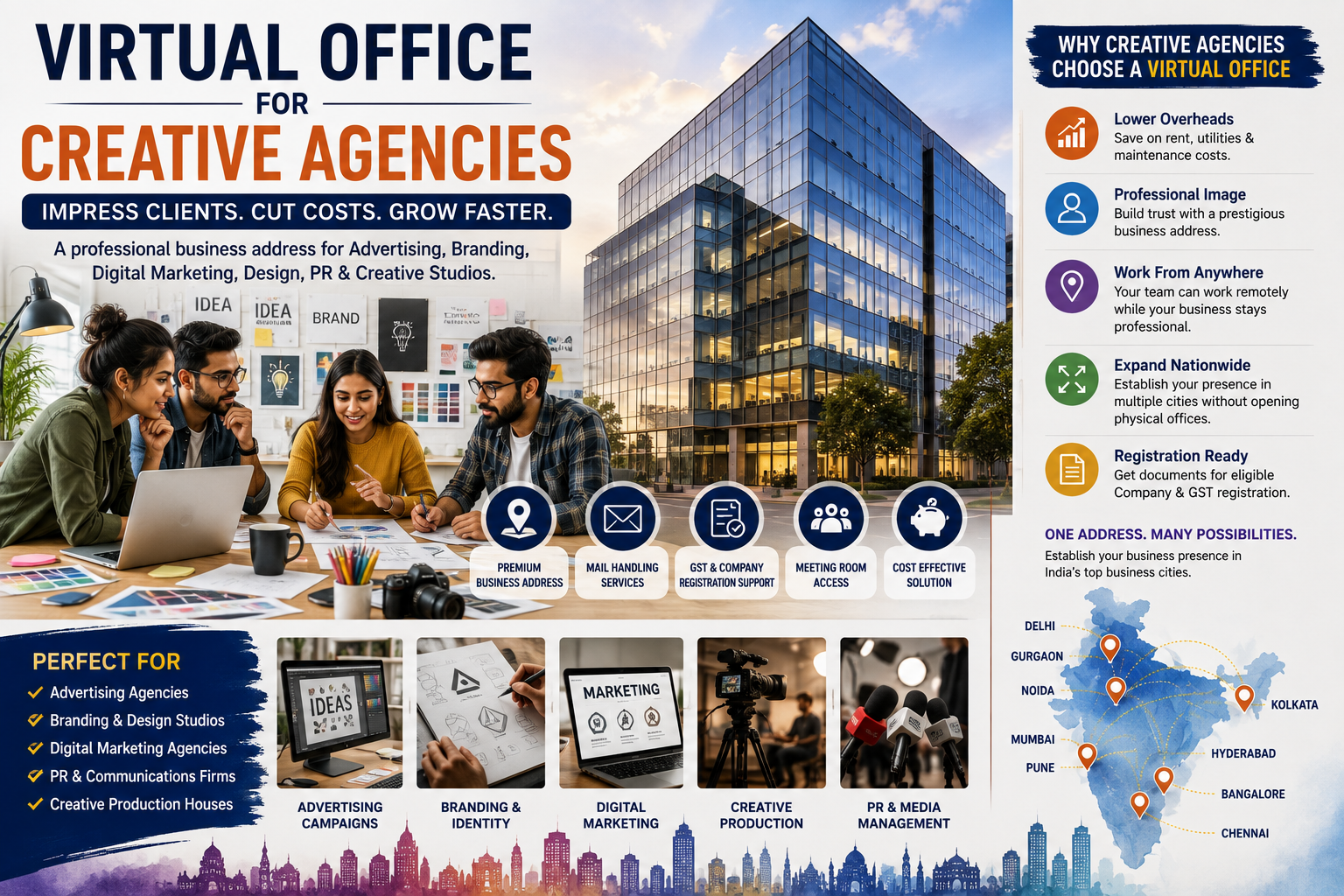
A Virtual Office for Creative Agencies gives advertising agencies, branding firms, PR companies, design studios, and digital marketing businesses a professional commercial address without the cost of maintaining a traditional office. It can support eligible company registration, GST registration, business correspondence, mail handling, and client-facing credibility while creative teams continue working remotely or from flexible workspaces.
For agencies that spend more time creating campaigns, meeting clients, visiting shoots, and collaborating online than sitting at desks, a Virtual Office can provide the business infrastructure they need without unnecessary office overhead.
Introduction
Creative businesses have never followed the traditional nine-to-five office model particularly well.
Advertising agencies may spend an afternoon shooting a campaign. Branding teams may work from a client’s office. Designers can collaborate from home. PR professionals travel between media meetings and events. Digital agencies manage campaigns through cloud-based platforms, while creative directors may work with freelancers and specialists located across different cities.
The work is flexible.
The expectations of clients, however, remain professional.
When a potential client searches for an agency, receives a proposal, checks an invoice, or asks for the company’s registered address, having a credible business address can make a significant difference.
This is where a Virtual Office for Creative Agencies becomes useful.
Instead of spending substantial amounts on commercial rent, furniture, utilities, reception staff, maintenance, and unused workspace, agencies can establish a professional business presence through a Virtual Office.
It allows creative businesses to separate their business address from their day-to-day working location.
This is particularly useful for advertising agencies, branding studios, PR firms, digital marketing agencies, production companies, design consultancies, and creative startups looking to maintain a polished corporate identity while keeping their operations flexible.
What Is a Virtual Office?
A Virtual Office is a business service that provides access to a professional commercial address without requiring the business to maintain a permanent physical office at that location.
Depending on the plan and provider, services can include:
- Professional commercial business address
- Company registration documentation
- GST registration documentation
- Rent agreement
- No Objection Certificate (NOC)
- Utility bill
- Business mail handling
- Courier handling
- Meeting room access
- Reception support
- Business correspondence support
The exact services and documents depend on the provider, location, and plan selected.
For creative agencies, the biggest advantage is simple: you can maintain a professional business presence without making office infrastructure the center of your business model.
Why Creative Agencies Are Choosing Virtual Offices
Traditional offices made sense when employees needed to work together in one location every day.
Creative agencies increasingly operate differently.
A typical agency may have:
- Full-time employees
- Freelance designers
- Remote copywriters
- External photographers
- Video production teams
- Social media specialists
- Performance marketers
- Developers
- Account managers
- Client-side teams
Not everyone needs a permanent desk.
Yet the agency still needs a credible address for business registration, correspondence, documentation, and client confidence.
A Virtual Office bridges this gap.
Who Should Use a Virtual Office for Creative Agencies?
A Virtual Office can be particularly useful for:
Advertising Agencies
Advertising agencies can maintain a professional corporate address while account managers, creative teams, and production specialists work flexibly.
Branding Agencies
Brand strategy and design companies often operate through project-based teams. A Virtual Office provides a stable business identity without requiring a large permanent workspace.
Digital Marketing Agencies
SEO, social media, PPC, content marketing, and performance agencies can operate almost entirely online while maintaining a professional commercial address.
Public Relations Agencies
PR professionals regularly travel for press meetings, launches, media events, and client engagements. A Virtual Office complements this mobile business model.
Design Studios
Graphic designers, UI/UX agencies, architectural designers, and creative studios can maintain a professional business presence without investing heavily in physical infrastructure.
Creative Production Companies
Photography, video production, animation, post-production, and content studios can use a Virtual Office while their actual work happens at studios, production locations, or client sites.
Influencer & Creator Agencies
Talent management and creator marketing businesses can maintain a professional business address while their teams work remotely.
Creative Startups
New agencies can establish credibility from the beginning without taking on a large commercial lease before revenue becomes predictable.
Benefits of a Virtual Office for Creative Agencies
1. Reduce Office Costs
Rent can become one of the largest fixed expenses for an agency.
A traditional office may require:
- Monthly rent
- Security deposit
- Furniture
- Electricity
- Internet
- Maintenance
- Housekeeping
- Office equipment
- Reception staff
- Office supplies
A Virtual Office eliminates the need for many of these expenses.
Instead, the agency can redirect capital toward revenue-generating activities.
2. Maintain a Professional Business Address
A creative agency may be completely remote, but that does not mean it needs to appear informal.
A professional business address can be used where appropriate across:
- Business documents
- Invoices
- Company profiles
- Websites
- Proposals
- Contracts
- Business correspondence
This helps create a consistent corporate identity.
3. Impress Potential Clients
Creative agencies sell ideas, expertise, strategy, and execution.
Client perception matters.
A professional business address can reinforce credibility when prospects evaluate an agency before signing a contract.
This can be particularly important when working with:
- Large corporations
- International clients
- Established brands
- Government organizations
- Financial institutions
- Enterprise businesses
A professional address is not a substitute for quality work, but it can strengthen the overall business presentation.
4. Work From Anywhere
Creative work is increasingly location-independent.
Teams can collaborate through:
- Video conferencing
- Cloud storage
- Project management platforms
- Online design tools
- CRM software
- Communication platforms
A Virtual Office allows the agency to maintain a stable business address while its team works from wherever the project requires.
5. Expand Into New Cities
Suppose a Delhi-based agency begins acquiring clients in Mumbai, Bangalore, Hyderabad, or Gurgaon.
Opening a physical branch in every city may not make financial sense.
A Virtual Office can provide a more flexible way to establish a commercial presence in strategic markets, subject to the specific registration and compliance requirements applicable to the business.
This can help agencies test new markets before making major infrastructure investments.
Can Creative Agencies Use a Virtual Office for Company Registration?
Eligible creative agencies can use a Virtual Office address for company registration where the address and documentation satisfy applicable legal requirements.
This can be relevant for businesses structured as:
- Private Limited Companies
- LLPs
- Partnerships
- Other eligible business structures
The exact requirements depend on the entity type and applicable regulations.
A provider may supply documents such as:
- Rent Agreement
- NOC
- Utility Bill
- Address Proof
- Other supporting documentation
Businesses should ensure that the documentation matches the requirements of the relevant authority before submitting an application.
Can Creative Agencies Use a Virtual Office for GST Registration?
A Virtual Office may be used for GST registration where the business, premises, documentation, and application meet applicable GST requirements.
This is particularly useful for agencies working with clients across different states or operating from flexible locations.
Depending on the business structure and circumstances, agencies may require documentation such as:
- Address proof
- Rent/lease documentation
- NOC
- Utility bill
- Identity documents
- Business incorporation documents
GST approval is ultimately subject to the applicable rules and verification process.
Documents Required for a Virtual Office
Requirements can vary depending on the purpose of the Virtual Office and the business structure.
Identity Documents
Commonly requested documents include:
- PAN Card
- Aadhaar Card
- Photograph
- Director or partner identification documents
Business Documents
Depending on the business, documents may include:
- Certificate of Incorporation
- LLP Agreement
- Partnership Deed
- Business PAN
- GST Certificate
- Board Resolution, where applicable
Address-Related Documents
Depending on the selected plan, the provider may supply:
- Rent Agreement
- NOC
- Utility Bill
- Commercial Address Proof
Always verify the exact documentation requirements before using an address for a specific registration.
Step-by-Step Process
Step 1: Identify Your Business Requirement
First decide why you need the Virtual Office.
For example:
- Company registration
- GST registration
- Business correspondence
- Mail handling
- Professional business address
- Market expansion
Step 2: Select Your Location
Choose a city that aligns with your business strategy.
Popular commercial markets include:
- Delhi
- Gurgaon
- Noida
- Mumbai
- Bangalore
- Hyderabad
- Pune
- Chennai
- Ahmedabad
For an agency, the best location is usually one that matches its target clients and expansion plans.
Step 3: Choose Your Plan
Compare the services included in each plan.
Look at:
- Address quality
- Documentation
- Mail handling
- Registration support
- Meeting room availability
- Duration
- Renewal terms
Do not choose solely on price.
Step 4: Complete KYC
Submit the required identity and business documents.
Make sure names, addresses, company details, and identification information are consistent.
Step 5: Receive Your Documentation
After successful verification, the applicable documents are provided according to your selected plan.
Review them carefully before submitting them to any government or financial institution.
Step 6: Complete Your Business Registration
Where eligible, use the documentation for the relevant company or GST registration process.
Step 7: Start Operating
Once your business address is established, you can continue operating remotely while using the Virtual Office for eligible administrative and business purposes.
Traditional Office vs Virtual Office for Creative Agencies
| Feature | Traditional Office | Virtual Office |
| Professional Business Address | Yes | Yes |
| Company Registration Support | Yes | Available with eligible plans |
| GST Registration Support | Yes | Available with eligible plans |
| Monthly Rent | High | Low |
| Security Deposit | Usually required | Generally lower/not applicable depending on plan |
| Furniture | Required | Not required |
| Utilities | Required | Not required |
| Maintenance | Required | Not required |
| Mail Handling | Available | Available with selected plans |
| Permanent Desks | Yes | No |
| Remote Team Friendly | Moderate | Excellent |
| Expansion Flexibility | Lower | Higher |
| Best For | Daily office operations | Flexible businesses |
Virtual Office Pricing Comparison
Pricing varies by city, address, documentation, services, and duration.
A general comparison looks like this:
| Office Solution | Typical Cost Range | Suitable For |
| Traditional Office | ₹5 lakh–₹20 lakh+ annually | Large agencies with permanent teams |
| Managed Office | ₹3 lakh–₹12 lakh+ annually | Established agencies |
| Coworking Space | ₹1.5 lakh–₹6 lakh+ annually | Teams requiring workspace |
| Virtual Office | ₹8,000–₹40,000+ annually* | Remote & flexible agencies |
*Indicative ranges only. Actual pricing depends on the city, address, provider, services, and plan.
For agencies that do not require daily desks, the difference in fixed costs can be substantial.
How Creative Agencies Can Reinvest the Savings
The biggest benefit of reducing office overhead is not simply saving money.
It is being able to deploy that money more intelligently.
An agency could redirect resources toward:
Client Acquisition
Invest in Google Ads, social media campaigns, outbound sales, networking, and lead generation.
Better Creative Talent
Hire experienced designers, copywriters, strategists, developers, and account managers.
Technology
Invest in:
- CRM systems
- AI tools
- Design software
- Marketing automation
- Analytics platforms
- Project management software
Brand Development
Improve:
- Website
- Portfolio
- Case studies
- Video content
- Social media presence
- Thought leadership
Business Expansion
Test new cities and customer segments without immediately taking on expensive leases.
Is a Virtual Office Suitable for Marketing Agencies?
Yes, particularly when the agency operates using a remote, hybrid, or project-based model.
Digital marketing agencies often need:
- Professional address
- GST documentation
- Company registration support
- Mail handling
- Client-facing credibility
They may not need 30 desks and a permanent office every day.
A Virtual Office allows agencies to separate where the business is registered from where the creative work happens.
Is a Physical Office Necessary for a Creative Agency?
Not necessarily.
The requirement depends on the business model and the purpose for which the premises are being used.
An agency that needs a full-time collaborative environment, production studio, equipment storage, or daily client meetings may benefit from physical premises.
However, agencies that primarily operate remotely can often use a Virtual Office for their address and administrative requirements while using meeting rooms, coworking spaces, studios, or client locations when physical interaction is necessary.
The right solution depends on actual operational requirements rather than assumptions about how a modern agency “should” operate.
Common Mistakes When Choosing a Virtual Office
Choosing Only on Price
A cheap address may not provide the documentation, support, or location quality your agency needs.
Compare the complete package.
Ignoring Location
An address in a relevant commercial business district can create a stronger impression than an unsuitable location.
Not Checking Documentation
Before purchasing, confirm whether the plan provides the documents needed for your intended purpose.
Forgetting Mail Management
Government and business correspondence should not be overlooked.
Choose a provider with a clear process for receiving and notifying you about important mail.
Using Inconsistent Business Information
Your company information should remain consistent across:
- Website
- Invoices
- Contracts
- Registrations
- Business profiles
Inconsistencies can create unnecessary confusion.
Why Choose Vo Spaces?
For creative agencies, the provider matters as much as the address.
Vo Spaces offers Virtual Office solutions designed to support businesses that need professional addresses without traditional office overhead.
Professional Business Addresses
Establish your agency in a commercial location that supports a credible corporate identity.
Documentation Support
Eligible plans can include documentation such as:
- Rent Agreement
- NOC
- Utility Bill
- Commercial Address Proof
These may support eligible company and GST registration requirements, subject to applicable regulations.
Mail Handling
Manage important business and government correspondence without requiring someone to remain at a traditional office throughout the day.
Flexible Solutions
Choose services according to your business requirements rather than paying for unnecessary office infrastructure.
Expansion Support
Agencies planning to enter multiple Indian markets can explore Virtual Office options in strategic cities as they scale.
Customer Support
A reliable support team can make onboarding, documentation, renewals, and address-related requirements easier to manage.
Best Practices for Creative Agencies Using a Virtual Office
To get the most value from your Virtual Office:
- Choose an address relevant to your target market.
- Confirm documentation before purchasing.
- Keep company information consistent everywhere.
- Maintain updated KYC and business records.
- Monitor business correspondence regularly.
- Use physical meeting spaces when important client interactions require them.
- Review your plan as your agency grows.
- Choose a provider capable of supporting expansion.
A Virtual Office should complement your agency’s operating model rather than replace services your team genuinely needs.
Frequently Asked Questions
1. Can creative agencies use Virtual Offices?
Yes. Advertising agencies, branding firms, PR companies, digital agencies, design studios, and other creative businesses can use Virtual Offices for eligible business and administrative purposes.
2. Is a Virtual Office legal in India?
Yes. Virtual Offices are legal when used through legitimate arrangements and in accordance with applicable business, MCA, GST, and other regulatory requirements.
3. Can I use a Virtual Office for GST registration?
A Virtual Office may support GST registration when the premises, documents, and application satisfy applicable GST requirements.
4. What documents are required?
Requirements vary, but commonly include identity documents, business documents, and address-related documentation such as an NOC, rent agreement, and utility bill where applicable.
5. How much does a Virtual Office cost?
Pricing varies by city and services. Virtual Office plans can cost substantially less than traditional office rentals, with exact pricing determined by the provider and selected plan.
6. Is a Virtual Office suitable for startups?
Yes. It can help startups maintain a professional business identity while keeping fixed infrastructure costs low.
7. Can I open a bank account using a Virtual Office?
A commercial address supported by valid documentation may be accepted by banks, but requirements vary between banks. Always confirm the current requirements with your chosen bank.
8. Can freelancers use Virtual Offices?
Yes. Freelance designers, consultants, copywriters, photographers, developers, and creative professionals can use Virtual Offices where appropriate.
9. Which city is best for a Virtual Office?
There is no single best city. Delhi, Gurgaon, Noida, Mumbai, Bangalore, Hyderabad, Pune, Chennai, and Ahmedabad are among the major business markets. The right choice depends on your clients and expansion plans.
10. How quickly can I receive the documents?
Processing time depends on KYC completion, documentation, provider procedures, and the selected plan.
11. Is a Virtual Office better than coworking?
If you primarily need a business address and registration-related services, a Virtual Office can be more economical. If you need desks and a daily workspace, coworking may be better.
12. Can an advertising agency register a company using a Virtual Office?
Eligible agencies can use an appropriate Virtual Office address for company registration when the premises and documentation meet applicable requirements.
13. Can a creative agency expand into multiple cities using Virtual Offices?
A Virtual Office can help agencies establish a commercial presence in multiple cities without immediately opening traditional branch offices, subject to the relevant registration and compliance requirements.
14. Can a Virtual Office improve agency credibility?
A professional commercial address can contribute to a stronger business presentation and may increase confidence among prospective clients, partners, and vendors.
15. What should agencies check before purchasing a Virtual Office?
Check the location, documentation, registration suitability, mail handling process, pricing, renewal terms, provider reputation, and customer support.
Summary
A creative agency does not necessarily need an expensive office to look professional.
Advertising agencies, branding firms, digital marketing companies, PR agencies, design studios, and creative consultancies increasingly work through flexible teams and digital infrastructure.
A Virtual Office for Creative Agencies gives these businesses a professional commercial address while helping reduce expenses associated with traditional office infrastructure.
The benefits can include:
- Lower fixed costs
- Professional business presence
- Eligible registration support
- Mail handling
- Greater flexibility
- Easier market expansion
- Better allocation of capital
Instead of spending a large portion of revenue on rent and office maintenance, agencies can invest in people, technology, marketing, client acquisition, and creative capabilities.
Final Conclusion
The modern creative agency is no longer defined by the number of desks it owns.
It is defined by the quality of its ideas, talent, technology, client relationships, and ability to deliver results.
A Virtual Office for Creative Agencies provides the business infrastructure needed to maintain a professional identity without forcing agencies into expensive traditional office arrangements.
For advertising agencies, branding companies, digital marketing firms, PR agencies, design studios, and creative startups, this can create a practical balance between professional credibility and operational flexibility.
With Vo Spaces, agencies can explore professional commercial addresses, eligible registration documentation, mail handling, and scalable Virtual Office solutions while keeping their attention on what actually drives their business: creativity, clients, campaigns, and growth.