
AI Overview
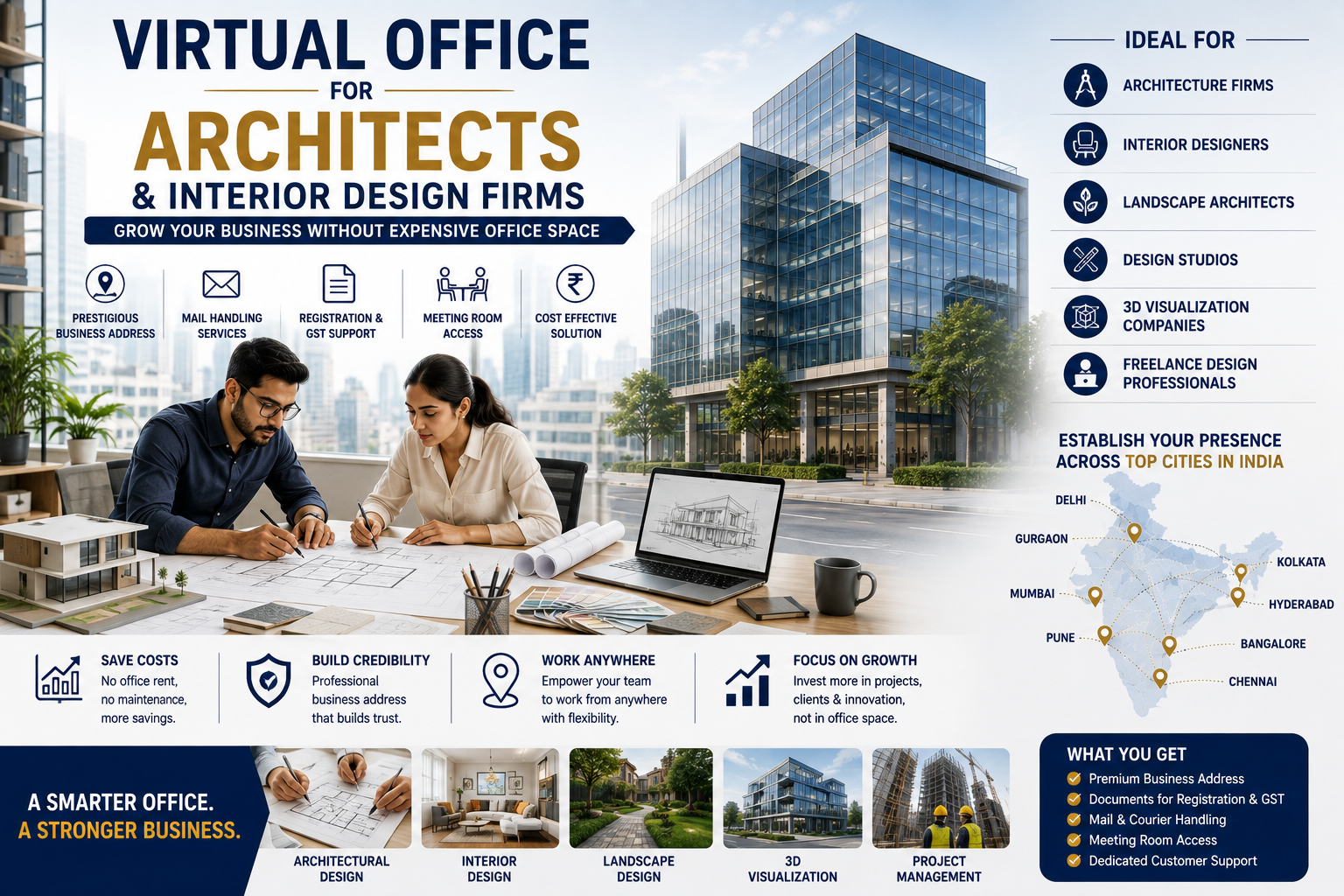
A Virtual Office for Architects gives architecture firms, interior designers, landscape consultants, design studios, and independent professionals access to a professional business address without the cost of maintaining a conventional full-time office.
It can be useful for eligible businesses that need a formal address for business registration, GST-related purposes, professional correspondence, client communication, and occasional meetings. However, a Virtual Office does not replace a project studio, site office, or any premises specifically required for carrying out regulated or operational activities.
For design professionals, the biggest advantage is flexibility. Architects and interior designers often spend substantial time visiting construction sites, meeting clients, inspecting properties, coordinating contractors, and working remotely. A permanent office with a large number of unused desks may therefore be an unnecessary expense.
A carefully selected Virtual Office can provide the professional address layer while the actual design work remains flexible.
Introduction
Architecture and interior design businesses have changed dramatically.
A traditional architecture firm might once have required a large studio filled with drafting tables, physical models, storage cabinets, printers, sample books, and dedicated workstations.
Today, much of that workflow can happen digitally.
Architects use BIM software, CAD platforms, 3D visualization tools, cloud storage, digital project-management systems, and remote collaboration tools. Interior designers can communicate with clients through video calls, present 3D walkthroughs online, share material boards digitally, and coordinate vendors from almost anywhere.
At the same time, the profession remains highly physical.
Architects visit construction sites.
Interior designers inspect properties.
Landscape consultants travel between project locations.
Design teams meet contractors, suppliers, developers, and clients.
This creates an unusual business requirement:
Your team may not need to sit in an office every day, but your business can still benefit from having a professional office address.
That is where a Virtual Office for Architects can make sense.
Instead of spending a significant portion of revenue on rent, interiors, maintenance, furniture, reception, utilities, and unused workspace, a design business can separate its business-address requirement from its daily workspace requirement.
The result can be a leaner operating model without making the firm appear informal or temporary.
What Is a Virtual Office?
A Virtual Office is a business service that provides access to a professional commercial address and selected office-related services without requiring the business to maintain a conventional full-time office at that location.
Depending on the provider and plan, services can include:
- Professional business address
- Business registration support
- GST registration support where applicable
- Rent or lease documentation
- No Objection Certificate (NOC)
- Utility/address proof
- Mail and courier handling
- Meeting-room access
- Reception services
- Business correspondence support
The exact services and documentation vary by provider, location, plan, and intended use.
For an architect or interior designer, the key advantage is simple:
You can maintain a professional corporate presence without making a permanent office the center of your entire business operation.
Why Architecture & Design Firms Are Well Suited to Flexible Offices
Architecture and interior design are project-driven industries.
A typical day could involve:
9:00 AM: Client presentation
11:00 AM: Site inspection
1:00 PM: Vendor meeting
3:00 PM: Contractor coordination
5:00 PM: Material selection
7:00 PM: Design revisions
The team may barely use a conventional office.
Yet the business may still need:
- A professional address
- A place for correspondence
- Registration documentation
- Client meeting facilities
- A credible business identity
- A base for administrative purposes
This mismatch between office usage and office cost is where Virtual Office solutions become interesting.
Who Can Use a Virtual Office for Architects?
A Virtual Office can be relevant to several categories of design professionals.
1. Architecture Firms
Small and growing architecture firms can use flexible infrastructure while concentrating resources on projects, staff, software, and client acquisition.
2. Interior Designers
Interior designers frequently work at client properties, showrooms, construction sites, and vendor locations.
A permanent office may not be necessary for the entire team.
3. Landscape Architects & Consultants
Landscape professionals are naturally project-based and may spend significant time outdoors or at development sites.
4. Independent Architects
An architect working independently may need a professional business address without renting a complete commercial studio.
5. Design Studios
Small design studios can use a Virtual Office for their corporate address while working remotely or from project-specific spaces.
6. Architecture Consultants
Consultants providing planning, design, documentation, or advisory services can benefit from a professional address when their work is primarily mobile or digital.
7. Interior Architecture Firms
Businesses combining architecture, interiors, visualization, and project consultancy may use flexible office infrastructure while their teams work across different projects.
Can Architects Use Virtual Offices?
Yes, eligible architects and architecture businesses can use Virtual Office arrangements for appropriate business purposes.
But there is an important distinction.
A Virtual Office can provide an address and related services.
It does not automatically satisfy every professional, regulatory, municipal, project, or operational requirement applicable to an architect.
For example, depending on the work being undertaken, an architecture practice may need:
- A professional registration
- Appropriate project documentation
- Site-specific permissions
- Municipal approvals
- Professional credentials
- Project offices
- Physical facilities for certain activities
Those requirements should be evaluated separately.
A Virtual Office should therefore be viewed as business infrastructure, not as a replacement for professional compliance.
Can Interior Designers Use a Virtual Office?
Interior designers can potentially use Virtual Office services for appropriate business purposes.
This can be especially useful for designers who:
- Work from home
- Visit client sites
- Operate with contractors
- Work with freelance designers
- Have distributed teams
- Meet clients at properties
- Use coworking spaces when necessary
- Operate primarily through digital communication
Instead of maintaining a fully furnished office every day, the designer can use a professional business address and access physical meeting facilities when needed.
Can an Architecture Firm Register Using a Virtual Office?
An eligible business can use an appropriate commercial premises for registration when the address and supporting documentation satisfy the relevant requirements.
For companies, the Ministry of Corporate Affairs requires appropriate registered-office documentation. MCA materials include proof relating to the office address, including lease/rent documentation, owner authorization where applicable, and utility evidence.
This means an architecture firm should not choose a Virtual Office based solely on its appearance or advertised price.
The important question is:
Does the specific address and documentation support the registration purpose for which I need it?
That should be confirmed before purchasing.
Can Architects Use a Virtual Office for GST Registration?
A Virtual Office may be suitable for GST registration when the premises, documentation, and business circumstances satisfy the applicable GST requirements.
The GST registration process specifically requires details and proof concerning the principal place of business. The official GST guidance states that rented or leased premises can be supported by a valid rent/lease agreement along with evidence supporting the lessor’s ownership; premises not falling into those categories can use a consent letter along with ownership evidence.
Therefore, the key issue is not simply whether an address is called a “Virtual Office.”
It is whether the actual premises and documentation meet the applicable GST requirements.
Documents Required for a Virtual Office for Architects
The exact documentation depends on the business structure and intended purpose.
Common documents can include:
Identity Documents
- PAN
- Aadhaar
- Passport-size photograph
- Director/partner/proprietor KYC
- Authorized signatory details
Business Documents
Depending on the entity:
- Certificate of Incorporation
- Company PAN
- LLP Agreement
- Partnership Deed
- GST Certificate
- Memorandum and Articles of Association
- Other business registration documents
Address Documents
Depending on the provider and intended use:
- Rent Agreement
- Lease Agreement
- NOC
- Utility Bill
- Ownership/address proof
- Consent documentation
Always confirm the exact document package before buying because requirements can differ by registration type and state.
Benefits of a Virtual Office for Architects
1. Reduce Unnecessary Office Expenses
A conventional architecture studio can require significant upfront investment.
Think about everything beyond rent:
- Security deposit
- Furniture
- Workstations
- Air conditioning
- Electricity
- Internet
- Printing equipment
- Maintenance
- Housekeeping
- Reception
- Security
- Interior decoration
For a small architecture firm, these costs can consume capital that could otherwise be invested in business development and design capabilities.
A Virtual Office can reduce the infrastructure burden.
2. Put More Money Into Design Technology
Architecture is becoming increasingly technology-driven.
Instead of spending heavily on office infrastructure, firms may prefer to invest in:
- High-performance computers
- BIM software
- CAD software
- Rendering systems
- 3D visualization
- Cloud storage
- Project-management platforms
- Digital collaboration tools
- VR/AR presentation technology
For many firms, these investments directly affect project quality.
3. Support Remote Design Teams
Modern architecture teams do not necessarily need to work from the same room.
A project may involve:
- Architect
- Interior designer
- 3D visualizer
- Structural consultant
- MEP consultant
- Landscape consultant
- Project manager
- Freelance specialists
These professionals may work from different locations.
A Virtual Office can provide a centralized corporate address without forcing everyone into one permanent workplace.
4. Build a Professional Business Identity
A professional business address can be useful when dealing with:
- Corporate clients
- Developers
- Contractors
- Vendors
- Property owners
- Real estate companies
- Institutional clients
An established business address can contribute to a more professional presentation.
However, design businesses should remember that credibility comes primarily from:
- Portfolio quality
- Previous projects
- Client reviews
- Professional credentials
- Communication
- Technical expertise
- Delivery quality
The address supports credibility; it does not create it by itself.
5. Meet Clients in Professional Spaces
Not every client wants to meet at a designer’s home.
And not every designer needs a permanent studio.
A Virtual Office plan that includes meeting-room access can bridge this gap.
You can arrange professional meetings for:
- Project discussions
- Design presentations
- Material selections
- Contract discussions
- Vendor meetings
- Client consultations
This allows the firm to maintain flexibility without sacrificing professionalism.
6. Useful for New Design Firms
Starting an architecture or interior design practice traditionally involves significant setup costs.
A new firm may have:
- Limited recurring revenue
- A small team
- Few projects
- Remote employees
- Uncertain growth
Taking an expensive long-term office lease before revenue stabilizes can create unnecessary pressure.
A lean Virtual Office arrangement can allow the firm to establish its business infrastructure first and upgrade its workspace later.
7. Expand Into New Cities
Imagine an architecture firm based in Pune receiving increasing enquiries from Bangalore.
The firm may want a professional presence in Bangalore without immediately:
- Renting an office
- Hiring administrative staff
- Purchasing furniture
- Signing a long-term lease
- Setting up a permanent studio
A Virtual Office can provide a lower-commitment way to establish an appropriate business address where legally and operationally suitable.
Once projects become substantial, the company can consider a permanent studio.
8. Separate Business Address From Project Locations
This is particularly relevant to architects.
Your business address does not necessarily have to be the location of every project.
A firm might have:
Corporate address: Mumbai
Project: Pune
Construction site: Goa
Client: Delhi
Design team: Remote
The firm’s infrastructure can therefore remain centralized while project operations remain distributed.
Virtual Office vs Traditional Architecture Studio
| Feature | Traditional Studio | Virtual Office |
| Permanent Business Address | Yes | Yes |
| Dedicated Desks | Yes | Usually no |
| Registration Support | Depending on premises | Available with suitable plans |
| Daily Team Workspace | Yes | No |
| Meeting Facilities | Usually | Available with selected plans |
| Initial Setup Cost | High | Lower |
| Furniture Required | Yes | No |
| Maintenance | Yes | Minimal |
| Remote Team Friendly | Moderate | High |
| Site-Based Professionals | Less efficient | More flexible |
| Best For | Permanent studio operations | Address-focused / flexible firms |
Pricing Comparison
The cost of a Virtual Office varies according to:
- City
- Location
- Provider
- Documentation
- Duration
- Mail handling
- Meeting facilities
- Registration requirements
A simple business comparison looks like this:
| Solution | Relative Cost | Best For |
| Traditional Office | Very High | Large design teams |
| Private Managed Office | High | Established firms |
| Coworking | Medium | Teams needing regular desks |
| Virtual Office | Low | Professional address + flexible operations |
The correct decision should not be based purely on the cheapest monthly price.
Instead, calculate your total annual office cost.
For example:
Rent + deposit + furniture + electricity + maintenance + internet + housekeeping + office equipment = actual office cost.
That number can be dramatically higher than advertised rent.
Step-by-Step Process to Get a Virtual Office for an Architecture Firm
Step 1: Identify Your Requirement
First determine why you need the address.
Is it for:
- Company registration?
- GST registration?
- Business correspondence?
- Client meetings?
- Market expansion?
- Professional branding?
- Mail handling?
Your answer determines what type of plan you should consider.
Step 2: Check Professional Requirements
If you are an architect or other regulated professional, determine whether your professional body, local authority, project, or other applicable rules impose any specific premises requirements.
Do not assume that a Virtual Office automatically satisfies those requirements.
Step 3: Select the City
Choose a location based on your business strategy.
Consider:
- Existing clients
- Target customers
- Projects
- Developers
- Business partners
- Team availability
- Market reputation
- Future expansion
Step 4: Verify the Address
Before paying, verify:
- Exact address
- Nature of premises
- Documentation
- Permitted use
- Registration suitability
- Mail handling
- Meeting facilities
- Renewal conditions
Step 5: Complete KYC
Submit the required identity and business documents.
Make sure names and company details are consistent.
Step 6: Receive Your Documents
After verification and onboarding, receive the documentation included in your selected plan.
Review the documents carefully before using them for official registrations.
Step 7: Complete Registration Where Applicable
Use the address for the specific purposes for which it is appropriate.
Step 8: Use Physical Space When You Actually Need It
If a project requires collaboration, client presentations, or team meetings, use meeting rooms or flexible workspace where available.
This creates a hybrid operating model.
Which Cities Are Best for Architects and Interior Designers?
There is no universally “best” city.
Your ideal location depends on your target market.
Mumbai
Suitable for firms targeting:
- Luxury interiors
- Corporate projects
- Developers
- Hospitality
- Premium residential projects
Delhi NCR
Useful for firms targeting:
- Corporate interiors
- Residential development
- Commercial real estate
- Hospitality
- Large construction projects
Gurgaon
An interesting market for:
- Corporate architecture
- Office interiors
- Commercial developments
- Startups
- High-end residential projects
Bangalore
Strong consideration for firms working with:
- Technology companies
- Corporate offices
- Commercial spaces
- New residential developments
Pune
Potentially useful for:
- Residential architecture
- IT office projects
- Industrial design
- Commercial development
Hyderabad
Relevant for:
- Technology campuses
- Commercial buildings
- Residential developments
- Hospitality projects
Chennai
Useful for:
- Industrial architecture
- Commercial development
- Residential projects
- Corporate interiors
The best address is therefore not necessarily the most expensive one.
It is the one closest to the market you want to win.
Virtual Office for Architecture Firms Expanding Into Multiple Cities
Suppose your architecture firm has built a strong portfolio in one city.
Your next goal is expansion.
Instead of immediately establishing full offices in five cities, consider a staged approach.
Phase 1: Market Entry
Establish an appropriate business presence in the target market.
Phase 2: Lead Generation
Start generating enquiries and partnerships.
Phase 3: Project Acquisition
Win actual projects.
Phase 4: Local Team
Build a local project team when the volume justifies it.
Phase 5: Permanent Studio
Open a dedicated office once the market has enough recurring business.
This approach prevents the common mistake of building infrastructure before building demand.
What Architecture Firms Should Check Before Buying a Virtual Office
1. Is the Address Actually Suitable?
Don’t select an address only because it is in a premium business district.
Verify whether it supports your intended use.
2. What Documents Are Included?
Ask for a written list.
Don’t rely solely on verbal promises.
3. Can You Use It for Your Intended Registration?
Company registration, GST, banking, professional registration, and other purposes can have different requirements.
4. Is Mail Handling Available?
Important project documents and official correspondence should be handled properly.
5. Can Clients Meet You There?
If client meetings matter, check meeting-room availability.
6. What Happens When the Plan Expires?
Understand:
- Renewal cost
- Notice period
- Documentation renewal
- Mail forwarding
- Cancellation terms
7. Can You Scale?
If your firm expands into additional cities, check whether the provider can support multiple locations.
Common Mistakes Architects Make
Mistake 1: Choosing an Address Based Only on Prestige
A premium address is useful only if it serves a business purpose.
Mistake 2: Assuming a Virtual Office Is a Complete Studio
It isn’t.
A Virtual Office primarily addresses business infrastructure and address requirements.
Mistake 3: Ignoring Professional Requirements
Architects and other professionals should separately verify any applicable professional or regulatory requirements.
Mistake 4: Choosing the Cheapest Provider
Low price doesn’t necessarily mean good documentation, reliability, or service.
Mistake 5: Renting a Large Office Too Early
A beautiful studio can improve your working environment—but it can also become a significant fixed expense before revenue justifies it.
Mistake 6: Not Planning for Client Meetings
If clients expect physical presentations, select a plan with appropriate meeting facilities or maintain access to suitable meeting spaces.
Is a Virtual Office Better Than Coworking for Architects?
It depends on how the firm operates.
Choose a Virtual Office when you primarily need:
- Professional address
- Business registration support
- GST-related address
- Mail handling
- Corporate identity
- Occasional meetings
Choose coworking when your team needs:
- Desks
- Internet
- Daily workspace
- Conference rooms
- Community
- Regular office access
A hybrid model can sometimes work best.
For example:
Virtual Office + Home Workspace + Meeting Rooms + Site Visits
This can provide flexibility without requiring a permanent studio.
Why Choose Vo Spaces?
For architects, interior designers, and design businesses, the Virtual Office provider should be evaluated on more than the address.
Important considerations include:
- Location quality
- Documentation
- Registration suitability
- Mail management
- Meeting facilities
- Reliability
- Customer support
- Flexibility
- Multi-city availability
Vo Spaces can be positioned as a Virtual Office solution for businesses that want professional commercial addresses while avoiding the fixed costs associated with traditional office infrastructure.
Depending on the selected plan, businesses can access services such as:
Professional Business Address
Use a commercial address that supports a professional corporate identity.
Registration Documentation
Eligible plans can provide documents required for appropriate business-registration purposes.
Mail Handling
Receive business correspondence without maintaining a full-time reception desk.
Meeting Facilities
Use available meeting spaces for client presentations, consultations, and professional discussions.
Flexible Plans
Choose a plan according to the actual requirements of your architecture or design practice.
Multi-City Options
Firms expanding across India can consider additional business addresses as their market grows.
Frequently Asked Questions
1. Can architects use virtual offices?
Yes, architects and architecture businesses can use Virtual Office services for appropriate business purposes, subject to applicable professional, registration, and premises requirements.
2. Is a Virtual Office suitable for interior designers?
Yes. It can be particularly useful for interior designers who work primarily at client locations, construction sites, showrooms, or remotely.
3. Can design firms register using a Virtual Office?
An eligible business can potentially use an appropriate Virtual Office address for company or other business registration when the premises and documentation satisfy the applicable requirements.
4. Can a Virtual Office be used for GST registration?
It may be used where the premises and supporting documentation satisfy applicable GST requirements. The GST portal specifically requires proof relating to the principal place of business.
5. Is a Virtual Office legal in India?
Virtual Office arrangements can be legitimate when properly structured and used for permitted purposes in accordance with applicable requirements.
6. What documents are required?
Requirements vary, but may include KYC documents, company/LLP documents, rent or lease documentation, NOC, utility/address proof, and other supporting documents.
7. How much does a Virtual Office cost?
Pricing depends on the city, location, provider, services, documentation, and duration. It is generally less expensive than maintaining a full traditional office.
8. Is a Virtual Office suitable for startups?
Yes. It can help a new architecture or design firm avoid committing significant capital to office infrastructure before establishing a stable client base.
9. Can I open a bank account using a Virtual Office?
A business address may be considered by a bank depending on its current KYC and verification requirements. Always confirm the bank’s requirements before relying on a particular address.
10. Can freelancers use Virtual Offices?
Yes, eligible freelancers and independent professionals can consider Virtual Office services where appropriate for their business requirements.
11. Which city is best for a Virtual Office?
The best city depends on your clients and target market. Mumbai, Delhi NCR, Gurgaon, Bangalore, Pune, Hyderabad, and Chennai can all be relevant depending on the firm’s specialization.
12. How quickly can I get the documents?
Processing time varies according to the provider, KYC verification, documentation, location, and selected plan.
13. Is a Virtual Office better than coworking?
A Virtual Office is generally better when the primary requirement is a professional address. Coworking is more suitable when your team needs desks and daily workspace.
14. Can an architecture firm operate entirely without a physical office?
Some firms can operate primarily through remote work, client locations, project sites, and flexible meeting spaces. However, professional, project-specific, regulatory, and operational requirements should be evaluated separately.
15. Does a Virtual Office improve an architecture firm’s credibility?
It can contribute to a more professional corporate presentation, but credibility ultimately comes from the firm’s portfolio, qualifications, project experience, communication, client satisfaction, and execution.
A Better Office Strategy for Modern Design Businesses
The traditional assumption was:
Successful architecture firm = expensive studio.
The modern model can be different:
Successful architecture firm = strong portfolio + talented team + technology + clients + efficient infrastructure.
The physical office is only one component.
For a small design firm, spending ₹1 lakh or more every month on office infrastructure may not necessarily create more business.
That same capital could potentially support:
- Better visualization
- Additional designers
- Marketing
- Website development
- Lead generation
- Software
- Portfolio photography
- Client acquisition
- Business development
The objective is not to eliminate physical spaces.
It is to pay for physical space when it creates measurable value.
The Hybrid Model: Virtual Office + Design Studio
For many established firms, the answer may not be “Virtual Office versus physical office.”
It may be both.
For example:
Corporate Address
Virtual Office
Daily Design Work
Remote / Home / Coworking
Client Presentations
Meeting room
Construction Work
Project site
Material Selection
Vendor showroom
Team Collaboration
Flexible studio
This hybrid model can make sense for firms that have variable workloads.
When the business grows, the firm can gradually transition toward a dedicated studio.
How Much Can an Architecture Firm Save?
There is no universal saving figure because office costs vary dramatically by city, size, location, staffing, and fit-out requirements.
Instead, calculate your current annual office cost.
Traditional Office Cost
Rent + deposit financing + electricity + internet + maintenance + housekeeping + furniture + equipment + office administration
Compare that with:
Virtual Office Cost
Virtual Office plan + occasional meeting-room/workspace costs
If your team spends most of its working hours on project sites, at client locations, or remotely, the difference can be substantial.
The important metric is not:
“How much cheaper is the Virtual Office?”
It is:
“How much office infrastructure does my business actually use?”
Summary
A Virtual Office for Architects can be a practical option for modern architecture firms, interior designers, landscape consultants, design studios, and independent professionals who want a professional business address without carrying the full cost of a conventional office.
Key advantages include:
- Lower fixed infrastructure costs
- Professional business address
- Flexible working arrangements
- Support for eligible registration requirements
- Mail handling
- Access to meeting facilities
- Easier entry into new markets
- Better capital allocation
- Support for remote and project-based teams
However, a Virtual Office should not be confused with a complete architecture studio or a substitute for professional and regulatory compliance.
The strongest use case is simple:
Use a Virtual Office for the address and administrative infrastructure; use project sites, remote workspaces, coworking facilities, or dedicated studios for the physical work your business actually requires.
For design firms that spend more time designing, visiting sites, meeting clients, and coordinating projects than sitting behind office desks, this can be a smarter way to build a modern practice.
Final Conclusion
Architecture and interior design are professions where work follows the project.
The team may travel.
Clients may be located in different cities.
Construction sites change.
Consultants work remotely.
Vendors operate from their own facilities.
Yet the business still needs a stable professional identity.
A Virtual Office for Architects bridges these two realities.
It allows a design firm to establish a professional address and selected office services while keeping its actual working model flexible.
- new architect, it can reduce the pressure of starting with a costly studio.
- For an established design firm, it can support expansion into new markets.
- For an interior designer, it can provide a professional address while most work happens at client properties.
And for a multi-city architecture practice, it can become one part of a broader expansion strategy.
The smartest approach is not to ask whether a Virtual Office is “better” than a traditional office.
Instead, ask:
What does my design business genuinely need from physical office space today?
If the answer is primarily an address, professional correspondence, registration support, and occasional meeting facilities, a Virtual Office may be the more efficient starting point.
And when the business eventually needs a permanent studio, you can build one from a position of stronger revenue, larger projects, and greater certainty.