
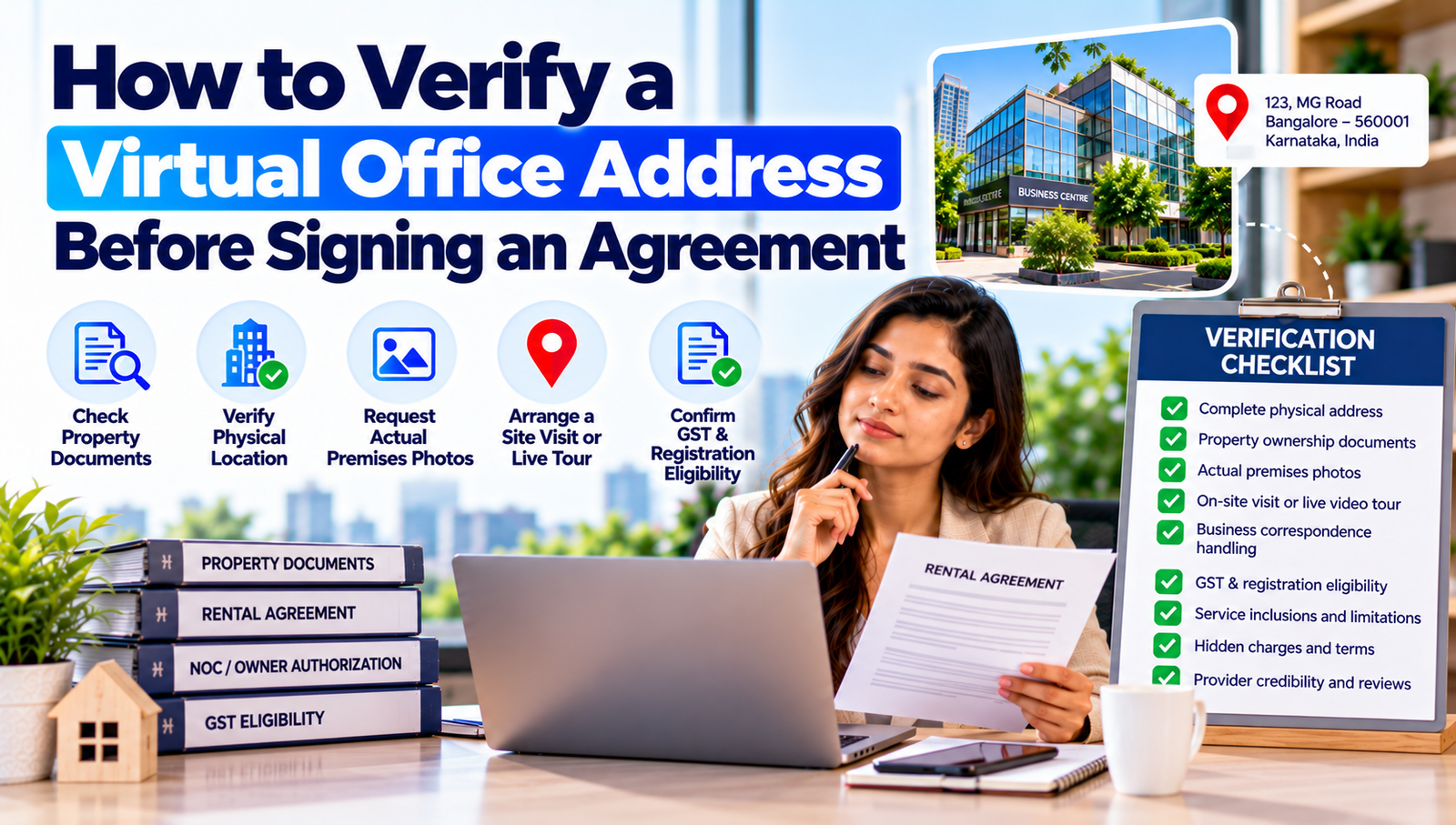
A virtual office can help businesses maintain a professional address without renting a dedicated office. For startups, consultants, remote teams and expanding companies, this arrangement may reduce administrative costs while providing access to correspondence handling and other business services.
However, not every virtual office address is suitable for every purpose.
An address may appear legitimate on a provider’s website but lack the documentation or premises authorisation required for the business’s intended use. In other cases, the property may exist, but the agreement may only permit mail handling rather than GST registration or use as a company’s registered office.
This is why virtual office address verification is important before signing an agreement or making payment.
Verifying the address involves checking the physical premises, property documents, owner authorisation, permitted address usage, provider credibility and contract terms.
This guide explains how to verify a virtual office address in India, what documents to review, which warning signs to identify and how to reduce avoidable registration and service-related problems.
What Is Virtual Office Address Verification?
Virtual office address verification is the process of checking whether a proposed business address is genuine, properly authorised and suitable for its intended use.
Meaning of Virtual Office Address Verification
Verification involves examining the physical location, premises documentation, provider arrangements and contractual rights associated with the address.
It helps businesses understand what they are actually purchasing.
Why Address Verification Matters Before Signing
Signing an agreement without checking the premises can expose a business to documentation problems, service limitations and unexpected expenses.
Verification helps identify these issues before the business commits to a contract.
Difference Between Address Authenticity and Registration Eligibility
A genuine address is not automatically eligible for GST or company registration.
| Address Authenticity | Registration Eligibility |
|---|---|
| Confirms that the premises exist | Assesses suitability for the intended registration |
| Involves location verification | Involves legal and documentary requirements |
| May include physical inspection | May require premises authorisation |
| Does not guarantee registration | Depends on applicable law and the actual arrangement |
What Businesses Should Verify Before Making Payment
Before paying, confirm:
- Complete physical address
- Provider identity
- Premises ownership or occupancy rights
- Permitted address usage
- Available supporting documents
- Mail handling arrangements
- Agreement duration
- Total charges
- Cancellation and refund conditions
Why Should You Verify a Virtual Office Address Before Renting It?
Verifying the address before renting can reduce preventable business risks.
Avoiding Invalid or Unusable Addresses
An address may be incomplete, incorrectly advertised or unsuitable for the business’s intended purpose.
Checking the premises helps identify such problems.
Reducing GST and Company Registration Documentation Problems
GST and MCA processes may require premises evidence and proof of the applicant’s right to use the address.
Incomplete or inconsistent documents can create objections.
Preventing Agreement and Ownership Disputes
A provider should have appropriate authority to offer the relevant address-use rights.
Verification helps reduce the risk of entering into an arrangement that the provider cannot legitimately support.
Ensuring Reliable Mail and Courier Handling
Businesses should confirm that correspondence can actually be received and managed at the location.
Avoiding Unexpected Charges and Service Limitations
A low advertised price may exclude registration documentation, mail forwarding, meeting rooms or other services.
How to Check Whether a Virtual Office Address Is Genuine
Start by establishing whether the premises exist and whether the provider genuinely operates or has authority there.
Verify the Complete Physical Address
Request the complete address, including building name, floor, unit number, locality, city, state and PIN code.
Check the Building and Commercial Location
Review the location through available maps and business directories.
Online listings can support preliminary checks but should not be treated as conclusive evidence.
Request Actual Premises Photographs
Ask for current photographs showing the building entrance, office space and relevant facilities.
Arrange a Physical Visit or Live Video Walkthrough
Where practical, visit the premises.
If an in-person visit is difficult, request a live video walkthrough that identifies the actual location.
Confirm the Office Exists and Is Operational
Check whether the premises are identifiable and whether the provider can deliver the advertised services.
Check Whether Business Correspondence Can Be Received
Ask who receives mail, how it is recorded and how clients are notified.
Physical Verification Checklist
| Check | What to Confirm |
|---|---|
| Complete address | Accurate building and unit details |
| Building | Genuine and identifiable |
| Premises | Actual office location |
| Provider presence | Appropriate authority or operating arrangement |
| Mail handling | Reliable receiving procedures |
| Access | Available as contractually promised |
What Property Documents Should You Verify for a Virtual Office?
Property documents help establish the provider’s relationship with the premises and the applicant’s proposed usage rights.
Property Ownership or Occupancy Proof
Request appropriate evidence showing who owns or lawfully occupies the premises.
Rental or Lease Agreement
If the provider occupies the premises under a lease, review whether the arrangement permits the services and address-use rights being offered.
Owner Consent or No Objection Certificate
An NOC or consent letter may be relevant where the proposed arrangement requires owner authorisation.
Utility Bill or Other Accepted Address Proof
A relevant utility bill or other accepted premises document may help confirm the property address.
Authorisation for Subletting or Third-Party Address Use
Where a provider grants rights to another business, check whether the provider has authority to do so.
Not every shared-office service legally constitutes a sublease, so the applicable arrangement should be reviewed on its own terms.
Matching the Property Details Across Documents
Compare the address, unit number and parties identified in the documents.
Document Verification Table
| Document | Purpose | What to Check |
|---|---|---|
| Ownership evidence | Establishes ownership | Correct property |
| Lease agreement | Establishes occupancy | Permitted use |
| NOC/consent | Establishes permission | Issuer’s authority |
| Utility bill | Supports address details | Correct premises |
| Service agreement | Defines client rights | Intended business use |
How to Verify a Virtual Office Rental Agreement Before Signing
The agreement determines the services and rights provided to the business.
Correct Business and Provider Details
Check that the legal names and relevant business details are accurate.
Complete Address and Premises Description
The agreement should clearly identify the premises covered by the arrangement.
Permitted Business Address Uses
Confirm whether the agreement permits:
- Business correspondence
- GST place-of-business use, where appropriate
- MCA registered-office use, where appropriate
- Meeting-room access
- Other agreed services
Agreement Duration and Renewal Conditions
Review the start date, expiry date, renewal procedure and notice period.
Mail Handling and Additional Services
Check which services are included and which incur additional charges.
Termination and Refund Conditions
Understand when either party may terminate the agreement and whether any refund is available.
Responsibility for Registration Documentation
Confirm which documents the provider agrees to supply and whether any additional charges apply.
How to Verify a Virtual Office NOC and Owner Authorisation
An NOC can be an important supporting document in certain premises arrangements.
What Is an NOC for a Virtual Office?
A No Objection Certificate is a document expressing the relevant person’s consent to a specified use of premises.
Who Should Issue the NOC?
The appropriate issuer depends on the ownership, occupancy and contractual arrangements.
Checking the Owner’s Authority Over the Premises
Verify that the person giving consent has the necessary authority.
Matching NOC Details With the Agreement
Compare the applicant’s name, premises address and permitted use.
Identifying Missing or Inconsistent Information
Look for incorrect unit numbers, inconsistent names or unclear authorisation.
When Additional Authorisation May Be Necessary
Where the provider is a tenant or intermediary, additional evidence may be relevant to establish its authority to grant the proposed rights.
How to Verify a Virtual Office Address for GST Registration
GST registration requires accurate information about the declared place of business.
Principal Place of Business Requirements
The principal place of business must accurately reflect the business’s actual arrangement.
Checking the Right to Use the Premises
The applicant should have a legitimate right to use the premises for the declared purpose.
Verifying Rental Agreement and Address Proof
Check the applicable occupancy documents and ensure that the address details are consistent.
Understanding GST Physical Verification
GST authorities may conduct physical verification in circumstances permitted by the applicable rules.
Common Reasons for Address-Related Objections
Potential issues include:
- Incorrect premises details
- Inconsistent supporting documents
- Insufficient authorisation
- Unverifiable address information
- Inadequate evidence of the declared arrangement
Why a Virtual Office Does Not Guarantee GST Approval
GST approval depends on the applicant’s circumstances and compliance with applicable requirements.
A provider cannot guarantee approval merely by selling an address package.
How to Verify a Virtual Office Address for Company Registration
A company’s registered office must meet the requirements of the Companies Act, 2013.
MCA Registered Office Requirements
Section 12 requires a company to maintain a registered office capable of receiving and acknowledging official communications and notices.
Checking Whether the Address Can Receive Official Communications
Confirm that the premises arrangement supports the receipt of statutory correspondence.
Verifying Registered Office Documents
Review applicable address evidence and premises authorisation.
Owner Authorisation and Premises Rights
Ensure that the business has the necessary permission to use the address as its registered office.
Registered Office Verification Requirements
Companies must comply with applicable registered-office verification and filing requirements.
Ongoing Address Compliance After Incorporation
The registered office must remain valid, and relevant changes must be reported through the applicable MCA procedures.
How to Check Whether a Virtual Office Provider Is Trustworthy
Provider credibility is as important as the address itself.
Verify Business Registration and Contact Information
Check the provider’s legal identity and contact details.
Review the Provider’s Website and Office Details
Compare published information with the actual premises and contractual documents.
Check Independent Customer Reviews
Look for recurring feedback about document delivery, mail handling and customer support.
Reviews are useful indicators but should not replace document verification.
Ask for a Sample Service Agreement
Review the contract before making a payment.
Confirm Mail Handling Procedures
Ask how mail is received, stored, notified and forwarded.
Understand Customer Support and Escalation Processes
Confirm how service problems are reported and resolved.
Check Whether Services Are Delivered Directly or Through Partners
If the provider uses partner locations, establish which entity controls the premises and delivers the services.
What Are the Warning Signs of an Unreliable Virtual Office Address?
Certain warning signs justify additional scrutiny.
Provider Refuses to Share Basic Premises Details
A provider should be able to establish that the advertised premises are genuine.
Sensitive ownership documents may be shared through controlled verification arrangements, but unexplained refusal to provide any credible evidence is concerning.
Address Cannot Be Independently Verified
If the premises cannot be identified, investigate before signing.
Agreement Does Not Clearly Permit Intended Use
A mailing-only agreement should not be assumed suitable for GST or MCA purposes.
Inconsistent NOC and Property Documents
Unexplained discrepancies can indicate documentation problems.
Guaranteed GST or MCA Approval Claims
No provider can guarantee approval irrespective of legal requirements and official verification.
Unclear Mail Handling Arrangements
Unreliable correspondence handling can create business risks.
Hidden Charges or Restrictive Refund Terms
Read the complete agreement and obtain written pricing details.
Warning Signs Checklist
| Warning Sign | Why It Matters |
|---|---|
| Unverifiable premises | Address authenticity concerns |
| No clear agreement | Uncertain contractual rights |
| Inconsistent documents | Potential registration objections |
| Guaranteed approval | Misleading expectations |
| Unclear mail services | Correspondence risk |
| Hidden fees | Unexpected costs |
| No cancellation clarity | Contractual disputes |
What Questions Should You Ask Before Signing a Virtual Office Agreement?
Ask specific questions and request written answers.
Is This Address Suitable for My Intended Business Use?
Explain whether you need correspondence services, GST registration support or MCA registered-office use.
Can I Review the Premises and Supporting Documents?
Ask what evidence is available and whether a visit can be arranged.
Who Owns or Controls the Property?
Understand the provider’s relationship with the premises.
Does the Agreement Permit GST or MCA Registration?
Confirm the contractual rights being granted, while recognising that the agreement alone cannot guarantee regulatory eligibility.
How Are Official Notices and Couriers Handled?
Ask about receiving, notification, forwarding and retention procedures.
What Happens if Registration Is Not Approved?
Clarify the provider’s responsibilities and any available replacement or refund terms.
What Are the Renewal and Cancellation Conditions?
Review notice periods, charges and service termination procedures.
How to Compare Verified Virtual Office Addresses
Once several providers pass basic verification, compare them against your actual requirements.
Physical Location and Accessibility
Consider whether the premises are accessible when needed.
Premises Documentation
Compare the completeness and suitability of the available documents.
GST and MCA Address Suitability
Evaluate each registration purpose separately.
Mail and Courier Services
Compare notification speed, forwarding options and handling procedures.
Meeting Room Availability
Check whether meeting facilities are available and how they are charged.
Pricing and Contract Terms
Compare total annual costs, not only advertised monthly prices.
Provider Responsiveness
Assess how clearly and promptly the provider answers verification questions.
Comparison Scorecard
| Evaluation Factor | Provider A | Provider B | Provider C |
|---|---|---|---|
| Genuine premises verified | Yes/No | Yes/No | Yes/No |
| Appropriate address rights | Yes/No | Yes/No | Yes/No |
| Supporting documents reviewed | Yes/No | Yes/No | Yes/No |
| Mail handling confirmed | Yes/No | Yes/No | Yes/No |
| Meeting facilities | Yes/No | Yes/No | Yes/No |
| Transparent pricing | Yes/No | Yes/No | Yes/No |
| Clear cancellation terms | Yes/No | Yes/No | Yes/No |
What Should You Do If a Virtual Office Address Fails Verification?
Do not proceed with an arrangement that has unresolved material concerns.
Identify the Missing or Inconsistent Information
Record the specific issue.
Request Clarification or Corrected Documents
Ask the provider to explain discrepancies and supply genuine supporting evidence.
Avoid Signing Until Material Issues Are Resolved
Do not rely on verbal assurances where important documents remain inconsistent.
Consider Alternative Premises
Explore another provider or a different premises arrangement if necessary.
Seek Professional Advice for Registration Questions
A qualified GST or company-law professional can help assess complex eligibility issues.
Retain Written Records of Provider Commitments
Keep copies of agreements, quotations and important correspondence.
Final Words
Virtual office address verification should be completed before signing an agreement or paying for a package.
A genuine physical address is only the starting point. Businesses must also verify the provider’s authority, premises documentation, permitted address use, mail handling arrangements and contract terms.
For GST or company registration, it is especially important to distinguish between a basic correspondence address and a premises arrangement that satisfies the relevant legal requirements.
Use this sequence before making a decision:
Verify the location → Check premises rights → Review documents → Confirm intended use → Examine the agreement → Compare costs → Sign
Taking these steps can reduce avoidable documentation problems, service disputes and unexpected expenses.
FAQs About Virtual Office Address Verification
How can I verify a virtual office address in India?
Check the complete physical address, inspect the premises where practical, review the provider’s authority and verify the relevant agreement and supporting documents.
Can I verify a virtual office address online?
Online maps, business records and provider information can support preliminary checks. However, online verification alone may not establish premises rights or registration eligibility.
What documents should I check before renting a virtual office?
Review the service agreement, applicable ownership or occupancy evidence, owner consent where relevant and accepted premises address proof.
How do I verify a virtual office NOC?
Check the issuer’s authority, premises details, applicant information and consistency with the underlying agreement.
Can a virtual office address be used for GST registration?
Potentially, when the actual premises arrangement meets the applicable GST requirements and the applicant provides accurate supporting information.
How can I check if a virtual office is suitable for company registration?
Review whether the address can satisfy the registered-office requirements under the Companies Act, including the ability to receive and acknowledge official communications.
Is a physical visit necessary before signing a virtual office agreement?
A physical visit is not universally mandatory, but it can be a useful verification step. A live video walkthrough and reliable documentation may support preliminary assessment where a visit is impractical.
What should I do if the virtual office provider refuses to share address documents?
Ask what alternative verification evidence is available. If the provider cannot establish the premises and its authority to offer the service, consider another provider.
Does a verified virtual office address guarantee GST approval?
No. Verification can reduce preventable problems, but GST approval depends on the applicant’s actual circumstances and compliance with applicable requirements.