
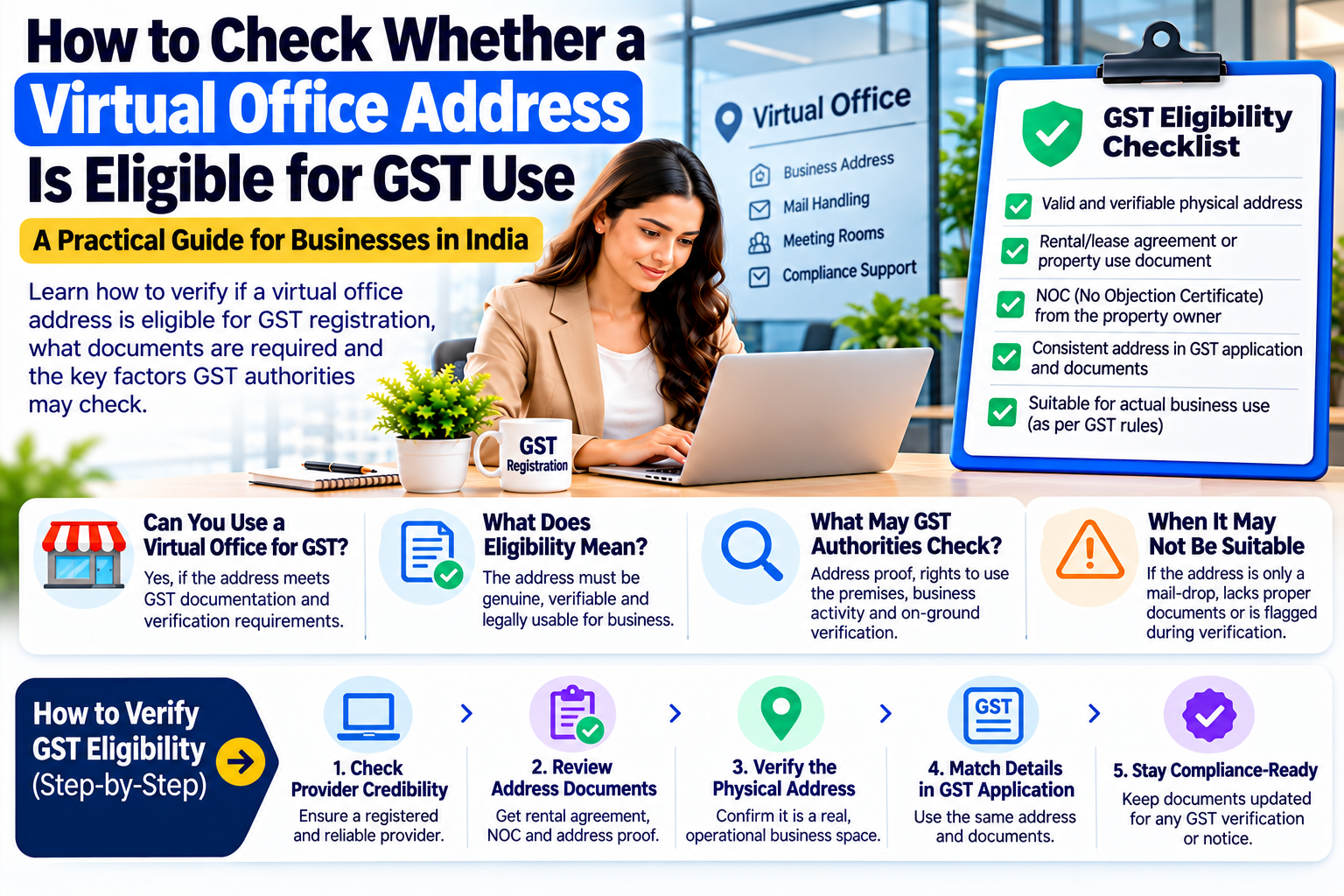
A virtual office can help startups, consultants, e-commerce sellers and growing businesses establish a professional address without renting a conventional office. However, choosing a virtual office for GST registration requires more than selecting a convenient location or purchasing an affordable package.
The address must represent a genuine premises arrangement, and the applicant must provide appropriate information about its right to use the property.
A provider may advertise a location as “GST-ready” or “GST-approved”, but such claims do not automatically establish virtual office GST eligibility.
For example, a provider might offer an address for receiving letters but not grant the business sufficient rights to declare the premises as its principal place of business. Alternatively, the premises may be genuine, but the agreement and supporting documents may contain inconsistent details.
These issues can result in clarification requests, verification difficulties or registration rejection.
This guide explains how to check whether a virtual office address is suitable for GST registration in India, which documents to examine and how to identify potential problems before making payment.
Can You Use a Virtual Office Address for GST Registration in India?
A virtual office address may be used for GST registration when the actual premises arrangement satisfies the applicable legal requirements.
The label “virtual office” does not independently determine whether an address is acceptable.
Is a Virtual Office Address Legally Acceptable for GST?
GST law does not impose a blanket prohibition on every premises arrangement marketed as a virtual office.
What matters is whether the applicant can accurately declare the location as a place of business and provide the appropriate supporting information.
Difference Between a Virtual Office and a Mail-Only Address
A virtual office package may provide a combination of address-use rights, workspace access and correspondence services.
A mail-only address may provide nothing beyond receiving and forwarding letters.
These arrangements are not necessarily equivalent for GST purposes.
Why Genuine Business Use and Address Documentation Matter
The application should accurately describe the premises, nature of possession and business activities.
Supporting documents should reflect the actual arrangement.
Does a Virtual Office Provider Guarantee GST Approval?
No. The registration decision is made under the applicable GST procedures.
A provider’s promise of approval is not a substitute for statutory compliance.
When a Virtual Office May Not Be Suitable
An address may be unsuitable when:
- The premises cannot be verified.
- The provider lacks appropriate authority.
- The agreement does not support the declared use.
- The applicant cannot establish its premises rights.
- The declared activities do not reflect the actual arrangement.
- Supporting documents are inaccurate or unreliable.
What Does Virtual Office GST Eligibility Actually Mean?
Virtual office GST eligibility refers to whether a particular premises arrangement can support a truthful and compliant GST registration application.
Meaning of GST-Eligible Business Premises
A suitable premises arrangement should allow the applicant to accurately declare its business location and provide the required supporting evidence.
There is no universal GST certification that makes every customer of a particular virtual office automatically eligible.
What GST Authorities May Verify
Depending on the application and applicable procedures, authorities may examine the declared address, nature of possession, supporting documents and other relevant information.
Role of the Declared Principal Place of Business
The principal place of business is the primary location specified in the GST registration.
Applicants must identify an appropriate location within the relevant registration jurisdiction.
Difference Between Address Eligibility and GST Registration Approval
| Address Suitability | GST Registration Approval |
|---|---|
| Assesses the proposed premises arrangement | Concerns the applicant’s registration |
| Reviews address-use rights | Reviews applicable registration requirements |
| Examines premises documentation | May involve additional verification |
| Can be assessed before payment | Determined through the official process |
| Does not guarantee approval | Results in the official registration decision |
Why Provider Claims Should Be Independently Verified
A provider may describe its services as GST-compatible, but buyers should independently review the underlying documents and contractual rights.
What GST Requirements Should a Virtual Office Address Meet?
Several practical factors help determine whether an address is appropriate for the intended registration.
Identifiable and Verifiable Physical Address
The premises should have a complete, accurate address that can be identified.
Appropriate Rights to Use the Premises
The applicant should have legitimate rights consistent with the declared business use.
Documents Supporting the Nature of Possession
The supporting documents should correspond to the actual ownership, rental, shared or consent-based arrangement.
Consistency Between Application and Address Proof
Building names, unit numbers and other material address details should match.
Suitability for the Declared Business Activities
The applicant should not declare activities at the premises that do not reflect the actual arrangement.
Availability for Applicable Physical Verification
The location and relevant facts should be capable of genuine verification where legally required.
Ability to Receive Official Correspondence
Reliable correspondence arrangements help businesses manage official notices and other communications.
How to Check Whether a Virtual Office Address Is Eligible for GST Use
Use the following ten-step process before signing an agreement.
Step 1: Verify the Complete Physical Address
Request the building name, unit number, floor, street, locality, city, state and PIN code.
Check whether the premises can be independently identified.
Step 2: Confirm the Provider’s Right to Offer the Premises
Establish whether the provider owns the property, occupies it under an agreement or operates through an authorised partner.
Step 3: Check the Rental, Licence or Service Agreement
Review the agreement to determine what rights the applicant receives.
A service agreement should not be assumed to provide the same rights as a lease.
Step 4: Verify the Owner’s Consent or NOC Where Required
Where the arrangement requires consent, confirm that it is issued by an appropriately authorised person.
Step 5: Check Utility Bills and Supporting Address Proof
Compare the premises details across the supporting documents.
Step 6: Confirm the Permitted Business Use
Ask whether the agreement supports the specific activities the applicant intends to declare.
Step 7: Assess Physical Verification Readiness
Confirm that the premises are genuine, identifiable and accurately represented in the application.
Step 8: Review Previous Address-Related Issues
Ask the provider about known problems that may affect the proposed arrangement.
A previous customer’s rejection does not automatically make the premises unusable, but unresolved issues warrant investigation.
Step 9: Obtain Written Clarification Before Payment
Request written confirmation of the documents and services included in the package.
Step 10: Seek Professional Advice Where Eligibility Is Unclear
Consult a qualified GST professional when the premises rights or registration implications are uncertain.
What Documents Are Required to Use a Virtual Office for GST Registration?
The required premises evidence depends on the nature of possession.
Rental or Lease Agreement
For rented or leased premises, a valid agreement and appropriate supporting ownership evidence are generally relevant.
Licence or Other Applicable Premises Agreement
Some arrangements operate through a licence or another contractual structure.
The document must genuinely establish the rights claimed by the applicant.
Owner Consent or No Objection Certificate
Consent documentation may be appropriate where the premises are used with permission rather than under a conventional rental arrangement.
Electricity Bill or Other Accepted Address Proof
An electricity bill, property tax receipt, municipal Khata document or other accepted evidence may support the premises address.
Property Ownership or Occupancy Evidence
Check whether the person granting the premises rights has appropriate authority.
Supporting Documents for Shared Premises
Shared premises can be supported through the applicable rental or consent-based evidence.
Business Applicant Documents vs Provider Documents
The applicant must supply its own registration information and applicable business documents.
The provider may supply premises-related evidence, but it cannot replace the applicant’s statutory responsibilities.
Document Validity and Address Consistency
Check that documents are genuine, relevant and consistent with the proposed application.
GST Premises Documentation Checklist
| Arrangement | Documents to Review |
|---|---|
| Owned premises | Accepted ownership/address evidence |
| Rented premises | Rent/lease agreement and applicable ownership proof |
| Consent-based premises | Consent letter and relevant supporting evidence |
| Shared premises | Appropriate rental or consent documentation |
| Virtual office | Genuine contractual rights and evidence matching the actual arrangement |
The CBIC’s Instruction No. 03/2025-GST provides specific guidance on documentary requirements, including rented, consent-based and shared premises. Applicants should consult the applicable instructions rather than assume every possible property document is mandatory.
How Can You Verify a Virtual Office Provider’s Property Documents?
Document verification helps establish whether the provider can legitimately offer the advertised address-use rights.
Match the Address Across All Documents
Compare the building name, floor, unit number and other relevant details.
Confirm the Identity of the Property Owner or Authorised Occupant
Check appropriate evidence identifying the person or entity controlling the premises.
Check the Provider’s Authority to Grant Use Rights
Where the provider operates through a lease or partner arrangement, confirm that the relevant rights are supported.
Review Agreement Validity and Renewal Terms
The premises arrangement should remain valid for the intended period.
Verify Signatures and Relevant Authorisations
Review the executed documents and relevant authority of the signatories.
Identify Missing or Contradictory Information
Unexplained discrepancies should be resolved before filing.
What to Do if the Provider Cannot Explain the Premises Arrangement
Request written clarification or consider another provider.
Do not rely on fabricated documents or unsupported representations.
Does GST Physical Verification Affect Virtual Office Eligibility?
Physical verification can be relevant to a GST application, but not every applicant is automatically subject to the same verification process.
When Physical Verification May Be Conducted
GST authorities may conduct physical verification in circumstances permitted by the applicable registration rules.
What Officers May Check at the Declared Address
Depending on the verification, officers may examine the premises and whether the declared business arrangement can be established.
Importance of the Actual Premises and Business Arrangement
The physical location should correspond to the information provided in the application.
Address Accessibility and Identification
Accurate building details and identifiable premises help avoid unnecessary confusion.
How to Prepare Accurate Supporting Information
Maintain genuine agreements, relevant premises evidence and accurate descriptions of business activities.
Common Verification Problems
Potential issues include incorrect address information, inaccessible premises, inconsistent documents and inability to establish the declared arrangement.
What Happens if the Premises Cannot Be Verified
The applicant may receive clarification requests or face an adverse registration decision, depending on the facts and applicable procedures.
Can a Virtual Office Be Used as a Principal or Additional Place of Business Under GST?
A qualifying virtual office arrangement may potentially support either classification, depending on the actual business activities.
Principal Place of Business Requirements
The principal place is the primary business location specified in the registration.
Additional Place of Business Requirements
An additional place is another qualifying location associated with the same GST registration.
When a Shared Office May Be Suitable
A shared office may qualify where the applicant has legitimate premises rights and the declared business activities accurately reflect the arrangement.
Difference Between Business Use and Mail Forwarding
Receiving mail at an address does not automatically establish that the premises are the applicant’s place of business.
Declaring Multiple Locations Within the Same State
A GSTIN can generally include a principal place and multiple additional places within the relevant state or union territory.
When a Separate State GST Registration May Be Necessary
Establishing a place of business in another state may create separate GST registration obligations.
What Are the Warning Signs of a Virtual Office Address That May Not Be Suitable for GST?
The following warning signs should be investigated before purchasing a package.
No Verifiable Physical Premises
The provider cannot establish that the advertised address corresponds to genuine premises.
Incomplete or Inconsistent Address Proof
The documents contain unexplained differences in the property details.
Missing Owner Authorisation
Necessary premises rights cannot be demonstrated.
Provider Cannot Explain Property Use Rights
The provider cannot explain whether it owns, rents or otherwise controls the property.
Agreement Does Not Permit the Intended Business Use
The contract only authorises services that do not match the applicant’s declared activities.
Unclear Physical Verification Arrangements
The provider cannot establish how the genuine premises arrangement would be verified.
Unsupported Claims of Guaranteed GST Approval
The provider promises approval regardless of the applicant’s circumstances.
Repeated Address-Related Objections Without Explanation
The provider reports recurring registration problems but cannot explain their causes.
Why Do Virtual Office Addresses Face GST Registration Objections or Rejection?
Registration problems may arise from the premises information, supporting documents or other aspects of the application.
Address Mismatch in Supporting Documents
Different property details can create questions about the declared location.
Insufficient Proof of Premises Use
The applicant may not establish the right to use the premises as declared.
Unclear Nature of Possession
The selected possession category may not match the supporting agreement.
Incomplete Registration Application
Missing or inaccurate information can delay processing.
Physical Verification Concerns
Adverse verification findings may affect the application.
Failure to Respond to Clarification Notices
Missing the applicable response deadline may result in rejection.
Difference Between a Clarification Notice and Final Rejection
A clarification notice requests additional information.
A rejection is a formal decision communicated through the prescribed process.
During registration, these processes generally involve GST REG-03 for clarification, GST REG-04 for the applicant’s response and GST REG-05 for rejection.
What Should You Do if Your Virtual Office Address Fails a GST Eligibility Check?
Do not proceed with an application containing known inaccuracies.
Identify the Specific Documentation or Premises Issue
Determine whether the problem concerns the address, occupancy rights, agreement or intended use.
Request Corrected Documents From the Provider
Ask for genuine corrections supported by the actual facts.
Confirm Whether Alternative Evidence Is Acceptable
Review the applicable GST documentation instructions.
Reassess the Intended Use of the Address
Determine whether the proposed arrangement genuinely supports the declared business activities.
Compare Other Suitable Business Premises
Consider an alternative provider or premises arrangement where necessary.
Avoid Filing With Known Inaccuracies
Do not submit false premises information or misleading documents.
Seek GST Professional Guidance When Needed
Professional advice may be appropriate for complex arrangements or unresolved registration concerns.
How to Choose a Virtual Office Provider for GST Registration
Choose a provider based on genuine premises rights and reliable documentation rather than marketing promises.
Verifiable Business Premises
The address should correspond to identifiable physical premises.
Transparent Ownership and Occupancy Documentation
The provider should be able to explain its authority to offer the relevant services.
Clear Rental or Licence Terms
The agreement should describe the customer’s actual rights.
Appropriate Consent and Address Proof
Relevant premises evidence should be available.
Honest Explanation of GST Suitability
A provider should explain limitations without guaranteeing approval.
Physical Verification Cooperation Where Applicable
The provider should be able to support genuine verification of the declared arrangement.
Transparent Pricing and Refund Terms
Review the complete costs, cancellation provisions and any replacement-address arrangements.
Reliable Support for Documentation Updates
Check whether updated agreements and other necessary documents can be provided when circumstances change.
Virtual Office GST Eligibility Checklist Before Paying
Use this checklist before purchasing a virtual office package.
Verify the Address and Premises
Confirm the complete address and existence of the location.
Review the Provider’s Authorisation
Establish whether the provider has the appropriate premises rights.
Confirm Applicable GST Documents
Check the documents relevant to the actual ownership or occupancy arrangement.
Check Permitted Business Activities
Ensure the contract supports the intended use.
Assess Verification Risks
Identify unresolved documentation or premises issues.
Review Agreement and Refund Conditions
Understand the services, charges and contractual obligations.
Keep Written Confirmation and Document Copies
Retain the agreement, supporting evidence and important provider correspondence.
Final Pre-Payment Checklist
| Verification Item | Status |
|---|---|
| Complete physical address verified | Yes / No |
| Premises existence established | Yes / No |
| Provider authority checked | Yes / No |
| Agreement reviewed | Yes / No |
| Appropriate address proof available | Yes / No |
| Owner consent checked, if required | Yes / No |
| Intended business use confirmed | Yes / No |
| Verification concerns addressed | Yes / No |
| Refund and renewal terms reviewed | Yes / No |
| Documents and commitments retained | Yes / No |
If a material issue remains unresolved, investigate before signing or paying.
Final Words
Checking virtual office GST eligibility is an important step before using a virtual office address for GST registration in India.
The key question is not whether the provider advertises the address as GST-approved. It is whether the actual premises arrangement, applicant’s rights and supporting documents satisfy the applicable requirements.
Businesses should verify the physical address, examine ownership and occupancy evidence, review the agreement and confirm that the declared activities accurately reflect the premises arrangement.
A practical approach is:
Verify the address → Confirm premises rights → Review documents → Assess intended use → Check verification readiness → Resolve concerns → Apply for GST registration
Completing these checks before payment can reduce avoidable documentation problems and help businesses make a more informed decision.
FAQs About Virtual Office GST Eligibility
Is a virtual office address valid for GST registration in India?
Potentially, yes. GST law does not automatically prohibit every arrangement marketed as a virtual office. The actual premises arrangement must meet the applicable requirements.
How can I check whether a virtual office is eligible for GST?
Verify the physical address, provider authority, premises agreement, supporting documents and suitability for the intended business activities.
What documents are required for virtual office GST registration?
The required documents depend on the premises arrangement and may include a rent or lease agreement, consent letter, relevant ownership evidence and accepted address proof.
Is an NOC mandatory for a virtual office under GST?
Not in every arrangement. Consent documentation may be appropriate where the premises are used with permission, while other arrangements may be supported by different accepted documents.
Can GST registration be rejected because of a virtual office address?
Registration may be rejected if the application fails to satisfy applicable requirements. The virtual office label alone does not establish a ground for rejection.
Can I use a virtual office as my principal place of business?
Potentially, if the premises arrangement genuinely supports the declared principal place of business and meets the applicable requirements.
Can I use the same virtual office address as an additional place of business?
A qualifying shared premises arrangement may support an additional place of business declaration. Merely receiving mail there does not automatically make it an APOB.
Does a GST officer physically verify virtual office addresses?
Physical verification may be conducted in circumstances permitted by GST law. It is not necessarily mandatory for every virtual office application.
Can multiple businesses register for GST at the same virtual office address?
Shared premises are not automatically prohibited. Each applicant must meet the applicable requirements and accurately establish its own business arrangement.
What should I do if my virtual office provider cannot supply address proof?
Request an explanation and determine whether another accepted form of evidence is available. If the necessary premises rights or documentation cannot be established, consider another provider.