
AI Overview
A Virtual Office for Marketplace Sellers can provide an online seller with a professional business address and supporting address documentation, subject to the provider’s terms and the requirements of the relevant authority or marketplace.
However, sellers should not assume that one address automatically serves every purpose.
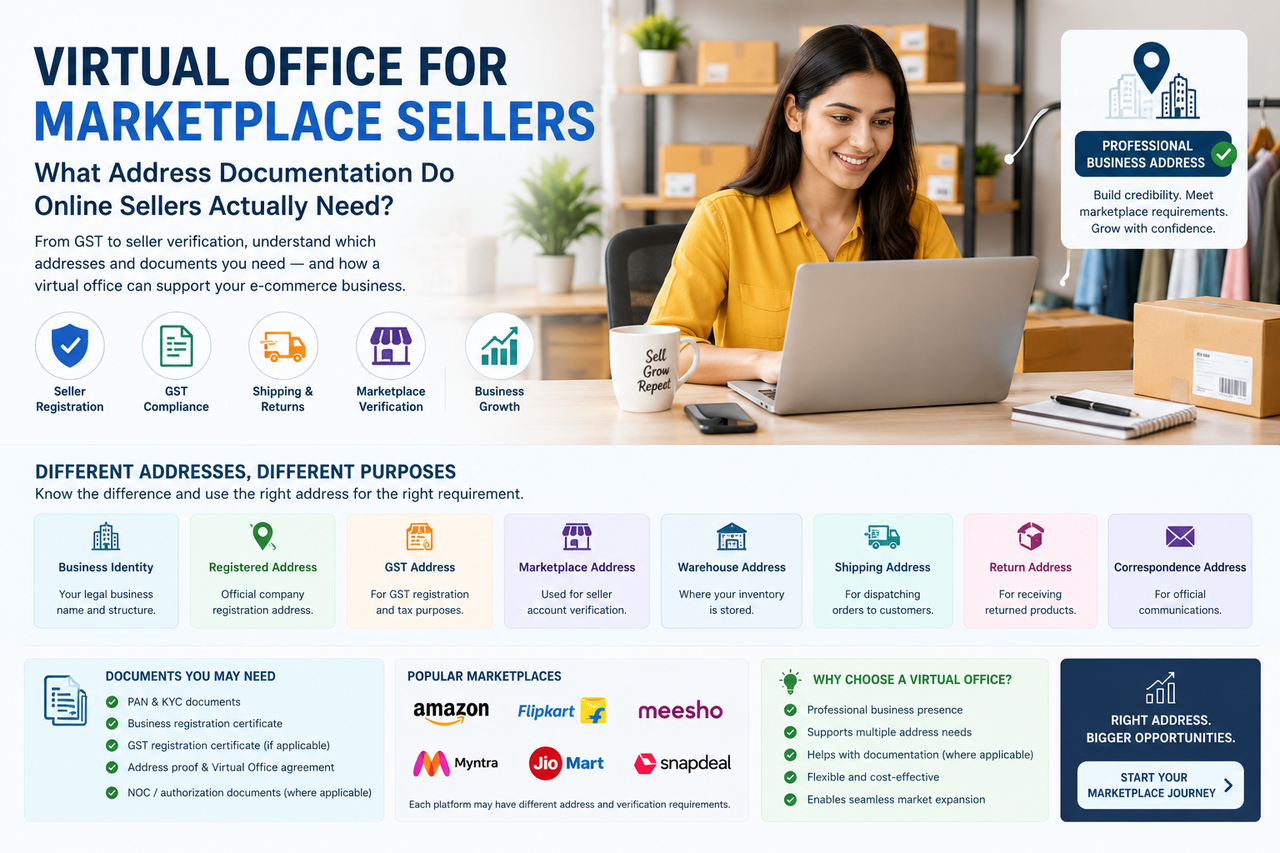
An online business may have several different address requirements, including its registered business address, GST registration address, marketplace account address, warehouse or fulfilment location, shipping address, return address, and correspondence address.
The correct approach is to identify what each platform or authority requires, obtain the appropriate documentation, and keep business information consistent across records.
A Virtual Office can be useful for eligible address-related requirements, but it does not automatically guarantee marketplace approval, GST registration, bank approval, or verification by every platform.
Introduction: Why Address Documentation Matters for Marketplace Sellers
Starting an online store can be remarkably simple.
A seller can source products, create product listings, photograph inventory, advertise on social media and begin receiving orders without maintaining a traditional office.
But as the business grows, another question appears:
What address should be used for the business?
This question becomes particularly important when an online seller starts dealing with:
- GST registration
- Marketplace onboarding
- Seller verification
- Business banking
- Suppliers
- Courier companies
- Warehouses
- Returns
- Invoices
- Government registrations
- Corporate buyers
For a home-based seller, using a residential address may initially seem convenient. But as the business becomes more established, the seller may prefer a dedicated business address.
This is where a Virtual Office for Marketplace Sellers can become relevant.
A Virtual Office can provide a professional commercial address without requiring the seller to maintain a conventional office with dedicated desks, furniture and daily occupancy.
However, the important part is understanding what that address is actually being used for.
A business address isn’t necessarily the same thing as a warehouse.
A GST registration address isn’t automatically the same as a shipping location.
And a marketplace’s seller verification requirements may differ from the requirements of a government authority.
Understanding these distinctions can help sellers avoid documentation problems later.
What Is a Virtual Office for Marketplace Sellers?
A Virtual Office provides a business with access to a professional address and, depending on the service package, additional facilities such as mail handling, call support or meeting-room access.
For an online seller, the address can potentially be useful for permitted business purposes where the relevant requirements are satisfied.
For example, an e-commerce entrepreneur operating from home might not want their residential address to appear throughout their business documentation.
A Virtual Office can offer an alternative business address where appropriate.
The seller can then maintain a more structured separation between:
Home → Personal activities
and
Business address → Business correspondence and permitted registrations
The exact permitted use depends on the provider, the location, the documentation available and the requirements of the relevant authority or platform.
Therefore, sellers should always confirm the intended use before purchasing a Virtual Office plan.
The Most Important Concept: One Business Can Have Multiple Addresses
One of the biggest sources of confusion for marketplace sellers is assuming that a company must have one single address for everything.
In practice, different activities can involve different locations.
For example:
| Address Type | Primary Purpose |
| Registered Business Address | Official company/business records |
| GST Registration Address | Tax registration |
| Marketplace Address | Seller account/business information |
| Warehouse Address | Storage and inventory |
| Shipping Address | Dispatching products |
| Return Address | Receiving returned products |
| Correspondence Address | Business communication |
| Meeting Address | Client or partner meetings |
These addresses may sometimes be the same.
But they don’t have to be identical in every business model.
The critical point is that the information submitted must be accurate and supported by appropriate documentation.
Registered Business Address vs Marketplace Seller Address
A registered business address is associated with the legal or official registration of a business.
A marketplace seller address, meanwhile, is information submitted to an online platform as part of its seller account or business verification process.
The two can overlap.
For example, a business may use the same eligible address for its formal registration and marketplace account.
But a marketplace may also request additional information relating to:
- Seller identity
- GST details
- Product category
- Pickup location
- Warehouse
- Bank account
- Contact information
Therefore, sellers should not assume that having a registered business address automatically completes marketplace verification.
GST Address vs Warehouse Address: Are They the Same?
This is one of the most important questions for online sellers.
No, they should not automatically be treated as the same thing.
A GST registration address relates to the location declared for GST purposes and must satisfy the applicable GST requirements.
A warehouse is primarily where inventory is stored or handled.
Consider a simple example.
An online seller may have:
Business/GST address: A professional commercial address
Warehouse: A third-party fulfilment centre
Pickup location: A logistics facility
Return location: A separate warehouse or service location
This structure can be perfectly logical from an operational perspective, provided the business accurately declares locations and complies with applicable requirements.
The mistake is assuming that a Virtual Office can simply be presented as a warehouse when the business does not actually operate inventory there.
Can Marketplace Sellers Use a Virtual Office?
Potentially, yes, depending on the marketplace’s rules and the intended use.
A Virtual Office can be relevant for sellers who need a professional business address but operate their actual e-commerce activities from:
- Home
- A warehouse
- A fulfilment partner
- A manufacturing unit
- A logistics facility
- Multiple locations
However, marketplace acceptance is not universal.
Every platform can establish its own verification process.
A marketplace may request information about the seller’s:
- Business identity
- GST registration
- Bank account
- Pickup location
- Inventory location
- Return address
- Business address
Therefore, the correct question isn’t simply:
“Does this marketplace accept virtual offices?”
Instead, ask:
“Does the marketplace accept this type of address for this specific purpose, and what supporting documents does it require?”
That distinction is much more useful for sellers.
What Address Documents May Marketplace Sellers Need?
Documentation varies depending on the seller’s business structure and the platform involved.
A Virtual Office package may provide some address-related documentation, while the marketplace or government authority may require additional documents.
Common business documentation can include:
- PAN
- Aadhaar or other KYC documentation where applicable
- Business registration documents
- GST registration documentation, where applicable
- Address proof
- Virtual Office agreement
- NOC or authorization documentation, where applicable
- Premises-related documents
- Bank account information
- Business licenses or registrations applicable to the product category
Not every seller will need every document.
The best practice is to create a documentation checklist before submitting an application.
Why Online Sellers Choose a Professional Business Address
1. Separation From a Residential Address
Home-based entrepreneurs often begin with their residential address.
As the business grows, maintaining a separate business address can provide greater separation between personal and commercial activities.
2. More Professional Business Information
A dedicated commercial address can look more structured when displayed on business documents, invoices, websites or correspondence where appropriate.
This can be particularly useful for sellers transitioning from a side business into a formal company.
3. Easier Business Administration
When business correspondence, registrations and commercial communication are organized around a dedicated address, maintaining records can become easier.
4. Supports a Remote Business Model
Many online sellers don’t need employees sitting in an office every day.
Their actual operations may involve:
- Product sourcing
- Inventory management
- Warehousing
- Photography
- Marketplace management
- Customer service
- Advertising
- Logistics
A traditional office may therefore be unnecessary for certain sellers.
5. Useful for Expansion
An e-commerce company may eventually sell across multiple states.
A suitable business-address solution can form part of a broader expansion strategy where the business needs a presence in a particular location for a permitted purpose.
The exact GST and registration implications should be assessed separately for each situation.
Who Should Consider a Virtual Office for Marketplace Selling?
A Virtual Office can be particularly relevant to certain types of sellers.
Home-Based E-commerce Entrepreneurs
Someone operating an online store from home may want to establish a separate business address.
D2C Brands
Direct-to-consumer brands often operate through websites, marketplaces and social media while keeping teams relatively small.
Marketplace-First Businesses
Businesses selling primarily through online marketplaces may not need customer-facing retail premises.
Dropshipping Businesses
Where the seller doesn’t maintain conventional retail premises, a business address can still be relevant for administrative purposes.
However, the actual fulfilment and product-related requirements need to be handled separately.
Private Label Sellers
A seller developing their own brand may eventually require a more formal business structure and documentation system.
Multi-Category Sellers
As a seller adds products, suppliers and marketplaces, maintaining organized business records becomes increasingly important.
Virtual Office for Marketplace Sellers: Key Benefits
Professional Business Presence
A commercial business address can create a more formal presence for an online-first business.
Potentially Lower Infrastructure Costs
Sellers who don’t need daily office space don’t necessarily have to maintain a conventional office solely for address-related purposes.
Better Separation of Business and Personal Information
A dedicated business address can reduce dependence on a residential address for permitted commercial uses.
Flexible Business Model
The seller can operate remotely while maintaining a formal business presence.
Support for Business Documentation
Depending on the service package, the provider may supply documentation required for particular permitted uses.
Meeting Facilities
Some Virtual Office plans include access to meeting facilities, which can be useful for supplier, partner or client meetings.
Easier Geographic Positioning
A seller entering a new commercial market can investigate appropriate business-address options without immediately renting a permanent office.
What a Virtual Office Does NOT Replace
This is equally important.
A Virtual Office is not automatically a replacement for every physical business facility.
It generally should not be confused with:
- Warehouse
- Factory
- Retail store
- Fulfilment centre
- Manufacturing facility
- Product showroom
- Operational branch
- Physical customer-service centre
If your business needs to physically store inventory, process products or conduct regulated operations, you need to meet the requirements applicable to those activities.
For example, an e-commerce seller cannot assume that obtaining a Virtual Office means inventory can be considered stored at that address.
The business should accurately represent where its operations actually occur.
Marketplace Verification Can Still Fail
One of the most important points for sellers is this:
A Virtual Office does not guarantee verification approval.
A platform can reject an application or request additional documentation for several reasons.
For example:
- Information doesn’t match
- Documents are incomplete
- Address cannot be verified
- Business information is inconsistent
- Additional KYC is required
- The marketplace has specific location requirements
- The submitted address isn’t permitted for that purpose
This is why sellers should avoid treating a Virtual Office as a guaranteed verification shortcut.
Instead, think of it as a business-address solution that may support a compliant documentation setup when the intended use is accepted.
How to Maintain Consistent Business Information
Online sellers often use multiple platforms.
For example:
- Amazon
- Flipkart
- Their own website
- Payment gateways
- Social media
- GST records
- Bank accounts
- Supplier portals
Information should be carefully maintained across these systems.
Create a master business-information sheet containing:
Legal business name
Business type
PAN
GSTIN, where applicable
Registered address
Correspondence address
Warehouse locations
Return locations
Official phone number
Business email
Bank account information
Whenever an address changes, review all relevant platforms and records.
Consistency can reduce unnecessary verification issues.
Step-by-Step: How to Choose a Virtual Office for Marketplace Selling
Step 1: Identify Why You Need the Address
First determine the actual purpose.
Is it for:
- Business registration?
- GST?
- Correspondence?
- Marketplace account information?
- Client meetings?
- Expansion?
Don’t buy a package before identifying the requirement.
Step 2: Check Marketplace Requirements
Read the relevant marketplace’s seller onboarding and verification requirements.
Look specifically for address-related documentation.
Step 3: Confirm GST Requirements Separately
If you need the address for GST registration, check the applicable GST requirements rather than relying solely on marketplace information.
Step 4: Choose the Location
Consider:
- Target market
- Commercial relevance
- Documentation
- Accessibility
- Meeting facilities
- Pricing
- Mail handling
Step 5: Complete KYC
Provide the requested business and identity documents to the provider.
Step 6: Review the Documentation
Before submitting the address to a marketplace or authority, verify that:
- Business name is correct
- Address is written consistently
- Documents are current
- Agreement details are accurate
- Any NOC/authorization documents are available where applicable
Step 7: Submit the Address
Use the address only for the purpose for which it is valid and permitted.
Step 8: Keep Records Updated
Maintain copies of:
- Agreements
- Address proofs
- Registration certificates
- GST documents
- Business records
This makes future verification easier.
How Much Does a Virtual Office Cost for Marketplace Sellers?
Pricing varies based on:
- City
- Business district
- Provider
- Contract period
- Documentation
- Mail handling
- Meeting-room access
- Additional services
Instead of looking only at the advertised monthly price, compare the total value of the package.
| Factor | Virtual Office | Traditional Office |
| Business address | Yes, depending on plan | Yes |
| Dedicated workspace | Usually no | Yes |
| Initial investment | Lower | Higher |
| Furniture | Usually unnecessary | Required |
| Utilities | Limited/plan dependent | Additional |
| Mail handling | Plan dependent | Usually internal |
| Meeting rooms | Plan dependent | Available |
| Best suited for | Online/remote businesses | Businesses needing daily workspace |
For a marketplace seller who mainly needs an address and documentation support rather than daily office occupancy, a Virtual Office may be more appropriate than paying for an unused physical office.
How to Select the Right City
There isn’t one universally “best” city for every online seller.
Your location should support your business strategy.
Mumbai
Useful for businesses targeting western India and major commercial networks.
Delhi NCR
Attractive for businesses targeting North India and the wider NCR market.
Ahmedabad
Relevant for businesses connected to manufacturing, trading and western India’s commercial ecosystem.
Bengaluru
Potentially useful for technology-driven brands and businesses targeting India’s major startup and technology ecosystem.
Hyderabad
A significant commercial and technology market.
Chennai
Important for businesses connected with southern India’s manufacturing, logistics and commercial ecosystem.
The right city depends on your customers, suppliers, logistics, expansion plans and actual business requirements.
A premium city name alone doesn’t make an address strategically valuable.
Virtual Office vs Home Address for Marketplace Sellers
| Factor | Home Address | Virtual Office |
| Setup | Simple | Requires provider onboarding |
| Privacy | Lower | Potentially higher |
| Professional appearance | Depends on location | Generally more commercial |
| Business correspondence | Personal/business mixed | Can be separated |
| Remote operation | Yes | Yes |
| Cost | Low direct cost | Paid service |
| Documentation | Depends on ownership/lease | Provider-dependent |
| Marketplace acceptance | Platform-dependent | Platform-dependent |
A home address isn’t inherently unsuitable.
The question is whether it remains practical for the seller’s business, privacy preferences and documentation requirements.
Common Mistakes Marketplace Sellers Should Avoid
Mistake 1: Assuming Every Marketplace Accepts Every Address
Marketplace policies can differ.
Always verify current requirements.
Mistake 2: Confusing a Virtual Office With a Warehouse
An address service doesn’t automatically become an inventory facility.
Mistake 3: Using Different Business Names
If your legal business name, GST records and marketplace account contain inconsistent information, verification may become more complicated.
Mistake 4: Buying the Cheapest Plan Without Checking Documents
The cheapest address isn’t necessarily the most useful one.
Check what documentation is included.
Mistake 5: Assuming GST and Marketplace Requirements Are Identical
They aren’t necessarily.
Treat each requirement separately.
Mistake 6: Making Unsupported Claims
Don’t describe a Virtual Office as a warehouse, branch or operational location if it isn’t one.
Accurate representation matters.
Why Choose Vo Spaces?
For an online seller, selecting a Virtual Office provider should be based on more than the address itself.
When evaluating Vo Spaces, sellers should look at the services and documentation included in the relevant plan and confirm that the selected location is suitable for their intended business use.
Important factors to evaluate include:
- Professional commercial locations
- Address documentation
- KYC support
- Mail handling
- Business correspondence
- Meeting-room availability
- Location options
- Customer support
- Agreement terms
- Renewal process
Most importantly, sellers should communicate their intended purpose clearly.
If the objective is GST registration, marketplace verification, business registration or another formal process, confirm whether the specific address and documentation meet the applicable requirements before proceeding.
A responsible Virtual Office provider should provide clarity about the service rather than promising automatic acceptance everywhere.
Frequently Asked Questions
1. Can marketplace sellers use virtual offices?
Marketplace sellers may be able to use a Virtual Office for certain business-address purposes, depending on the marketplace’s rules and the applicable legal or registration requirements.
2. Can I use a Virtual Office for seller registration?
It may be possible where the marketplace accepts the address and the required documentation satisfies its onboarding process. Acceptance varies by platform.
3. What address documents do online sellers need?
Requirements vary, but documents can include business KYC, PAN, registration documents, address proof, Virtual Office agreements and NOC or authorization documents where applicable.
4. Is a GST address the same as a warehouse address?
Not necessarily. A GST registration address and an actual inventory/warehouse location can serve different purposes. Sellers should accurately declare locations according to applicable requirements.
5. Can marketplace verification reject a Virtual Office address?
Yes. A marketplace can request additional documentation or reject an address if its requirements aren’t satisfied. A Virtual Office does not guarantee approval.
6. Is a Virtual Office legal in India?
A legitimate Virtual Office arrangement can be used for permitted business purposes, subject to applicable laws and the requirements of the relevant authority or platform.
7. Can a Virtual Office be used for GST registration?
It may be possible when the premises arrangement and supporting documentation satisfy the applicable GST requirements. Sellers should verify the current requirements for their specific situation.
8. What documents are required?
Documents depend on the provider and intended use. Common requirements can include identity/KYC documents, PAN, business registration documents, address proof, Virtual Office agreement and NOC or authorization documentation where applicable.
9. How much does a Virtual Office cost?
The cost depends on the city, location, provider, duration and services included. Compare documentation, mail handling and other features rather than price alone.
10. Is a Virtual Office suitable for startups?
Yes. It can be useful for startups and online sellers that operate remotely and need a professional business address for permitted purposes.
11. Can I open a bank account using a Virtual Office?
A Virtual Office may provide address documentation that can be relevant to business banking, but banks conduct their own KYC and verification. Acceptance isn’t guaranteed.
12. Can freelancers use Virtual Offices?
Yes, freelancers and independent professionals may use Virtual Office services where appropriate and permitted.
13. Which city is best for a Virtual Office?
The best city depends on your target customers, business operations, suppliers, logistics and expansion strategy. There is no single best city for every seller.
14. How quickly can I get documents?
Processing time depends on the provider, location and completion of KYC. Confirm the expected timeline before purchasing.
15. Is a Virtual Office better than a coworking space?
They serve different purposes. A Virtual Office is primarily focused on business presence and address-related services, while coworking provides physical workspace. An online seller that doesn’t need daily desks may not require coworking space.
Marketplace Seller Address Documentation Checklist
Before submitting your business information, check the following:
Business Identity
- Legal business name is correct
- PAN details are accurate
- GSTIN is correct, where applicable
- Business registration information is consistent
Address
- Address is entered exactly as documented
- Virtual Office agreement is available
- Required NOC/authorization documents are available
- Address is suitable for the intended purpose
Marketplace
- Marketplace address requirements have been reviewed
- Seller verification requirements have been checked
- Pickup location is correctly identified
- Return address is correctly identified
- Warehouse information is accurate
Records
- Business documents are stored securely
- Agreements are current
- Address changes are recorded
- Marketplace information matches relevant business records
Final Takeaway: Don’t Treat Every Business Address as the Same
For marketplace sellers, the most important lesson is simple:
A business address is not automatically a warehouse, GST location, pickup point, return centre and marketplace verification address all at once.
Each serves a particular purpose.
A Virtual Office for Marketplace Sellers can be useful when an online business needs a professional address and supporting documentation without maintaining a traditional office. But the real value comes from using the address correctly and understanding what each marketplace, bank, tax authority or business partner requires.
Before selecting a Virtual Office, identify the exact purpose.
Then verify:
What address do I need?
What documentation is required?
Does the relevant platform or authority accept this type of address?
Is the address being represented accurately?
Once these questions are answered, choosing a Virtual Office becomes much more straightforward.
For an online seller, the goal isn’t simply to obtain an address.
The goal is to create a clean, consistent and properly documented business identity that can support the company’s growth across marketplaces, suppliers, customers and business systems.