
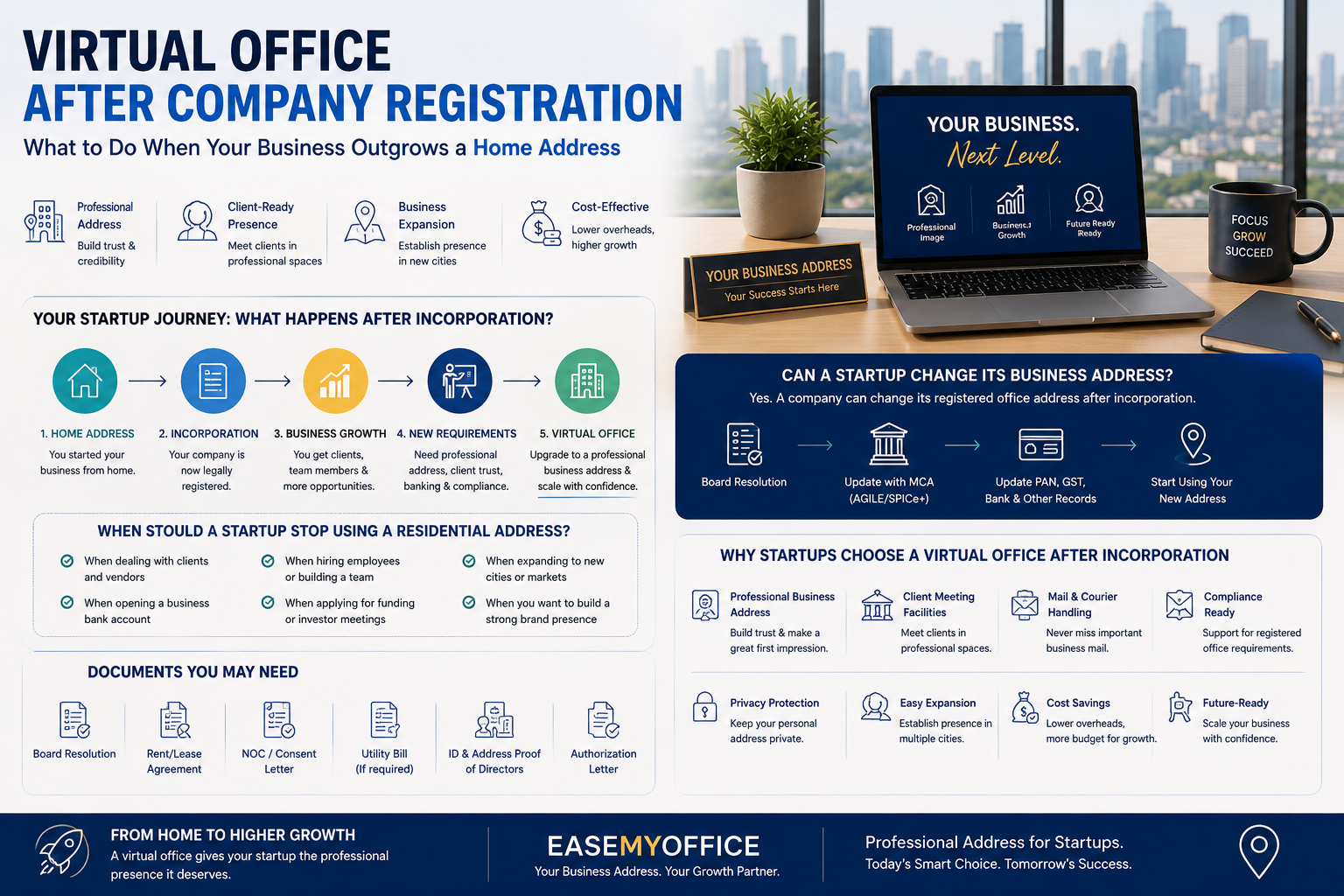
AI Overview: Virtual Office After Company Registration
After incorporating a company, many founders continue operating from their home because the business is still small. But as the startup grows, a residential address can become less practical for business communication, client meetings, professional branding and expansion.
A Virtual Office After Company Registration can provide a professional commercial address and business-support services without requiring the company to immediately lease a full-time office.
A startup may consider changing its business address when it wants to move away from a residential location, establish a stronger commercial presence, enter another city or create a more professional environment for clients and partners.
However, a virtual office should not automatically be treated as a replacement for every type of physical business premises. The suitability of a particular address depends on its intended use, applicable regulations, documentation and the actual activities conducted by the company.
The ideal approach is to upgrade the business address when the company’s requirements justify it—not simply because the company has been incorporated.
Introduction: Incorporation Is Not the End of the Startup Journey
Getting your company incorporated feels like a finish line.
For many founders, it is actually the beginning of a much bigger operational journey.
The early stages often look something like this:
Founder at home → Business idea → Initial customers → Company incorporation → First employees → Growing revenue → More clients → Professional business presence → Expansion
At the beginning, using a residential address may be perfectly practical.
You may be:
- Working from a laptop
- Handling calls yourself
- Meeting clients online
- Keeping expenses extremely low
- Testing your product
- Searching for your first customers
- Operating without employees
But the situation changes when the business starts gaining traction.
Suddenly, you may need to answer questions such as:
- Should we continue using the founder’s home address?
- Do we need a professional business address?
- Should we rent an office?
- Can we change the company’s registered address?
- What happens if we move to another city?
- Do clients need somewhere to meet us?
- Do we need an office in another business location?
- How can we maintain a professional presence without taking on a large lease?
This is where a Post-Incorporation Virtual Office can become relevant.
It allows a growing company to think beyond the question of “Where do I work?” and focus instead on:
“What kind of business presence does my company need at this stage?”
What Is a Virtual Office?
A Virtual Office is a business service that gives a company access to a professional commercial address and, depending on the package, additional services such as mail handling, correspondence support and meeting facilities.
Unlike a traditional office, it generally does not require the company to maintain a dedicated workspace for employees every day.
For a growing startup, this creates an important distinction.
Traditional office
You pay for:
- Dedicated space
- Furniture
- Utilities
- Maintenance
- Internet
- Security
- Office equipment
- Long-term commitments
Virtual Office
You primarily pay for:
- Professional business presence
- Commercial address
- Business correspondence support
- Selected office facilities
- Meeting access, depending on the plan
The exact services and permitted uses vary by provider and location.
A Virtual Office therefore works particularly well for companies whose employees can work remotely but whose business identity has outgrown a residential address.
What Happens After Company Incorporation?
Company incorporation gives your business a legal identity, but it does not automatically solve every operational requirement.
After incorporation, founders typically begin dealing with:
- Customers
- Vendors
- Banks
- Employees
- Investors
- Government departments
- Service providers
- Corporate clients
- Partners
The business also begins appearing in more places.
Your address may be included in:
- Business documents
- Invoices
- Contracts
- Company profiles
- Proposals
- Correspondence
- Websites
- Vendor forms
- Client documentation
At this point, the address becomes more than a piece of paperwork.
It becomes part of your company’s professional identity.
If the company is still using a residential address, a founder may eventually decide that the business has reached the point where a dedicated commercial address makes more sense.
That doesn’t necessarily mean signing a large office lease.
There is a middle ground:
Residential Address → Virtual Office → Coworking/Dedicated Office
The right stage depends on how the company operates.
When Should a Startup Stop Using a Home Address?
There is no universal revenue number or company age at which a startup must stop using a residential address.
Instead, look for practical signals.
1. You Are Receiving More Business Correspondence
If important documents, courier packages and business communications are regularly arriving at your home, separating business and personal activity may become useful.
2. Clients Are Asking for Your Office Location
This doesn’t mean every client requires a physical office.
But if your sales process increasingly involves corporate buyers, suppliers or partners who want to verify your business presence, a professional address can improve how your company is presented.
3. Your Team Has Become Remote
If your employees don’t need to sit in one location every day, renting a traditional office purely for the sake of having an address can be inefficient.
A Virtual Office can provide the address while your team continues working remotely.
4. You Are Entering a New City
Suppose your company started in Delhi but is now acquiring customers in Mumbai.
Do you immediately need a full Mumbai office?
Not necessarily.
A Virtual Office can potentially provide a local business presence while you evaluate whether the market justifies permanent infrastructure.
5. Your Business Is Becoming More Corporate
A founder working from home may be completely normal during the early stage.
As the company starts working with:
- Large enterprises
- Banks
- Manufacturers
- Government organisations
- Institutional clients
- International customers
the overall presentation of the company may become increasingly important.
A professional Startup Business Address can be one component of that presentation.
Can a Startup Change Its Business Address After Incorporation?
Yes, a company can change its address after incorporation, subject to the applicable legal and regulatory procedures.
The exact process depends on what address is being changed and the company’s circumstances.
For example, changing the registered office can involve formal corporate compliance steps and filings.
Therefore, founders should not assume that simply purchasing a Virtual Office automatically changes the company’s registered office.
The process generally involves:
Choose suitable premises → Obtain supporting documents → Complete required internal approvals → Make applicable filings/updates → Update business records
The specific requirements should be confirmed based on the company’s legal structure and the nature of the address change.
Virtual Office After Company Registration: Why Consider It?
A Virtual Office can make sense when the company has moved beyond its home-based phase but isn’t ready for a full-time office.
Here are some of the strongest reasons.
1. Create a Professional Business Identity
Your company may now have:
- A website
- Employees
- Customers
- Revenue
- Contracts
- Corporate documentation
Using a professional commercial address can bring the physical side of the business in line with the maturity of the company.
2. Separate Personal and Business Life
Using your home address for business can blur the line between personal and professional life.
A separate business address can help create a clearer boundary.
This can be particularly useful for founders working from home.
3. Reduce Fixed Office Costs
Traditional offices can involve significant upfront and recurring expenses.
These can include:
- Security deposits
- Monthly rent
- Furniture
- Electricity
- Internet
- Maintenance
- Office equipment
- Cleaning
- Administrative costs
A Virtual Office can reduce the need for these expenses when a company doesn’t actually need a full-time workplace.
4. Support Remote Teams
Modern startups often have employees spread across different cities.
For example:
Founder – Delhi
Developer – Bengaluru
Sales – Mumbai
Designer – Pune
There may be little reason to force everyone into one permanent office.
A Virtual Office can provide a central business presence while the team remains distributed.
5. Establish Presence in New Markets
Suppose your startup wants to test three markets:
Delhi → Mumbai → Bengaluru
Renting three offices immediately would create a large fixed commitment.
A more flexible approach could be:
Virtual presence → Market testing → Customer acquisition → Local team → Permanent office
This allows infrastructure investment to follow actual business growth.
Who Should Use a Post-Incorporation Virtual Office?
A Virtual Office after company registration can be particularly useful for businesses that have low physical-space requirements.
SaaS startups
Software companies often operate almost entirely online.
Digital agencies
Marketing, SEO, design and development agencies can usually operate with distributed teams.
Consulting firms
Consultants may spend most of their time with clients rather than sitting in an office.
E-commerce businesses
Online businesses can separate their business address from their fulfilment and warehouse infrastructure.
Professional service companies
Accounting, legal support, recruitment, HR and business advisory companies may not need large offices.
Technology startups
Product teams can work remotely while maintaining a professional commercial presence.
D2C brands
Consumer brands can use separate warehouses, fulfilment centres and logistics providers while maintaining a corporate address.
Who May Need More Than a Virtual Office?
A Virtual Office isn’t the right solution for every company.
You may require dedicated physical premises if your business needs:
- Manufacturing
- Product assembly
- Inventory storage
- Regular physical operations
- Large onsite teams
- Equipment
- Laboratories
- Customer walk-in facilities
- Dedicated production infrastructure
For example, a manufacturing company cannot treat a Virtual Office as a substitute for its factory.
Similarly, an e-commerce company with significant inventory will still need appropriate warehouse or fulfilment infrastructure.
The key principle is simple:
A business address is not automatically an operational facility.
Documents Required for a Post-Incorporation Virtual Office
The exact documents depend on the provider, location and intended use.
Commonly requested information may include:
- Company incorporation documents
- PAN
- Director/partner identification
- Business registration details
- Authorisation documentation
- GST details, where applicable
- Address-related documentation
- NOC or consent documentation, where applicable
If you are using the address for a particular registration or compliance requirement, additional premises-related documents may be necessary.
Before purchasing a package, clearly tell the provider what you intend to use the address for.
This avoids one of the most common mistakes:
Buying an address first and checking its eligibility later.
The better approach is:
Requirement first → Documentation second → Address selection third
Benefits of a Virtual Office for Growing Startups
Professional Credibility
A commercial address can create a more established impression when interacting with clients, vendors and partners.
It is not a substitute for good service or business performance, but it can strengthen your professional presentation.
Better Privacy
Founders don’t necessarily want their home address appearing across business documents and communications.
A separate business address can provide an additional layer of separation.
Flexibility
The company can maintain a business presence without committing immediately to a large permanent workspace.
Lower Infrastructure Costs
Instead of paying for unused desks, furniture and utilities, a remote company can invest its capital into:
- Hiring
- Product development
- Marketing
- Sales
- Customer acquisition
- Technology
Multi-City Expansion
A company can explore new markets without immediately opening a traditional branch-style office in every city.
Client Meeting Options
Depending on the provider and package, meeting rooms may be available when an important client or partner wants an in-person discussion.
This creates a useful hybrid model:
Remote work every day + Professional meeting space when required
Pricing Comparison: Virtual Office vs Traditional Office
The actual price varies considerably depending on city, location, provider, contract period and services included.
Instead of comparing only monthly rent, consider the total cost.
| Cost Factor | Virtual Office | Traditional Office |
| Professional address | Yes | Yes |
| Dedicated workspace | Usually no | Yes |
| Security deposit | Plan-dependent | Often significant |
| Furniture | Usually unnecessary | Required |
| Utilities | Provider-dependent | Additional |
| Maintenance | Provider-managed | Business responsibility |
| Meeting rooms | Depending on plan | Usually available |
| Remote team suitability | Excellent | Moderate |
| Multi-city presence | Easier | More expensive |
| Long-term commitment | Usually lower | Usually higher |
| Storage | Generally unsuitable | Depends on premises |
| Manufacturing | Not suitable | Requires appropriate facility |
The right choice depends on whether your company needs presence or workspace.
If you need desks for ten employees every day, a Virtual Office won’t solve the underlying requirement.
If everyone works remotely and you only need a professional address plus occasional meeting facilities, paying for a large office may be unnecessary.
How to Decide Whether Your Startup Needs a Virtual Office
Ask yourself these seven questions:
Question 1: Do employees need to work from the office every day?
If yes, consider coworking or dedicated office space.
If no, continue evaluating a Virtual Office.
Question 2: Are clients asking for a professional business address?
If yes, a commercial address may become valuable.
Question 3: Are you still comfortable using your residential address?
If not, it’s worth considering a separate business address.
Question 4: Are you entering a new city?
If yes, a Virtual Office may help you establish an initial presence before committing to permanent infrastructure.
Question 5: Do you need to store products?
If yes, you’ll need appropriate storage separately.
Question 6: Do you regularly meet customers?
If yes, consider a package that includes meeting-room access.
Question 7: Do you need the address for a particular registration?
If yes, verify eligibility and documentation before selecting the provider.
Step-by-Step: How to Move From a Home Address to a Virtual Office
Step 1: Identify the Problem
Determine why you want to change the address.
Is it:
- Privacy?
- Professional credibility?
- Client meetings?
- Business expansion?
- Mail management?
- Registration requirements?
- Entering another city?
Your reason determines the right solution.
Step 2: Determine the Type of Address You Need
You may need:
- Business correspondence address
- Registered office address
- GST-related premises
- Mailing address
- Meeting location
Don’t assume these are interchangeable.
Step 3: Select the City
Choose a city based on your business objectives.
For example:
- Delhi NCR for North India
- Mumbai for financial and commercial ecosystems
- Bengaluru for technology businesses
- Hyderabad for technology and healthcare ecosystems
- Chennai for manufacturing and southern markets
- Ahmedabad for industrial and trading businesses
The best city is the one that supports your customers, employees, suppliers and expansion plans.
Step 4: Compare Providers
Look at:
- Address quality
- Documentation
- Permitted usage
- Meeting rooms
- Mail handling
- Contract terms
- Support
- Pricing
- Additional charges
Step 5: Complete Verification
Submit the required KYC and business documents.
Step 6: Obtain the Supporting Documents
Depending on the plan, you may receive documentation supporting the relevant business use.
Step 7: Complete Applicable Address Updates
If you are changing a company’s registered office or another formally recorded address, complete the required corporate and regulatory process.
Do not assume the change is complete merely because you have signed a Virtual Office agreement.
Step 8: Update Your Business Information
Once the change has been properly completed, update relevant business records and communication channels.
These may include:
- Website
- Company profile
- Invoices
- Proposals
- Email signatures
- Business cards
- Vendor records
- Client documentation
A Practical Example: The Startup That Outgrew Its Home Address
Consider a hypothetical SaaS company called GrowthStack Technologies.
The founder initially starts the business from home.
Stage 1
- Founder working alone
- Three customers
- Remote operations
- Residential address
A traditional office makes little sense.
Stage 2
The company is incorporated.
Now it has:
- Six employees
- Twenty-five customers
- Regular vendor communication
- Corporate contracts
- Increasing business correspondence
The founder starts feeling uncomfortable using a residential address.
Stage 3
The team remains remote.
Instead of renting a 1,000-square-foot office, the company chooses a Virtual Office.
It gets:
- Professional commercial address
- Business correspondence support
- Meeting facilities when required
Stage 4
The startup begins acquiring customers in Mumbai.
Instead of immediately opening a permanent branch, it establishes a suitable business presence there.
Stage 5
After significant growth, the company hires a local sales team.
Now a dedicated workspace may make financial and operational sense.
This illustrates an important principle:
Office infrastructure should grow with business requirements.
Not before them.
Virtual Office After Incorporation vs Coworking Space
These services solve different problems.
Choose a Virtual Office when:
- Your team works remotely
- You primarily need a professional address
- You want to separate business and home
- You need occasional meeting facilities
- You want lower fixed costs
Go for a Coworking when:
- You need desks regularly
- Employees work onsite
- You need a professional workspace
- You frequently conduct meetings
- You want office infrastructure without a conventional lease
Choose a Traditional Office when:
- You need dedicated space
- Your team is onsite
- You require permanent infrastructure
- Your business needs operational premises
A growing company can move between these models over time.
Can a Virtual Office Be Used as a Company Registered Office Alternative?
This question requires some care.
A Virtual Office may be suitable for certain registered-office arrangements when the address, documentation and premises satisfy the applicable legal requirements.
However, “Virtual Office” does not automatically mean “registered office.”
A company should verify:
- Whether the particular premises can be used for the intended purpose.
- Whether the provider supplies the required documentation.
- Whether the company meets applicable legal requirements.
- Whether additional filings or approvals are necessary.
For formal company-address changes, professional legal or compliance advice can be appropriate.
The important takeaway is:
Don’t choose an address based solely on its marketing label. Choose it based on the legal and operational purpose for which you need it.
Can a Startup Use a Virtual Office for GST Registration?
Potentially, where the premises arrangement and documentation satisfy the applicable GST requirements.
But the eligibility of a particular address should be verified before proceeding.
GST registration involves premises-related documentation and verification requirements, and those requirements can depend on the circumstances.
Therefore, if GST registration is your reason for purchasing a Virtual Office, make that requirement explicit when evaluating providers.
Can a Startup Open a Bank Account Using a Virtual Office?
A Virtual Office address may be relevant to business banking documentation, but banks have their own KYC and verification requirements.
Acceptance can vary.
A startup should therefore avoid assuming:
Virtual Office = Guaranteed bank account approval
Instead, confirm the requirements of the specific bank and account type.
The company’s incorporation documents, PAN, KYC and other information may also be required.
Why Choose Vo Spaces?
When a startup has reached the point where a home address no longer feels appropriate, the next step should be flexible rather than unnecessarily expensive.
Vo Spaces can be positioned as a solution for businesses that need a professional commercial presence without immediately maintaining a conventional full-time office.
When evaluating a Vo Spaces plan, businesses should look at:
- Available locations
- Address usage
- Documentation
- Mail and courier handling
- Meeting-room availability
- Contract duration
- Pricing
- Additional services
- Registration-related support, where applicable
The important consideration is not simply whether a provider offers a “Virtual Office.”
It’s whether the particular package matches your post-incorporation requirement.
For example:
Need a professional address?
Choose a package designed around business presence.
Need occasional client meetings?
Look for meeting-room access.
Need a registration-related address?
Confirm the documentation and eligibility first.
Need daily workspace?
Consider coworking or dedicated office space instead.
This approach prevents a common startup mistake: paying for facilities that the company doesn’t actually use.
Frequently Asked Questions
1. What happens after company incorporation?
After incorporation, the company begins managing its ongoing business operations, compliance, banking, customers, vendors, employees and other stakeholders.
As the business grows, its address and workspace requirements may also change.
2. Can a startup change its business address after incorporation?
Yes, a startup can change its business address after incorporation, subject to the applicable procedures.
If the registered office is being changed, formal corporate and regulatory requirements may apply.
3. When should a startup stop using a residential address?
There is no fixed deadline.
A startup may consider changing when privacy, client expectations, business correspondence, professional presentation or expansion makes a residential address less practical.
4. Should startups use a Virtual Office after incorporation?
It can be useful for startups that operate remotely and need a professional commercial address without requiring a full-time office.
It is less suitable for businesses that need substantial physical operations.
5. Is a virtual office legal in India?
A properly structured Virtual Office arrangement can be legitimate when used for permitted purposes and supported by appropriate documentation.
The suitability of a specific address depends on its intended use and applicable requirements.
6. Can a virtual office be used for GST registration?
It may be possible when the premises arrangement and supporting documentation meet applicable GST requirements.
Always verify the specific address and documentation before applying.
7. What documents are required?
Requirements vary by provider and purpose.
They may include company incorporation documents, PAN, identity/KYC documents, authorisation documents and premises-related documentation.
8. How much does a Virtual Office cost?
Pricing depends on the city, address, provider, contract duration and included services.
Meeting rooms, mail handling and registration-related services may affect the total price.
9. Is a Virtual Office suitable for startups?
Yes, particularly for remote-first startups that have outgrown a residential address but don’t yet need a permanent office.
10. Can I open a bank account using a Virtual Office?
It may be possible depending on the bank and account type, but approval depends on the bank’s KYC and verification requirements.
11. Can freelancers use Virtual Offices?
Yes. Freelancers, consultants and independent professionals can use Virtual Office services when they need a professional business presence.
12. Which city is best for a startup Virtual Office?
There is no universally best city.
Choose based on your customers, industry, suppliers, employees and expansion plans.
Common business hubs include Delhi NCR, Mumbai, Bengaluru, Hyderabad, Chennai, Pune and Ahmedabad.
13. How quickly can I get the documents?
Processing time depends on the provider, location, KYC verification and selected package.
Confirm the expected timeline before purchasing.
14. Is a Virtual Office better than a coworking space?
It depends on what you need.
A Virtual Office focuses primarily on business presence and address-related services, while coworking provides physical workspace.
15. Can a Virtual Office replace a physical office?
For some remote businesses, it can reduce or eliminate the need for a traditional office.
However, it cannot replace premises required for manufacturing, inventory storage, laboratories, production or other physical activities.
Key Mistakes Startups Should Avoid
Mistake 1: Choosing an Address Only Because It Is Cheap
The cheapest address may not provide the documentation or services your company requires.
Mistake 2: Assuming Every Virtual Office Supports Every Registration
Different uses can have different requirements.
Always verify the intended use.
Mistake 3: Confusing a Business Address With a Workspace
A Virtual Office isn’t necessarily a place where ten employees can work every day.
Mistake 4: Ignoring Future Expansion
If you expect to enter multiple cities, think about your address strategy early.
Mistake 5: Changing the Address Without Completing Formalities
A company’s official registered-office change may involve specific procedures.
Simply signing a Virtual Office agreement does not necessarily complete those formalities.
The Post-Incorporation Address Strategy
A startup’s address requirements often evolve in stages.
Stage 1: Idea
Home address
The founder is validating the idea.
Stage 2: Incorporation
Existing registered setup
The company becomes legally established.
Stage 3: Early Growth
Professional Virtual Office
The company wants a commercial presence without major office overhead.
Stage 4: Team Expansion
Coworking or flexible workspace
Employees increasingly need somewhere to work and collaborate.
Stage 5: Established Operations
Dedicated office
The company now has sufficient employees and activity to justify permanent space.
This isn’t a mandatory sequence.
Some businesses may skip stages.
Others may use several simultaneously.
The point is to align infrastructure with actual requirements.
Summary
A company’s journey doesn’t stop when incorporation is completed.
In many cases, incorporation is when the real operational questions begin.
A founder who started from a bedroom or home office may eventually find that a residential address no longer matches the company’s growing professional identity.
That’s when a Virtual Office After Company Registration can become a practical option.
It can help a startup:
- Establish a professional commercial presence
- Separate business and personal addresses
- Support remote operations
- Reduce unnecessary office expenses
- Handle business correspondence
- Meet clients when facilities are available
- Explore new cities
- Scale its physical presence gradually
But a Virtual Office should be selected based on the actual requirement.
- If you need an address, choose an address solution.
- If you need daily desks, choose coworking.
- If you need manufacturing or storage, arrange proper operational premises.
- If you need a registered-office change, complete the appropriate corporate process.
The smartest startups don’t ask:
“How can I get the biggest office?”
They ask:
“What infrastructure does my business actually need right now?”
That mindset allows the company to preserve capital, remain flexible and upgrade its physical presence as revenue and operational requirements grow.
Final Takeaway: From Home-Based Founder to Established Business
The transition from a home-based founder to a professionally established company doesn’t have to happen overnight.
You don’t need to jump directly from:
Home → Expensive Office
There can be a more flexible progression:
Home-Based Business → Company Incorporation → Professional Business Address → Virtual Office → Flexible Workspace → Dedicated Office
The right stage depends on your business.
For a remote-first startup that has customers, employees and growing business activity but doesn’t need daily office space, a Post-Incorporation Virtual Office can provide the professional presence it needs without forcing the company into unnecessary fixed costs.
As the company grows, the infrastructure can grow with it.
That’s the real advantage—not simply having a different address, but having an office strategy that evolves with the business.