
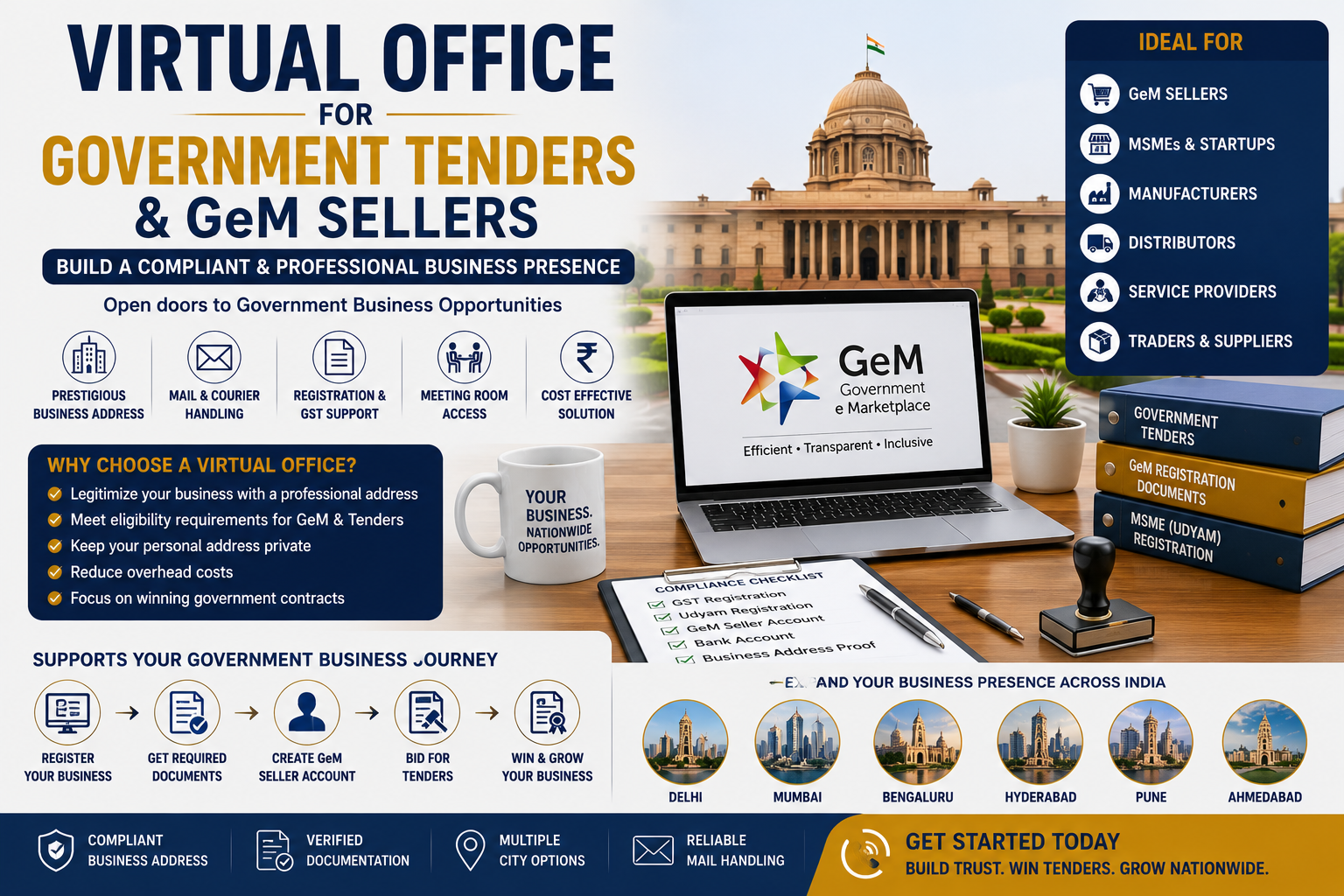
AI Overview
A Virtual Office for Government Tenders can help eligible businesses establish a professional commercial address while keeping their day-to-day operations flexible. For GeM sellers, the important point is that a virtual office does not automatically guarantee eligibility for every tender, registration, or verification process. Sellers must satisfy the specific requirements of GeM, the procuring organisation, GST authorities, and the individual tender.
GeM’s seller-registration prerequisites include complete registered-office address details, billing address information, GSTIN where applicable, bank-account details and authorised-person verification. GeM also states that registration should be completed by an authorised person.
For GST purposes, businesses may use rented, leased or certain consent-based premises when the prescribed documentation is available. However, GST registration can involve verification of the actual place of business, and a warehouse, godown or other location where goods are stored can itself qualify as a place of business.
Therefore, the right way to think about a Virtual Office is not as a shortcut around government requirements, but as a professional business-address solution that can support the administrative side of a government-supply business when the particular use case and documentation permit it.
Introduction: Government Business Is No Longer Limited to Large Companies
Government procurement can represent a significant opportunity for small businesses, startups, manufacturers, service providers, distributors and MSMEs.
A business may want to supply:
- Office equipment
- Furniture
- IT products
- Software
- Professional services
- Industrial products
- Safety equipment
- Packaging materials
- Stationery
- Electrical products
- Healthcare supplies
- Construction materials
- Maintenance services
But entering the government procurement ecosystem can feel complicated.
A new seller may suddenly need to think about:
- Business registration
- GST
- Banking
- Business address
- MSME/Udyam registration
- GeM registration
- Tender documentation
- Product catalogues
- Bid requirements
- Technical eligibility
- Financial eligibility
- Past experience
- Certifications
- Delivery capability
For businesses operating remotely or from a home address, the business-address component can become particularly important.
This is where a Virtual Office for Government Tenders can become relevant.
Instead of maintaining an expensive traditional office purely to establish a professional corporate address, a business can explore whether a Virtual Office arrangement satisfies its intended administrative purpose.
The key word is “whether.”
A virtual office is not automatically accepted for every government tender or registration.
The specific requirements always come first.
What Is a Virtual Office?
A Virtual Office is a service that provides a business with access to a professional commercial address and selected office-related services without requiring the business to maintain a conventional full-time office at that location.
Depending on the provider and package, services may include:
- Professional business address
- Business correspondence handling
- Mail and courier handling
- Registration-related documentation
- Consent/NOC documentation where applicable
- Rent or lease documentation where applicable
- Meeting-room access
- Reception services
- Multi-city address options
The exact services differ by provider.
For a government supplier, the most important benefit is often the ability to establish a formal business presence without immediately taking on the full cost of a conventional office.
However, the address should never be treated as a replacement for actual operational capability.
If a tender requires:
- A factory
- Warehouse
- Service centre
- Stock
- Machinery
- Employees
- Local technicians
- Physical inspection
- Product testing
- Delivery infrastructure
a Virtual Office does not replace those requirements.
Can a GeM Seller Use a Virtual Office?
This is one of the most important questions for businesses considering this model.
Potentially, yes for appropriate business-address purposes, but the seller must satisfy the applicable GeM, GST and tender-specific requirements.
GeM’s published seller-registration prerequisites state that sellers need to provide complete registered-office address details, along with billing-address information and other business details. The same document identifies GSTIN requirements and bank-account information for receiving payments.
This means the address used by a seller is not merely a marketing detail.
It becomes part of the business information associated with the seller.
Therefore, before selecting a Virtual Office for GeM-related activity, a seller should verify:
- Whether the provider supplies the required documentation.
- Whether the address is suitable for the intended registration.
- Whether GST documentation is available where required.
- Whether the particular GeM profile can use that address for the intended purpose.
- Whether the individual tender has additional location requirements.
Can a Virtual Office Be Used for Government Tenders?
There is no universal rule saying that every government tender can be fulfilled using a Virtual Office.
Government procurement works through tender-specific eligibility criteria.
One tender might focus primarily on:
- Product specifications
- Price
- Delivery
- Manufacturer authorization
- Certifications
Another may require:
- Local service centre
- Physical inspection
- Prior experience
- Turnover
- Specific infrastructure
- Registered office in a particular jurisdiction
- Local manpower
Therefore, a Virtual Office should be considered a business infrastructure option, not a universal tender-compliance solution.
The correct question is:
“Does this particular tender permit my business to use this type of business address while satisfying all other eligibility conditions?”
That distinction protects businesses from one of the biggest mistakes in government procurement: assuming that one registration solution automatically satisfies every tender.
Why Business Address Matters for Government Suppliers
A professional business address can support the credibility and administrative structure of a business.
Consider two suppliers.
Supplier A
- Residential address
- No dedicated business contact point
- Limited documentation
- Informal online presence
Supplier B
- Professional commercial address
- Proper business documentation
- GST registration where applicable
- Business bank account
- Udyam registration where applicable
- GeM seller profile
- Professional website
- Clear product catalogue
The second business may appear more established.
However, a professional address alone does not make a company eligible for a tender.
Government buyers evaluate the criteria specified in the procurement process.
The address is one component of the broader business structure.
Who Should Use a Virtual Office for Government Procurement?
1. MSMEs
Small businesses can use flexible infrastructure to avoid unnecessary office overhead.
The Ministry of MSME’s Udyam portal states that Udyam is integrated with GeM and other government procurement platforms, giving MSMEs access to marketplaces and e-tender opportunities.
For an MSME exploring government procurement, a professional business address can therefore be one part of building a more structured business setup.
2. Startups
A technology or product startup may operate with:
- Remote employees
- Founders working from home
- Contract manufacturers
- Third-party logistics
- Cloud infrastructure
The business may not need a large office during its early stage.
A Virtual Office can provide an alternative to immediately taking a long-term commercial lease, provided the address is suitable for the intended purpose.
3. Manufacturers
Manufacturers may have factories or production facilities outside major commercial centres.
Their corporate or registered office can be in another location.
A professional business address can help separate the corporate function from the manufacturing facility.
However, where a tender requires factory inspection, production capacity or physical infrastructure, the actual facility remains relevant.
4. Distributors
Distributors selling products to government departments may operate through:
- Manufacturer partnerships
- Third-party warehouses
- Logistics providers
- Remote sales teams
A Virtual Office can support their corporate administration while operational arrangements handle inventory and delivery.
5. Professional Service Providers
Consultants, software companies, training providers, design firms and other service businesses may not require traditional office infrastructure.
Their tender requirements may focus more on:
- Qualification
- Experience
- Technical capability
- Personnel
- Certifications
- Previous projects
rather than daily office occupancy.
6. GeM Sellers
Businesses that sell products through GeM can explore a Virtual Office as part of their wider business-address strategy.
But sellers should always distinguish between:
Seller registration requirements
and
Individual bid eligibility requirements.
They are not necessarily the same.
Documents Required for a Virtual Office
The exact documents depend on the business structure and intended purpose.
Common business documents may include:
Private Limited Company
- Certificate of Incorporation
- Company PAN
- Director KYC
- Authorised-signatory information
- Corporate documents where applicable
LLP
- LLP incorporation certificate
- LLP agreement
- Partner KYC
- Authorisation documents
Partnership
- Partnership deed
- PAN
- Partner KYC
- Authorisation documentation
Proprietorship
- Proprietor PAN
- Accepted KYC
- Photograph
- Business details
Premises-Related Documents
Depending on the arrangement and intended registration, these may include:
- Rent/lease agreement
- Consent letter
- NOC
- Utility bill
- Property ownership proof
- Other premises-related documentation
For GST registration, the official framework provides documentation routes for owned, rented/leased and certain consent-based premises.
A 2025 CBIC instruction further clarifies documentation requirements in cases involving consent letters and premises ownership, including circumstances where a rent/lease agreement is unavailable.
Can a Virtual Office Be Used for GST Registration?
It can be possible, provided the premises and documentation satisfy the applicable GST requirements.
GST registration certificates identify the principal place of business and additional places of business.
The GST framework also defines “place of business” broadly. It can include the place where business is ordinarily carried on, warehouses or godowns where goods are stored, places where goods or services are supplied or received, locations where books are maintained, and certain places where business is carried out through an agent.
This is especially important for government suppliers.
Suppose a business sells electrical equipment to government departments.
Its:
Registered office
may be at one address.
Its:
Warehouse
may be at another address.
Its:
Manufacturing facility
may be somewhere else.
Its:
Customer delivery locations
may be spread across India.
A Virtual Office should not be used to obscure these operational realities.
If a location is genuinely functioning as a place of business under applicable GST rules, the business should address the relevant GST requirements for that location.
Benefits of a Virtual Office for Government Suppliers
1. Reduce Unnecessary Office Costs
Government procurement businesses often need to protect margins.
Office expenses can include:
- Rent
- Security deposit
- Electricity
- Internet
- Furniture
- Maintenance
- Reception
- Housekeeping
- Office equipment
A Virtual Office can reduce the amount of money tied up in corporate office infrastructure.
2. Build a Professional Presence
A commercial address can make a small business appear more structured.
This can be useful across:
- Website
- Proposals
- Company profiles
- Invoices
- Business correspondence
- Vendor communication
Again, credibility comes from the complete business—not simply the address.
3. Operate With a Remote Team
Many modern suppliers do not need everyone sitting in one office.
A business can have:
- Founder in Delhi
- Salesperson in Mumbai
- Accountant working remotely
- Manufacturer in Gujarat
- Warehouse in Haryana
- Customers across India
The Virtual Office can serve the administrative layer.
4. Enter New Markets
A supplier targeting government buyers in another city may want a local commercial presence before committing to a permanent office.
This can help businesses test the market first.
5. Preserve Working Capital
For a small government supplier, cash flow is critical.
Money may be better allocated toward:
- Inventory
- Manufacturing
- Certifications
- Product development
- Employees
- Transportation
- Packaging
- Marketing
- Tender participation
rather than an expensive office.
Virtual Office vs Traditional Office for Government Suppliers
| Factor | Virtual Office | Traditional Office |
| Professional address | Yes | Yes |
| Full-time workspace | Usually no | Yes |
| Setup cost | Lower | Higher |
| Furniture investment | Minimal | Required |
| Utilities | Limited | Required |
| Meeting facilities | Depending on plan | Yes |
| Mail handling | Depending on plan | Yes |
| Warehouse | No | No, unless separately equipped |
| Factory | No | No |
| Market testing | Excellent | Expensive |
| Remote teams | Suitable | Less flexible |
| Daily operations | Limited | Yes |
The choice depends on the business.
A supplier requiring a daily office with ten employees may need conventional workspace.
A remote government supplier that primarily needs a professional address and occasional meeting facilities may benefit more from a flexible model.
Virtual Office vs Coworking Space
These two solutions are often confused.
Virtual Office
Designed primarily for:
- Business address
- Corporate presence
- Correspondence
- Registration-related needs
- Occasional meetings
Coworking Space
Designed primarily for:
- Daily work
- Desks
- Internet
- Meeting rooms
- Team collaboration
Traditional Office
Designed for:
- Dedicated employees
- Daily operations
- Permanent workspace
- Corporate infrastructure
Warehouse
Designed for:
- Inventory
- Storage
- Packing
- Dispatch
- Goods handling
For government suppliers, these can serve completely different purposes.
How Much Does a Virtual Office Cost?
There is no single nationwide price.
Pricing depends on:
- City
- Address
- Provider
- Duration
- Registration package
- Meeting-room access
- Mail handling
- Documentation
- Business requirements
Instead of asking only:
“What is the cheapest Virtual Office?”
ask:
“What will I actually need the address to do?”
A low-cost address that does not provide the documentation you need may be less useful than a slightly more expensive package designed for your intended purpose.
Best Cities for Government Suppliers
There is no universal best city.
Choose a location based on:
- Target government departments
- Industry
- Customer concentration
- Supply chain
- Transport network
- Existing business operations
- Tender requirements
- Expansion plans
Potential commercial hubs include:
Delhi NCR
Suitable for businesses targeting central government ecosystems, corporate buyers and northern markets.
Mumbai
Relevant for financial services, industrial suppliers, infrastructure and western India.
Bengaluru
Useful for technology, software and innovation-focused businesses.
Hyderabad
Relevant for technology, pharmaceuticals, infrastructure and service businesses.
Pune
Strong for engineering, automotive, industrial and technology suppliers.
Ahmedabad
Relevant for manufacturing, industrial products, pharmaceuticals, textiles and trading businesses.
Chennai
Useful for manufacturing, automotive, electronics and southern India operations.
But don’t choose a city simply because it sounds prestigious.
Choose a location that makes commercial sense.
Step-by-Step Process
Step 1: Identify Your Government Procurement Goal
Determine whether you want to:
- Sell through GeM
- Participate in tenders
- Supply PSUs
- Become a government vendor
- Expand into a new state
- Establish a professional business presence
Step 2: Check the Actual Eligibility Requirements
Before purchasing a Virtual Office, read the relevant:
- GeM requirements
- Tender document
- GST requirements
- Buyer-specific requirements
- Registration requirements
This is the most important step.
Step 3: Choose Your Business Location
Select the city based on commercial strategy rather than appearance.
Step 4: Verify Documentation
Ask the provider exactly what you receive.
For example:
- Rent/lease agreement?
- Consent letter?
- NOC?
- Utility documentation?
- Mail handling?
- Meeting access?
Step 5: Complete KYC
Submit the required company and identity documentation.
Step 6: Complete Applicable Registrations
Where permitted and appropriate, use the documentation for:
- GST
- Business registrations
- Vendor onboarding
- Other eligible business purposes
Step 7: Create Your GeM Seller Profile
Complete the required GeM seller information.
GeM’s published prerequisites include registered-office information, billing address/GSTIN information where applicable, bank-account details and authorised-person verification.
Step 8: Prepare Your Tender Documentation
Keep your:
- Product documents
- Certifications
- Financial documents
- Experience records
- Technical specifications
- Manufacturer authorisations
- GST details
- MSME/Udyam information
organised.
Step 9: Start Bidding
Select tenders that genuinely match your:
- Products
- Capacity
- Eligibility
- Pricing
- Delivery capability
How MSMEs Can Combine Udyam, GeM and a Professional Business Address
For eligible small businesses, these components can work together as part of a broader procurement strategy.
Udyam
Establishes MSME identity through the official Udyam system.
GeM
Provides access to government procurement opportunities.
GST
Supports the business’s tax and registration framework where applicable.
Business Address
Provides a formal location for business administration and eligible registration purposes.
Banking
Provides the financial infrastructure for receiving payments and operating the business.
The Ministry of MSME states that Udyam is integrated with GeM and other procurement platforms to facilitate MSME participation in marketplaces and e-tender processes.
The objective should therefore be to build a complete procurement-ready business, not simply obtain an address.
What a Virtual Office Cannot Do for a Government Supplier
A Virtual Office cannot magically create:
- Manufacturing capacity
- Product inventory
- Technical expertise
- Delivery infrastructure
- Qualified employees
- Certifications
- Previous experience
- Financial eligibility
- Required licences
- Warehouse capacity
- Local service capability
- If a tender says the bidder must have a service centre within a particular area, a Virtual Office should not be assumed to satisfy that requirement.
- If a tender requires physical stock, the business must have appropriate stock.
- If a tender requires factory inspection, the actual factory must be available.
- If a tender requires technical personnel, the company needs those personnel.
The address supports the business. It does not replace the business.
Common Mistakes to Avoid
Mistake 1: Assuming Every Tender Accepts a Virtual Office
Tender documents control the eligibility criteria.
Always read them carefully.
Mistake 2: Buying an Address Before Checking Requirements
Determine what documentation you actually need first.
Mistake 3: Confusing GeM Registration With Tender Eligibility
Being registered on a procurement platform does not automatically mean that you qualify for every bid.
Mistake 4: Using a Virtual Office Instead of an Operational Facility
A Virtual Office cannot substitute for a warehouse, factory or service centre where one is genuinely required.
Mistake 5: Ignoring GST Requirements
If your business has multiple operational locations, understand the GST implications of those locations.
Mistake 6: Focusing Only on Address
Government procurement is ultimately about the supplier’s ability to meet the procurement requirement.
Why Choose Vo Spaces?
For businesses targeting government procurement, choosing a Virtual Office provider should be based on documentation, transparency, location and service quality, rather than simply the lowest price.
A suitable Vo Spaces plan can be positioned as part of a business infrastructure strategy for companies that need a professional commercial presence while maintaining flexible operations.
Depending on the selected plan and location, businesses may look for services such as:
- Professional commercial address
- Registration-support documentation
- Mail and courier handling
- Meeting facilities
- Flexible plans
- Multi-city options
- Business support
Before purchasing, businesses should clearly explain their intended use—particularly if the address is being considered for GST, GeM, vendor registration or tender-related purposes.
The provider can then confirm what documentation and services are actually available for that location and plan.
Frequently Asked Questions
1. Is a Virtual Office legal in India?
A properly structured Virtual Office arrangement can be legitimate when used for permitted business purposes and supported by appropriate documentation. Its suitability depends on the specific use case.
2. Can a Virtual Office be used for GST registration?
It can be possible where the premises and documentation satisfy GST requirements. GST rules provide documentation routes for owned, rented/leased and certain consent-based premises.
3. Can a GeM seller use a Virtual Office?
A GeM seller may be able to use a suitable business address, but the seller must satisfy GeM’s requirements and any additional conditions applicable to the relevant procurement opportunity. GeM’s seller prerequisites include registered-office and billing-address information.
4. Can a Virtual Office be used for government tenders?
It depends on the tender. A Virtual Office may support the business-address component, but it does not automatically satisfy location, infrastructure, service-centre or other tender-specific requirements.
5. Do government suppliers need a physical office?
Not every government supplier necessarily needs a conventional full-time office. Requirements depend on the business and the procurement opportunity.
6. What documents are required?
Requirements vary. They can include company or proprietor KYC, incorporation documents, premises documentation, GST documents and other documents specified by the relevant authority or tender.
7. How much does a Virtual Office cost?
Pricing varies by city, provider, duration and services. Registration-oriented plans may cost more than basic address plans.
8. Is a Virtual Office suitable for startups?
Yes, particularly for startups that operate remotely and want to avoid committing capital to a traditional office too early.
9. Can I open a bank account using a Virtual Office?
A bank may accept a business address depending on its KYC and account-opening policies. Acceptance should be confirmed with the specific bank.
10. Can freelancers use Virtual Offices?
Yes, freelancers and independent professionals can use Virtual Offices where the service is appropriate for their business needs.
11. Which city is best for a government supplier?
There is no universal answer. Choose based on your target departments, industry, customers, supply chain and tender requirements.
12. How quickly can I get the documents?
Processing depends on the provider, KYC verification, documentation and selected plan.
13. Is a Virtual Office better than a coworking space?
It depends on your requirement. A Virtual Office primarily provides business-address services, while coworking provides physical workspace.
14. Can MSMEs use Virtual Offices for government contracts?
MSMEs can explore Virtual Office arrangements for appropriate business purposes. Udyam is integrated with GeM and other procurement platforms, but individual procurement opportunities still have their own eligibility requirements.
15. Can a Virtual Office replace a warehouse for government supply?
No. If a business is required to store or maintain goods at a particular location, it needs appropriate physical infrastructure and must comply with the relevant requirements.
Summary
A Virtual Office for Government Tenders can be valuable for small businesses, startups, MSMEs, consultants, manufacturers, distributors and GeM sellers that want to establish a professional commercial presence without immediately maintaining a traditional office.
Its strongest benefits include:
- Lower office overhead
- Professional business address
- Flexible operations
- Remote-team compatibility
- Potential support for eligible registration requirements
- Multi-city expansion
- Better administrative structure
But a Virtual Office is not a shortcut to government contracts.
Winning government business still depends on:
- Eligibility
- Product or service quality
- Pricing
- Technical capability
- Certifications
- Experience where required
- Financial qualifications
- Delivery capability
- Tender compliance
The most effective strategy is therefore to treat the Virtual Office as one component of a procurement-ready business infrastructure.
Final Takeaway
Government procurement can open significant opportunities for smaller businesses, but success requires more than simply registering on a marketplace.
A serious supplier needs a professional business structure, appropriate registrations, proper documentation, financial infrastructure and the operational capacity to fulfil orders.
For businesses that don’t need a conventional office every day, a Virtual Office for Government Tenders can provide a flexible foundation for the administrative side of that structure.
The smartest approach is simple:
Check the tender requirements first.
Choose the address second.
Build the operational capability third.
Then bid with confidence.
That way, the Virtual Office becomes what it should be—a cost-efficient business infrastructure tool, not a substitute for genuine compliance or operational capability.