
AI Overview
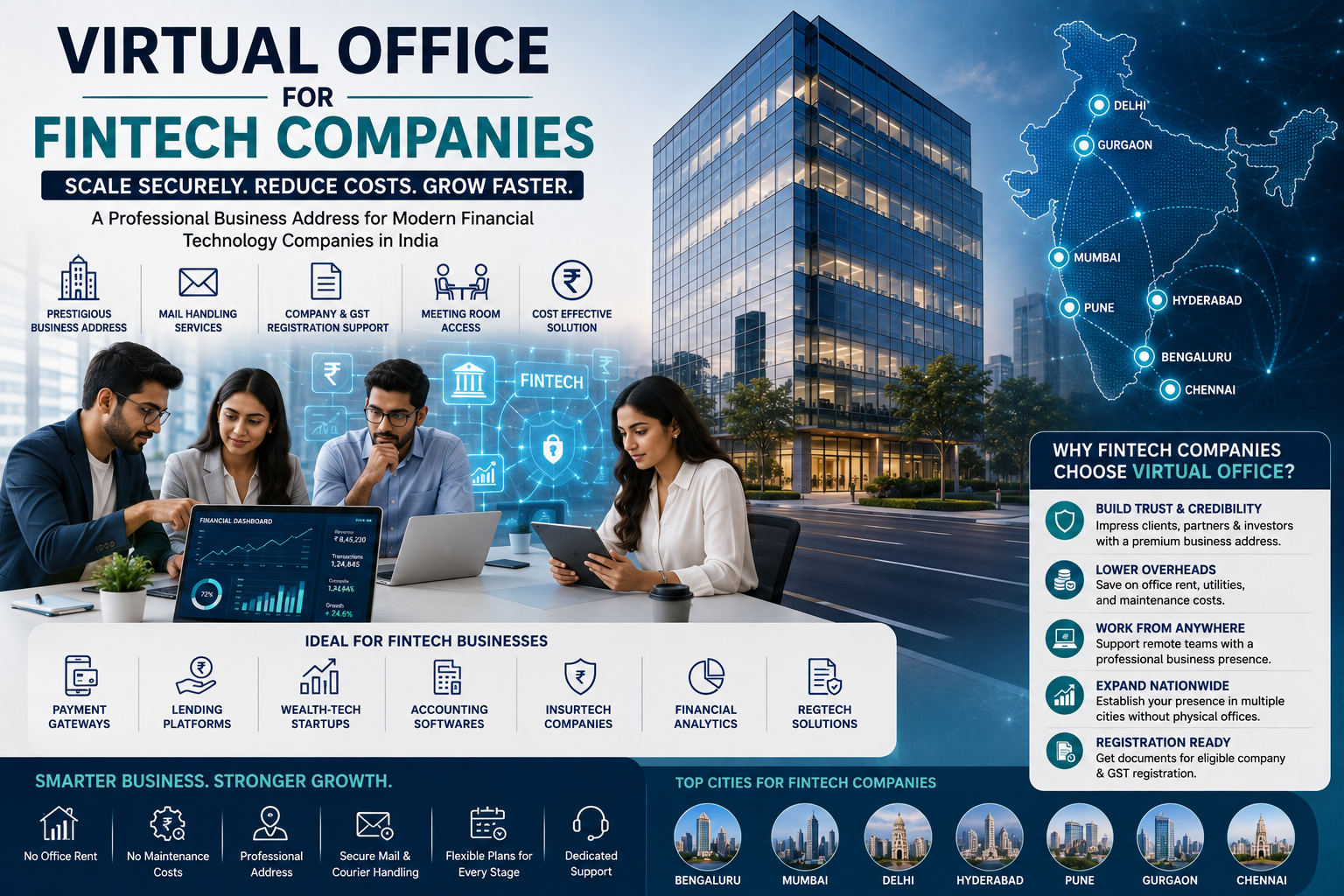
A Virtual Office for FinTech Companies provides eligible financial technology businesses with a professional commercial business address without requiring a conventional full-time office at that location. It can be useful for payment technology companies, lending platforms, wealth-tech businesses, accounting software providers, financial SaaS companies, and other technology-led financial businesses.
For FinTech companies, however, a Virtual Office should be viewed primarily as corporate infrastructure, not as a replacement for regulated operational premises. Depending on the company’s activities, regulatory framework, documentation, and state-specific requirements, a Virtual Office may support company registration, GST registration, business correspondence, mail handling, meetings, and market expansion.
The real advantage is operational flexibility: FinTech founders can keep office overhead under control while investing more heavily in technology, cybersecurity, product development, compliance, talent, and customer acquisition.
Introduction
FinTech companies operate differently from traditional financial businesses.
A payment technology startup may have developers working remotely, compliance specialists working from another city, sales representatives visiting merchants, and management teams meeting investors virtually.
A lending platform may operate through a digital application while its technology, customer-support, risk, and business-development teams are distributed across several locations.
A wealth-tech startup may serve customers entirely online.
An accounting software company may sell its platform throughout India without needing hundreds of physical desks.
Yet these companies still need to look established.
They need a professional business address.
They may need documentation for business registration, GST, banking, contracts, correspondence, vendor onboarding, and other administrative purposes.
That creates an interesting challenge:
Why maintain an expensive office when the business itself is designed to operate digitally?
This is where a Virtual Office for FinTech Companies can become valuable.
Instead of treating a physical office as a symbol of business maturity, FinTech founders can separate their corporate address requirements from their day-to-day workspace requirements.
That distinction can help a growing financial technology company maintain a professional presence without locking significant capital into unnecessary office infrastructure.
For FinTech businesses, this is particularly important because capital often needs to be directed toward areas that directly affect the company’s ability to survive and scale:
- Product development
- Cybersecurity
- Compliance
- Technology infrastructure
- Data protection
- Engineering talent
- Customer acquisition
- Financial controls
- Partnerships
- Regulatory readiness
A Virtual Office does not solve these challenges.
What it can do is prevent office infrastructure from becoming another major fixed cost.
What Is a Virtual Office?
A Virtual Office is a business service that gives a company access to a professional commercial address without requiring it to maintain a conventional office there every working day.
Depending on the provider and selected plan, services may include:
- Professional business address
- Company registration documentation
- GST registration support
- Rent agreement
- No Objection Certificate (NOC)
- Utility bill
- Business mail handling
- Courier handling
- Meeting-room access
- Reception support
- Business correspondence services
The exact documents and services vary according to the provider, location, plan, business structure, and intended use.
For a FinTech company, the important concept is that the business address does not necessarily have to be the same place where every employee performs their daily work.
A technology team can work remotely.
A sales team can operate in the field.
A founder can travel between investor and partner meetings.
A compliance team can work from another location.
The company can still maintain a central professional address for eligible corporate purposes.
Why FinTech Companies Have Different Virtual Office Requirements
A generic Virtual Office can work for many businesses.
FinTech companies require more careful planning.
The reason is that “FinTech” covers a very broad range of businesses.
For example:
Payment Technology
Companies developing payment infrastructure, merchant technology, reconciliation platforms, or payment-related software.
Lending Technology
Platforms supporting lending workflows, credit assessment, loan management, or financial product distribution.
WealthTech
Digital investment, portfolio-management, financial-planning, or wealth-management technology.
Accounting & Finance SaaS
Cloud platforms for accounting, invoicing, bookkeeping, payroll, expense management, or financial reporting.
InsurTech
Technology businesses serving insurance distribution, claims, underwriting, policy management, or related processes.
Financial Data Platforms
Businesses providing financial analytics, APIs, reporting tools, or data-driven technology.
Personal Finance Platforms
Apps and platforms designed to help users manage expenses, financial information, or financial planning.
Each category can have different legal, regulatory, licensing, data, and premises requirements.
Therefore, a Virtual Office should be selected according to the actual activity of the company, rather than simply because it is a FinTech business.
Who Should Consider a Virtual Office for FinTech?
A Virtual Office can be particularly useful for the following businesses.
Payment Technology Startups
Early-stage payment technology businesses often prioritize engineering, integrations, security, merchant acquisition, and compliance over maintaining a large office.
A Virtual Office can provide corporate infrastructure while the operational team works remotely or from flexible workspaces.
WealthTech Companies
Digital wealth and investment platforms can operate through technology rather than traditional branches.
A professional business address can support their corporate identity while the technology and management teams operate flexibly.
Accounting Software Companies
Cloud accounting platforms generally do not require every employee to work from a permanent physical office.
A Virtual Office can provide a formal business address while keeping infrastructure lean.
Financial SaaS Businesses
B2B FinTech software companies often sell subscriptions to businesses across India.
Their teams may be distributed across several cities.
A Virtual Office can provide a centralized corporate address.
Lending Technology Businesses
Technology businesses supporting lending workflows may operate digitally while maintaining separate partnerships with financial institutions.
A professional business address can help establish a formal corporate identity.
InsurTech Startups
Insurance technology companies can use flexible office infrastructure for corporate operations while maintaining any separate premises and regulatory arrangements required for their actual activities.
Finance Consultants & Technology Providers
Businesses providing financial software, analytics, automation, or technology consulting may benefit from a professional address without taking on the expense of a conventional office.
Can FinTech Startups Use a Virtual Office?
Yes, potentially—but the answer depends on what the FinTech company actually does.
A software company developing accounting technology has different premises requirements from a regulated entity conducting financial activities.
This distinction is critical.
A Virtual Office can be appropriate for the corporate address of an eligible technology company.
It does not automatically satisfy requirements for:
- Licensed financial activities
- Customer-facing financial operations
- Regulated storage
- Physical data infrastructure
- Secure document storage where required
- Branch operations
- Cash handling
- Other activities requiring specific premises
FinTech founders should therefore ask two separate questions:
Question 1: Where does my company need a registered or business address?
Question 2: Where must my regulated or operational activities actually take place?
The answers may be different.
Can a FinTech Company Use a Virtual Office for Company Registration?
An eligible FinTech company can use an appropriate Virtual Office address for company registration when the premises and supporting documentation satisfy applicable requirements.
For example, a software-led FinTech startup establishing a Private Limited Company may require a registered office address.
A suitable Virtual Office arrangement may provide documents such as:
- Rent Agreement
- NOC
- Utility Bill
- Address proof
- Other supporting documentation
The exact requirements depend on the company structure and applicable rules.
Importantly, company incorporation does not itself mean that the company has permission to conduct every type of financial activity.
Incorporation and regulatory authorization are separate matters.
A FinTech founder should therefore avoid treating company registration as equivalent to regulatory approval.
Can FinTech Companies Register for GST Using a Virtual Office?
A Virtual Office may be used for GST registration where the business, premises, documentation, and application satisfy the applicable GST requirements.
This can be relevant for FinTech businesses providing taxable software, technology, consulting, subscription, or other eligible services.
For example:
- Financial SaaS companies
- Accounting software providers
- FinTech consultants
- Financial analytics companies
- Technology service providers
- B2B financial platforms
may have GST requirements depending on the nature of their supplies.
GST treatment can vary according to the exact service, customer, location, supply structure, and applicable exemptions or rules.
Therefore, a Virtual Office should be selected only after confirming that the premises and documentation are appropriate for the intended GST purpose.
Virtual Office vs Regulatory Office: An Important Difference
This is one of the most important sections for a FinTech business.
A Virtual Office provides business infrastructure.
It does not automatically provide:
- RBI authorization
- SEBI registration
- IRDAI authorization
- Other financial licences
- Regulatory approval
- Cybersecurity certification
- Data-security compliance
- Permission to conduct regulated activities
For example, a company may be incorporated as a technology company and operate a financial software platform.
That does not automatically authorize the company to provide regulated financial services.
Similarly, obtaining GST registration does not mean the business has obtained every licence required for its specific financial activity.
The Virtual Office solves an address and infrastructure requirement.
It does not replace regulatory compliance.
This distinction makes the article particularly relevant to serious FinTech founders rather than businesses simply looking for a cheap address.
Documents Required for a FinTech Virtual Office
Documentation depends on the purpose of the Virtual Office and the business structure.
Identity Documents
Common requirements may include:
- PAN Card
- Aadhaar Card
- Photograph
- Director identification
- Partner identification
- Other KYC documents
Business Documents
Depending on the stage and entity structure:
- Certificate of Incorporation
- Company PAN
- LLP Agreement
- Partnership Deed
- GST Certificate
- Memorandum and Articles of Association
- Board Resolution where applicable
Address Documentation
A Virtual Office provider may provide applicable documents such as:
- Rent Agreement
- NOC
- Utility Bill
- Commercial Address Proof
Always verify the exact documentation required for your intended use before purchasing.
Benefits of a Virtual Office for FinTech Companies
1. Lower Fixed Infrastructure Costs
A traditional office requires much more than monthly rent.
There can be:
- Security deposits
- Furniture
- Internet
- Electricity
- Maintenance
- Housekeeping
- Office equipment
- Reception infrastructure
- Security
- Insurance
- Administrative expenses
A Virtual Office can reduce many of these costs.
For a FinTech startup, that money can be deployed into higher-priority areas.
2. More Capital for Technology
Technology is the foundation of most FinTech businesses.
Instead of spending heavily on office infrastructure, a founder can allocate resources toward:
- Cloud computing
- Software development
- API integrations
- Cybersecurity
- Monitoring
- Automation
- Data infrastructure
- Testing
- Product design
This can be a more strategic use of early-stage capital.
3. Support Distributed Teams
FinTech businesses frequently recruit specialized talent.
A cybersecurity engineer may live in Bangalore.
A product manager may be based in Gurgaon.
A compliance consultant may work from Mumbai.
A developer may work remotely from Pune.
A physical office does not necessarily need to become the center of every activity.
A Virtual Office supports the company’s corporate identity while allowing the team to remain geographically flexible.
4. Professional Business Presence
Financial businesses operate in a trust-sensitive environment.
Potential stakeholders may include:
- Banks
- Investors
- Enterprise clients
- Technology partners
- Vendors
- Financial institutions
- Corporate customers
A professional commercial business address contributes to a more structured corporate presentation.
It is not a replacement for trust.
Trust ultimately comes from:
- Product quality
- Security
- Transparency
- Compliance
- Financial controls
- Customer support
- Reputation
But the address can be one part of the overall professional identity.
5. Easier Market Testing
Suppose a FinTech startup operates from Bangalore and wants to explore Delhi NCR.
The founders may not want to immediately rent an office, hire local administrative staff, and establish a full branch infrastructure.
A Virtual Office can offer a lighter approach to establishing a business address where appropriate.
The company can test demand first.
If the market becomes significant, it can later invest in dedicated physical infrastructure.
6. Support Multi-City Expansion
FinTech companies often sell nationally.
A technology product does not necessarily need a physical branch in every city.
A business may nevertheless need specific addresses for legitimate registration, tax, commercial, or operational purposes.
Virtual Office solutions can help companies explore multi-location corporate infrastructure without immediately taking on traditional leases.
Applicable state-level requirements should always be evaluated before establishing additional registrations.
7. Investor-Friendly Infrastructure
A Virtual Office does not make a company investable.
Investors care primarily about:
- Market opportunity
- Product
- Revenue
- Growth
- Team
- Technology
- Risk
- Compliance
- Unit economics
- Scalability
However, organized corporate infrastructure can support a company’s overall presentation.
For a FinTech startup preparing for fundraising, having:
- Proper incorporation
- Consistent company records
- Professional correspondence
- Organized documentation
- Appropriate business address
- Clear compliance processes
can contribute to a more mature operational setup.
The address is one piece of the puzzle—not the investment thesis.
8. Better Use of Office Space
Not every FinTech employee needs a desk.
A technology team may need quiet remote working conditions.
A sales team may spend most of its time meeting customers.
Executives may travel frequently.
A compliance team may work from home.
Instead of paying for unused desks, the company can use meeting rooms or coworking facilities when physical collaboration is actually necessary.
FinTech Business Address vs Traditional Finance Office
| Feature | Traditional Office | Virtual Office |
| Professional Address | Yes | Yes |
| Eligible Registration Support | Yes | Available with suitable plans |
| GST Support | Yes | Available with suitable plans |
| Permanent Desks | Yes | No |
| Monthly Infrastructure Cost | High | Lower |
| Security Deposit | Usually required | Depends on plan |
| Furniture | Required | Not required |
| Remote Team Support | Moderate | High |
| Mail Handling | Available | Available with selected plans |
| Meeting Facilities | Usually available | Available with selected plans |
| Multi-City Expansion | Expensive | More flexible |
| Best For | Permanent operations | Lean corporate infrastructure |
Pricing Comparison for FinTech Businesses
Pricing depends on city, address, provider, services, documentation, and duration.
A practical comparison is:
| Workspace Solution | Typical Relative Cost | Best Use |
| Traditional Office | Very High | Large permanent teams |
| Managed Office | High | Growing teams |
| Coworking Space | Medium | Teams needing regular workspace |
| Virtual Office | Low | Address-focused businesses |
Rather than asking only:
“What is the cheapest option?”
FinTech founders should ask:
“What infrastructure does my company actually need right now?”
If the answer is primarily a professional address, registration support, correspondence, and occasional meeting facilities, paying for an entire conventional office may be unnecessary.
Step-by-Step Process for Getting a FinTech Virtual Office
Step 1: Define the Purpose
Identify whether you need the address for:
- Company registration
- GST registration
- Business correspondence
- Corporate branding
- Market expansion
- Mail handling
- Client meetings
Step 2: Identify Regulatory Requirements
Before choosing an address, determine whether your particular FinTech activity has premises-specific requirements.
This step is especially important for businesses involved in regulated financial activities.
Step 3: Select a City
Choose a location based on:
- Customer base
- Investors
- Partners
- Talent
- Expansion strategy
- Corporate positioning
Step 4: Select a Suitable Plan
Compare:
- Documentation
- Address
- Mail handling
- Meeting access
- Registration suitability
- Duration
- Renewal terms
- Support
Step 5: Complete KYC
Submit the required documents for verification.
Ensure the information matches your company records.
Step 6: Receive the Documentation
Once onboarding is complete, receive the documents included with your selected plan.
Check them carefully before using them for official registration.
Step 7: Complete Eligible Registrations
Use the address and documentation for the purposes for which they are suitable.
Step 8: Build the Actual FinTech Operation
Your Virtual Office should support the business—not become the business.
Focus your operational resources on:
- Product
- Compliance
- Security
- Customers
- Technology
- Partnerships
- Revenue
Which Cities Are Best for FinTech Companies?
There is no single best location.
Your choice should reflect where your customers, investors, talent, and partners are concentrated.
Bangalore
Bangalore is a natural consideration for technology-heavy FinTech businesses because of its large software, startup, and engineering ecosystem.
Mumbai
Mumbai can be particularly relevant to businesses seeking proximity to financial institutions, financial professionals, investors, and major corporate organizations.
Delhi NCR
Delhi, Gurgaon, and Noida provide access to a large corporate and technology market.
Hyderabad
Hyderabad can be attractive for technology-focused financial businesses requiring access to software talent and growing enterprise ecosystems.
Pune
Pune offers access to technology professionals and a strong business ecosystem.
Chennai
Chennai can be relevant for enterprise technology businesses and companies serving large corporate markets.
The correct decision should be based on business strategy—not simply the prestige of an address.
How FinTech Founders Can Use Virtual Offices Strategically
A Virtual Office becomes more valuable when it is part of a broader operating strategy.
Consider the following model:
Stage 1: Build
Use a lean corporate setup while developing the product.
Stage 2: Validate
Use saved infrastructure costs to acquire early customers.
Stage 3: Expand
Add business addresses in strategically important markets when required.
Stage 4: Establish
When a market reaches sufficient scale, consider a permanent office or dedicated facility.
Stage 5: Scale
Maintain a combination of physical and virtual infrastructure according to the needs of each market.
This creates a more flexible approach than assuming every city requires a permanent branch from day one.
What FinTech Companies Should Check Before Choosing a Virtual Office
1. Address Suitability
Make sure the address is appropriate for the intended business purpose.
2. Documentation
Confirm exactly which documents are included.
3. Regulatory Compatibility
Determine whether your specific activity has premises-related requirements beyond ordinary business registration.
4. Mail Management
Financial and corporate correspondence can be important.
Understand how incoming mail is received, recorded, forwarded, and stored.
5. Meeting Access
If investor or enterprise meetings are important, check whether meeting rooms are available.
6. Renewal Terms
Understand the recurring cost before committing.
7. Business Continuity
Ask what happens if the provider changes the premises or terminates the arrangement.
8. Data & Privacy
FinTech companies handle sensitive information.
Avoid casually sharing confidential financial, customer, or regulatory information with third parties.
Common Mistakes FinTech Startups Make
Mistake 1: Thinking a Virtual Office Equals Regulatory Approval
It does not.
An address cannot replace a required financial licence or authorization.
Mistake 2: Choosing an Address Only Because It Is Cheap
Documentation and suitability are more important than saving a small amount.
Mistake 3: Using One Address for Every Purpose Without Checking
Company registration, GST, banking, regulatory filings, and operational requirements can have different rules.
Verify each intended use.
Mistake 4: Ignoring Compliance
A lean office strategy should never become a lean compliance strategy.
Mistake 5: Overbuilding Too Early
The opposite problem also exists.
Some founders rent expensive offices before they have validated the product.
A flexible setup can help preserve capital during the early stages.
Why Choose Vo Spaces?
For FinTech businesses, the Virtual Office provider should be evaluated on documentation, reliability, location, flexibility, and support.
Vo Spaces provides Virtual Office solutions designed for businesses that want professional commercial addresses without committing to traditional office infrastructure.
Professional Business Addresses
Choose suitable commercial locations for your corporate presence.
Registration Documentation
Eligible plans can provide documentation such as:
- Rent Agreement
- NOC
- Utility Bill
- Commercial Address Proof
The suitability of these documents depends on the intended registration and applicable requirements.
Mail Handling
Manage business correspondence without maintaining a full-time reception desk.
Meeting Facilities
Where included, meeting facilities can be useful for:
- Investors
- Enterprise clients
- Partners
- Vendors
- Internal strategy meetings
Flexible Plans
Choose a package according to the actual needs of your business rather than paying for unnecessary office infrastructure.
Multi-City Solutions
FinTech companies expanding across India can explore Virtual Office locations in multiple commercial markets.
Frequently Asked Questions
1. Can FinTech startups use Virtual Offices?
Yes, eligible technology-led FinTech businesses can use Virtual Offices for appropriate corporate, administrative, and registration-related purposes.
However, regulated activities may have additional premises and licensing requirements.
2. Is a Virtual Office legal in India?
Yes. Virtual Office arrangements can be legitimate when structured and used in accordance with applicable laws and requirements.
3. Can a FinTech company use a Virtual Office for company registration?
An eligible company can use an appropriate Virtual Office address when the premises and documentation satisfy the applicable incorporation requirements.
4. Can FinTech companies use Virtual Offices for GST registration?
A Virtual Office may be used for GST registration where the address, documentation, business activity, and application meet applicable GST requirements.
5. What documents are required?
Common requirements can include PAN, Aadhaar, company documents, KYC information, and address-related documentation. Exact requirements vary.
6. How much does a Virtual Office cost?
Cost depends on the city, provider, address, documentation, duration, and services included. It is generally less expensive than maintaining a traditional office.
7. Is a Virtual Office suitable for FinTech startups?
Yes, particularly for technology-focused businesses that do not require permanent office infrastructure for their daily operations.
8. Can I open a bank account using a Virtual Office?
A properly documented commercial address may be accepted depending on the bank’s current requirements and verification procedures. Acceptance should be confirmed with the specific bank.
9. Can freelancers working in finance use Virtual Offices?
Eligible financial consultants, accounting professionals, software consultants, analysts, and other independent professionals can consider Virtual Office services where appropriate.
10. Which city is best for a FinTech Virtual Office?
Mumbai, Bangalore, Delhi NCR, Hyderabad, Pune, and Chennai are important business markets. The best choice depends on customers, investors, partners, talent, and expansion plans.
11. How quickly can I get Virtual Office documents?
Processing depends on KYC completion, documentation, provider procedures, and the selected plan.
12. Is a Virtual Office better than coworking?
If you primarily need a professional address, registration support, and correspondence services, a Virtual Office can be more economical.
If your team needs desks every day, coworking may be more suitable.
13. Can a payment technology company use a Virtual Office?
A payment technology company can potentially use a Virtual Office for appropriate corporate requirements, but any regulated payment activity remains subject to the applicable regulatory framework.
14. Can a lending startup use a Virtual Office?
A lending technology company may use a Virtual Office for suitable corporate requirements, but lending activities and regulatory obligations must be assessed separately.
15. Is a Virtual Office investor-friendly?
A professional address can contribute to an organized corporate presentation, but investors evaluate much more than an address. Product-market fit, team, technology, revenue, compliance, risk management, and growth potential remain far more important.
Virtual Office for FinTech: The Bigger Business Case
The strongest reason for a FinTech company to consider a Virtual Office is not simply saving rent.
It is capital efficiency.
Imagine two early-stage companies.
Company A
Spends heavily on:
- Office rent
- Furniture
- Utilities
- Maintenance
- Reception
- Unused desks
Company B
Uses a lean Virtual Office structure and invests more heavily in:
- Engineering
- Cybersecurity
- Product development
- Compliance
- Sales
- Customer acquisition
Both companies have the same market opportunity.
The second company may have more flexibility to deploy capital toward growth.
That is the real strategic value of a Virtual Office.
Virtual Office Does Not Mean “No Physical Infrastructure”
This is another important distinction.
A successful FinTech company may eventually require physical facilities.
For example:
- Dedicated management offices
- Secure operations centers
- Customer-support facilities
- Data infrastructure
- Compliance teams
- Training centers
- Enterprise meeting spaces
The point is not to avoid physical infrastructure forever.
The point is to add it when the business actually needs it.
A Virtual Office can therefore be viewed as one layer of a broader infrastructure strategy.
Summary
A Virtual Office for FinTech Companies can help technology-led financial businesses establish a professional corporate presence while controlling unnecessary office expenditure.
It can be relevant for:
- Payment technology companies
- Lending platforms
- WealthTech startups
- Accounting software businesses
- Financial SaaS companies
- InsurTech businesses
- Financial analytics companies
- Finance technology consultants
Key advantages can include:
- Lower fixed infrastructure costs
- Professional business address
- Flexible remote operations
- Eligible registration support
- Mail handling
- Meeting facilities
- Multi-city expansion flexibility
- Better allocation of startup capital
However, FinTech companies need to understand one fundamental principle:
A Virtual Office provides corporate infrastructure; it does not replace financial regulation.
Licensing, authorization, cybersecurity, data protection, financial controls, and sector-specific compliance must be addressed separately according to the company’s actual activities.
Final Conclusion
FinTech is fundamentally changing how financial products and services are built and delivered.
A modern financial technology company can have developers in one city, customers across India, investors in another country, and partners distributed across multiple markets.
Its infrastructure should reflect that reality.
A traditional office can be useful when a company genuinely needs permanent physical space.
But when the primary requirement is a professional business address, eligible registration documentation, correspondence management, and occasional physical meeting access, a Virtual Office for FinTech Companies can offer a more flexible alternative.
The money saved on unnecessary office infrastructure can instead support the areas that matter most to a financial technology business:
technology, security, compliance, talent, customers, and growth.
For founders building the next generation of payment platforms, financial SaaS products, wealth-tech businesses, accounting platforms, lending technology, and other FinTech solutions, the goal should not be to look large.
The goal should be to build efficiently.
A well-selected Virtual Office can become one small but useful part of that strategy.
With Vo Spaces, eligible FinTech businesses can explore professional commercial addresses, registration-related documentation, mail handling, meeting facilities, flexible plans, and multi-city Virtual Office solutions designed for modern companies.