
AI Overview
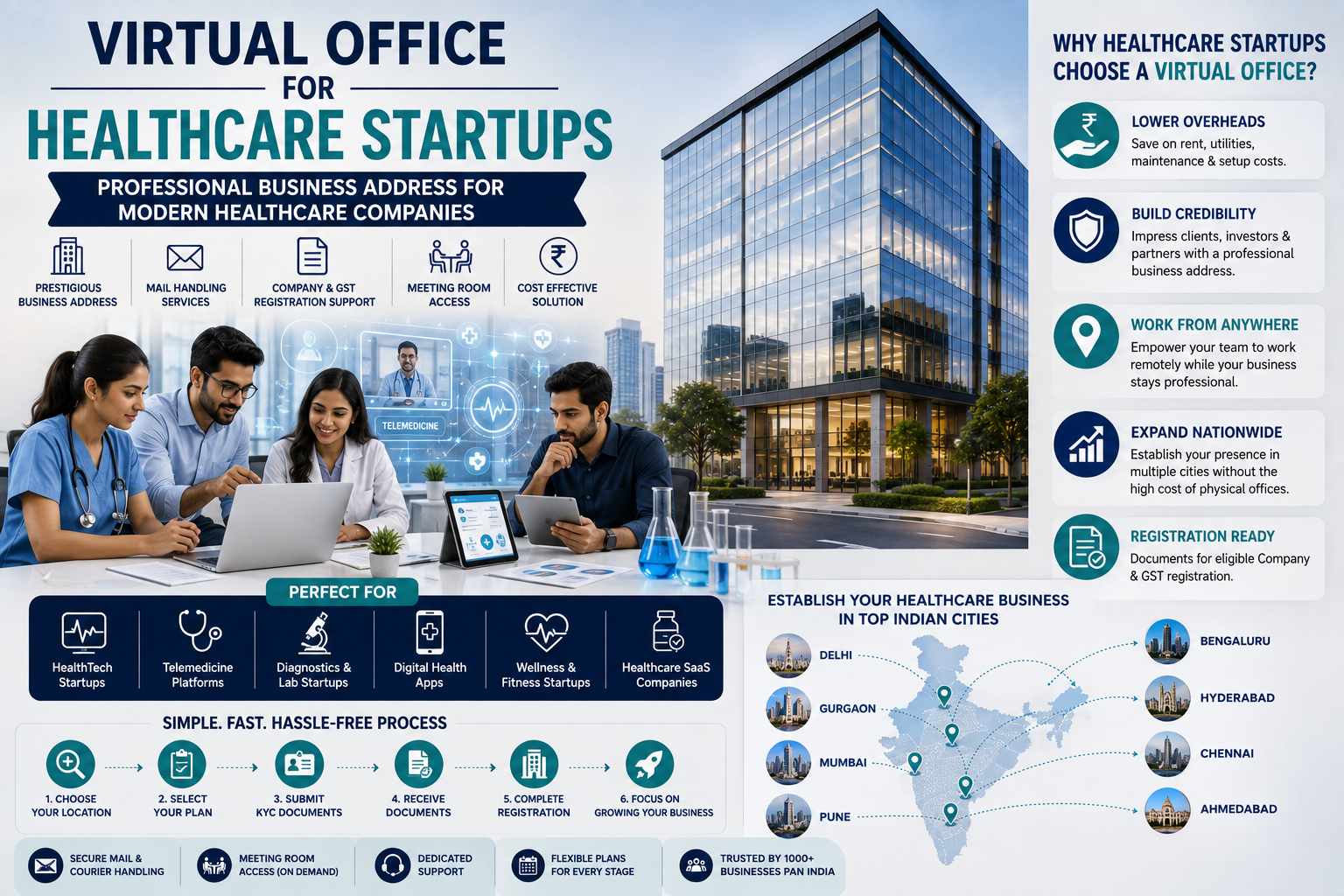
A Virtual Office for Healthcare Startups provides digital health companies, telemedicine platforms, wellness businesses, diagnostics startups, and HealthTech entrepreneurs with a professional commercial business address without requiring them to maintain a conventional office. Depending on the business model, location, documentation, and applicable regulations, a Virtual Office can support eligible company registration, GST registration, business correspondence, and administrative requirements.
For healthcare startups that operate through technology, remote teams, partner clinics, laboratories, hospitals, or distributed networks, a Virtual Office can help reduce fixed infrastructure costs while maintaining a professional business presence.
Introduction
Healthcare is undergoing a major transformation in India.
Telemedicine platforms, digital pharmacies, online consultation services, diagnostic technology companies, wellness platforms, health management applications, medical SaaS businesses, and healthcare marketplaces are changing how people access and manage healthcare services.
Many of these businesses are technology-driven rather than office-driven.
A HealthTech startup may have:
- A technology team working remotely
- Doctors operating from clinics or hospitals
- Sales teams visiting healthcare institutions
- Developers working from different cities
- Customer support teams operating online
- Diagnostic partners located across multiple regions
- Consultants working on a project basis
Yet the company still needs a professional business identity.
This is where a Virtual Office for Healthcare Startups can become a practical solution.
Instead of spending a large portion of early-stage capital on commercial rent, furniture, maintenance, utilities, reception infrastructure, and unused office space, a healthcare startup can establish a professional business address and maintain a flexible operating model.
The objective is not to replace facilities that genuinely require physical premises.
A diagnostic laboratory, clinic, hospital, pharmacy, medical manufacturing unit, or other regulated healthcare operation may require specific premises, licences, inspections, or infrastructure.
Instead, a Virtual Office can be particularly useful for the corporate and administrative side of eligible healthcare businesses.
What Is a Virtual Office?
A Virtual Office is a service that provides a business with access to a professional commercial address without requiring the company to maintain a traditional full-time office at that location.
Depending on the provider and plan, services may include:
- Professional business address
- Company registration documentation
- GST registration support
- Rent agreement
- No Objection Certificate (NOC)
- Utility bill
- Business mail handling
- Courier handling
- Meeting room access
- Reception services
- Administrative support
The exact services and documentation available depend on the location, plan, provider, and intended use.
For a healthcare startup, the main attraction is the ability to maintain a credible corporate presence while allowing employees and healthcare professionals to work from locations that actually suit their operations.
Why Healthcare Startups Are Considering Virtual Offices
Healthcare startups face a unique combination of technology, compliance, talent, and operational requirements.
An early-stage HealthTech company may need to invest heavily in:
- Software development
- Cybersecurity
- Cloud infrastructure
- Product development
- Medical professionals
- Regulatory compliance
- Customer acquisition
- Partnerships
- Research
- Clinical or operational technology
Office infrastructure may not be the highest-priority use of capital.
A Virtual Office can therefore help separate business infrastructure from workspace infrastructure.
The company can maintain a professional address while using:
- Coworking spaces
- Shared meeting rooms
- Partner facilities
- Hospitals
- Clinics
- Laboratories
- Client locations
- Remote workspaces
Who Should Use a Virtual Office for Healthcare Startups?
A Virtual Office can be particularly useful for several categories of healthcare and HealthTech businesses.
Telemedicine Platforms
Telemedicine businesses often connect patients with doctors digitally.
Their technology, support, and management teams may operate remotely while doctors work from clinics, hospitals, or independent practices.
A Virtual Office can provide a central corporate address for eligible administrative requirements.
HealthTech SaaS Companies
Healthcare software companies provide solutions for:
- Hospitals
- Clinics
- Doctors
- Diagnostic centers
- Pharmacies
- Insurance companies
- Healthcare administrators
These businesses may not require a large physical office, particularly during their early stages.
Digital Health Platforms
Digital health companies offering patient-management, health tracking, appointment scheduling, healthcare discovery, or other technology-enabled services can benefit from flexible office arrangements.
Wellness Startups
Businesses operating in areas such as:
- Wellness technology
- Fitness platforms
- Nutrition services
- Preventive health
- Mental wellness platforms
- Lifestyle management
may operate primarily through digital channels.
A Virtual Office can help establish a professional corporate identity.
Diagnostics Technology Companies
A diagnostics technology startup may develop software, platforms, devices, or services while its actual testing or laboratory activities take place at appropriate facilities.
A Virtual Office may be useful for its corporate operations where permitted.
The actual diagnostic activity must still take place at premises that satisfy applicable healthcare and regulatory requirements.
Medical Technology Startups
MedTech companies developing healthcare devices, software, monitoring technology, or digital solutions may use Virtual Offices for eligible corporate requirements while maintaining their actual research, manufacturing, testing, or clinical facilities separately.
Healthcare Marketplaces
Healthcare marketplaces connecting patients with doctors, clinics, hospitals, diagnostic providers, or other healthcare businesses can operate through digital platforms.
A Virtual Office can provide a centralized commercial address for the corporate entity.
Can Healthcare Startups Use a Virtual Office for Company Registration?
Eligible healthcare startups can use an appropriate Virtual Office address for company registration where the premises and documentation satisfy applicable legal requirements.
The important distinction is between the company’s registered/corporate address and a regulated healthcare operating facility.
For example, a HealthTech software company may require a corporate address but may not need a dedicated office where its entire technology team works every day.
However, a healthcare business performing regulated activities may have additional requirements beyond company registration.
Depending on the business structure, company registration may involve documentation such as:
- Identity documents
- PAN
- Address proof
- Rent agreement
- NOC
- Utility bill
- Incorporation documents
- Other applicable declarations
The exact requirements depend on the entity type and current regulations.
Can HealthTech Companies Use a Virtual Office for GST Registration?
A Virtual Office may be suitable for GST registration where the business, premises, documentation, and application satisfy applicable GST requirements.
This can be particularly useful for HealthTech businesses providing taxable services or products across different markets.
Potentially relevant businesses include:
- Healthcare software companies
- HealthTech consultants
- Digital healthcare platforms
- Wellness technology companies
- Healthcare marketing businesses
- Medical technology service providers
- Healthcare management platforms
GST treatment depends on the nature of the business, supplies, services, exemptions, and applicable tax rules.
Therefore, businesses should verify their specific GST position before registration.
Documents Required
Documentation varies according to the business structure and intended purpose.
Identity Documents
Commonly requested documents can include:
- PAN Card
- Aadhaar Card
- Photograph
- Director/Partner identification
- Other KYC documents where applicable
Business Documents
Depending on the company structure:
- Certificate of Incorporation
- Memorandum and Articles of Association
- LLP Agreement
- Partnership Deed
- Business PAN
- Existing GST Certificate
- Board Resolution where applicable
Address Documents
Depending on the Virtual Office plan, documentation may include:
- Rent Agreement
- No Objection Certificate
- Utility Bill
- Commercial Address Proof
Before purchasing a plan, confirm that the documents provided are appropriate for your intended registration or business purpose.
Benefits of a Virtual Office for Healthcare Startups
1. Lower Fixed Costs
Healthcare startups need to carefully manage capital.
Traditional office space can involve:
- Monthly rent
- Security deposit
- Furniture
- Electricity
- Internet
- Maintenance
- Housekeeping
- Office equipment
- Reception services
A Virtual Office can reduce many of these infrastructure costs.
The resulting savings can be directed toward product development, technology, marketing, talent, and compliance.
2. Professional Corporate Identity
Healthcare is a trust-sensitive industry.
Patients, hospitals, investors, doctors, pharmaceutical companies, and strategic partners may all evaluate a company’s professionalism before entering into a relationship.
A professional business address contributes to a stronger corporate identity.
3. Support Remote Teams
HealthTech startups frequently employ distributed teams.
Developers may work from Bangalore.
Product managers may work from Delhi.
Healthcare consultants may operate from Mumbai.
Sales teams may travel throughout India.
A Virtual Office provides a consistent business address while supporting this flexible operating model.
4. Expand Into New Markets
Healthcare startups often need to test new geographic markets before establishing expensive physical infrastructure.
A Virtual Office can provide a flexible business presence in selected cities where appropriate.
For example, a HealthTech company headquartered in Bangalore could explore business operations in:
- Delhi
- Gurgaon
- Mumbai
- Hyderabad
- Pune
- Chennai
- Ahmedabad
- Noida
without immediately committing to conventional branch offices.
Any state-specific registration or regulatory requirements should still be evaluated separately.
5. Improve Business Credibility
A professional commercial address can strengthen how a startup presents itself to:
- Investors
- Hospitals
- Clinics
- Corporate clients
- Technology partners
- Vendors
- Banks
- Potential employees
It should be viewed as one component of credibility—not as a substitute for proper licences, qualified professionals, operational capability, or regulatory compliance.
6. Flexible Client Meetings
Some healthcare startups do not require permanent meeting rooms.
Instead, they may need physical meeting facilities occasionally for:
- Investor meetings
- Hospital partnerships
- Vendor discussions
- Corporate presentations
- Board meetings
- Strategic negotiations
Plans that include meeting-room access can provide flexibility without requiring a permanent conference room.
Virtual Office vs Traditional Office for Healthcare Startups
| Feature | Traditional Office | Virtual Office |
| Professional Business Address | Yes | Yes |
| Company Registration Support | Yes | Available with eligible plans |
| GST Registration Support | Yes | Available with eligible plans |
| Permanent Workspace | Yes | No |
| Monthly Rent | High | Lower |
| Security Deposit | Usually required | Depends on plan |
| Furniture Investment | Required | Not required |
| Utilities | Required | Not required |
| Maintenance | Required | Not required |
| Remote Team Friendly | Moderate | Excellent |
| Mail Handling | Available | Available with selected plans |
| Meeting Facilities | Included | Available with selected plans |
| Multi-City Flexibility | Expensive | Higher |
| Best For | Teams requiring permanent premises | Flexible corporate operations |
Pricing Comparison
Actual pricing varies by city, provider, address, documentation, and services.
An indicative comparison may look like this:
| Office Solution | Approximate Annual Cost | Suitable For |
| Traditional Office | ₹5 lakh–₹20 lakh+ | Established healthcare companies |
| Managed Office | ₹3 lakh–₹12 lakh+ | Growing healthcare teams |
| Coworking Space | ₹1.5 lakh–₹6 lakh+ | Teams needing workspace |
| Virtual Office | ₹8,000–₹40,000+* | Remote HealthTech businesses |
*Indicative figures only. Actual pricing varies according to location, services, and provider.
For a startup that does not require permanent desks, the difference can be significant.
Where Should Healthcare Startups Choose a Virtual Office?
There is no universally “best” city.
The right location depends on:
- Target customers
- Investor ecosystem
- Healthcare partnerships
- Talent availability
- Expansion strategy
- Existing operations
- Regulatory considerations
- Business credibility
Bangalore
Bangalore is particularly attractive for technology-led healthcare businesses because of its large technology ecosystem and startup community.
Delhi NCR
Delhi NCR provides access to a large corporate, healthcare, government, and startup ecosystem.
Potential locations include Delhi, Gurgaon, and Noida.
Mumbai
Mumbai can be valuable for healthcare companies targeting financial services, enterprise clients, investors, and large corporate networks.
Hyderabad
Hyderabad has strong technology and healthcare ecosystems, making it relevant for HealthTech and healthcare technology companies.
Pune
Pune can be attractive for technology companies, startups, and businesses serving healthcare and enterprise customers.
Chennai
Chennai has significant healthcare, technology, and medical infrastructure, making it an important market for healthcare businesses.
The best city should ultimately be selected based on business strategy rather than simply choosing the most famous business address.
Step-by-Step Process
Step 1: Determine Your Requirement
Decide whether you need the Virtual Office for:
- Company registration
- GST registration
- Business correspondence
- Corporate address
- Mail handling
- Market expansion
Step 2: Select a Suitable City
Choose a location based on your customers, partnerships, and expansion plans.
Step 3: Compare Virtual Office Plans
Review:
- Address
- Documentation
- Mail handling
- Meeting rooms
- Registration support
- Duration
- Renewal terms
- Customer support
Step 4: Complete KYC
Submit the required identity and business documents.
Ensure all information is accurate and consistent.
Step 5: Receive the Documentation
After verification and onboarding, receive the documents included in your selected plan.
Review everything before using the address for official purposes.
Step 6: Complete Eligible Registrations
Where applicable, use the documents for company registration, GST registration, or other permitted business purposes.
Step 7: Continue Building the Healthcare Business
With the administrative address established, your team can concentrate on:
- Product development
- Healthcare partnerships
- Customer acquisition
- Technology
- Compliance
- Fundraising
- Market expansion
How Virtual Offices Can Help HealthTech Companies Scale
Healthcare startups often face an important strategic decision:
Should we build infrastructure first or prove demand first?
For technology-led businesses, maintaining a large office before achieving product-market fit can put unnecessary pressure on cash flow.
A Virtual Office allows founders to maintain a professional corporate setup while keeping infrastructure lean.
This can be particularly useful during:
Pre-Seed Stage
Focus on product development and validation instead of expensive office infrastructure.
Seed Stage
Allocate capital toward hiring, customer acquisition, technology, and partnerships.
Expansion Stage
Establish business addresses in selected markets without immediately building complete branch infrastructure.
Scale-Up Stage
As teams and operational requirements grow, the company can transition toward dedicated offices or facilities where genuinely necessary.
Important Consideration: Virtual Office Does Not Replace Regulated Healthcare Facilities
This distinction is essential.
A Virtual Office can be appropriate for the corporate and administrative needs of eligible healthcare businesses.
It does not automatically replace premises required for activities such as:
- Clinical treatment
- Diagnostic testing
- Laboratory operations
- Pharmacy operations
- Medical manufacturing
- Storage of regulated products
- Patient care
- Other regulated healthcare activities
If your business performs regulated healthcare activities, you must maintain any facilities, licences, registrations, professional qualifications, inspections, or operational standards required under applicable laws.
A HealthTech software company and a diagnostic laboratory have very different premises requirements.
Understanding this distinction helps startups use Virtual Offices appropriately.
Common Mistakes Healthcare Startups Should Avoid
Choosing an Address Without Checking Documentation
Do not purchase a plan based solely on the address.
First determine whether the documentation supports your intended purpose.
Assuming Every Healthcare Business Has the Same Requirements
A telemedicine platform, diagnostic company, medical device company, wellness platform, and pharmaceutical business may have completely different compliance obligations.
Choosing the Cheapest Provider
Price matters, but documentation quality, address suitability, mail handling, customer support, and reliability can matter more.
Ignoring Regulatory Requirements
A Virtual Office does not remove industry-specific regulatory obligations.
Treating the Virtual Office as a Clinical Facility
If your business requires patient-facing or regulated physical operations, maintain the appropriate facility separately.
Why Choose Vo Spaces?
For healthcare startups, choosing a Virtual Office provider should involve more than simply selecting an address.
Professional Commercial Addresses
Vo Spaces provides Virtual Office solutions in business locations designed to help companies establish a credible corporate presence.
Documentation Support
Eligible plans can include documents such as:
- Rent Agreement
- NOC
- Utility Bill
- Commercial Address Proof
These may support eligible company or GST registration requirements, subject to applicable regulations.
Mail Handling
Important business correspondence, government communications, and other eligible mail can be managed through professional mail handling services.
Flexible Plans
Startups can choose services based on their actual business requirements rather than paying for an entire traditional office infrastructure.
Multi-City Expansion
Healthcare companies planning to expand into new markets can explore Virtual Office options across major Indian business hubs.
Customer Support
A dedicated support team can assist with onboarding, documentation, renewals, and address-related requirements.
Frequently Asked Questions
1. Can healthcare startups use Virtual Offices?
Yes. Eligible HealthTech, wellness, healthcare software, telemedicine, and other technology-led businesses can use Virtual Offices for appropriate corporate and administrative purposes.
2. Is a Virtual Office legal in India?
Yes. Virtual Offices are legal when structured and used in accordance with applicable laws and regulations.
3. Can a healthcare startup use a Virtual Office for company registration?
Eligible businesses can use an appropriate Virtual Office address for company registration when the premises and documentation satisfy applicable requirements.
4. Can HealthTech companies use a Virtual Office for GST registration?
A Virtual Office may support GST registration when the business and premises meet applicable GST requirements and the required documentation is provided.
5. What documents are required?
Requirements vary, but can include PAN, Aadhaar, company incorporation documents, rent agreement, NOC, utility bill, and other applicable KYC or business documents.
6. How much does a Virtual Office cost?
Pricing depends on the city, location, documentation, services, and duration. Virtual Office plans are generally significantly less expensive than maintaining a traditional commercial office.
7. Is a Virtual Office suitable for healthcare startups?
Yes, particularly for technology-led businesses that do not require permanent office infrastructure for their core operations.
8. Can I open a bank account using a Virtual Office?
A properly documented commercial business address may be accepted depending on the bank’s current requirements. Banks can have different documentation and verification policies.
9. Can freelancers use Virtual Offices?
Yes. Healthcare consultants, health coaches, technology consultants, medical content professionals, and other eligible independent professionals may use Virtual Office services where appropriate.
10. Which city is best for a healthcare startup?
Bangalore, Delhi NCR, Mumbai, Hyderabad, Pune, and Chennai are important markets. The best location depends on your target customers, partnerships, talent, and expansion strategy.
11. How quickly can I receive Virtual Office documents?
Processing depends on KYC completion, documentation, the selected plan, and provider procedures.
12. Is a Virtual Office better than coworking?
If you primarily need a professional address and eligible registration-related services, a Virtual Office can be more economical. Coworking is better when you need permanent or regular workspace.
13. Can a telemedicine company use a Virtual Office?
A technology company operating a telemedicine platform may use a Virtual Office for appropriate corporate requirements, while complying separately with healthcare-specific regulations applicable to its services.
14. Can healthcare startups expand into multiple cities using Virtual Offices?
A Virtual Office can help businesses establish commercial addresses in multiple markets without immediately maintaining conventional branch offices. Any state-specific registration or operational requirements must still be evaluated.
15. Does a Virtual Office replace a clinic or diagnostic center?
No. A Virtual Office should not be treated as a substitute for physical facilities required for clinical, diagnostic, laboratory, pharmaceutical, manufacturing, or other regulated healthcare activities.
Why a Virtual Office Makes Sense for Lean HealthTech Businesses
Healthcare startups need to be careful about where they deploy capital.
Building technology, recruiting skilled teams, establishing partnerships, acquiring customers, and meeting compliance requirements can consume significant resources.
A large office may not contribute directly to any of these priorities.
A Virtual Office allows the corporate infrastructure to remain lean while the business invests in areas that can directly contribute to growth.
For a digital healthcare company, that can mean:
Less office overhead → More capital for technology → More resources for growth.
Summary
A Virtual Office for Healthcare Startups can provide a practical foundation for technology-driven healthcare businesses that want a professional corporate address without the expense of maintaining a conventional office.
It can be particularly useful for:
- HealthTech startups
- Telemedicine companies
- Healthcare SaaS businesses
- Wellness technology companies
- Digital health platforms
- Healthcare marketplaces
- Medical technology businesses
- Healthcare consulting companies
Potential benefits include:
- Reduced office overhead
- Professional business presence
- Flexible working arrangements
- Eligible registration support
- Mail handling
- Multi-city expansion flexibility
- Better allocation of startup capital
However, businesses must distinguish between corporate office requirements and physical facilities required for regulated healthcare operations.
Final Conclusion
The future of healthcare is increasingly connected to technology.
Healthcare companies can now build products, coordinate professionals, serve customers, and manage teams across multiple cities without requiring every employee to work from one central office.
For these businesses, a Virtual Office for Healthcare Startups can provide the professional address and administrative infrastructure needed to operate efficiently while maintaining a lean cost structure.
Whether you are building a telemedicine platform, healthcare SaaS product, wellness company, diagnostics technology business, or digital health marketplace, the right Virtual Office can help you establish a professional corporate presence while allowing your team to focus on what matters most: technology, healthcare partnerships, customer experience, compliance, and sustainable growth.
With Vo Spaces, eligible businesses can explore professional commercial addresses, documentation support, mail handling, flexible plans, and solutions designed for companies expanding across India’s major business markets.