
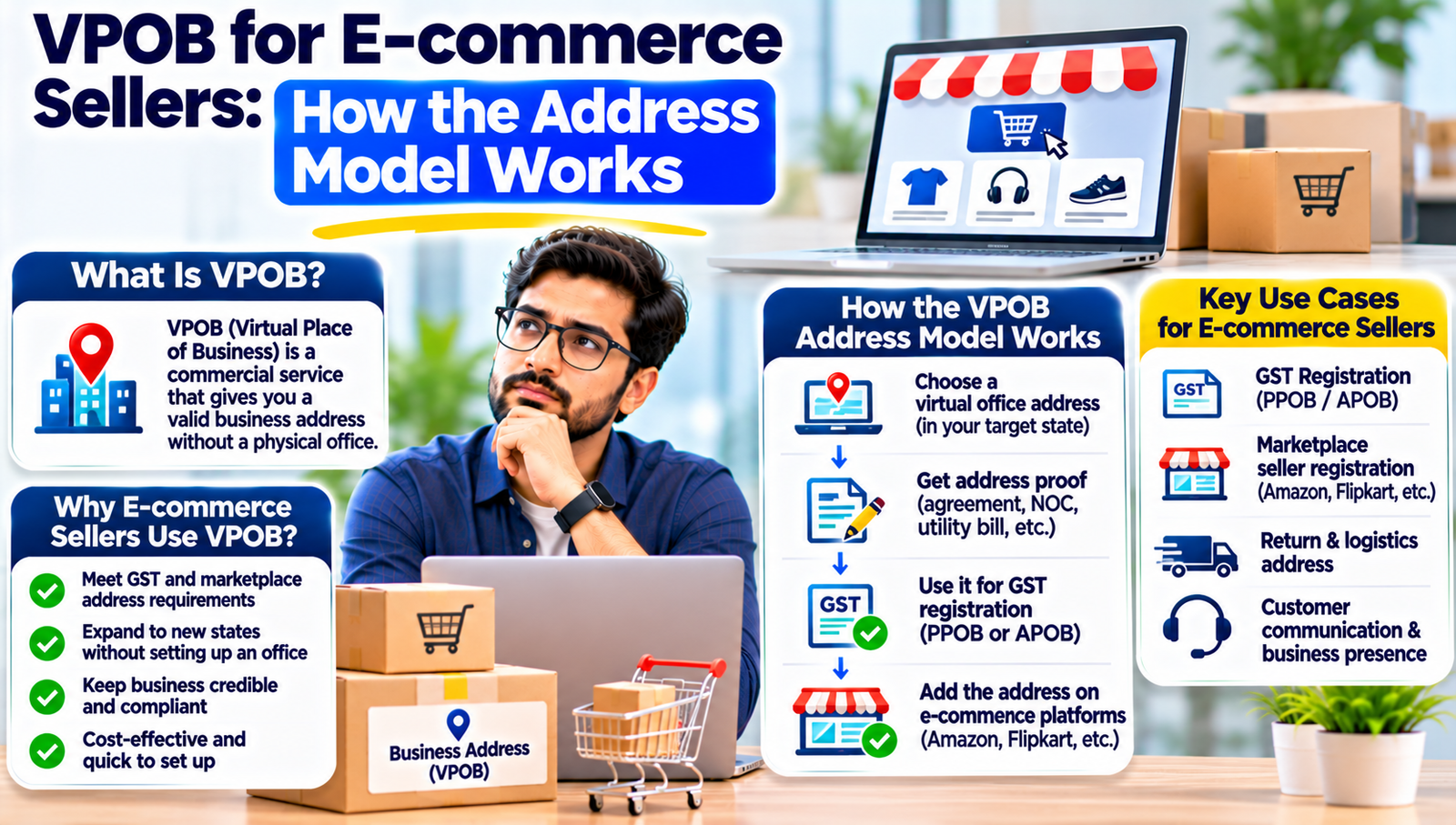
Expanding an e-commerce business across India often involves managing different business addresses, GST registrations, inventory locations and marketplace requirements.
For sellers operating through platforms such as Amazon and Flipkart, renting a dedicated office in every city may not be practical. This is where VPOB (Virtual Place of Business) services are often considered.
A VPOB service provides a business address arrangement that may include premises-use rights, documentation, mail handling and access to shared workspace facilities.
However, using a VPOB address does not automatically qualify a seller for GST registration or marketplace approval.
The suitability of the address depends on the business’s actual activities, applicable GST requirements, premises documentation and marketplace policies.
This guide explains how VPOB works for e-commerce sellers in India, including its relationship with GST registration, required documents, costs, advantages and limitations.
What Is VPOB in E-commerce?
VPOB is a commercial term used for virtual business address arrangements.
Meaning and Full Form of VPOB
VPOB stands for Virtual Place of Business.
In e-commerce, it commonly refers to a service through which a seller obtains permission to use a specified business address, subject to the provider’s agreement and available facilities.
How a Virtual Place of Business Works
A VPOB provider may offer a business address, relevant premises documentation, mail handling and access to shared facilities.
The services and permitted business activities depend on the agreement.
Why E-commerce Sellers Consider VPOB Services
Sellers may consider VPOB arrangements when exploring new markets, managing administrative activities or reducing the need for dedicated office space.
Is VPOB an Official GST Registration Category?
No. VPOB is not a separate statutory GST registration category.
The GST framework recognises a Principal Place of Business (PPOB) and Additional Places of Business (APOB).
A virtual address may be declared under one of these categories only where it genuinely qualifies under the applicable requirements.
Difference Between a VPOB Address and a Physical Warehouse
A VPOB address may support administrative or other permitted business activities.
A physical warehouse is a location where inventory is actually stored.
A virtual address agreement does not automatically grant warehouse or inventory storage rights.
How Does the VPOB Address Model Work for E-commerce Sellers?
The VPOB model typically involves selecting a premises arrangement, reviewing the agreement and obtaining supporting documents.
Selecting a Business Address in the Required State
The seller first identifies the location needed for legitimate business activities.
Understanding the Address Service Agreement
The agreement should explain the address, duration, permitted use, facilities and service conditions.
Establishing Permitted Use of the Premises
The seller must confirm what activities are permitted at the premises.
Collecting Address and Occupancy Documents
Relevant agreements, ownership evidence and consent documents should be collected where applicable.
Assessing GST Registration Requirements
The seller should determine whether GST registration is required in the state based on actual business activities and applicable law.
Using the Address for Permitted Business Activities
The premises should only be used for activities permitted by the agreement and applicable regulations.
Handling Mail and Official Correspondence
Where mail handling is included, the provider may receive and notify the business about correspondence.
Maintaining the Address Agreement and Business Records
The seller should track agreement expiry dates, renewals and changes to registered address information.
Why Do E-commerce Sellers Use VPOB Services?
VPOB services may offer operational flexibility when a dedicated office is unnecessary.
Exploring New Regional Markets
A business may assess opportunities in different regions before committing to permanent office space.
Managing Business Addresses Across Cities
Address services may help businesses organise legitimate administrative locations.
Reducing the Need for a Dedicated Office
Shared facilities can reduce certain fixed office expenses.
Supporting Administrative Business Operations
Some arrangements include meeting rooms, workstations or other administrative facilities.
Managing Government and Business Correspondence
Mail handling services may support correspondence management, although businesses remain responsible for monitoring official electronic notices.
Maintaining Address Documentation
A provider may supply documentation relevant to the permitted premises arrangement.
Understanding the Limitations of Virtual Address Services
A VPOB does not automatically provide warehouse facilities, establish a taxable business presence or guarantee registration approval.
Is VPOB Valid for GST Registration in India?
A virtual address may be suitable for GST registration when it meets the applicable requirements.
Can a Virtual Address Be Used for GST Registration?
Potentially, yes.
GST law does not impose a blanket prohibition on virtual office arrangements. However, the declared location must genuinely qualify as a place of business.
GST Requirements for Declared Business Premises
The business must accurately identify its principal or additional places of business and provide applicable supporting documentation.
Genuine Business Use and Premises-Use Rights
The applicant should have legitimate permission to use the declared premises for relevant business activities.
Why an Address Agreement Alone May Not Be Sufficient
An agreement does not automatically establish that the location meets every GST requirement.
The actual rights granted, business activities and supporting evidence matter.
GST Physical Verification Considerations
GST authorities may conduct verification under the applicable procedures.
The declared premises and business arrangement should be capable of genuine verification.
When a Mail-Only Address May Be Unsuitable
A service limited to receiving letters may not establish a qualifying place of business.
Why VPOB Providers Cannot Guarantee GST Approval
Approval depends on the applicant’s eligibility, documents and applicable verification requirements.
What Is the Difference Between VPOB, PPOB and APOB?
These terms describe different concepts.
VPOB: Virtual Place of Business
VPOB is a commercial description of a virtual business address service.
PPOB: Principal Place of Business
PPOB is the principal business location declared under a GST registration.
APOB: Additional Place of Business
APOB refers to another qualifying business location declared under an existing GST registration.
How a Virtual Address May Be Declared Under GST
Depending on its actual use and eligibility, a virtual address arrangement may potentially support a PPOB or APOB declaration.
When a Physical Warehouse Must Be Declared Separately
Where inventory is stored at a separate qualifying business location, that premises may need to be declared appropriately.
Why These Terms Should Not Be Used Interchangeably
| Factor | VPOB | PPOB | APOB |
|---|---|---|---|
| Full form | Virtual Place of Business | Principal Place of Business | Additional Place of Business |
| Nature | Commercial service term | Statutory GST concept | Statutory GST concept |
| Separate GST category | No | Recognised registration field | Recognised registration field |
| Main purpose | Address and related services | Main declared business premises | Additional declared premises |
| Can include a virtual address | Describes the arrangement | Potentially, if eligible | Potentially, if eligible |
| Inventory storage | Not automatically included | Depends on actual premises | Depends on actual premises |
Can E-commerce Sellers Use VPOB to Register for GST in Multiple States?
A VPOB service does not automatically establish GST registration eligibility in multiple states.
Understanding State-Wise GST Registration
GST registrations are generally state-specific.
A business may have different GSTINs under the same PAN in different states.
When Separate State Registration May Be Required
Registration may be required when the seller becomes liable under the applicable provisions in a particular state.
Can One VPOB Address Cover Multiple States?
No. A single physical address cannot serve as premises located in multiple states.
Business Operations vs Correspondence Addresses
A mailing address and an actual place of business are not necessarily the same.
How Inventory and Fulfilment Locations Affect Registration
Stock storage, dispatch arrangements and the location from which supplies are made can affect GST compliance and registration analysis.
Why VPOB Does Not Automatically Create GST Eligibility
Purchasing an address service does not itself create a GST registration obligation or entitlement.
Managing Multiple State GSTINs
Maintain a record of each GSTIN, declared premises, inventory location and supporting agreement.
What Documents Are Required for a VPOB Address Arrangement?
The required documents depend on the provider’s arrangements and the purpose for which the address will be used.
Virtual Office Service Agreement
The agreement should identify the business, premises, permitted use and service duration.
Rental or Licence Agreement Where Applicable
A rental or licence agreement may establish the relevant premises-use rights.
Owner Consent or NOC Where Applicable
Consent may be required depending on the nature of possession.
Property Ownership or Supporting Premises Evidence
Relevant property records may help establish the authority of the person granting premises-use rights.
Utility Bill or Other Accepted Address Proof
An electricity bill, property tax receipt or another accepted document may be required.
Business PAN and Constitution Documents
GST applications require the prescribed legal identity and business constitution information.
Authorised Signatory Details
The relevant authorised person must complete the application and verification requirements.
Additional Documents Required by GST Authorities or Marketplaces
Additional evidence may be requested under applicable procedures or platform policies.
| Document | Purpose |
|---|---|
| VPOB service agreement | Establish service and premises-use terms |
| Rental or licence agreement | Establish occupancy or use rights |
| Owner consent/NOC | Support permission where applicable |
| Property evidence | Support ownership or premises authority |
| Utility bill | Support address identification |
| Business PAN | Establish taxpayer identity |
| Constitution documents | Establish legal business structure |
| Authorised signatory details | Support application submission |
How to Set Up a VPOB Address for an E-commerce Business
Follow a structured process before using a virtual address for business or GST purposes.
Step 1: Identify the Business Requirement
Determine whether the business needs administrative facilities, correspondence handling, workspace or another legitimate service.
Step 2: Check Whether GST Registration Is Required in the State
Assess the actual business activities and applicable registration provisions.
Step 3: Choose a Suitable VPOB Provider
Compare providers based on documentation, facilities, service terms and legitimacy.
Step 4: Verify the Physical Address
Confirm the premises exist and the address details are correct.
Step 5: Review the Agreement and Permitted Use
Check whether the arrangement supports the activities the business intends to conduct.
Step 6: Collect Applicable Address Documents
Obtain the relevant agreement, consent and premises evidence.
Step 7: Apply for or Amend GST Registration Where Required
Complete the applicable GST registration or amendment procedure using accurate information.
Step 8: Complete Applicable Verification
Follow the authentication, clarification or physical verification procedures where applicable.
Step 9: Update Marketplace and Business Records
Update seller account information where the platform permits and requires it.
Step 10: Maintain the Address and Compliance Documents
Monitor renewals, changes and ongoing obligations.
How Does VPOB Work for Amazon and Flipkart Sellers?
Marketplace sellers must consider both GST requirements and platform-specific policies.
Business Address Information Used by Marketplaces
Marketplaces may collect business, pickup, return and other address information.
GSTIN and Seller Account Requirements
GSTIN requirements vary according to the seller, products, programme and applicable rules.
Difference Between Seller Address and Inventory Location
A seller’s administrative address may differ from the location where products are stored.
Fulfilment Centre and Warehouse Address Considerations
Inventory stored at a marketplace fulfilment centre may create separate documentation or registration considerations.
Marketplace Address Verification
Marketplaces may require verification of business information or premises details.
Why Marketplace Approval and GST Registration Are Separate
GST registration does not automatically guarantee marketplace onboarding.
Similarly, marketplace account approval does not replace GST compliance.
Checking Current Platform-Specific Policies
Sellers should confirm current requirements directly with Amazon or Flipkart before purchasing a VPOB service.
Important: Neither marketplace should be assumed to universally accept VPOB addresses for every seller or fulfilment programme.
VPOB vs Physical Office vs Warehouse: Which Does an E-commerce Seller Need?
The appropriate premises depend on actual business activities.
VPOB for Administrative Business Activities
A suitable VPOB arrangement may support permitted administrative and correspondence functions.
Physical Office for Regular Operations
A dedicated office may be more appropriate for regular staff operations, meetings and daily business activities.
Warehouse for Inventory Storage
A warehouse provides physical facilities for storing goods.
Fulfilment Centre for Order Processing
A fulfilment centre may support inventory management, picking, packing and dispatch.
When Multiple Business Locations Are Necessary
An e-commerce business may require separate administrative, inventory and fulfilment premises.
Choosing Based on Actual Business Activities
| Business Requirement | Potentially Suitable Arrangement |
|---|---|
| Administrative business activities | Eligible VPOB or shared office |
| Daily office operations | Physical or suitably equipped shared office |
| Inventory storage | Warehouse |
| Picking, packing and dispatch | Fulfilment centre |
| Mail handling | Correspondence service |
| Multiple operational functions | Combination of suitable premises |
How Much Does VPOB Cost for E-commerce Sellers in India?
VPOB prices vary by provider, location, facilities and service terms.
There is no single standard VPOB price across India.
Factors Affecting VPOB Pricing
The main factors include location, premises facilities, agreement duration and additional services.
City and Location
Commercial addresses in different cities may have different pricing structures.
Agreement and Documentation Services
Providers may include certain documentation services in their packages or charge separately.
Mail Handling and Forwarding Charges
Mail receiving, scanning and courier forwarding may involve additional charges.
Workspace Access and Additional Facilities
Meeting rooms, desks and other facilities may be charged separately.
Renewal and Cancellation Fees
Review renewal rates, deposits, cancellation conditions and notice periods.
VPOB vs Physical Office Cost Considerations
A VPOB arrangement may reduce certain office expenses but cannot replace facilities that the business genuinely requires.
| Cost Factor | VPOB | Dedicated Physical Office |
|---|---|---|
| Premises cost | Service/package fee | Rent |
| Workspace | Limited or shared, depending on agreement | Usually dedicated |
| Utilities | May be included | Often separate |
| Mail handling | May be included or extra | Managed by business |
| Maintenance | Depends on package | Usually ongoing |
| Inventory storage | Not automatically available | Depends on premises |
What Are the Risks and Limitations of Using VPOB for E-commerce?
A VPOB arrangement should be evaluated carefully.
Insufficient Premises Documentation
Incomplete agreements or missing supporting evidence may create compliance problems.
Address Verification Problems
The declared address may be difficult to verify if records are inaccurate or the arrangement is unsuitable.
Using a Mail-Only Address as an Operational Location
A correspondence service should not be misrepresented as an actual business premises.
Incorrect GST Registration Assumptions
A VPOB does not automatically create eligibility for GST registration in a particular state.
Marketplace Account Verification Issues
The marketplace may reject or question address information that does not meet its policies.
Expired Address Agreements
An expired agreement can create problems where the business no longer has valid premises-use rights.
Missed Government Notices
Poor correspondence handling may cause businesses to miss important communications.
Incorrect Inventory or Warehouse Address Declarations
Actual stock locations should be accurately recorded where required.
How to Choose a Reliable VPOB Provider for E-commerce
Before purchasing a VPOB service, evaluate the following factors.
Verify the Actual Business Address
Confirm the location and complete premises details.
Confirm Permitted Business Activities
Ensure the agreement allows the intended use.
Check the Provider’s Authority Over the Premises
Confirm that the provider has legitimate authority to grant the relevant rights.
Review Agreement and Address Proof Documents
Examine the documents before entering into the arrangement.
Understand Mail Handling Services
Ask how mail is received, recorded, forwarded and retained.
Check Workspace Access Where Needed
Confirm access arrangements if the business needs meeting rooms or workstations.
Review Pricing, Renewal and Cancellation Terms
Understand the full cost and contractual obligations.
Avoid Guaranteed GST or Marketplace Approval Claims
A reliable provider should explain limitations rather than promise automatic approval.
VPOB Setup Checklist for E-commerce Sellers
| Checklist Item | Status |
|---|---|
| Confirm the intended business use | Pending |
| Assess state-wise GST requirements | Pending |
| Verify the address and provider | Pending |
| Review permitted premises use | Pending |
| Collect supporting documents | Pending |
| Confirm marketplace requirements | Pending |
| Identify actual inventory locations | Pending |
| Complete applicable GST procedures | Pending |
| Maintain accurate business records | Pending |
| Track agreement renewal dates | Pending |
Final Words
VPOB services can offer flexibility for e-commerce sellers who need legitimate business address arrangements without maintaining a dedicated office at every location.
However, VPOB is a commercial service model, not a separate GST registration category.
Businesses must distinguish virtual address services from actual warehouses, fulfilment centres and other operational premises.
Before selecting a VPOB provider, sellers should verify the address, review permitted use, assess GST requirements and confirm marketplace-specific policies.
The right arrangement is one that supports the seller’s genuine business activities while maintaining accurate documentation and compliance.
FAQs About VPOB for E-commerce Sellers
What is VPOB in e-commerce?
VPOB stands for Virtual Place of Business. It is a commercial term for a virtual business address arrangement that may include premises-use rights and related services.
Is VPOB legal in India?
Virtual business address arrangements are not inherently illegal. Their suitability depends on the actual agreement, business activities and applicable laws.
Can I use VPOB for GST registration?
Potentially, yes, where the premises genuinely qualify as a place of business and the applicant satisfies the applicable requirements.
What is the difference between VPOB and APOB?
VPOB is a commercial term for a virtual business address arrangement. APOB is a statutory GST concept referring to an Additional Place of Business.
Can Amazon sellers use a VPOB address?
Suitability depends on the seller’s circumstances, the address arrangement and Amazon’s current programme-specific requirements. Acceptance should not be assumed.
Can Flipkart sellers use VPOB for business registration?
This depends on the applicable GST requirements and Flipkart’s current seller verification policies.
Can VPOB be used for GST registration in multiple states?
A business may have suitable premises arrangements in multiple states, but each state’s registration obligations must be assessed separately. One address does not cover multiple states.
What documents are required for VPOB?
Documents may include a service or licence agreement, owner consent where applicable, supporting property evidence and other documents required for the intended business use.
Does VPOB allow sellers to store inventory at the address?
Not automatically. Inventory storage requires suitable physical facilities and permission under the premises arrangement.
How much does VPOB cost in India?
Prices vary by city, provider, agreement duration, documentation services and additional facilities. Compare total costs and permitted use before selecting a package.