
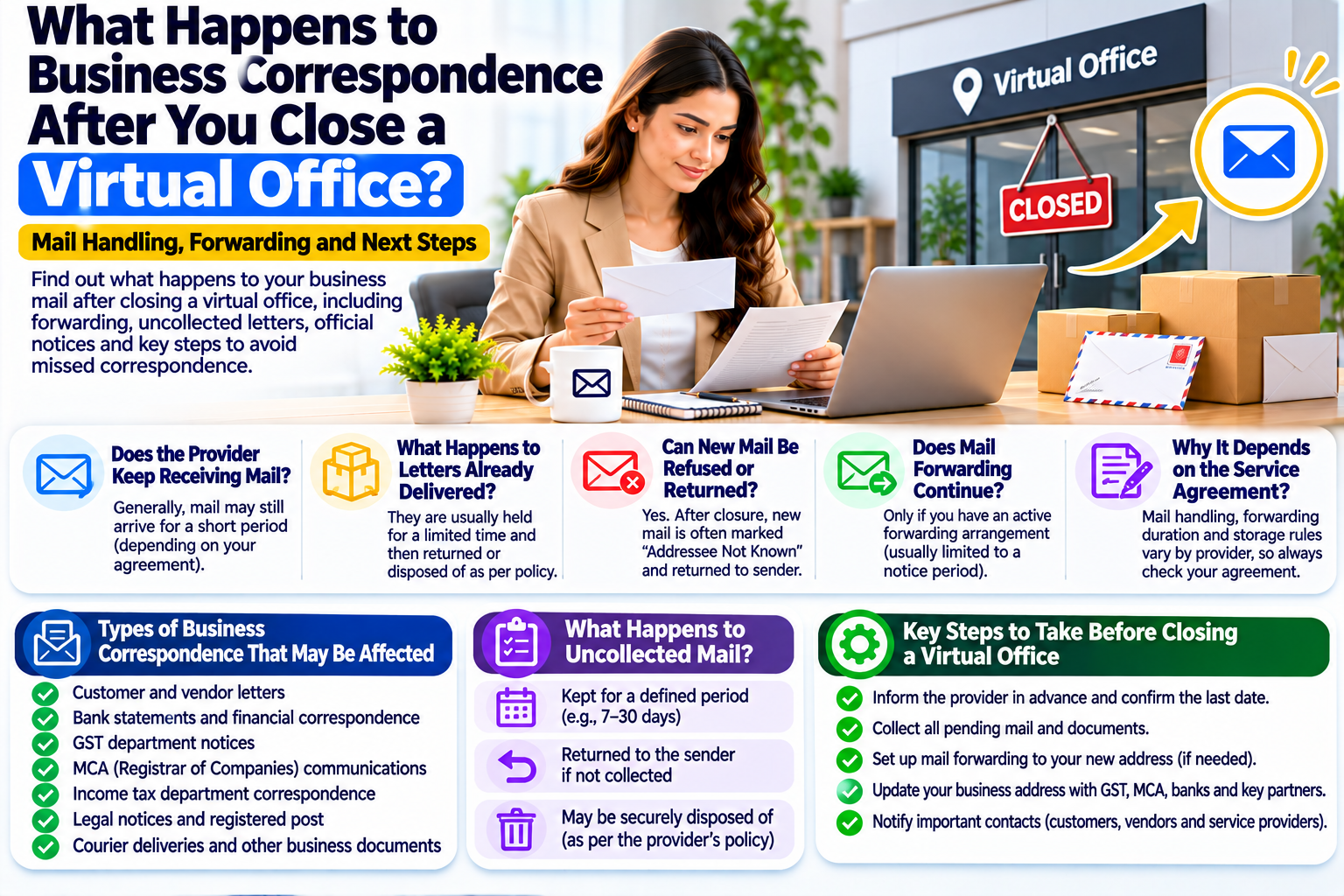
Closing a virtual office may seem as simple as cancelling an agreement and paying any outstanding charges. However, businesses often overlook one important question: What happens to business mail after the virtual office closes?
Your old address may still receive customer letters, bank documents, GST notices, MCA communications, legal correspondence and courier deliveries. If the provider stops accepting mail, important documents could be returned, delayed or left uncollected.
The consequences can extend beyond missed correspondence. Businesses may also need to update statutory registrations, financial accounts and public-facing contact information.
This guide explains what happens to business correspondence after virtual office closure in India, how mail forwarding works, what to do with uncollected letters and how to manage official address changes.
What Happens to Business Mail After You Close a Virtual Office?
When a virtual office agreement ends, the provider’s obligation to receive, store or forward business correspondence generally depends on the service agreement and applicable law.
Does the Virtual Office Provider Continue Receiving Mail?
Not necessarily. Some providers stop accepting correspondence immediately after the agreement ends. Others may offer a limited transition period.
Businesses should confirm the final mail acceptance date in writing.
What Happens to Letters Already Delivered?
Letters received before closure may remain available for collection or forwarding under the provider’s contractual procedures.
Ask for an inventory of outstanding correspondence before the final service date.
Can New Mail Be Refused or Returned to Sender?
Yes, depending on the delivery method and applicable arrangements, correspondence arriving after closure may be refused or returned to the sender.
However, a provider should not assume it can dispose of or redirect another party’s correspondence without appropriate authority.
Does Mail Forwarding Continue After Cancellation?
Mail forwarding does not automatically continue after cancellation.
Some providers offer paid post-closure forwarding, while others discontinue the service when the agreement expires.
Why Mail Handling Depends on the Service Agreement
The agreement should explain mail acceptance, storage, forwarding, collection deadlines, charges and treatment of uncollected correspondence.
These terms should be reviewed before cancellation.
What Types of Business Correspondence May Be Affected by Virtual Office Closure?
Several categories of correspondence can be affected.
Customer and Vendor Letters
Customers and suppliers may continue sending contracts, invoices, confirmations and other documents to the old address.
Bank Statements and Financial Correspondence
Banks may send account documents, verification requests and other communications to the registered correspondence address.
GST Department Notices
GST authorities may communicate through physical or electronic channels, including the GST portal.
MCA and Registrar of Companies Communications
Companies may receive statutory correspondence at their registered office.
Income Tax Department Correspondence
Income tax communications may arrive electronically or through other legally permitted service methods.
Legal Notices and Registered Post
Legal notices and court-related documents require particular attention because delivery and service dates may have legal consequences.
Courier Deliveries and Business Documents
Business documents, certificates, contracts and parcels may be delayed or returned if the old provider no longer accepts deliveries.
| Correspondence Type | Potential Risk After Closure | Recommended Action |
|---|---|---|
| Customer and vendor mail | Missed business communications | Notify business contacts |
| Bank correspondence | Delayed verification or account updates | Update bank KYC and contact records |
| GST notices | Missed statutory deadlines | Update registration and monitor portal |
| MCA correspondence | Registered office compliance concerns | Complete applicable MCA filings |
| Income tax notices | Missed responses | Monitor Income Tax portal |
| Legal notices | Missed legal deadlines | Arrange immediate legal review |
| Couriers and documents | Returned or uncollected deliveries | Confirm final collection arrangements |
What Happens to Uncollected Mail When a Virtual Office Agreement Ends?
Uncollected mail should be addressed before the agreement terminates.
How Providers Handle Mail Already in Their Possession
Providers may retain correspondence for collection or offer forwarding, subject to their service terms.
Mail Retention Periods and Contractual Terms
There is no single universal retention period applicable to every virtual office provider.
The relevant period depends on the agreement, provider policies and applicable legal obligations.
Collection Before the Final Service Date
Arrange collection of important original documents before the final date.
Charges for Storage or Forwarding
Providers may charge for storage, courier services or additional handling.
What Happens When Mail Is Not Collected?
The outcome depends on the provider’s lawful procedures and contractual terms. Correspondence may be retained for a specified period or handled under an agreed return or disposal procedure.
Confidential documents require appropriate safeguards.
How to Request a Final Mail Inventory
Ask the provider for a list showing the sender, receipt date, item type and collection or forwarding status.
Can You Continue Forwarding Business Mail After Closing a Virtual Office?
Yes, if the previous provider agrees to provide forwarding services or another authorised redirection arrangement is available.
Temporary Mail Forwarding Arrangements
A temporary forwarding service can help manage correspondence during the transition.
Whether Post-Closure Forwarding Is Included
Check whether forwarding is included in the existing agreement or requires a separate arrangement.
Setting Up a Replacement Delivery Address
Provide the provider with an accurate, authorised replacement correspondence address.
Forwarding Registered Post and Couriers
Registered post and courier items may have delivery restrictions or require specific authorisation.
Confirm whether these items can be forwarded.
Additional Forwarding Charges
Ask about courier fees, handling charges and any minimum service period.
Limitations of Postal Redirection Services
Postal redirection may not cover every delivery service, sender or category of correspondence.
Why Forwarding Is Not a Substitute for Updating Official Records
Forwarding helps manage correspondence temporarily.
It does not replace the need to update statutory registrations and other records where the declared business address has changed.
How to Manage Business Correspondence Before Closing a Virtual Office
Follow these steps to reduce the risk of lost correspondence.
Step 1: Review Your Virtual Office Agreement
Check termination terms, notice periods, mail handling obligations and post-closure services.
Step 2: Confirm the Final Mail Receiving Date
Ask the provider to confirm when it will stop accepting correspondence.
Step 3: Request a List of Pending and Uncollected Mail
Identify letters, parcels and official documents awaiting collection.
Step 4: Collect Important Original Documents
Prioritise legal, financial, statutory and contractual documents.
Step 5: Arrange Temporary Forwarding Where Available
Agree on the forwarding address, duration, charges and handling procedure.
Step 6: Establish a Valid Replacement Business Address
Ensure the replacement address is suitable for the business’s intended use and supported by legitimate premises rights.
Step 7: Update Government and Business Records
Review GST, MCA and other registration requirements.
Step 8: Notify Banks, Vendors and Customers
Inform relevant parties about the new address.
Step 9: Confirm Final Mail Collection
Obtain confirmation that outstanding items have been collected or forwarded.
Step 10: Obtain Written Closure Confirmation
Retain confirmation of the termination date, final mail arrangements and outstanding obligations.
What Happens to Government Notices Sent to a Closed Virtual Office?
Government notices sent to a former address may still create compliance concerns.
GST Notices Sent to the Former Business Address
Under Section 169 of the CGST Act, notices may be served through prescribed methods, including registered post, email and the GST common portal.
A business should not assume that a notice is ineffective merely because its former provider did not forward it.
MCA and Registered Office Communications
Companies must maintain a registered office capable of receiving and acknowledging communications as required by Section 12 of the Companies Act, 2013.
Income Tax Department Notices
Income tax communications may be delivered through the department’s electronic systems or other legally permitted methods.
Legal Notices and Court Correspondence
The legal effect of delivery depends on the applicable service rules and circumstances.
Why Official Notices May Still Have Legal Consequences
A notice can potentially be legally served even when the business does not physically receive a forwarded copy.
How to Check Government Portals for Pending Notices
Regularly review:
What to Do if an Important Notice Was Missed
Obtain the complete notice, verify the relevant service and response dates, and seek appropriate professional advice about available responses or remedies.
Do You Need to Update GST Registration After Closing a Virtual Office?
If the virtual office was declared as a business location and that location is no longer valid, the GST registration particulars generally need to be reviewed and updated.
When Closing a Virtual Office Creates an Address Change
An amendment may be required when the principal or additional place of business changes.
Updating the Principal Place of Business
For most ordinary registrations, changes to the principal place of business are handled through the applicable core amendment process using Form GST REG-14.
Certain categories of registrations may follow different processing rules.
Updating an Additional Place of Business
Additional-place amendments are generally processed as non-core amendments under the changes introduced in October 2026.
Supporting Documents for a Replacement Address
Provide the relevant rental, ownership, consent or other acceptable premises documents.
Applicable GST Amendment Timelines
Under Rule 19 of the CGST Rules, changes to registration particulars generally must be reported within 15 days of the change.
Interstate Address Changes and GST Registration
A GSTIN is state-specific. Moving business operations to another state may require a separate GST registration and consideration of the existing registration.
Why Closing an Office Does Not Automatically Cancel GST Registration
Ending a virtual office agreement does not automatically cancel a GSTIN.
GST cancellation is a separate statutory process and depends on the relevant circumstances.
What Happens to Your MCA Registered Office After Virtual Office Closure?
Companies should ensure that their registered office remains compliant when a virtual office agreement ends.
Why Companies Must Maintain a Compliant Registered Office
Section 12 of the Companies Act requires a company to maintain a registered office capable of receiving and acknowledging official communications.
When a Registered Office Change Is Required
If the company no longer has valid rights to use the declared registered office, it should arrange a compliant replacement and complete applicable filings.
Applicable MCA Filings and Supporting Documents
Form INC-22 is commonly used to notify a registered office change.
Other approvals or filings may be necessary depending on the nature and location of the move.
Risks of Continuing to Use an Address Without Valid Rights
Using an address without appropriate premises rights can create documentation, verification and compliance concerns.
How to Confirm Updated Company Master Data
Check the company’s registered office details through the MCA portal after the relevant filings are processed.
Why Virtual Office Closure Does Not Automatically Close a Company
Terminating an office agreement does not dissolve or strike off a company.
Company closure requires separate legal procedures.
Which Business Records Should You Update After Closing a Virtual Office?
Review the following records where the previous address is no longer accurate.
GST Registration
Update the declared business premises as required.
MCA Registered Office Details
Complete the applicable registered office change procedure.
Income Tax and PAN-Related Contact Information
Review registered contact and address details and update them through the relevant process where required.
Bank Accounts and KYC Records
Inform banks of the new business correspondence or registered address.
Business Licences and Registrations
Review licences and registrations connected to the previous premises.
Invoices and Billing Information
Ensure relevant business address and GST particulars are accurate.
Marketplace and Payment Gateway Accounts
Update seller, merchant and payment processing records.
Website, Google Business Profile and Business Directories
Correct published contact details. Google Business Profile eligibility should be assessed separately because mail-only virtual offices are not automatically eligible.
Vendor and Customer Contact Records
Notify important customers, suppliers and contractual partners.
What Should You Do if Mail Is Still Being Delivered to Your Old Virtual Office?
Take action as soon as you discover that correspondence is arriving at the former address.
Contact the Previous Provider
Ask whether the correspondence has been accepted and whether collection is possible.
Check Whether the Mail Has Been Received
Request delivery evidence and available tracking information.
Request Collection or Forwarding if Available
Arrange lawful collection or forwarding under the provider’s procedures.
Notify the Sender of the Correct Address
Contact the sender and request an address update.
Update Recurring Correspondence Sources
Review banks, suppliers, subscriptions and government records.
Check Official Portals for Government Communications
Do not rely exclusively on the old provider for statutory notices.
Maintain a Record of Missed or Redirected Mail
Record the sender, delivery date, issue and corrective action.
What Are the Risks of Not Managing Mail After Virtual Office Closure?
Poor transition planning can create operational and compliance risks.
Missing Important Government Notices
Businesses may miss clarification requests, hearings or other statutory communications.
Delayed Customer and Vendor Communications
Missed letters may affect commercial relationships.
Lost Financial or Banking Correspondence
Important financial documents may be returned or remain uncollected.
Legal and Compliance Issues
Failure to update relevant records or respond to valid notices can create legal consequences.
Exposure of Confidential Business Documents
Uncollected correspondence may contain confidential commercial or personal information.
Continued Use of an Outdated Business Address
Inaccurate records can create verification problems and confusion.
Operational Disruption During Provider Changes
Poor coordination can interrupt deliveries and communication with stakeholders.
How to Switch Virtual Office Providers Without Losing Business Mail
A planned transition is usually preferable to cancelling the old agreement before arranging a replacement.
Arrange the New Address Before Ending the Old Agreement
Confirm that the replacement premises are suitable and available.
Confirm the New Provider’s Mail Handling Services
Review registered post acceptance, scanning, forwarding and notification procedures.
Coordinate the Transition Dates
Where feasible, arrange a short overlap between the two service agreements.
Collect Existing Mail and Documents
Clear outstanding correspondence from the old address.
Set Up Temporary Forwarding Where Available
Agree on a transition period and forwarding procedure.
Update Government and Business Records
Complete applicable statutory filings and notify relevant contacts.
Verify Delivery at the New Address
Confirm that the new provider can receive correspondence correctly.
What Should You Check in a Virtual Office Closure Policy?
Before cancellation, review the provider’s closure conditions.
Notice Period and Termination Requirements
Check the required notice and any early termination charges.
Final Mail Acceptance Date
Confirm the date after which the provider will stop accepting deliveries.
Uncollected Mail Retention Terms
Ask how long outstanding correspondence will be retained.
Post-Closure Forwarding Availability
Confirm whether forwarding can continue and under what conditions.
Registered Post and Courier Handling
Check whether registered items can be accepted or forwarded after closure.
Storage and Forwarding Fees
Review all applicable charges.
Confidentiality and Document Disposal
Confirm how sensitive correspondence is protected and how uncollected documents are lawfully handled.
Final Collection and Handover Procedures
Request a documented handover process.
Virtual Office Closure Mail Management Checklist
| Task | Priority | Status |
|---|---|---|
| Confirm agreement termination date | High | Pending |
| Check pending mail and courier deliveries | High | Pending |
| Collect important original documents | High | Pending |
| Arrange temporary forwarding if available | High | Pending |
| Establish a replacement address | High | Pending |
| Review and update GST registration | As applicable | Pending |
| Review and update MCA records | As applicable | Pending |
| Notify banks and business contacts | High | Pending |
| Monitor government portals | High | Pending |
| Confirm final mail handover | High | Pending |
| Obtain written closure confirmation | High | Pending |
| Retain previous agreement and transition records | High | Pending |
Final Words
Closing a virtual office does not necessarily end all correspondence sent to that address.
Customers, banks, government departments and other parties may continue using the old address until their records are updated.
The provider’s responsibility for receiving and forwarding mail depends on the applicable agreement and legal obligations. Businesses should therefore confirm mail handling arrangements before the service ends.
Most importantly, virtual office closure does not automatically update GST registration, change an MCA registered office or redirect official notices.
A reliable transition process is:
Review the agreement → Establish a replacement address → Collect outstanding mail → Arrange forwarding → Update official records → Notify contacts → Confirm closure
Taking these steps can help businesses avoid missed correspondence, unnecessary delays and compliance problems.
FAQs About Virtual Office Closure and Business Mail
What happens to my business mail after I cancel a virtual office?
The provider may stop receiving new mail when the agreement ends. Existing correspondence may be available for collection or forwarding under the applicable terms.
Can a virtual office provider continue receiving mail after closure?
Yes, if the provider agrees to a post-closure service arrangement and has the necessary authority. Continued mail acceptance should not be assumed.
Will my business mail be returned to the sender after cancellation?
It may be refused or returned, depending on the delivery method, provider arrangements and applicable rules.
How long does a virtual office provider keep uncollected mail?
There is no universal retention period for all providers. Check the service agreement and request written confirmation.
Can I forward mail from my old virtual office to a new address?
Potentially, yes. Some providers offer temporary forwarding, often for an additional charge.
What happens if a GST notice is delivered to my closed virtual office?
The notice may still have legal consequences depending on how it was served. Check the GST portal, obtain the notice and review applicable response deadlines promptly.
Do I need to update GST registration after cancelling a virtual office?
If the declared business premises change or are no longer valid, the relevant GST registration particulars generally need to be updated. Cancellation of the service agreement alone does not cancel the GSTIN.
Can I continue using my old virtual office address after the agreement expires?
You should not assume you can continue using it without valid premises-use rights or another lawful arrangement.
What should I do if an important document is sent to my old virtual office?
Contact the former provider, obtain delivery details, arrange collection or forwarding if available and notify the sender of the correct address.
How can I avoid losing business correspondence when switching virtual office providers?
Secure the new address before ending the old agreement, collect outstanding documents, arrange forwarding where available and update official and commercial records.