
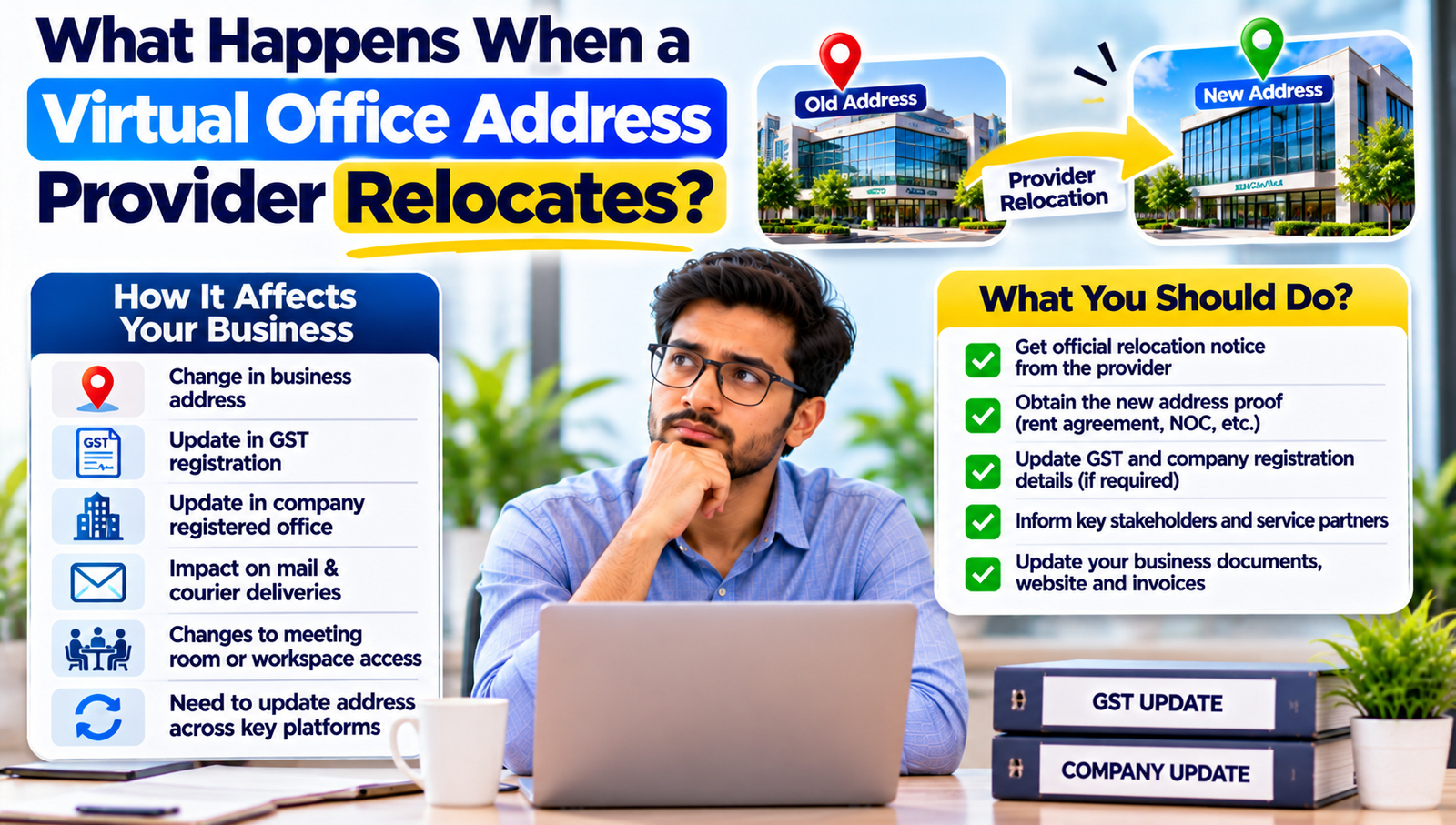
A virtual office allows businesses to use a professional address without maintaining a conventional office. However, what happens if the virtual office provider moves to another building, city or state?
For businesses using the address for GST registration, company incorporation, official correspondence or customer communication, a virtual office provider relocation can create administrative and compliance responsibilities.
For example, a startup may have registered its company and GST account using a virtual office address in Delhi. If the provider stops operating at that location and shifts to another building, the startup must determine whether its registered address remains valid, whether new premises documents are needed and whether official records must be updated.
The impact depends on the agreement, the actual premises arrangement and how the business uses the address.
A provider changing its own headquarters does not necessarily affect every customer. The issue arises when the premises available to the customer change or the customer’s right to use the existing address ends.
This guide explains how virtual office relocation affects GST registration, MCA records, mail handling and contractual obligations, along with the steps businesses should take to manage the transition.
What Does It Mean When a Virtual Office Provider Relocates?
Virtual office provider relocation occurs when a provider moves some or all of its operations or address services from one location to another.
Meaning of Virtual Office Provider Relocation
Relocation may involve changing the building, business centre or premises from which virtual office services are delivered.
However, a change to the provider’s corporate headquarters does not necessarily mean that customers must change their registered business addresses.
Moving to a New Building or Business Centre
A provider may close its existing centre and offer customers another location.
If customers no longer have the right to use the original premises, their business records may require updating.
Relocation Within the Same City
Moving within the same city can still involve a change to the complete registered address.
The consequences depend on whether the customer’s declared premises actually change.
Relocation to Another City or State
Moving to another city may create additional registration and operational considerations.
Inter-state relocation is particularly important because GST registrations are state-specific.
Difference Between Provider Relocation and Customer-Initiated Address Change
Provider relocation is initiated by the service provider.
A customer-initiated address change occurs when the business independently decides to move or select another address.
In both cases, the business remains responsible for maintaining accurate statutory records.
Why Do Virtual Office Providers Change Their Business Locations?
Providers may relocate for commercial, operational or property-related reasons.
Lease Expiry or Property Agreement Changes
A lease may expire or become unavailable for renewal.
Office Expansion or Downsizing
The provider may need more space or decide to operate from smaller premises.
Building Closure or Redevelopment
Renovation, redevelopment or building closure may require relocation.
Changes in Property Ownership
A property sale or change in landlord arrangements may affect the provider’s continued occupancy.
Operational or Commercial Reasons
Providers may move to reduce costs, improve facilities or change their service locations.
Relocation Due to Premises-Related Compliance Issues
In some cases, relocation may follow unresolved property, authorisation or regulatory issues.
Customers should request clarification if these circumstances could affect the legitimacy of their address arrangements.
How Does Virtual Office Provider Relocation Affect Existing Customers?
The impact depends on the customer’s package and whether the existing premises remain available.
Change in the Business Address
If the customer must begin using a different physical location, its business address may need to change.
Impact on GST Registration Details
A change to the declared principal or additional place of business may require updating GST registration particulars.
Impact on Company Registered Office Details
Companies may need to notify the Registrar of Companies when their registered office changes.
Disruption to Mail and Courier Deliveries
Letters sent to the old address may be delayed or returned if forwarding arrangements are not maintained.
Changes to Meeting Room or Workspace Access
Customers may lose access to previously included meeting rooms or workspaces.
Address Updates Across Business Platforms
Banks, marketplaces, business directories and other platforms may need updated information.
Additional Documentation and Administrative Costs
Relocation may involve fresh agreements, address proof, filing fees and professional charges.
Impact Summary
| Business Area | Possible Impact | Recommended Action |
|---|---|---|
| GST registration | Declared premises change | Assess amendment requirements |
| MCA records | Registered office changes | Complete applicable filings |
| Business mail | Deliveries reach old address | Arrange forwarding |
| Banking | Address records become outdated | Notify the institution |
| Website | Contact details become incorrect | Update address |
| Agreements | Existing premises rights end | Review or replace contract |
| Business licences | Registered location changes | Check amendment requirements |
What Happens to Your Virtual Office Agreement When the Provider Relocates?
The existing agreement is the starting point for determining the provider’s obligations.
Reviewing the Original Service Agreement
Check the premises address, service duration, permitted uses and termination conditions.
Relocation and Address Change Clauses
Some agreements allow the provider to substitute premises under specified conditions.
Others may require customer consent or a new agreement.
Notice Period and Customer Communication
Review whether the provider must give advance notice and how that notice must be delivered.
Whether the Existing Agreement Remains Valid
An agreement does not automatically become invalid merely because a provider relocates.
Its continued effectiveness depends on the contract and whether the agreed services can still be performed.
Requirements for a New Agreement or Addendum
A new address may require an updated agreement or written addendum establishing the customer’s rights.
Refund, Cancellation and Alternative Address Options
Check whether the provider offers an alternative location, refund or termination option.
Responsibilities for Address Update Costs
Determine whether the contract allocates the cost of new documents, professional services and statutory amendments.
Does Virtual Office Provider Relocation Affect GST Registration?
GST implications arise when the business’s declared premises or registration particulars change.
When the Declared Principal Place of Business Changes
If the customer’s principal place of business moves, the business generally needs to update the relevant GST registration information.
When an Additional Place of Business Is Affected
A relocated or discontinued additional place of business may also require an amendment.
Difference Between Same-State and Inter-State Relocation
A change within the same state can generally be handled through the applicable amendment process.
Moving the only business premises from one state to another cannot simply be treated as an ordinary address amendment under the old state’s GSTIN.
The business must assess separate registration and cancellation obligations.
GST Address Amendment Requirements
Under Rule 19 of the CGST Rules, changes to registration particulars generally must be reported within 15 days.
The applicable approval process depends on the field being amended and the current rules.
Importantly, changes to additional places of business have been moved into the non-core amendment process under the updated GST framework, while most principal-place amendments remain subject to officer approval. Certain registrations under Rule 14A have different treatment.
Supporting Documents for the New Premises
The business may need a new agreement, applicable consent documentation and accepted premises address proof.
Physical Verification and Clarification Considerations
Verification or clarification may arise where permitted under the applicable GST procedures.
Risks of Continuing to Use an Outdated GST Address
An outdated address may cause problems with notices, premises verification and registration accuracy.
How to Update Your GST Address After a Virtual Office Provider Relocates
Where the business’s declared premises have actually changed, follow the applicable GST amendment process.
Step 1: Obtain the New Address and Supporting Documents
Request the complete new address, agreement and relevant premises evidence.
Step 2: Confirm the New Premises Are Suitable for Your Business Use
Verify that the arrangement supports the activities being declared.
Step 3: Log In to the GST Portal
Visit www.gst.gov.in and access the taxpayer account.
Step 4: Open Amendment of Registration Core Fields
For a principal-place change requiring core amendment, use:
Services → Registration → Amendment of Registration Core Fields
For an additional-place change or an eligible automatically processed amendment, use the appropriate non-core amendment facility shown on the portal under the current rules.
Step 5: Update the Principal or Additional Place of Business
Enter the correct premises information and relevant business activities.
Step 6: Upload Applicable Address Proof
Attach the documents required for the particular premises arrangement.
Step 7: Submit the Amendment Application
Review and submit the application using the applicable authentication method.
Step 8: Track the Application and Respond to Clarifications
Monitor the GST portal for the application status and any official communication.
Step 9: Verify the Updated GST Registration Details
Confirm that the correct address appears in the updated registration record.
What Happens to Your Company Registration When a Virtual Office Provider Moves?
A company must maintain a registered office that satisfies Section 12 of the Companies Act, 2013.
Registered Office Address Requirements Under MCA
The registered office must be capable of receiving and acknowledging communications and notices.
When a Registered Office Change Must Be Reported
Where the company’s registered office actually changes, the company must comply with the applicable statutory notification and filing requirements.
Section 12(4) provides a 30-day period for notifying the Registrar of a registered-office change.
Same-City and Same-ROC Jurisdiction Changes
Some changes within the same local limits involve comparatively straightforward corporate approvals and filings.
The specific procedure depends on the facts.
Changes Outside Local Limits or ROC Jurisdiction
Moving outside the local limits of the city, town or village may require a special resolution.
A change involving another Registrar’s jurisdiction or another state can require additional approvals and procedures.
When Additional Approvals or Filings May Be Required
Depending on the relocation, filings such as INC-22, MGT-14 or INC-23 and applicable approvals may be relevant.
Supporting Documents for the New Registered Office
The company may need premises evidence, appropriate authorisation and accepted utility proof.
Updating Company Records After Approval
After completing the relevant procedure, update statutory records and other business documents.
What Documents Should the Virtual Office Provider Share After Relocation?
The provider should supply documents appropriate to the new premises arrangement and contracted services.
Updated Virtual Office Service Agreement or Addendum
The document should identify the new premises and describe the customer’s rights.
New Premises Address Proof
Request appropriate evidence establishing the new physical location.
Owner Consent or NOC Where Applicable
Consent documentation may be needed depending on the arrangement.
Rental, Lease or Licence Documentation
Relevant contractual evidence should support the customer’s permitted use.
Evidence of the Provider’s Authority to Offer the Premises
Verify whether the provider owns, occupies or otherwise has authority to offer services at the new location.
Updated Mail Handling Instructions
Obtain the new collection, forwarding and notification procedures.
Written Relocation Notice
Keep written confirmation of the relocation.
Effective Date of the Address Change
Confirm the date on which services at the original location end and the new arrangement begins.
How Does Provider Relocation Affect Business Mail and Courier Deliveries?
Mail continuity is one of the most immediate operational concerns during relocation.
Mail Sent to the Previous Address
Letters may continue arriving at the original location after the provider moves.
Forwarding Arrangements During the Transition
Request a written forwarding plan where the provider can lawfully and practically continue receiving correspondence.
Handling Official Government Notices
GST, MCA and other official correspondence should be monitored carefully during the transition.
Customer and Vendor Correspondence
Notify important customers, suppliers and service providers of the new address.
Courier Acceptance at the New Location
Confirm which deliveries the new premises can accept.
Mail Collection and Notification Procedures
Review how incoming correspondence will be recorded, notified and released.
Preventing Lost or Delayed Documents
Maintain an overlap period where possible and track important deliveries.
Which Business Records Should You Update After a Virtual Office Address Change?
A relocation can affect several business records.
GST Registration
Update the relevant declared business premises where required.
MCA Registered Office Details, Where Applicable
Complete the necessary registered-office filings.
Bank and Financial Institution Records
Notify banks and financial institutions where the address on record changes.
Business Website and Contact Pages
Update the website footer, contact page and other published address information.
Invoices, Quotations and Letterheads
Review documents containing the old address.
Vendor and Customer Records
Communicate relevant changes to important business partners.
Marketplace and E-commerce Seller Accounts
Update address details on applicable seller and fulfilment platforms.
Business Listings and Relevant Online Profiles
Correct business directory listings and online profiles where appropriate.
Other Applicable Licences and Registrations
Review registrations or licences that identify the business premises.
Can You Continue Using the Old Virtual Office Address After the Provider Relocates?
The answer depends on whether the customer retains legitimate rights to the old premises.
Whether the Provider Retains Rights to the Old Premises
A provider may relocate its own staff while continuing to operate the original address service.
In that situation, customers may not need to change their registered address.
Validity of Existing Address-Use Agreements
Review whether the original agreement remains effective.
Mail Forwarding vs Continued Registered Address Use
Forwarding mail from an old address does not automatically establish a continuing right to declare that premises as a place of business.
Risks of Declaring Premises No Longer Available
Continuing to use an address without a genuine supporting arrangement can create registration and verification problems.
Temporary Transition Arrangements
An overlap arrangement may help maintain correspondence while amendments are completed.
When the Old Address Must Be Replaced
Where the customer’s right to use the old premises has ended and the address no longer qualifies for its declared purpose, the business should arrange an appropriate replacement and complete the applicable updates.
What Should You Do if Your Virtual Office Provider Relocates Without Notice?
Unexpected relocation requires prompt investigation.
Verify the Relocation and Effective Date
Confirm whether the provider has moved and whether the original premises remain available.
Request Written Confirmation
Ask for the new address, effective date and service transition arrangements.
Review Contractual Notice Obligations
Check whether the agreement required advance notice.
Check Whether Your Registered Address Is Affected
Determine whether the business’s GST or MCA address actually changed.
Secure Important Business Correspondence
Arrange collection or forwarding of pending mail where possible.
Request New Premises Documents
Obtain the relevant agreement and address proof before relying on the replacement location.
Consider Refund or Termination Rights
Review the contract and applicable legal rights before seeking a refund or cancelling services.
Seek Professional Advice Where Registration Issues Arise
Consult a qualified professional if statutory deadlines, filings or contractual disputes are involved.
Should You Move With Your Virtual Office Provider or Choose a New One?
Businesses should compare the replacement premises with alternative providers.
Compare the New Location With Your Business Requirements
Consider whether the new location supports the intended business activities.
Check GST and MCA Suitability
Verify the actual premises arrangement and applicable documentation.
Review Documentation and Premises Rights
Ensure the provider has authority to grant the proposed address-use rights.
Compare Costs and Contract Terms
Consider the service fee, documentation costs and cancellation provisions.
Assess Mail Handling and Customer Support
Review the reliability of the new correspondence arrangements.
Consider Address Change and Administrative Costs
Factor in professional fees, filing expenses and operational disruption.
When Switching Providers May Be More Practical
Changing providers may be preferable where the replacement address is unsuitable, documents are inadequate or the revised service does not meet business needs.
Decision Comparison
| Factor | Stay With Existing Provider | Choose Another Provider |
|---|---|---|
| New location | Meets business requirements | Better alternative available |
| Documents | Complete and suitable | Existing provider cannot supply them |
| Service continuity | Reliable transition | Significant disruption |
| Pricing | Acceptable revised terms | Better overall value |
| Correspondence | Dependable forwarding | Unreliable mail handling |
| Contract | Suitable replacement terms | Unfavourable relocation terms |
How to Prepare for a Virtual Office Provider Relocation
Businesses can reduce disruption by creating a clear transition plan.
Confirm the Relocation Timeline
Identify the final date for services at the original premises.
Review Existing Agreements
Check the provider’s obligations and the customer’s address-use rights.
Collect Updated Premises Documents
Obtain the documents needed for the new location.
Identify Registrations Requiring Changes
Review GST, MCA and other applicable records.
Plan Mail Forwarding and Communications
Arrange correspondence continuity and notify important contacts.
Assign Responsibility for Filing Updates
Identify who will prepare and submit each required amendment.
Monitor Amendment Applications
Track official submissions and respond to requests for clarification.
Verify All Updated Business Records
Check that the correct address appears across statutory records, contracts and business platforms.
Practical Relocation Checklist
| Action | Priority | Status |
|---|---|---|
| Confirm whether the customer’s premises change | Immediate | Pending |
| Review existing agreement | Immediate | Pending |
| Obtain new address documents | High | Pending |
| Assess GST amendment requirements | High | Pending |
| Assess MCA filing requirements | High | Pending |
| Arrange mail forwarding | High | Pending |
| Notify banks and business partners | Medium | Pending |
| Update website and business listings | Medium | Pending |
| Verify completed statutory filings | High | Pending |
Final Words
A virtual office provider relocation does not always require customers to change their registered addresses. The outcome depends on whether the premises used by the customer remain available and whether the existing address-use rights continue.
Where the customer’s declared business location changes, GST, MCA and other records may need updating.
Businesses should obtain written relocation details, review their agreements, verify the new premises and arrange reliable mail handling before completing the transition.
A practical process is:
Confirm the relocation → Review address-use rights → Obtain new documents → Assess statutory filings → Arrange mail continuity → Update business records → Verify completion
By managing these steps carefully, businesses can reduce operational disruption and avoid unnecessary address-related compliance problems.
FAQs About Virtual Office Provider Relocation
What happens if my virtual office provider changes its address?
You should first confirm whether the premises used by your business have changed. If your registered address is affected, you may need updated documents, statutory amendments and new mail-handling arrangements.
Do I need to update my GST registration if my virtual office provider relocates?
Yes, where the relocation changes the business premises declared under your GST registration. A provider moving its own headquarters does not automatically require every customer to amend its GST address.
Can I continue using my old virtual office address after relocation?
Potentially, if you retain legitimate rights to use the premises and the arrangement remains suitable for the declared purpose.
What documents should my virtual office provider provide after moving?
Depending on the arrangement, request an updated agreement, new premises address proof, relevant owner consent, supporting occupancy evidence and written relocation details.
Does changing a virtual office address affect company registration?
It can. If the company’s registered office changes, the applicable MCA procedures must be followed. The required approvals and filings depend on the type of relocation.
How long do I have to update my GST address after relocation?
Rule 19 generally requires changes to GST registration particulars to be reported within 15 days of the change.
What happens to business mail sent to the old virtual office address?
Delivery depends on whether the provider continues receiving mail at the old premises and whether forwarding arrangements are available. Confirm these arrangements in writing.
Can a virtual office provider relocate without informing customers?
The provider’s contractual notice obligations depend on the agreement and applicable law. Customers should review the relevant clauses and request written clarification.
Can I cancel my virtual office agreement if the provider relocates?
Cancellation or refund rights depend on the agreement, the services promised and applicable legal protections.
Is it better to move with the provider or switch virtual office providers?
Compare the new premises, address-use rights, documents, costs and mail-handling arrangements. Choose the option that best supports your business requirements and compliance obligations.