
AI Overview
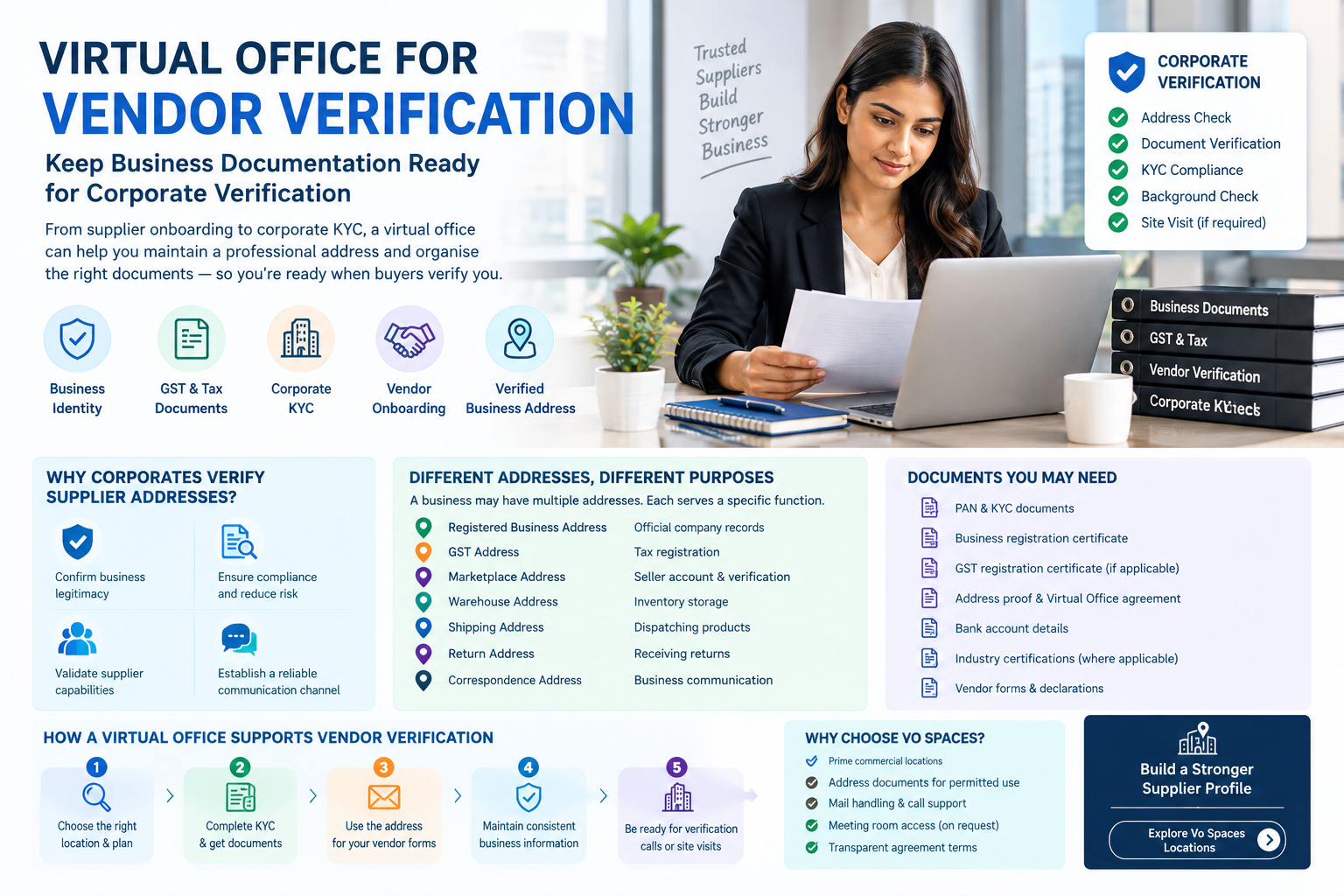
A Virtual Office for Vendor Verification can help businesses maintain a professional business address and organize address-related documentation when undergoing corporate supplier onboarding or verification. This can be useful for manufacturers, distributors, IT companies, agencies, consultants and B2B service providers that operate remotely or do not maintain a conventional office.
However, a virtual office does not guarantee vendor approval. Corporate buyers may conduct document checks, verification calls, address checks, references or physical site visits depending on their procurement policies and the nature of the supplier relationship.
The best approach is to maintain consistent business information, keep supporting documents ready, clearly distinguish an administrative address from an operational facility, and provide accurate information throughout the corporate KYC process.
Introduction: Vendor Verification Starts After Registration
Getting onto a corporate vendor list is only one part of becoming a supplier.
The more important challenge can begin afterward.
A procurement team may ask for your company information. A finance department may request tax details. A compliance team may conduct KYC. A sourcing manager may want to confirm your business address. Someone from the organization may call the listed contact number. For certain suppliers, a site visit or operational assessment may also be part of the process.
Suddenly, the question isn’t:
“Do you have a business address?”
It becomes:
“Can you prove that your business information is accurate, consistent and properly documented?”
This distinction matters.
A supplier might have:
- A registered business address
- A GST address
- A warehouse
- A factory
- A residential working address
- A correspondence address
- A client meeting location
These may be different locations.
A Virtual Office for Vendor Verification can potentially address the need for a professional administrative or business address where permitted. But it should be used honestly and for the purpose supported by the arrangement.
For companies dealing with larger corporate buyers, the real advantage is not simply having an impressive-looking address. It is having a well-organized business documentation system that can withstand routine verification.
What Is a Virtual Office for Vendor Verification?
A Virtual Office is a business-address solution that allows a company to maintain a professional address without necessarily renting a conventional office for full-time occupancy.
Depending on the provider and package, services can include:
- Business address
- Address documentation
- Mail handling
- Business correspondence support
- Meeting-room access
- Call handling
- Reception-related services
For vendor verification, the address may become part of the supplier’s wider business information.
For example, a company may provide its business address to a prospective corporate buyer during onboarding.
The procurement team might then compare that information with other records.
This is why address consistency is important.
If the company uses one address on its vendor form, another on its invoice, a third on its GST records and a fourth on its website without explanation, the procurement team may ask additional questions.
A properly managed business address can make this process easier to understand.
Why Do Corporations Verify Supplier Addresses?
Corporate vendor verification isn’t necessarily about questioning whether a supplier has an expensive office.
The buyer typically wants confidence that the supplier is a legitimate business and that the information supplied during onboarding is reliable.
Depending on the organization and industry, verification can help with several objectives.
1. Confirming Business Identity
A corporation needs to know exactly who it is contracting with.
This can involve checking:
- Legal business name
- PAN
- GST information
- Registration details
- Authorized representatives
- Business contact information
The address becomes one component of this identity.
2. Supporting Corporate KYC
Large organizations often have internal vendor onboarding procedures.
A procurement or compliance team may request documents relating to:
- Business identity
- Tax registration
- Bank details
- Ownership
- Authorized signatories
- Address
- Certifications
A clear address trail can make documentation easier to organize.
3. Assessing Supplier Risk
A company buying products or services from a supplier takes on commercial risk.
The buyer may therefore want to understand whether the supplier has a genuine business presence and whether the submitted information can be verified.
This is especially relevant for:
- High-value contracts
- Long-term supply agreements
- Manufacturing relationships
- Financially sensitive services
- Regulated industries
- Large procurement programs
4. Establishing a Communication Point
A supplier needs to be reachable.
A business address can provide another formal communication channel alongside:
- Telephone
- Website
- Account manager
- Official correspondence
Can a Virtual Office Support Vendor Verification?
It can support the address and documentation side of vendor verification when the specific arrangement is appropriate and accepted by the corporate buyer.
But this distinction is crucial:
Supporting verification is not the same as guaranteeing verification.
A corporate buyer may have its own supplier policies.
One organization might only require business documentation.
Another may request a physical operational location.
A manufacturing company may want to inspect production capabilities.
A logistics company may need to confirm warehouse facilities.
An IT services company may primarily evaluate its team, security controls and delivery capabilities.
Therefore, a Virtual Office can solve an address requirement, but it cannot replace a genuine operational facility when a buyer specifically needs to verify one.
Virtual Office Address vs Operational Address
This is one of the most important concepts for suppliers to understand.
Imagine an IT consulting company with:
- 20 remote employees
- Clients across India
- No daily-use office
- A professional Virtual Office address
- Cloud-based operations
The Virtual Office may be a suitable administrative business-address solution if the intended use is permitted.
Now consider a manufacturing company.
It might have:
- A Virtual Office for correspondence or another permitted administrative purpose
- A factory where production occurs
- A warehouse for inventory
The factory is still the factory.
The Virtual Office doesn’t turn into a manufacturing facility simply because it is listed as a business address.
This distinction becomes particularly important during vendor audits.
Always represent each location according to what actually happens there.
Who Should Use a Virtual Office for Vendor Verification?
A Virtual Office can be particularly relevant for businesses that operate with lean or distributed structures.
Manufacturers
Manufacturers may need a professional administrative presence while maintaining production at a factory or industrial facility.
Distributors
Distributors working through warehouses and logistics partners may not need a traditional office in every market.
IT Companies
Software companies and technology service providers frequently operate through remote or hybrid teams.
Digital Agencies
Marketing, advertising, design and performance agencies may have distributed teams and client locations rather than a conventional office.
Consultants
Management, financial, operations and business consultants can work remotely while maintaining a formal commercial address.
B2B Service Providers
Companies providing professional services to corporate clients may benefit from maintaining organized business documentation and a professional address.
What Documents May Corporate Buyers Request?
There isn’t one universal vendor-verification checklist.
Each corporate buyer can establish its own requirements.
However, suppliers should be prepared for requests involving several categories.
Business Identity Documents
These can include:
- PAN
- Certificate of Incorporation, where applicable
- Partnership or LLP documentation, where applicable
- Proprietorship documentation, where applicable
- GST registration certificate, where applicable
Address Documentation
Depending on the purpose and company requirements, this could include:
- Business address proof
- Address agreement
- Supporting premises documentation
- NOC or authorization documentation, where applicable
Tax Information
Corporate buyers may request:
- GST details
- PAN
- Tax-related declarations
- Other applicable registrations
Banking Information
For payment onboarding, a buyer may request:
- Cancelled cheque
- Bank account details
- Bank confirmation
- Account-holder information
Compliance Documents
Depending on the industry:
- MSME/Udyam information
- Industry certifications
- Quality certifications
- Insurance documents
- Regulatory licenses
- Safety documentation
- Data-security certifications
Not every business will need all of these.
The important lesson is to prepare according to the buyer’s actual vendor checklist.
Corporate KYC Address: Why Consistency Matters
Suppose a supplier provides the following information:
Vendor Form: Mumbai address
GST Certificate: Mumbai address
Website: Mumbai address
Invoice: Mumbai address
Bank documentation: Legal business name differs
The procurement team can quickly understand the supplier’s information.
Now imagine:
Vendor Form: Delhi
Website: Mumbai
GST: Ahmedabad
Invoice: Gurgaon
Bank account: Different business name
There may be legitimate reasons for these differences, but the buyer could reasonably request clarification.
This is why companies should create a master business-information record.
Maintain the following:
| Information | Master Record |
| Legal business name | Exact legal name |
| PAN | Current PAN |
| GSTIN | Applicable GST details |
| Registered address | Official address |
| Correspondence address | Current correspondence location |
| Operational locations | Factory/warehouse/service locations |
| Bank details | Verified business account |
| Contact person | Authorized representative |
| Official email | Business email |
| Phone number | Active business contact |
When completing vendor forms, use this master record as the reference.
What Happens During a Vendor Verification Call?
A verification call may be straightforward, but suppliers should still prepare.
The person conducting the call may want to confirm:
- Company name
- Business activity
- Contact person
- Address
- Years in operation
- Services/products offered
- Website
- Operational locations
- Authorized representatives
The best approach is simple:
Give accurate answers.
Employees involved in vendor onboarding should know the company’s basic information.
They should also understand the difference between:
- Registered address
- Correspondence address
- Warehouse
- Factory
- Branch
- Virtual Office
If a buyer asks whether employees work from a particular location, the company should answer accurately rather than attempting to make the Virtual Office appear to be something it isn’t.
Can a Corporate Buyer Conduct a Site Visit?
Yes, potentially.
Whether a site visit occurs depends on the corporate buyer, contract value, industry, supplier risk and procurement policy.
This is particularly relevant for businesses such as:
- Manufacturers
- Industrial suppliers
- Warehousing companies
- Logistics providers
- Construction suppliers
- Food businesses
- Pharmaceutical businesses
- Equipment suppliers
A site visit may be designed to assess actual operational capacity.
For example, a manufacturer might need to demonstrate:
- Machinery
- Production capacity
- Quality systems
- Storage
- Safety procedures
- Workforce
- Inventory
A Virtual Office cannot replace these facilities.
For a remote professional-services company, however, the buyer may have very different verification requirements.
Therefore, suppliers should understand that address verification and operational verification are separate concepts.
Benefits of a Virtual Office for Vendor Verification
1. Creates a Formal Business Address
A dedicated commercial address can provide a more structured business identity for an eligible business.
2. Supports Documentation Management
Depending on the provider and package, the business can receive supporting address documentation relevant to permitted uses.
3. Helps Remote Companies
A business doesn’t necessarily need employees sitting at desks every day to maintain a formal business presence.
4. Separates Personal and Business Information
Founders operating from home may prefer to maintain a separate commercial address for appropriate business purposes.
5. Supports Multi-City Strategies
Companies expanding into different markets can evaluate address requirements city by city rather than immediately committing to conventional offices everywhere.
6. Can Reduce Unnecessary Office Costs
If the business only requires an address and occasional facilities, paying for a full-time office may not be necessary.
7. Provides a More Organized Corporate Image
A consistent professional address can contribute to a company’s overall business presentation.
Virtual Office for Vendor Verification vs Traditional Office
| Feature | Virtual Office | Traditional Office |
| Professional address | Yes | Yes |
| Dedicated daily workspace | Usually not | Yes |
| Full-time employees onsite | Not necessarily | Usually |
| Mail handling | Plan-dependent | Yes |
| Meeting facilities | Plan-dependent | Yes |
| Infrastructure cost | Generally lower | Generally higher |
| Best for | Remote/lean businesses | Daily office operations |
| Operational facility | No | Potentially |
| Vendor verification | Purpose-dependent | Purpose-dependent |
The right choice depends on what the corporate buyer actually needs to verify.
If the buyer only requires a business address and supporting documents, a Virtual Office may be sufficient for that particular requirement.
If the buyer needs to inspect your manufacturing unit, warehouse or laboratory, you’ll need the relevant physical facility.
Pricing Comparison
Virtual Office pricing varies according to:
- City
- Business district
- Provider
- Contract duration
- Documentation included
- Mail handling
- Meeting-room access
- Additional services
Rather than comparing only the headline price, evaluate the package against your vendor-verification requirements.
| Cost Factor | Virtual Office | Traditional Office |
| Security deposit | Often lower or plan-dependent | Usually applicable |
| Furniture | Usually unnecessary | Required |
| Utilities | Limited/plan-dependent | Additional |
| Dedicated workspace | Usually not included | Included |
| Business address | Included in applicable plans | Included |
| Documentation | Plan-dependent | Premises-dependent |
| Meeting room | May be available | Usually available |
| Long-term commitment | Often flexible | Usually greater |
For a remote B2B company, the cost difference can be significant when a full office isn’t actually required.
How to Choose a Virtual Office for Vendor Verification
Don’t select an address based solely on its pin code.
Evaluate the provider using a practical checklist.
1. Confirm the Intended Use
Tell the provider exactly what you need the address for.
For example:
- Corporate vendor onboarding
- Correspondence
- Business registration
- GST-related requirements
- Client meetings
2. Review Documentation
Ask what documents are supplied and whether they correspond to your intended use.
3. Check Address Consistency
Make sure the business name and address can be represented consistently across your records.
4. Understand Mail Handling
Corporate buyers may send correspondence or documents.
Understand how incoming mail is handled.
5. Check Meeting Facilities
If corporate clients occasionally need to meet representatives, meeting-room access can be useful.
6. Understand Site-Visit Limitations
Ask what the service actually provides.
Don’t assume an address service means a company can represent the location as its operational facility.
Step-by-Step: Preparing for Corporate Vendor Verification
Step 1: Create Your Business Document Folder
Keep your core documents together.
For example:
01 – Business Registration
02 – PAN/GST
03 – Address
04 – Banking
05 – Certifications
06 – Contracts
07 – Vendor Forms
This simple structure can save considerable time.
Step 2: Create an Address Master Sheet
Record every business location.
Include:
- Address
- Purpose
- Supporting document
- Responsible person
- Start date
- End date, if applicable
This prevents teams from accidentally using the wrong address.
Step 3: Identify Operational Locations
Clearly record where:
- Products are manufactured
- Inventory is stored
- Employees work
- Services are delivered
- Returns are received
This becomes particularly important if a corporate buyer conducts an operational assessment.
Step 4: Review Your Virtual Office Agreement
Ensure the address and documentation are current.
Check:
- Business name
- Address
- Agreement period
- Permitted use
- Documentation
- Contact process
Step 5: Prepare for KYC
Keep copies of relevant company and authorized-person documents ready.
Step 6: Standardize Business Information
Use the same verified information when completing:
- Vendor forms
- Proposals
- Invoices
- Company profiles
- Websites
- Purchase documentation
Step 7: Train the Person Handling Verification
The employee or founder responsible for vendor onboarding should understand the company’s information.
They should know:
- What the listed address represents
- Where operations occur
- Who is authorized to speak for the company
- Which documents are available
- How corporate communication is handled
Step 8: Respond Promptly
Corporate procurement teams often work with multiple suppliers.
Fast, organized responses can make the onboarding process smoother.
Why Choose Vo Spaces?
When selecting a Virtual Office provider for vendor verification, Vo Spaces can be evaluated based on the practical requirements of your business rather than simply the appearance of the address.
A suitable provider should help businesses understand:
- What the address can be used for
- Which documents are included
- How correspondence is handled
- Whether meeting facilities are available
- What the agreement covers
- What happens when documentation needs to be renewed
For businesses dealing with corporate procurement teams, clarity is particularly valuable.
Before selecting a plan, explain your intended requirement—such as corporate vendor verification, supplier onboarding, business correspondence or another permitted business purpose—and confirm that the selected service supports it.
The objective should be straightforward:
professional address + accurate documentation + consistent business information.
No responsible provider should promise automatic vendor approval because the final decision remains with the corporate buyer.
10 Practical Tips for Passing Vendor Verification Smoothly
1. Keep Every Document Current
Expired agreements or outdated certificates can create unnecessary delays.
2. Use One Standard Business Profile
Maintain a master company profile for everyone in the organization.
3. Don’t Mix Operational and Administrative Addresses
Clearly distinguish your Virtual Office from your factory, warehouse or other operational facilities.
4. Use Official Communication Channels
Vendor communications should come through recognizable company email addresses and phone numbers.
5. Keep Address Proof Accessible
Don’t start searching for documents after the procurement team requests them.
6. Prepare a Company Profile
A concise company profile can include:
- Company overview
- Products/services
- Industries served
- Locations
- Certifications
- Contact details
7. Keep Authorized Signatory Details Ready
Corporate buyers may need these for contracts and onboarding.
8. Respond Consistently
Different employees should not provide conflicting company information.
9. Don’t Overstate Your Physical Presence
If your team is remote, say so.
If manufacturing occurs elsewhere, identify the manufacturing location.
10. Check Requirements Before Buying a Plan
The correct Virtual Office package depends on the intended purpose.
Frequently Asked Questions
1. Is a virtual office legal in India?
A Virtual Office arrangement can be used for legitimate and permitted business purposes in India. However, the legal and regulatory requirements depend on the specific use, business structure and applicable authority.
2. Can a virtual office be used for GST registration?
It may be possible where the premises arrangement and supporting documentation satisfy the applicable GST requirements. GST acceptance should be verified for the specific circumstances rather than assumed.
3. What documents are required for vendor verification?
Corporate buyers can request different documents. Common categories include business registration documents, PAN, GST information, address proof, banking information, KYC documents, certifications and other compliance records.
4. How much does a virtual office cost?
Pricing depends on the provider, city, location, agreement duration and services included. Plans can differ significantly, so compare documentation and facilities as well as the advertised price.
5. Is a virtual office suitable for startups?
Yes. A Virtual Office can be useful for startups operating remotely that need a professional business address and supporting documentation for permitted purposes.
6. Can I open a bank account using a virtual office?
A Virtual Office may provide address documentation relevant to a bank’s business-account application, but banks conduct their own KYC and verification. Approval isn’t guaranteed solely because a Virtual Office is being used.
7. Can freelancers use virtual offices?
Yes. Freelancers and independent consultants can use Virtual Office services for appropriate business purposes, subject to the provider’s terms and any applicable requirements.
8. Which city is best for a virtual office?
There is no universally best city. Choose based on your clients, suppliers, target market, business operations and expansion strategy. Major commercial hubs may be useful for businesses seeking a presence in specific markets.
9. How quickly can I get documents?
The timeline depends on the provider, location, plan and completion of KYC. Confirm the current processing timeline before purchasing.
10. Is a virtual office better than a coworking space?
They solve different problems. A Virtual Office primarily provides business-address and related services, while coworking provides physical workspace. A remote supplier that rarely needs desks may prefer a Virtual Office.
11. Why do corporations verify supplier addresses?
Address verification can help corporate buyers confirm supplier information, support internal KYC procedures and assess business legitimacy and risk.
12. Can a supplier use a virtual office address?
A supplier may be able to use a Virtual Office address for appropriate business purposes when the arrangement and documentation meet the buyer’s requirements. The supplier should accurately represent what the address is used for.
13. Does a virtual office guarantee vendor approval?
No. Vendor approval is ultimately determined by the corporate buyer. A Virtual Office can support an address and documentation requirement, but it cannot guarantee acceptance.
14. Can a corporate buyer conduct a physical site visit?
Yes. A buyer may conduct a site visit when its procurement process requires operational verification. A Virtual Office does not replace an actual factory, warehouse or other operational facility.
15. Can a Virtual Office replace a factory or warehouse?
No. A Virtual Office should not be represented as a factory, warehouse or other operational facility unless those activities genuinely occur there and the arrangement and applicable requirements support that use.
Vendor Verification Readiness Checklist
Before sending your supplier documents, run through this checklist.
Business Information
- ✓ Legal business name is consistent
- ✓ PAN information is accurate
- ✓ GST details are current, where applicable
- ✓ Registration information is available
- ✓ Authorized representative is identified
Address
- ✓ Current address is clearly identified
- ✓ Supporting address documents are available
- ✓ Virtual Office agreement is current
- ✓ NOC/authorization documents are available where applicable
- ✓ Administrative and operational locations are clearly distinguished
Corporate KYC
- ✓ Vendor form completed accurately
- ✓ Banking documents available
- ✓ Certifications available
- ✓ Company profile prepared
- ✓ Contact information verified
Operational Verification
- ✓ Factory details available, where relevant
- ✓ Warehouse information available, where relevant
- ✓ Service-delivery locations documented
- ✓ Site-visit expectations understood
Final Takeaway
Corporate vendor verification is fundamentally about trust backed by documentation.
A professional address can be one part of that process, but it shouldn’t be treated as the entire solution.
For businesses that work remotely, operate through distributed teams or don’t require a traditional office, a Virtual Office for Vendor Verification can provide a practical business-address solution for appropriate purposes.
The strongest approach is to build a complete verification-ready system:
Accurate business identity
↓
Consistent address information
↓
Organized corporate KYC documents
↓
Clear distinction between administrative and operational locations
↓
Fast, accurate responses to procurement teams
↓
Transparent communication during verification
A Virtual Office can help with the address component. Your actual business operations, documentation, compliance and supplier capabilities remain equally important.
For manufacturers, distributors, IT companies, agencies, consultants and other B2B businesses, this approach turns vendor verification from a last-minute documentation scramble into a repeatable business process.