
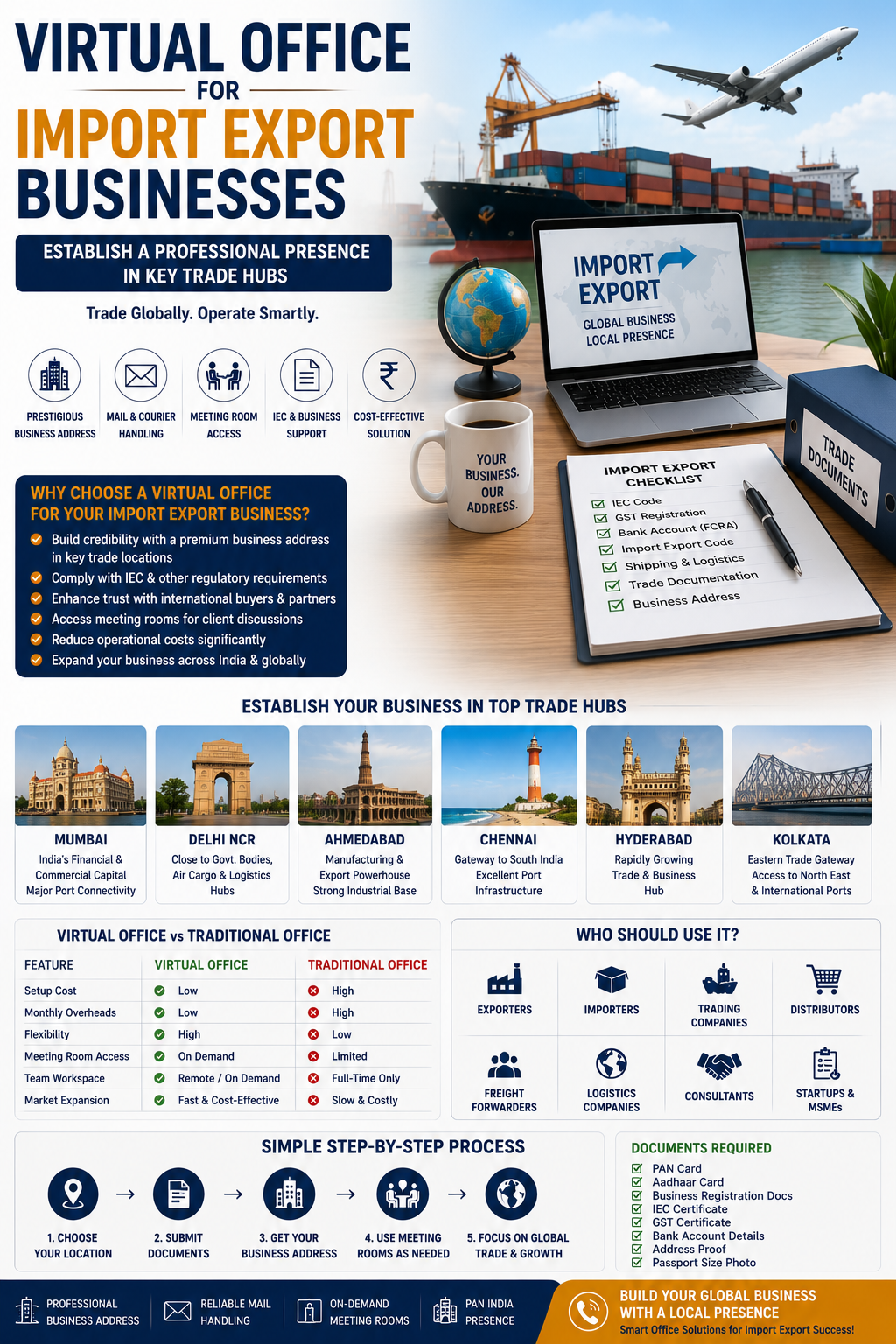
AI Overview: Virtual Office for Import Export Business
A Virtual Office for Import Export Business can help importers, exporters, manufacturers, traders and international sourcing businesses establish a professional business presence in important commercial cities without immediately renting a conventional office.
For entrepreneurs entering India’s international trade ecosystem, a professional address can support business communication, correspondence and, where permitted and properly documented, certain registration or compliance requirements.
However, a virtual office is not a warehouse, factory, cargo terminal or customs facility. Import-export businesses that physically store, manufacture, inspect or distribute goods may require additional premises suited to those activities.
The most suitable setup depends on what the business actually does.
A trader working remotely and coordinating shipments through third-party logistics providers has very different premises requirements from an exporter operating a warehouse and packing facility.
For businesses primarily looking for a professional commercial address in a strategic trade hub, a virtual office can provide a flexible starting point.
Introduction: Why Location Matters in Import-Export Business
International trade is not only about finding buyers and suppliers.
Your business also needs to look established, organised and commercially credible.
Whether you are:
- Exporting Indian products overseas
- Importing products for domestic distribution
- Sourcing products internationally
- Acting as a merchant exporter
- Trading commodities
- Supplying manufacturers
- Running an e-commerce export business
- Working with overseas buyers
- Managing international procurement
your business will interact with multiple stakeholders.
These can include:
- Overseas buyers
- Indian suppliers
- Freight forwarders
- Customs professionals
- Banks
- Logistics companies
- Insurance providers
- Government authorities
- Trade associations
- Distributors
- Procurement teams
As the business grows, having a professional Import Export Business Address can become an important part of how the company presents itself.
But does an import-export entrepreneur really need to rent a conventional office?
Not always.
Many modern trading businesses operate with lean teams. The founder may work remotely, suppliers may operate from factories elsewhere, and logistics may be outsourced to specialised partners.
In this situation, spending heavily on a permanent office before the business has established consistent trade volume may not make financial sense.
This is where a Virtual Office for Import Export Business can become relevant.
What Is a Virtual Office?
A Virtual Office provides a business with access to a professional commercial address and selected business-support services without requiring the company to maintain a traditional full-time office at that location.
Depending on the provider and package, services may include:
- Professional business address
- Business correspondence handling
- Mail and courier management
- Meeting-room access
- Workspace access
- Visitor handling
- Documentation support
- Registration-related services where applicable
The exact services vary between providers and locations.
For import-export businesses, it is particularly important to understand what a virtual office does and does not provide.
A Virtual Office can potentially provide:
Business presence + address + correspondence support + occasional physical meeting facilities
It does not automatically provide:
Warehouse + factory + cargo handling facility + storage premises + manufacturing unit + customs-controlled facility
This distinction is extremely important.
If your business only needs a professional address while its actual logistics and inventory operations happen elsewhere, a virtual office may be appropriate.
If your business needs to physically store goods at the registered premises, you need to evaluate whether a suitable commercial facility is required instead.
Why Import-Export Businesses Need a Professional Address
International trade often involves transactions where trust matters.
An overseas buyer evaluating an Indian supplier may want to understand:
- Where is the company based?
- Is the business professionally established?
- How can correspondence be sent?
- Who manages the business?
- Where can important documents be delivered?
- Does the company have an identifiable commercial presence?
A professional Export Business Office Address can contribute to the overall presentation of the company.
It does not guarantee credibility or successful exports.
The actual foundation of an import-export business remains:
Product quality + pricing + compliance + logistics + reliability + buyer relationships
The business address is one part of the larger professional identity.
Who Should Use a Virtual Office for Import Export Business?
A Virtual Office can be particularly useful for lean businesses that don’t require a permanent operational office.
1. New Exporters
Entrepreneurs starting their first export business may not want to commit to expensive commercial premises before securing regular buyers.
A Virtual Office can provide a professional starting point while the business develops its customer base.
2. Merchant Exporters
Merchant exporters often source goods from manufacturers rather than producing everything themselves.
Their operations may involve:
Supplier → Quality Check → Freight Forwarder → Port/Air Cargo → International Buyer
The exporter may not need a large office.
3. Import Traders
Importers coordinating products from overseas suppliers may operate with a small administrative team while using third-party warehouses and logistics providers.
A professional address can support their corporate presence.
4. E-Commerce Exporters
Online businesses selling Indian products internationally may operate from home or a small team environment.
They can use appropriate business infrastructure while their inventory is handled through separate fulfilment or logistics facilities.
5. Sourcing Companies
Businesses that connect international buyers with Indian manufacturers often operate through distributed networks.
Their sales and sourcing teams may work remotely.
A Trade Business Virtual Office can provide a professional base without requiring a large permanent office.
6. International Procurement Consultants
Consultants helping overseas businesses source products from India may not require traditional offices.
They can work with suppliers, factories and logistics partners across multiple locations.
7. Export-Focused Manufacturers
Manufacturers may already have factories in one location while wanting an administrative or commercial presence in another city.
However, the virtual office should not be presented as a replacement for the actual manufacturing premises.
Can Exporters Use Virtual Offices?
Yes, exporters can potentially use virtual office arrangements for appropriate business purposes, provided the arrangement and documentation satisfy the requirements applicable to that purpose.
The important point is that not every regulatory or operational requirement can be fulfilled simply by having a virtual address.
An exporter should distinguish between:
Administrative presence
A business address used for appropriate correspondence and business purposes.
Registered business premises
An address used for a particular registration where applicable requirements are satisfied.
Operational premises
A location where goods are actually stored, packed, manufactured, processed or handled.
These three concepts should not be treated as interchangeable.
Before using a virtual office for any specific registration, confirm that the provider’s address and documentation support that intended use.
Can an Import-Export Business Use a Virtual Office?
Yes, a suitable import-export business can use a virtual office when its business model does not require the virtual location to function as a warehouse, factory or operational facility.
For example, imagine an entrepreneur exporting:
Handicrafts from India → Buyers in Germany, UAE and the UK
The entrepreneur may:
- Work remotely
- Source products from Indian artisans
- Use third-party quality inspectors
- Hire logistics providers
- Use freight forwarders
- Work with customs professionals
- Coordinate international payments
- Meet buyers occasionally
Such a business may not need a conventional office from day one.
A professional business address can support the administrative side of the company.
However, if the business starts storing large quantities of goods, the entrepreneur will need to arrange appropriate storage and fulfilment infrastructure separately.
Is a Physical Office Required for an Export Business?
Not necessarily.
Whether a physical office is required depends on the nature of the business and the specific legal, tax, banking, licensing and operational requirements applicable to it.
A small export business may operate with:
- Remote employees
- Third-party warehouses
- Freight forwarders
- Customs professionals
- Contract manufacturers
- External logistics providers
This is fundamentally different from an export business that owns a warehouse and maintains a large operations team.
Therefore, the better question is:
“What physical activities does my business actually perform?”
If the answer is primarily sales, sourcing, coordination and administration, a traditional office may not be necessary initially.
If the answer includes manufacturing, storage, packaging or regular physical handling of goods, dedicated operational premises may be necessary.
Can a Virtual Office Support IEC-Related Business Requirements?
An IEC (Importer Exporter Code) is a key identifier associated with businesses engaged in import or export activities in India.
Whether a particular virtual office address can be used for an IEC-related requirement depends on the applicable rules, the nature of the business and the documentation submitted.
Businesses should not assume that every virtual office package automatically qualifies.
Before purchasing a service specifically for IEC-related purposes, verify:
- Whether the address is permitted for the intended use
- What premises documents are supplied
- Whether an NOC or authorisation is available where required
- Whether the provider supports the relevant application process
- Whether additional verification may apply
The safest approach is to choose the address after identifying the exact compliance requirement, rather than purchasing a generic virtual address and attempting to determine its usability later.
Documents Required for a Virtual Office
The documentation depends on the provider, location and intended use.
Common business documents may include:
- PAN
- Identity proof
- Business incorporation documents
- Partnership or LLP documents, where applicable
- GST documentation, where applicable
- Authorisation letters
- Director or partner information
- Business registration information
For premises-related purposes, additional documentation may include:
- Address proof
- Rent or lease-related documentation
- NOC
- Consent documentation
- Utility-related documentation
- Other premises documents
If the address is being used for a specific regulatory application, additional documentation may be required.
Always confirm the exact documentation before making payment.
Benefits of a Virtual Office for Import-Export Businesses
1. Establish a Professional Commercial Presence
A professional address can make a newly established trading company appear more structured in its external communications.
This can be particularly useful when communicating with overseas buyers and B2B suppliers.
2. Reduce Initial Infrastructure Costs
Launching an import-export business already involves multiple costs:
- Product sourcing
- Samples
- Packaging
- Freight
- Customs
- Certifications
- Marketing
- Buyer acquisition
- Working capital
Adding a large office lease may not be the best early use of capital.
A Virtual Office can reduce the need for unnecessary fixed office infrastructure.
3. Access Strategic Trade Hubs
An entrepreneur based in a smaller city may want a commercial presence in a major business hub.
Cities such as Mumbai, Delhi NCR, Ahmedabad, Chennai, Hyderabad and Kolkata can be considered depending on the company’s trade corridors and industry.
4. Support International Business Communication
A consistent commercial address can be used where appropriate across business communications and correspondence.
It can form part of:
- Company profiles
- Business proposals
- Vendor documents
- Corporate presentations
- Business cards
- Website information
Always ensure that the address is used accurately and for permitted purposes.
5. Maintain a Lean Business Structure
Import-export businesses can often involve multiple external partners.
Instead of maintaining large internal infrastructure, a company may outsource:
- Logistics
- Warehousing
- Customs support
- Accounting
- Freight forwarding
- Packaging
A flexible office model can fit naturally into this structure.
6. Expand Into New Trade Markets
An established business may want to create a presence in another city without immediately moving its entire operation.
For example:
Ahmedabad → Mumbai
or
Delhi NCR → Chennai
A Virtual Office can potentially support the administrative side of such expansion.
Strategic Cities for Import-Export Businesses in India
Different cities offer different commercial advantages.
The best location depends on your products, suppliers, buyers, ports, airports, logistics network and target markets.
Mumbai
Mumbai can be attractive for businesses connected to:
- International trade
- Financial services
- Manufacturing
- Wholesale
- Shipping
- Corporate buyers
Its broader commercial ecosystem can make it a strategic location for certain trading businesses.
Delhi NCR
Delhi NCR is useful for businesses targeting:
- North Indian suppliers
- Manufacturers
- Wholesale markets
- Consumer products
- Handicrafts
- Apparel
- B2B distribution
It can also be relevant for companies operating across the broader northern market.
Ahmedabad
Ahmedabad can be particularly relevant to businesses connected with:
- Textiles
- Chemicals
- Pharmaceuticals
- Engineering
- Manufacturing
- Industrial products
Exporters sourcing from Gujarat’s industrial ecosystem may consider it strategically.
Chennai
Chennai can be relevant for:
- Automotive products
- Engineering goods
- Electronics
- Industrial products
- Manufacturing
- Southern India trade
Businesses working with suppliers and customers in South India may find Chennai strategically useful.
Hyderabad
Hyderabad can be considered by companies involved in:
- Pharmaceuticals
- Technology
- Healthcare products
- Engineering
- B2B services
Kolkata
Kolkata can be relevant for businesses operating across:
- Eastern India
- Industrial products
- Consumer goods
- Engineering
- Regional distribution
- International trade routes
Which City Is Best for an Export Business?
There is no universal answer.
The best city is the one that provides the strongest connection to your:
Suppliers + Buyers + Logistics + Industry + Market
For example:
| Business Type | Potentially Relevant City |
| Textiles | Ahmedabad / Delhi NCR / Mumbai |
| Pharmaceuticals | Hyderabad / Ahmedabad |
| Automotive | Chennai / Pune |
| Engineering | Ahmedabad / Chennai |
| Consumer Products | Delhi NCR / Mumbai |
| Technology Products | Bengaluru / Hyderabad |
| Eastern India Distribution | Kolkata |
| Multi-region Trading | Mumbai / Delhi NCR |
This is only a strategic starting point.
The actual choice should be based on your supply chain rather than simply choosing the most popular business city.
Virtual Office vs Traditional Office for Import Export Businesses
| Factor | Virtual Office | Traditional Office |
| Professional address | Yes | Yes |
| Full-time workspace | Usually limited/not included | Yes |
| Initial investment | Lower | Higher |
| Remote operations | Excellent fit | Suitable |
| Meeting clients | Depending on plan | Yes |
| Product storage | Generally unsuitable | Depends on premises |
| Manufacturing | No | Possible with appropriate premises |
| Mail handling | Depending on provider | Yes |
| Market testing | Flexible | More expensive |
| Multi-city presence | Easier to scale | Higher cost |
| Permanent operations | Limited | Better suited |
The distinction is important.
A Virtual Office is primarily a business-presence solution.
A conventional commercial premises is an operational solution.
Virtual Office vs Coworking Space
Import-export entrepreneurs often confuse these two models.
Virtual Office
Best when you primarily need:
- Professional address
- Business correspondence
- Occasional meetings
- Low fixed overhead
- Flexible business presence
Coworking Space
Better when you need:
- Daily desk access
- Team workspace
- Regular meetings
- Internet and office infrastructure
- A collaborative working environment
Traditional Office
More suitable when you need:
- Dedicated employees onsite
- Regular client visits
- Permanent desks
- Operational infrastructure
- Physical business activities
Some businesses may eventually use a combination.
For example:
Virtual Office → Coworking → Dedicated Office
as the company grows.
Pricing Comparison
Virtual Office pricing varies based on:
- City
- Location
- Provider
- Contract period
- Documentation
- Mail handling
- Meeting-room access
- Registration-related services
- Additional business support
A simple comparison:
| Expense | Virtual Office | Traditional Office |
| Monthly rent | Lower | Higher |
| Security deposit | Depends on plan | Usually applicable |
| Furniture | Minimal | Required |
| Utilities | Often included/managed | Additional |
| Maintenance | Provider-dependent | Business responsibility |
| Meeting rooms | Depending on package | Usually available |
| Dedicated desks | Usually not included | Yes |
| Multi-city expansion | More flexible | Expensive |
| Administrative burden | Lower | Higher |
Don’t select a provider solely because it has the lowest advertised price.
Instead, compare the complete package.
Step-by-Step Process to Set Up a Virtual Office for Import Export Business
Step 1: Identify Your Business Model
Determine whether you are:
- Exporter
- Importer
- Merchant exporter
- Manufacturer-exporter
- Sourcing company
- International trader
- E-commerce exporter
- Distribution business
Your business model determines your physical infrastructure requirements.
Step 2: Identify Your Compliance Requirements
List the registrations and documentation you need.
These may include applicable:
- Business registration
- GST requirements
- IEC-related requirements
- Banking documentation
- Industry-specific licences
Do this before selecting an address.
Step 3: Select a Strategic City
Choose a location based on:
- Supplier network
- Buyer concentration
- Logistics
- Industry cluster
- Port or airport connectivity
- Future expansion plans
Step 4: Compare Virtual Office Providers
Evaluate:
- Address quality
- Documentation
- Permitted usage
- Meeting facilities
- Mail handling
- Pricing
- Customer support
- Contract terms
Step 5: Complete KYC
Submit the required business and identity documentation.
Step 6: Obtain Address Documentation
After completing the process, obtain the applicable documents supplied under your selected plan.
Step 7: Use the Address Correctly
Update relevant business materials only where appropriate.
These may include:
- Business cards
- Company profile
- Website
- Proposals
- Email signature
- Vendor documentation
Avoid representing a Virtual Office as a warehouse, factory or operational facility if it is not one.
Step 8: Build Your Actual Trade Infrastructure
Your virtual office should be complemented by the infrastructure your business genuinely needs.
This could include:
- Manufacturer relationships
- Warehouse
- Freight forwarder
- Customs consultant
- Packaging facility
- Quality-control partner
- Logistics provider
- International payment setup
How Import-Export Businesses Can Expand Without Heavy Office Investment
Imagine an entrepreneur starts exporting home décor products.
Instead of immediately renting an office, the business could structure its operations like this:
Business Address: Virtual Office
↓
Product Source: Indian manufacturers
↓
Quality Control: Third-party inspection
↓
Storage: Third-party warehouse
↓
Shipping: Freight forwarder
↓
Customs: Customs professional/clearing agent
↓
Buyer: International distributor
This creates a lean operating structure.
As export volumes grow, the company can gradually invest in:
- Dedicated warehouse
- Sales office
- Procurement team
- Quality-control department
- Regional employees
- Permanent commercial premises
This approach allows infrastructure to grow alongside actual business demand.
Important Considerations Before Choosing a Virtual Office
Don’t Confuse Address With Operations
A professional address doesn’t mean goods can be stored there.
If your business needs physical inventory, arrange appropriate storage.
Verify Registration Eligibility
If you need the address for GST, IEC-related requirements, company registration or another regulatory purpose, confirm the exact documentation and eligibility before purchasing.
Consider Banking Requirements Separately
Banks may have their own KYC and address-verification requirements.
A Virtual Office address should not be assumed to satisfy every bank’s requirements automatically.
Think About Client Meetings
If you regularly meet overseas buyers visiting India, meeting-room availability can be useful.
Check:
- Room capacity
- Booking process
- Included hours
- Additional charges
- Availability
- Visitor handling
Why Choose Vo Spaces?
For an entrepreneur building an import-export business, the right Virtual Office provider should offer more than simply an address.
A useful service should align with the practical needs of a modern trading business.
When evaluating Vo Spaces, businesses can consider factors such as:
- Professional commercial locations
- Multi-city availability
- Business correspondence support
- Mail and courier handling
- Meeting facilities
- Flexible plans
- Relevant documentation support
- Customer assistance
The most important step is to clearly explain how you intend to use the address.
For example:
“I operate an import-export business and need a professional commercial address for business correspondence and applicable registration requirements.”
This allows the provider to clarify what its particular plan supports.
Before purchasing, confirm:
- Address usage
- Documentation
- Registration support
- Meeting-room access
- Mail handling
- Contract duration
- Additional charges
The right service should match your business model rather than forcing your business to fit the office package.
Frequently Asked Questions
1. Can exporters use virtual offices?
Yes, exporters can potentially use Virtual Offices for appropriate business purposes when the address arrangement and documentation satisfy the applicable requirements.
A Virtual Office should not be treated as a warehouse or manufacturing facility.
2. Can an import-export business use a virtual office?
Yes. An import-export company that primarily handles administration, sales, sourcing and coordination may find a Virtual Office suitable.
Businesses handling physical goods still need appropriate operational premises where required.
3. Is a physical office required for an export business?
Not necessarily. Requirements depend on the business model and applicable regulations.
A remote export business using third-party logistics and warehousing may have different premises requirements from a business handling goods directly.
4. Can a virtual office support IEC-related business requirements?
It may, depending on the applicable requirements and documentation.
Businesses should verify the specific address and supporting documents before using a Virtual Office for an IEC-related application or requirement.
5. Which city is best for an export business?
There is no single best city.
Mumbai, Delhi NCR, Ahmedabad, Chennai, Hyderabad and Kolkata can each be strategically relevant depending on the products, suppliers, buyers and logistics network involved.
6. Is a virtual office legal in India?
A properly structured Virtual Office arrangement can be legitimate when used for permitted purposes and supported by appropriate documentation.
The legality and suitability of a particular address depend on the intended use and applicable requirements.
7. Can a virtual office be used for GST registration?
It may be possible when the premises arrangement and documentation meet applicable GST requirements.
Businesses should verify the exact address documentation and state-specific requirements before proceeding.
8. What documents are required?
Requirements vary by provider and intended use.
Businesses may be asked for PAN, identity documents, incorporation or business-registration documents, authorisation letters and premises-related documentation.
9. How much does a virtual office cost?
Pricing depends on the city, address, provider, contract duration and included services.
Meeting rooms, mail handling and registration-related services can affect the overall cost.
10. Is a virtual office suitable for startups?
Yes. It can be particularly useful for import-export startups that need a professional business presence but don’t yet require permanent office infrastructure.
11. Can I open a bank account using a virtual office?
Banking requirements vary by bank and account type.
A business should confirm the bank’s current KYC and address requirements rather than assuming every Virtual Office address will be accepted.
12. Can freelancers use virtual offices?
Yes. Freelancers, consultants and independent professionals can use Virtual Office services when the service matches their business requirements.
13. How quickly can I get the documents?
Processing time depends on the provider, selected location, KYC verification and service package.
Ask for the expected processing timeline before purchasing.
14. Is a virtual office better than a coworking space?
Neither is universally better.
A Virtual Office is primarily designed around business presence and related services, while coworking is designed for people who need physical workspace.
15. Can an exporter use a virtual office as a warehouse?
Generally, a Virtual Office should not be treated as a warehouse unless the premises actually provides the required storage facilities and is legally suitable for that purpose.
If your business handles inventory, arrange appropriate warehousing separately.
Summary
A Virtual Office for Import Export Business can be a practical option for entrepreneurs who want to establish a professional commercial presence without immediately taking on the expense of a traditional office.
It can be particularly useful for:
- New exporters
- Import traders
- Merchant exporters
- E-commerce exporters
- International sourcing companies
- Trading businesses
- Procurement consultants
- Remote B2B teams
The strongest use case is a business that needs an address and professional presence but does not require the location to function as a warehouse, factory or daily operational facility.
Strategic cities such as Mumbai, Delhi NCR, Ahmedabad, Chennai, Hyderabad and Kolkata can be considered based on the company’s suppliers, customers, trade corridors and logistics requirements.
The smarter approach is to separate your infrastructure into three layers:
Business Presence → Trade Operations → Logistics Infrastructure
A Virtual Office can potentially handle the first layer.
Your manufacturers, warehouses, freight forwarders and logistics partners handle the operational layers.
As the business grows, permanent infrastructure can be added when actual trade volume justifies the investment.
Final Takeaway
Starting an import-export business does not automatically mean renting an expensive office in a major commercial city.
For many modern traders and exporters, the actual business may happen across several locations:
Supplier in Ahmedabad → Exporter in Delhi → Freight Forwarder in Mumbai → Buyer in Dubai
The entrepreneur’s own team may work remotely throughout the process.
In this model, maintaining a large permanent office from day one can create unnecessary fixed costs.
A Virtual Office for Import Export Business can offer an alternative: establish a professional presence, maintain business correspondence, access meeting facilities when necessary and build your trading operation around the actual needs of your business.
However, the address should never be confused with the physical infrastructure required to handle goods.
The goal is not simply to find the cheapest office solution.
The goal is to build an efficient, compliant and scalable import-export business structure.
Start lean.
Establish your commercial presence.
Build reliable supplier and logistics relationships.
Win international customers.
Track your trade volume.
Then invest in warehouses, offices and additional infrastructure when the business genuinely needs them.
For a growing international-trade business, that can be a far more flexible path than paying for permanent infrastructure before the market has been validated.