
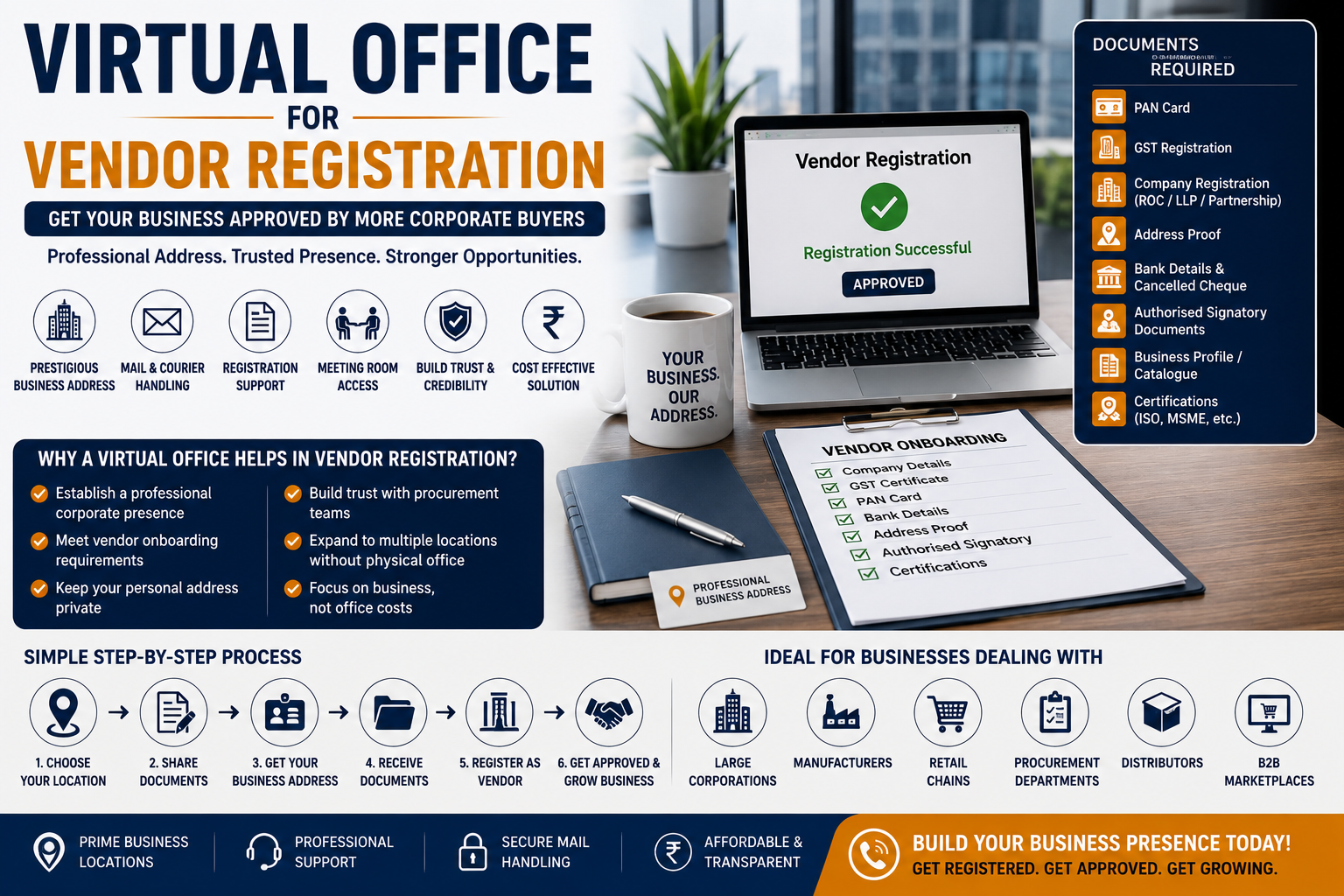
AI Overview
A Virtual Office for Vendor Registration can help businesses establish a professional commercial address while maintaining a flexible operating model. This can be particularly useful for startups, consultants, manufacturers, distributors, agencies, technology companies and other B2B businesses that want to become approved suppliers for larger organisations.
However, a Virtual Office does not automatically guarantee vendor approval. Corporate procurement teams may independently verify the supplier’s legal identity, registered or operating address, GST details, PAN, bank information, certifications, financial records, technical capability and other documents.
Vendor registration is generally a buyer-specific onboarding process. Some organisations may ask for GST certificates, PAN, bank details, address proof, MSME/Udyam information, incorporation documents, cancelled cheques, certifications, authorised-signatory details and other records. Government and corporate procurement portals can also have their own requirements. For example, India’s central e-procurement system asks corporate bidders for company details, registration number, registered address, PAN and authorised-person information.
The right Virtual Office therefore isn’t simply the cheapest address. It should provide documentation that matches the intended business purpose and should be used alongside genuine operational, financial and compliance capabilities.
Introduction: Getting Approved as a Vendor Is More Than Filling Out a Form
Winning a large corporate client can transform a small business.
One purchase order from a major manufacturer, retailer, technology company or infrastructure organisation can create:
- Recurring revenue
- Larger order volumes
- Stronger business credibility
- Better supplier references
- New customer opportunities
- Expansion into new markets
But before a company can receive that purchase order, it may have to pass through vendor registration or supplier onboarding.
This process is designed to answer a basic question:
“Can this business be trusted to supply what we need under the required commercial, legal and operational conditions?”
A procurement department may therefore ask for considerably more than a company name and phone number.
It may want to verify:
- Who owns the business?
- Is the business legally established?
- Where is it based?
- Is it registered for GST where applicable?
- Where should payments be made?
- Who is authorised to represent the company?
- Does the supplier have the required certifications?
- Does the company have relevant experience?
- Can it meet delivery requirements?
- Does it have the financial capacity to execute orders?
This is why a professional Vendor Registration Business Address can become one useful part of a company’s overall supplier-readiness strategy.
For businesses that operate remotely, from a home address or through distributed teams, a Virtual Office can provide a more structured business-address solution without immediately taking on the cost of a conventional office.
But the distinction is important:
A professional address can support vendor onboarding. It cannot replace the qualifications or operational capability required by the buyer.
What Is a Virtual Office?
A Virtual Office provides businesses with a professional commercial address and selected office-related services without requiring them to maintain a traditional full-time office at that location.
Depending on the provider and plan, services may include:
- Professional business address
- Business correspondence handling
- Mail and courier management
- Registration-support documentation
- Consent or NOC documentation where applicable
- Lease or rent documentation where applicable
- Meeting-room access
- Reception services
- Multi-city address options
The exact services vary between providers and locations.
For a business looking for a Supplier Registration Virtual Office, the most important question is not simply whether an address is available.
The more useful questions are:
- What documentation will I receive?
- Is the documentation suitable for my intended purpose?
- Can the address be used for my business registration requirements?
- Is mail/courier handling available?
- Can I use the location for occasional client meetings?
- Is the address appropriate for my target procurement process?
That approach helps prevent businesses from choosing an address first and discovering later that it does not satisfy their intended requirements.
What Is Vendor Registration?
Vendor registration is the process through which a company or organisation evaluates and onboards a supplier into its procurement system.
It may also be called:
- Supplier registration
- Vendor onboarding
- Supplier onboarding
- Vendor empanelment
- Supplier empanelment
- Vendor approval
The exact process varies significantly between organisations.
A large manufacturer may have one vendor portal.
A retail chain may have another.
A construction company may request an entirely different documentation package.
A B2B marketplace may have its own KYC and business verification process.
A government procurement portal has its own rules as well.
For example, the Government of India’s eProcurement system asks corporate bidders for information including company name, registration number, registered address, PAN, legal status, business nature and authorised contact details.
This illustrates an important point:
Business identity and address information are part of supplier onboarding—but they are only one part of the process.
Why Do Companies Ask for a Business Address?
A procurement department has to know who it is dealing with.
A business address can help establish:
1. Business Identity
It connects the supplier to a specific legal and commercial location.
2. Correspondence
Purchase-related communications, notices and other documents may need a formal business address.
3. Verification
Some organisations may use the address as one element of supplier due diligence.
4. Commercial Credibility
A professional address can make a small or remote business appear more structured.
5. Documentation Consistency
The business address may appear across:
- GST records
- Vendor forms
- Invoices
- Contracts
- Bank documentation
- Company records
- Procurement profiles
Consistency matters.
If a company uses different addresses across its documents without explanation, the procurement team may need additional clarification.
Can I Use a Virtual Office for Vendor Registration?
Potentially, yes—but acceptance depends on the organisation and the specific onboarding requirements.
There is no single universal corporate vendor-registration rule in India that forces every buyer to accept or reject Virtual Office addresses.
Every organisation can establish its own supplier-verification process.
Therefore, before using a Virtual Office for vendor onboarding, businesses should check:
- What address does the vendor form require?
- Does the buyer require a registered office, principal place of business or operational location?
- Does the buyer conduct physical verification?
- Does the buyer require a warehouse, factory or service centre?
- Are there location-specific requirements?
- What address documentation must be submitted?
- Does the company need GST registration at that location?
- Does the business actually operate from the address in the manner represented?
A Virtual Office is most useful when it genuinely satisfies the administrative requirement being addressed.
Who Should Use a Virtual Office for Vendor Registration?
1. Startups
Startups often want large corporate customers before they are ready to rent a permanent office.
A startup might have:
- Founders working remotely
- Employees working from home
- Contractors across different cities
- Outsourced manufacturing
- Cloud-based systems
- Third-party logistics
A Virtual Office can provide a professional address while the startup focuses capital on product development and customer acquisition.
2. B2B Service Companies
Examples include:
- Digital marketing agencies
- IT companies
- Software firms
- HR consultants
- Business consultants
- Accounting firms
- Training companies
- Design studios
These businesses may deliver their services remotely and therefore may not require a large physical office.
3. Manufacturers
A manufacturing business may have its factory in an industrial area while maintaining its corporate administration elsewhere.
A professional Corporate Vendor Office Address can support the administrative side of supplier relationships.
However, if the buyer wants to inspect the factory or verify manufacturing capacity, the actual factory remains essential.
4. Distributors and Traders
Distributors may operate through:
- Third-party warehouses
- Manufacturer partnerships
- Logistics providers
- Regional stockists
They may not require a large corporate office for their sales and procurement functions.
A Virtual Office can therefore provide an administrative business address while physical inventory remains at the appropriate operational location.
5. Remote B2B Teams
Modern companies increasingly have salespeople, account managers and procurement staff spread across multiple cities.
Instead of renting a dedicated office purely for appearances, a business can explore a flexible address solution.
6. Companies Expanding Into New Cities
A company headquartered in one city may want to approach corporate customers in another.
Before committing to a long-term lease, it can evaluate whether a professional business address and occasional meeting facilities are sufficient for its initial market-entry phase.
Documents Required for Vendor Onboarding
There is no single universal vendor-registration document list.
The buyer determines what it requires.
However, many supplier onboarding processes can involve some combination of:
Business Identity
- Certificate of Incorporation
- Partnership deed
- LLP agreement
- Proprietorship proof
- PAN
- Business registration documents
Tax Documentation
- GST registration certificate where applicable
- PAN
- Other tax-related information requested by the buyer
Address Documentation
- Registered-office proof
- Principal-place-of-business proof
- Rent/lease agreement
- Consent letter
- NOC
- Utility documentation
- Other accepted address evidence
Banking Information
- Bank account details
- IFSC
- Cancelled cheque
- Bank confirmation letter where required
Ownership and Authorisation
- Director/partner/proprietor information
- Authorised-signatory documents
- Board resolution
- Letter of authorisation
- Power of attorney where applicable
Business Capability
Depending on the buyer:
- Product catalogue
- Technical specifications
- Certifications
- ISO certificates
- Quality certificates
- Manufacturer authorisation
- Experience certificates
- Purchase orders
- Client references
- Turnover information
- Financial statements
The Government of India eProcurement registration process itself demonstrates how vendor/bidder onboarding can involve company identity, registered address, PAN, legal status and authorised-person details.
What Documents Should You Ask From a Virtual Office Provider?
Before purchasing a plan, ask specifically about the documentation included.
Depending on your intended purpose, you may need:
- Address confirmation
- Rent/lease documentation
- NOC
- Consent letter
- Utility bill
- Property ownership-related documentation
- Mail-handling confirmation
- Meeting access
- Registration-support documentation
Do not assume that every Virtual Office package includes every document.
Two providers can offer the same-looking “business address” while providing very different documentation.
Can a Virtual Office Support GST Registration?
A Virtual Office may be usable for GST-related purposes where the premises and documentation satisfy the applicable GST requirements.
The GST framework recognises a principal place of business and additional places of business, and the registration certificate records those locations.
CBIC guidance also provides documentation routes for different premises situations, including owned, rented/leased and certain consent-based arrangements.
However, businesses should not interpret this as:
“Any Virtual Office automatically qualifies for GST registration.”
It does not.
The business must have appropriate documentation for the premises and comply with the applicable verification requirements.
GST officers can also require physical verification of business premises in certain cases.
That is why documentation and genuine business-use considerations matter.
Why a Professional Address Can Help Vendor Credibility
Imagine a procurement manager receives proposals from two small suppliers.
Supplier A
- Generic email address
- Residential address
- Limited company information
- No clear business documentation
Supplier B
- Professional domain email
- Commercial business address
- Proper GST details
- Company website
- Clear product catalogue
- Organised vendor documentation
- Authorised contact person
The second supplier may create a more organised first impression.
But professional appearance should never be confused with procurement eligibility.
A company earns vendor trust through:
Professional presentation + compliance + capability + performance.
The address is only one component.
Benefits of a Virtual Office for Vendor Registration
1. Lower Fixed Costs
Traditional offices can require:
- Security deposits
- Monthly rent
- Furniture
- Electricity
- Internet
- Maintenance
- Housekeeping
- Office equipment
A Virtual Office can reduce the need for this infrastructure when a business doesn’t require daily workspace.
2. Professional Corporate Presence
A commercial address can be used, where appropriate, across:
- Vendor forms
- Business proposals
- Website
- Company profile
- Invoices
- Correspondence
- Business cards
3. Better Support for Remote Operations
If the team works remotely, the business doesn’t necessarily need a permanent office simply to maintain a formal address.
4. Easier Market Entry
A company exploring a new city can establish a professional presence before committing to a large office lease.
5. Meeting Facilities
Some Virtual Office providers offer access to meeting rooms.
This can be useful when a supplier occasionally needs to meet:
- Procurement managers
- Corporate clients
- Partners
- Investors
- Vendors
6. Mail and Courier Handling
Businesses involved in B2B procurement can receive important correspondence without requiring employees to remain at an office all day.
7. Multi-City Expansion
A company can potentially maintain addresses in multiple cities through appropriate Virtual Office plans.
This can be useful for companies building a national sales strategy.
Virtual Office vs Traditional Office for Vendor Registration
| Factor | Virtual Office | Traditional Office |
| Professional address | Yes | Yes |
| Full-time workspace | Usually limited/not included | Yes |
| Setup cost | Lower | Higher |
| Monthly overhead | Lower | Higher |
| Meeting facilities | Depending on plan | Usually available |
| Remote team support | Excellent | Moderate |
| Mail handling | Depending on plan | Yes |
| Daily employee operations | Not ideal | Ideal |
| Vendor address use | Subject to buyer requirements | Subject to buyer requirements |
| Warehouse | No | No, unless separately equipped |
| Factory | No | No |
| Market testing | Strong | Expensive |
A Virtual Office is not “better” in every situation.
If your procurement business has 20 employees who need to work together every day, a traditional office may make more sense.
If your business has a remote team and primarily needs a professional business address, a Virtual Office may be more efficient.
Virtual Office vs Coworking Space
These solutions serve different purposes.
Virtual Office
Best suited for:
- Business address
- Mail handling
- Corporate presence
- Registration-related requirements
- Occasional meetings
Coworking Space
Best suited for:
- Daily workspace
- Dedicated desks
- Team collaboration
- Meeting rooms
- Internet and office infrastructure
Traditional Office
Best suited for:
- Permanent teams
- Daily operations
- Dedicated infrastructure
- Long-term physical presence
Warehouse
Best suited for:
- Inventory
- Storage
- Packing
- Dispatch
- Goods handling
A supplier should select the infrastructure according to what the business actually needs.
How Much Does a Virtual Office Cost?
Virtual Office pricing varies significantly.
Factors can include:
- City
- Building/location
- Provider
- Contract duration
- Documentation
- Registration support
- Mail handling
- Meeting-room access
- Number of locations
- Business requirements
Therefore, businesses should avoid choosing solely on the lowest advertised price.
A better question is:
“Does this package provide the documentation and services required for my vendor-registration strategy?”
A cheaper package may not include the documentation or facilities your procurement process requires.
Best Cities for a Vendor Registration Business Address
There is no universally best city.
Your ideal location depends on your customers and industry.
Delhi NCR
Useful for businesses targeting:
- Corporate headquarters
- Government-linked organisations
- B2B services
- Northern India
Mumbai
Relevant for:
- Finance
- Corporate services
- Trading
- Media
- Large enterprises
Bengaluru
Strong for:
- SaaS
- IT
- Technology
- Consulting
- Startups
Hyderabad
Relevant for:
- Technology
- Pharmaceuticals
- Healthcare
- Corporate services
Pune
Strong for:
- Engineering
- Automotive
- Manufacturing
- Technology
Ahmedabad
Relevant for:
- Manufacturing
- Trading
- Pharmaceuticals
- Industrial businesses
Chennai
Strong for:
- Automotive
- Manufacturing
- Electronics
- Logistics
The correct city is ultimately the one that aligns with your target customers and expansion strategy.
Step-by-Step Process for Using a Virtual Office for Vendor Registration
Step 1: Identify Your Target Buyers
Make a list of the organisations you want to become vendors for.
For example:
- Large manufacturers
- Retail chains
- IT companies
- Infrastructure companies
- Distributors
- B2B marketplaces
Step 2: Review Their Vendor Requirements
Before purchasing an address, download or review the buyer’s vendor-registration requirements.
Check:
- Address requirements
- GST requirements
- Banking requirements
- Certifications
- Experience
- Turnover
- Authorisation documents
Step 3: Determine What Address You Actually Need
Ask whether the buyer requires:
- Registered office
- Corporate office
- Principal place of business
- Correspondence address
- Operational address
- Warehouse
- Service centre
These are not necessarily interchangeable.
Step 4: Select a Suitable City
Choose a location based on your target market.
Step 5: Compare Virtual Office Providers
Evaluate:
- Address quality
- Documentation
- Mail handling
- Meeting facilities
- Support
- Pricing
- Contract terms
- Transparency
Step 6: Complete KYC
Submit the required:
- PAN
- Company documents
- Identity documents
- Authorisation documents
- Business information
Step 7: Obtain Your Address Documentation
Collect the documentation included in your selected plan.
Keep digital and physical copies organised.
Step 8: Update Relevant Business Records
Where appropriate, ensure your business address is consistent across:
- GST records
- Company records
- Website
- Invoices
- Vendor applications
- Procurement profiles
Step 9: Submit Vendor Registration
Complete the buyer’s supplier onboarding process.
Step 10: Respond to Verification Requests
A procurement team may ask for:
- Clarifications
- Additional documents
- Certificates
- Bank verification
- Address verification
- Product information
Respond promptly.
Step 11: Maintain Your Vendor Profile
Vendor registration isn’t necessarily a one-time event.
Update:
- GST details
- Bank details
- Address
- Authorised persons
- Certifications
- Contact information
- Company records
when changes occur.
Can Startups Register as Corporate Vendors?
Yes, startups can apply to become corporate vendors where the buyer’s supplier policy allows startups to participate.
However, being a startup does not automatically remove procurement requirements.
A corporate buyer may still assess:
- Product/service capability
- Financial strength
- Experience
- Certifications
- Team
- Delivery capability
- Pricing
- Legal documentation
A startup can therefore use a Virtual Office to support its professional infrastructure while continuing to build the capabilities required by its target buyers.
Does a Professional Address Improve Vendor Credibility?
It can improve presentation, but it does not guarantee trust or approval.
A professional business address may help communicate that the business has a structured commercial presence.
But experienced procurement teams look beyond appearances.
They may evaluate:
- Legal identity
- Tax compliance
- Financial stability
- Certifications
- Past performance
- Product quality
- Delivery capability
- Customer references
- Contract compliance
The strongest supplier profile combines all of these.
Common Mistakes Businesses Make During Vendor Onboarding
Mistake 1: Assuming Vendor Registration Means Approval
Submitting an application is not the same as being approved.
Mistake 2: Using Inconsistent Business Information
The legal name, address, GST information and banking details should be carefully checked for consistency.
Mistake 3: Choosing a Virtual Office Without Checking Documentation
Always ask what documents are actually included.
Mistake 4: Assuming Every Buyer Accepts the Same Address
A corporate procurement department may have requirements different from another organisation.
Mistake 5: Treating the Address as a Substitute for Operations
If a buyer requires a factory, warehouse, technicians or service centre, the Virtual Office cannot replace them.
Mistake 6: Ignoring Physical Verification Possibilities
For GST and certain business processes, physical verification can occur in applicable circumstances.
Mistake 7: Focusing Only on Price
The cheapest Virtual Office may not be the most useful one.
Documentation, location and support can be more important.
Why Choose Vo Spaces?
For businesses exploring a Virtual Office for Vendor Registration, the provider should be evaluated as a business-infrastructure partner rather than simply an address seller.
A suitable Vo Spaces solution can be considered based on factors such as:
- Professional commercial address
- Registration-support documentation
- Mail and courier handling
- Meeting facilities
- Flexible plans
- Multi-city availability
- Business support
Before purchasing, clearly explain your intended purpose.
For example:
“I need this address for corporate vendor onboarding and may also require it for GST-related business documentation.”
This allows the provider to clarify which documentation and services are available for the specific location and package.
Businesses should always verify the buyer’s own vendor-registration requirements before committing to a particular address.
Frequently Asked Questions
1. Can I use a Virtual Office for vendor registration?
It can be possible, depending on the organisation’s vendor-onboarding policy and the documentation required. Always confirm the buyer’s requirements before selecting an address.
2. Why do companies ask for business addresses?
Business addresses help organisations identify, communicate with and verify suppliers as part of their procurement and onboarding processes.
3. What documents are needed for vendor onboarding?
Requirements vary, but may include PAN, GST certificate, incorporation/constitution documents, address proof, bank details, authorised-signatory information, certifications and financial or experience documents.
4. Can startups register as corporate vendors?
Yes, where the buyer’s procurement policy permits startups to participate. The startup must still satisfy the buyer’s applicable requirements.
5. Does a professional address improve vendor credibility?
A professional address can improve business presentation, but vendor approval depends on the organisation’s due-diligence and eligibility criteria.
6. Is a Virtual Office legal in India?
A properly structured Virtual Office arrangement can be legitimate when used for permitted business purposes and supported by appropriate documentation.
7. Can a Virtual Office be used for GST registration?
It can be possible where the premises and documentation meet applicable GST requirements. GST rules provide for principal and additional places of business, with prescribed documentation and verification processes.
8. What documents are required for a Virtual Office?
Depending on the plan and intended use, documentation may include address confirmation, rent/lease documentation, consent/NOC documentation and premises-related proof.
9. How much does a Virtual Office cost?
Pricing depends on the city, provider, duration, documentation and services included.
10. Is a Virtual Office suitable for startups?
Yes. It can be particularly useful for remote startups that want a professional commercial presence without committing to a full-time office.
11. Can I open a bank account using a Virtual Office?
A bank’s acceptance depends on its KYC and account-opening policies. Confirm the requirements with the bank before relying on the address for account opening.
12. Can freelancers use Virtual Offices?
Yes, where the service matches their business requirements and intended use.
13. Which city is best for a vendor-registration business address?
There is no universal best city. Choose based on your target customers, industry, procurement opportunities and expansion strategy.
14. How quickly can I get the required documents?
Processing time varies according to the provider, location, KYC process and selected plan.
15. Is a Virtual Office better than a coworking space?
Neither is universally better. A Virtual Office primarily addresses business-address and related administrative needs, while coworking is designed for physical workspace.
Summary
A Virtual Office for Vendor Registration can be a practical solution for businesses that want to build a professional B2B presence without immediately renting a conventional office.
It can be particularly relevant for:
- Startups
- B2B service providers
- Manufacturers
- Distributors
- Consultants
- Technology companies
- Remote businesses
- Companies entering new cities
The biggest advantage is flexibility.
Instead of spending heavily on an office that employees may rarely use, a company can explore a business-address solution that supports its administrative and commercial requirements.
But the address is only the beginning.
Successful vendor onboarding depends on the complete supplier profile:
Business identity + documentation + compliance + financial information + operational capability + professional presentation.
A Virtual Office can support that structure, but it cannot replace genuine business capability.
Final Takeaway
Corporate procurement departments want suppliers they can identify, verify and trust.
That is why a professional Vendor Registration Business Address can be useful—but it should be part of a much larger supplier-readiness strategy.
Before choosing a Virtual Office:
1. Identify your target buyers.
2. Check their vendor requirements.
3. Determine what type of address they require.
4. Verify the documentation provided by the Virtual Office provider.
5. Keep GST, banking, company and vendor information consistent.
6. Build the operational capability required to actually fulfil orders.
The goal isn’t simply to look like a bigger company.
The goal is to build a business that is easy for procurement teams to verify, easy to onboard and capable of delivering what it promises.
For businesses that don’t need a traditional office every day, a Virtual Office can be one efficient part of that strategy.