
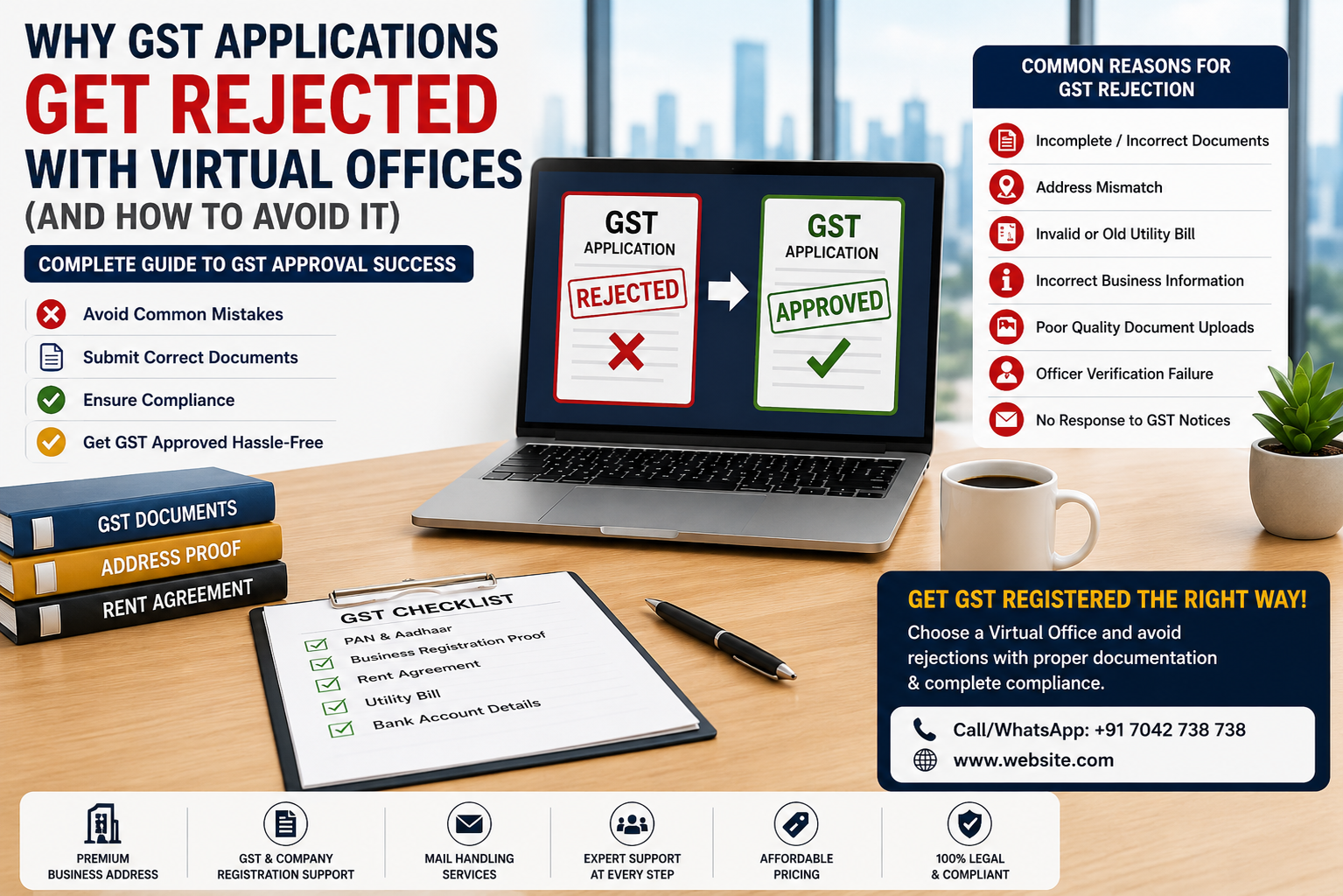
Obtaining GST registration is one of the first legal requirements for many businesses operating in India. Whether you’re a startup, Private Limited Company, LLP, One Person Company (OPC), consultant, e-commerce seller, or service provider, a valid GST registration helps you operate legally, collect taxes, claim input tax credit, and build credibility with customers.
Today, thousands of businesses choose a Virtual Office for GST registration because it offers a professional commercial address without the expense of leasing a traditional office.
However, one concern frequently discourages business owners:
“Will my GST application be rejected if I use a Virtual Office?”
The answer is not simply yes or no.
A Virtual Office itself is not the reason for rejection. In many cases, GST applications are approved using Virtual Office addresses. Rejections generally occur because of documentation issues, verification failures, incorrect application details, or non-compliance with GST requirements.
Understanding these common pitfalls can significantly improve your chances of successful registration.
In this guide, you’ll learn:
- Why GST applications get rejected
- Whether a Virtual Office is legally acceptable
- Mandatory documentation
- GST officer verification process
- Common applicant mistakes
- How to improve approval chances
- Why businesses trust Vo Spaces for GST-compliant Virtual Office solutions
What is a Virtual Office?
A Virtual Office is a commercial business address that allows businesses to establish an official presence without renting a dedicated office.
Instead of paying for expensive office infrastructure, businesses receive access to a professional address along with selected business support services.
Depending on the plan, a Virtual Office may include:
- Commercial Business Address
- GST Registration Documentation
- Company Registration Documentation
- Mail Handling
- Courier Receiving
- Business Correspondence
- Meeting Room Access
- Reception Services
This solution is especially popular among startups, consultants, freelancers, digital businesses, and companies expanding into multiple cities.
Can a Virtual Office Be Used for GST Registration?
Yes. A Virtual Office can be used for GST registration provided that:
- The business has the necessary address documentation.
- The address complies with applicable GST requirements.
- The application is completed accurately.
- All required documents are submitted.
- The GST officer is satisfied during verification, wherever applicable.
Many businesses across India successfully obtain GST registrations using Virtual Offices each year.
The key lies in choosing a reputable provider and ensuring complete compliance throughout the registration process.
Is a Virtual Office Legal in India?
Yes.
Virtual Offices are a legally recognized business solution used by startups, MSMEs, LLPs, OPCs, Private Limited Companies, consultants, and multinational businesses.
A Virtual Office provides a legitimate commercial business address that may be used for eligible business registrations when supported by the appropriate documentation and in accordance with applicable laws.
However, businesses must remember that obtaining a Virtual Office alone does not guarantee GST approval. Compliance with GST regulations remains essential.
Why Do GST Applications Get Rejected?
One of the biggest misconceptions is that GST officers reject applications simply because the applicant uses a Virtual Office.
In reality, most rejections are caused by avoidable mistakes.
Some of the most common reasons include:
- Incorrect documentation
- Incomplete application forms
- Address mismatches
- Invalid supporting documents
- KYC issues
- Verification failures
- Poor-quality document uploads
- Incorrect business information
- Non-responsive applicants during verification
Understanding these issues before applying can save considerable time and prevent unnecessary delays.
How GST Verification Works
After submitting the GST application, the tax authorities review the information provided.
Depending on the application and risk assessment, verification may include:
- Document verification
- Identity verification
- Address verification
- Additional information requests
- Physical verification (where considered necessary under applicable procedures)
The purpose of this process is to confirm that:
- The applicant is genuine.
- The business information is accurate.
- The declared address is valid.
- Supporting documents are authentic.
When documentation is complete and accurate, the registration process is generally smoother.
Common Myths About Virtual Offices and GST
Myth 1: Virtual Offices Are Illegal
False.
Virtual Offices are widely used by businesses across India and are recognized as legitimate commercial office solutions when provided by a genuine service provider.
Myth 2: Every GST Application Using a Virtual Office Gets Rejected
False.
Many businesses successfully obtain GST registration using Virtual Office addresses.
Rejections are usually linked to documentation or compliance issues rather than the Virtual Office itself.
Myth 3: A Residential Address Is Always Better
Not necessarily.
Both residential and commercial addresses must satisfy applicable GST requirements.
Using a premium commercial address can often improve professionalism and business credibility.
Myth 4: GST Approval Is Guaranteed
False.
No service provider can legitimately guarantee GST registration approval.
The final decision always rests with the GST authorities after reviewing the application and supporting documents.
Businesses should be cautious of providers making unrealistic promises of “100% guaranteed GST approval.”
Why Choosing the Right Virtual Office Provider Matters
Not all Virtual Office providers offer the same level of documentation, compliance support, or customer service.
A reliable provider should offer:
- Premium commercial business addresses
- Professionally prepared documentation
- Transparent pricing
- Mail handling services
- Responsive customer support
- Guidance throughout the documentation process
Choosing an experienced provider such as Vo Spaces helps businesses avoid many of the common issues that lead to delays and application rejections.
Top Reasons Why GST Applications Get Rejected with a Virtual Office
Most GST registration rejections are not caused by the Virtual Office itself—they result from errors in documentation, incorrect application details, or compliance issues. Understanding these common reasons can help businesses avoid delays and improve their chances of approval.
1. Incomplete Documentation
One of the most common reasons for GST rejection is submitting incomplete or missing documents.
Applicants may forget to upload:
- PAN Card
- Aadhaar Card
- Business Constitution Documents
- Address Proof
- Rent Agreement
- No Objection Certificate (NOC)
- Utility Bill
- Authorization Letter (where applicable)
Even a single missing document can delay or reject the application.
2. Incorrect Business Information
The information entered in the GST application must match all supporting documents.
Common mistakes include:
- Incorrect company name
- Wrong PAN details
- Incorrect mobile number
- Mismatched email address
- Wrong business constitution
- Incorrect trade name
Any inconsistency may trigger additional verification or rejection.
3. Address Mismatch
The address mentioned in the GST application should exactly match the address mentioned in:
- Rent Agreement
- Utility Bill
- NOC
- Supporting Documents
Differences in spelling, building number, floor number, locality, or PIN code may result in queries from the GST department.
4. Invalid Address Documents
GST authorities generally expect clear and valid address proof.
Problems often arise when:
- Utility bills are outdated
- Documents are illegible
- The address is incomplete
- Mandatory documents are missing
- Documents are not properly signed where required
Using professionally prepared documentation significantly reduces these risks.
5. Poor Quality Document Uploads
Blurry scans or incomplete uploads are surprisingly common.
Avoid:
- Cropped documents
- Low-resolution images
- Missing pages
- Handwritten corrections
- Password-protected files
- Illegible scans
Always upload high-quality, clearly readable PDF or image files.
6. KYC Verification Issues
Identity verification is an important part of the GST registration process.
Applications may face delays if:
- Aadhaar details do not match
- PAN information is incorrect
- Mobile number verification fails
- OTP authentication is incomplete
- Authorized signatory details are incorrect
Ensure all KYC information is accurate before submission.
7. GST Officer Seeks Additional Clarification
Sometimes, the GST officer may raise a query requesting:
- Additional supporting documents
- Clarification regarding business activities
- Explanation of the business model
- Clarification regarding the registered address
Responding promptly and accurately helps avoid unnecessary delays.
8. Business Activity Doesn’t Match the Application
The declared business activity should accurately reflect the actual nature of your business.
For example:
- Software company
- Digital marketing agency
- Consultancy
- Trading business
- E-commerce seller
- Manufacturing company
Providing vague or inaccurate descriptions may invite additional scrutiny.
9. Incorrect Principal Place of Business Details
The Principal Place of Business is a key component of the GST application.
Applicants should ensure that:
- The address is complete.
- The supporting documents correspond to the declared address.
- The business activities align with the chosen location.
10. Ignoring GST Notices
If the GST department requests clarification or additional documents, businesses should respond within the prescribed timeline.
Ignoring notices may result in rejection of the application.
Documents Required for GST Registration
Although documentation requirements vary depending on the type of business entity, the following are commonly required.
Proprietorship
- PAN Card
- Aadhaar Card
- Photograph
- Mobile Number
- Email Address
- Address Proof
- Bank Account Details
Partnership Firm
- Partnership Deed
- PAN Card
- Partner Identity Proof
- Address Proof
- Authorization Letter
LLP
- LLP Incorporation Certificate
- LLP Agreement
- PAN Card
- Partner Details
- Authorized Signatory Documents
Private Limited Company
- Certificate of Incorporation
- PAN Card
- Director Identity Proof
- Board Resolution (where applicable)
- Authorized Signatory Details
Additional documents may be required depending on the business structure and applicable GST rules.
Documents Provided by Vo Spaces
Choosing a reliable Virtual Office provider ensures that you receive professionally prepared documentation suitable for eligible business registrations.
Depending on the selected plan, Vo Spaces provides:
- Commercial Business Address
- Rent Agreement
- No Objection Certificate (NOC)
- Utility Bill
- Address Documentation
- Mail Handling Services
- Business Correspondence Support
These documents may support GST registration where applicable, subject to compliance with GST regulations.
Step-by-Step Process for Successful GST Registration Using a Virtual Office
Step 1: Choose a Reliable Virtual Office Provider
Select a provider with experience in supporting businesses through GST registration.
Look for:
- Premium business locations
- Transparent pricing
- Complete documentation
- Responsive support
Step 2: Complete KYC Verification
Submit all required identity and business documents accurately.
Ensure names, addresses, and identification details match across all documents.
Step 3: Receive Address Documentation
After successful verification, receive the documentation associated with your selected Virtual Office plan.
Review every document carefully before proceeding.
Step 4: Prepare the GST Application
Complete the GST application with accurate business information.
Double-check:
- Business name
- PAN details
- Address
- Contact information
- Business activity
- Bank details
Step 5: Upload High-Quality Documents
Upload clear, readable copies of all required documents.
Avoid blurred photographs or incomplete scans.
Step 6: Respond Promptly to Queries
If the GST department requests clarification or additional documents, respond within the specified timeline with accurate information.
Step 7: Maintain Compliance
After registration, continue maintaining accurate business records and comply with ongoing GST filing requirements.
How to Prepare for GST Officer Verification
Businesses can improve their chances of approval by following these best practices:
- Ensure all application details are accurate.
- Use clear and valid documentation.
- Keep copies of all submitted documents.
- Respond promptly to official communications.
- Verify that your business activities are correctly described.
- Choose a reputable Virtual Office provider with professionally prepared documentation.
Proper preparation minimizes delays and helps ensure a smoother registration process.
Common Mistakes Businesses Make During GST Registration
Many GST registration applications are delayed or rejected because applicants make simple yet avoidable mistakes. Understanding these errors beforehand can save valuable time and help ensure a smoother approval process.
Choosing the Cheapest Virtual Office Instead of the Right One
Price is important, but documentation quality is even more critical.
Some businesses purchase low-cost Virtual Office plans without confirming whether the provider offers documentation suitable for GST registration.
Before selecting a provider, verify that they can provide:
- Commercial Address Documentation
- Rent Agreement
- No Objection Certificate (NOC)
- Utility Bill
- Business Support
Working with an experienced provider like Vo Spaces can help reduce documentation-related issues.
Using Incorrect Business Details
The GST application should exactly match your official business records.
Common errors include:
- Incorrect legal business name
- Wrong PAN number
- Incorrect constitution of business
- Incorrect HSN/SAC selection
- Wrong business commencement date
- Incorrect trade name
Even minor inconsistencies can result in notices or delays.
Uploading Poor-Quality Documents
GST officers review uploaded documents carefully.
Avoid uploading:
- Blurry photographs
- Cropped documents
- Incomplete PDFs
- Low-resolution scans
- Documents with unclear signatures
- Files that cannot be opened
Always upload high-quality scanned copies.
Using an Incorrect Business Activity
Businesses sometimes select the wrong business activity during registration.
For example:
A software company should not register as a trader.
An e-commerce seller should correctly declare online trading activities.
A consultancy should accurately describe the consulting services offered.
Selecting the correct business activity helps prevent unnecessary clarification requests.
Ignoring GST Notices
Many applications are rejected simply because applicants fail to respond to official GST notices.
If clarification is requested:
- Read the notice carefully.
- Respond within the prescribed timeline.
- Upload all requested documents.
- Provide accurate explanations.
Prompt responses improve the chances of successful registration.
Not Verifying Documents Before Submission
Before submitting your application, confirm that:
- Names match across all documents.
- Address details are identical.
- Contact information is accurate.
- Uploaded documents are complete.
- Every required document has been attached.
A final review can prevent many avoidable mistakes.
How to Improve Your GST Approval Chances
Although GST approval depends on the tax authorities, businesses can significantly improve their chances by following best practices.
Choose a Reliable Virtual Office Provider
An experienced provider understands the documentation generally required for GST registration and offers professionally prepared commercial address documents.
Keep Your Documentation Organized
Maintain digital copies of:
- PAN Card
- Aadhaar Card
- Certificate of Incorporation
- Partnership Deed or LLP Agreement (where applicable)
- Address Proof
- Bank Details
- Rent Agreement
- Utility Bill
- No Objection Certificate (NOC)
Having organized records allows you to respond quickly if additional information is requested.
Ensure Consistency Across All Records
The following information should remain consistent:
- Business Name
- Trade Name
- Registered Address
- Mobile Number
- Email Address
- PAN Details
- Authorized Signatory Information
Consistency reduces the likelihood of verification issues.
Describe Your Business Clearly
Avoid vague descriptions such as:
- Business Services
- Consultancy
- Trading
Instead, use specific descriptions such as:
- Digital Marketing Agency
- Software Development Services
- Chartered Accountancy Services
- Management Consultancy
- E-commerce Retail Business
- IT Consulting
- Manufacturing of Electrical Components
A clear business description helps GST officers understand your operations.
Keep Communication Active
Monitor:
- Mobile Number
- GST Portal Notifications
Prompt communication allows you to address queries without unnecessary delays.
Virtual Office vs Traditional Office for GST Registration
| Feature | Traditional Office | Virtual Office |
| Commercial Business Address | ✔ | ✔ |
| GST Registration Support | ✔ | ✔ (Subject to compliance and documentation) |
| Office Rent | High | None |
| Security Deposit | Required | Not Required |
| Office Maintenance | High | None |
| Utility Expenses | High | None |
| Mail Handling | ✔ | ✔ |
| Business Correspondence | ✔ | ✔ |
| Remote Work Friendly | Limited | Excellent |
| Cost Effective | No | Yes |
| Easy Multi-City Expansion | Limited | Yes |
For businesses that do not require a full-time workspace, a Virtual Office often provides a more flexible and economical solution.
Pricing Comparison
Operating a traditional office involves substantial recurring expenses. A Virtual Office offers a cost-effective alternative while providing a professional commercial address.
| Office Solution | Estimated Annual Cost | Best For |
| Traditional Office | ₹5,00,000 – ₹20,00,000+ | Established businesses requiring dedicated office space |
| Managed Office | ₹2,50,000 – ₹10,00,000 | Growing companies |
| Coworking Space | ₹1,20,000 – ₹5,00,000 | Teams needing regular workspace |
| Virtual Office | ₹8,000 – ₹40,000* | Startups, MSMEs, consultants, e-commerce sellers, expanding businesses |
*Actual pricing depends on the city, location, services included, and subscription period.
Best Practices After GST Registration
Receiving GST approval is only the beginning. Businesses should continue following compliance requirements to maintain good standing.
Maintain Proper Records
Keep copies of:
- GST Certificate
- Rent Agreement
- Utility Bill
- NOC
- Business Correspondence
- Purchase Records
- Sales Records
Organized documentation simplifies future compliance.
File GST Returns on Time
Timely filing helps avoid:
- Interest
- Late fees
- Compliance notices
- Business disruptions
Use reminders or professional accounting support to stay compliant.
Update Registration Details When Required
Whenever your business information changes, update the GST portal promptly.
Examples include:
- Business Address
- Authorized Signatory
- Mobile Number
- Email Address
- Bank Account
- Business Activity
Accurate records reduce the risk of future complications.
Why Businesses Choose Vo Spaces
Businesses across India rely on Vo Spaces because we focus on providing professionally managed Virtual Office solutions designed to support modern business needs.
Premium Commercial Business Addresses
Establish your presence in some of India’s most recognized commercial locations, helping your business build credibility with clients and stakeholders.
Professionally Prepared Documentation
Our Virtual Office plans include documentation such as Rent Agreements, No Objection Certificates (NOCs), Utility Bills, and commercial address proof associated with the selected plan. These documents may support eligible GST registrations and other business compliance requirements where applicable.
Transparent Pricing
Choose from flexible plans with straightforward pricing and no hidden charges.
Reliable Mail Handling
Receive and manage important business correspondence efficiently through our professional mail handling services.
Fast Onboarding
Our streamlined KYC and verification process helps eligible businesses activate their Virtual Office quickly, enabling them to move forward with registration procedures without unnecessary delays.
Dedicated Customer Support
From selecting the right business location to understanding documentation requirements, our support team assists businesses throughout the onboarding process.
Frequently Asked Questions (FAQs)
1. Why does GST registration get rejected when using a Virtual Office?
GST registration is not rejected simply because you use a Virtual Office. Most rejections occur due to incomplete documentation, incorrect business details, address mismatches, poor-quality document uploads, or failure to respond to GST officer queries. Choosing a reliable Virtual Office provider and submitting accurate information significantly improves approval chances.
2. Is a Virtual Office valid for GST registration?
Yes. A Virtual Office can be used for GST registration when the commercial address is supported by the required documentation and the application complies with applicable GST regulations. Many businesses across India successfully register for GST using Virtual Office addresses.
3. Which documents are mandatory for GST registration?
The exact requirements depend on the business structure, but commonly required documents include:
- PAN Card
- Aadhaar Card
- Certificate of Incorporation / Partnership Deed / LLP Agreement (as applicable)
- Rent Agreement
- No Objection Certificate (NOC)
- Utility Bill
- Bank Account Details
- Authorized Signatory Documents
Additional documents may be requested depending on the application.
4. What is the most common reason for GST rejection?
The most common reasons include:
- Incorrect application details
- Address mismatch
- Missing or invalid documents
- Poor-quality document uploads
- Incorrect business activity
- Failure to respond to GST notices
- Incomplete KYC verification
Most of these issues are preventable with careful preparation.
5. Can GST officers physically verify my business address?
Yes. Depending on the application and the verification requirements, GST authorities may conduct additional verification, including physical verification where considered necessary under applicable procedures.
Businesses should ensure that all information provided during registration is accurate and supported by valid documentation.
6. Is a Virtual Office legal in India?
Yes. A Virtual Office is a legally recognized commercial office solution in India. It is widely used by startups, MSMEs, LLPs, OPCs, Private Limited Companies, consultants, and expanding businesses.
7. Can I use a Virtual Office for company registration as well?
Yes. Many businesses use a Virtual Office for eligible company registrations in addition to GST registration, provided the required documentation is available and applicable legal requirements are met.
8. How long does GST registration usually take?
The processing time depends on factors such as:
- Accuracy of the application
- Completeness of documentation
- Verification requirements
- GST department processing timelines
- Whether additional clarification is requested
Submitting a complete and accurate application generally helps avoid unnecessary delays.
9. Can freelancers and consultants use a Virtual Office?
Absolutely. Freelancers, consultants, digital agencies, architects, software developers, Chartered Accountants, Company Secretaries, lawyers, and many other professionals frequently use Virtual Offices to maintain a professional business presence while working remotely.
10. Which city is best for a Virtual Office?
The ideal location depends on your customers, industry, and expansion strategy. Popular commercial cities include:
- Bangalore
- Delhi
- Gurgaon
- Noida
- Mumbai
- Pune
- Hyderabad
- Chennai
A premium business address can improve your company’s credibility and brand perception.
11. Can I open a bank account using a Virtual Office?
Many banks accept commercial business addresses supported by appropriate documentation. Since documentation requirements vary between banks, businesses should confirm the specific requirements with their banking partner before proceeding.
12. How quickly can I receive my Virtual Office documents?
Following successful KYC verification, Vo Spaces aims to provide the documentation associated with your selected plan promptly, allowing businesses to begin the GST registration process without unnecessary delays.
13. Is a Virtual Office better than a coworking space for GST registration?
If your primary requirement is a professional commercial address, documentation, and mail handling, a Virtual Office is generally a more cost-effective option. Businesses that require a physical workspace for employees may also consider a coworking space.
14. How can I avoid GST verification issues?
To reduce the likelihood of verification issues:
- Choose a reputable Virtual Office provider.
- Ensure all business details are accurate.
- Upload clear, complete, and legible documents.
- Verify that the address matches across all records.
- Respond promptly to GST department queries.
- Maintain organized business documentation.
15. Why choose Vo Spaces for GST-compliant Virtual Offices?
Vo Spaces provides premium commercial business addresses, professionally prepared documentation, transparent pricing, reliable mail handling, and dedicated customer support. Our Virtual Office solutions are designed to help businesses prepare complete documentation for eligible GST registrations and other business compliance needs.
Why Choose Vo Spaces?
Applying for GST registration is a crucial step for any business, and the quality of your documentation can make a significant difference. At Vo Spaces, we focus on providing professionally managed Virtual Office solutions that help businesses establish a credible commercial presence with confidence.
Premium Commercial Locations
Choose from prestigious business addresses in major commercial cities across India to strengthen your brand image and inspire trust among clients, vendors, and stakeholders.
Documentation Prepared for Business Compliance
Our Virtual Office plans include professionally prepared documentation such as Rent Agreements, No Objection Certificates (NOCs), Utility Bills, and commercial address proof associated with your selected package. These documents may support eligible GST registrations, company registrations, and other compliance requirements where applicable.
Transparent Pricing
We offer straightforward pricing with flexible plans suitable for startups, MSMEs, LLPs, OPCs, Private Limited Companies, consultants, and growing businesses.
Professional Mail Handling
Stay connected with important government notices and business correspondence through our reliable mail handling services available with selected plans.
Fast Onboarding
Our streamlined verification process enables eligible businesses to activate their Virtual Office quickly, helping them proceed with GST registration and other business formalities without unnecessary delays.
Dedicated Customer Support
Our experienced support team assists businesses in understanding documentation requirements, selecting the right location, and choosing the most suitable Virtual Office plan.
Scalable Business Solutions
Whether you’re launching a startup, expanding into multiple states, or establishing a presence in a new city, Vo Spaces provides scalable Virtual Office solutions that grow with your business.
Summary
A Virtual Office does not automatically lead to GST registration rejection. In reality, many businesses successfully obtain GST registration using Virtual Office addresses every year. Most rejections occur because of preventable issues such as incomplete documentation, incorrect application details, address mismatches, poor-quality document uploads, or failure to respond to verification requests.
Businesses can significantly improve their chances of approval by choosing a reputable Virtual Office provider, ensuring consistency across all records, submitting clear and complete documentation, and responding promptly to GST department communications.
A professionally managed Virtual Office offers more than just a commercial address—it provides credibility, flexibility, and cost savings while supporting modern business operations. For startups, consultants, e-commerce sellers, MSMEs, and expanding companies, it is an efficient solution for establishing a professional business presence without the expense of maintaining a traditional office.
With Vo Spaces, businesses gain access to premium commercial locations, professionally prepared documentation, reliable mail handling, transparent pricing, and dedicated customer support. Our Virtual Office solutions are designed to help businesses confidently prepare for eligible GST registrations and future growth.
Final Thoughts
GST registration is a critical milestone for any business, and careful preparation can make the process much smoother. By understanding the common reasons behind application rejections and following best practices for documentation and compliance, businesses can reduce delays and improve their chances of approval.
Choosing an experienced Virtual Office provider like Vo Spaces gives businesses access to quality documentation, premium commercial addresses, and responsive support—helping them establish a compliant and professional business presence while focusing on long-term success.