
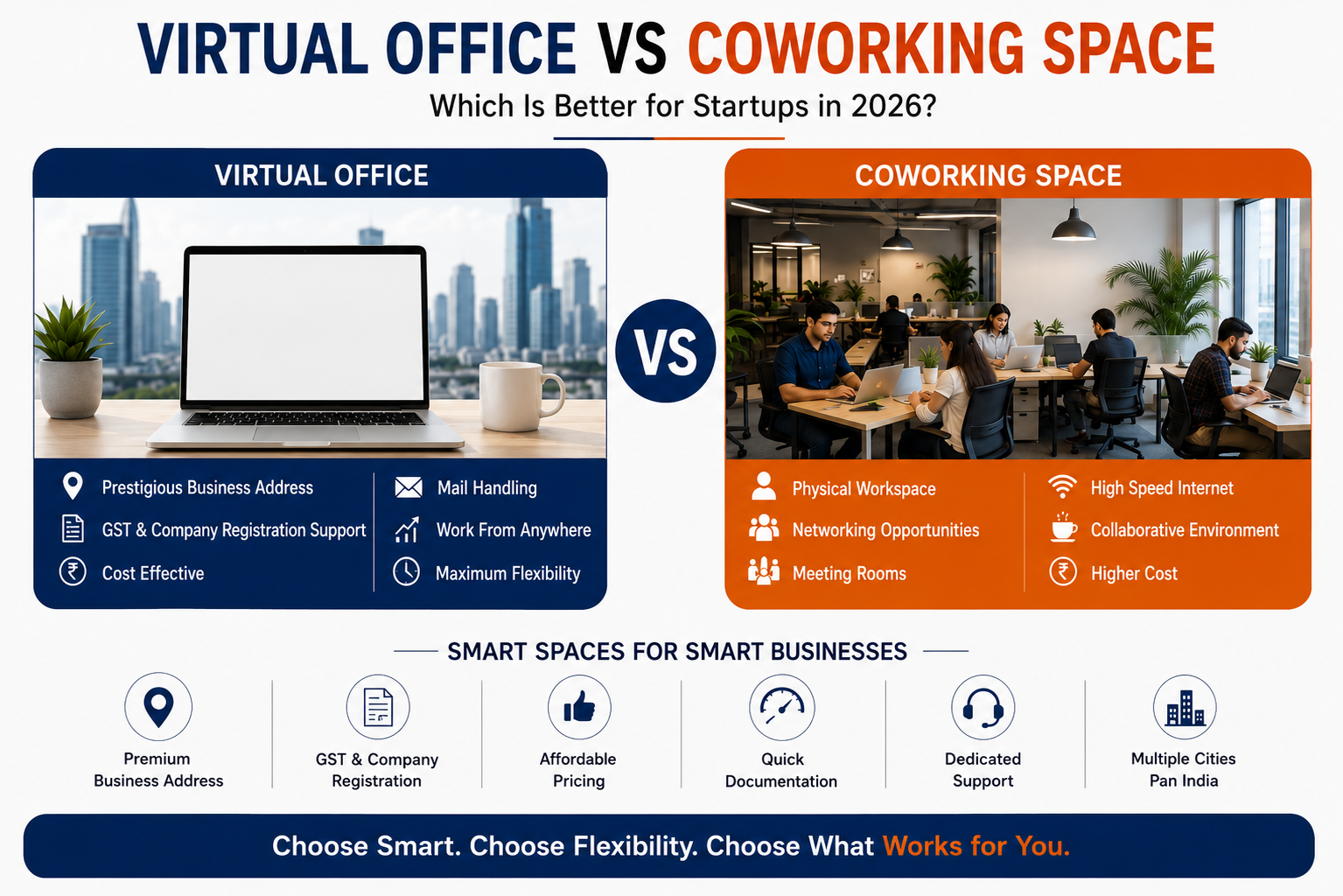
Starting a business in 2026 is significantly different from launching one a decade ago. Today’s startups prioritize flexibility, cost efficiency, scalability, and digital-first operations. Instead of signing expensive long-term office leases, entrepreneurs now have access to smarter workspace solutions such as virtual offices and coworking spaces.
However, one question continues to dominate startup discussions:
Should you choose a virtual office or a coworking space?
Both options offer unique benefits, but they serve different business needs. While coworking spaces provide physical workstations and collaborative environments, virtual offices focus on delivering a professional business address and compliance support without the high costs of a traditional office.
This comprehensive guide compares virtual offices and coworking spaces across costs, flexibility, legal compliance, scalability, and business growth potential to help startups make the right decision in 2026.
What is a Virtual Office?
A virtual office is a service that provides businesses with a professional commercial address without requiring them to rent a physical office space full-time.
Businesses can use this address for:
- GST Registration
- Company Registration
- Business Correspondence
- Website and Marketing Materials
- Client Communication
- Banking and Compliance Requirements
Most virtual office providers also offer:
- NOC (No Objection Certificate)
- Rent Agreement
- Utility Bill
- Mail Handling
- Meeting Room Access (Optional)
- Business Support Services
A virtual office allows startups to establish a credible business presence in premium locations while significantly reducing operational costs.
What is a Coworking Space?
A coworking space is a shared physical workspace where professionals, startups, freelancers, and businesses work alongside one another.
Coworking spaces typically provide:
- Dedicated Desks
- Hot Desks
- Private Cabins
- Meeting Rooms
- Internet Access
- Reception Services
- Community Events
- Networking Opportunities
Coworking environments are ideal for businesses requiring a physical workplace but wanting to avoid the expense of traditional office leases.
Virtual Office vs Coworking Space: Quick Comparison
| Feature | Virtual Office | Coworking Space |
|---|---|---|
| Physical Workspace | No | Yes |
| Business Address | Yes | Sometimes |
| GST Registration Support | Yes | Limited |
| Company Registration | Yes | Limited |
| Monthly Cost | Very Low | Higher |
| Remote Team Friendly | Excellent | Moderate |
| Scalability | High | Medium |
| Networking Opportunities | Limited | High |
| Long-Term Flexibility | Excellent | Moderate |
| Compliance Documents | Included | Not Always |
Why Startups Are Rethinking Office Spaces in 2026
The startup ecosystem has evolved rapidly due to:
- Remote work adoption
- AI-powered operations
- Distributed teams
- Increased commercial rents
- Digital-first customer acquisition
Many startups no longer need a full-time office. Instead, they require:
- Legal business registration
- GST compliance
- Professional business presence
- Affordable operating costs
This shift has significantly increased demand for virtual offices across India.
Cost Comparison: Virtual Office vs Coworking Space
Cost is often the biggest deciding factor for startups.
Virtual Office Cost
Typical annual costs:
- Business Address
- GST Registration Documents
- Company Registration Documents
- Mail Handling
Approximate Range:
₹999 – ₹15,000 per year depending on location and services.
Coworking Space Cost
Monthly pricing generally includes:
- Desk Access
- Utilities
- Internet
- Community Access
Approximate Range:
₹4,000 – ₹20,000+ per month per person.
For a team of five employees, annual costs can easily exceed:
₹2,50,000 – ₹10,00,000+
Winner: Virtual Office
For startups focused on minimizing expenses while maintaining compliance, virtual offices offer significantly better value.
Which Option is Better for GST Registration?
Businesses registering for GST require valid commercial address documentation.
A quality virtual office provider usually offers:
- Rent Agreement
- NOC
- Utility Bill
These documents are commonly used during GST registration processes.
Some coworking providers may provide address documentation, while others focus primarily on workspace services.
For businesses specifically seeking GST registration support, virtual offices are often the more straightforward solution.
Which Option is Better for Company Registration?
During company incorporation, businesses must provide a registered office address.
Virtual offices are specifically designed to support:
- Private Limited Company Registration
- LLP Registration
- OPC Registration
- Startup Registration
Required documentation is generally available immediately after purchase.
Coworking spaces may not always provide suitable documentation depending on their policies.
Virtual Office Benefits for Startups
1. Significant Cost Savings
Startups can avoid:
- Security deposits
- Brokerage fees
- Utility bills
- Office maintenance
This frees up capital for:
- Marketing
- Product Development
- Hiring
2. Professional Business Presence
A premium business address improves:
- Brand credibility
- Customer trust
- Vendor confidence
- Investor perception
3. Easy Business Expansion
Virtual offices allow startups to establish presence in multiple cities without opening physical branches.
Popular expansion cities include:
- Delhi
- Gurgaon
- Noida
- Mumbai
- Pune
- Bangalore
- Hyderabad
4. Remote Team Compatibility
Modern startups increasingly operate remotely.
A virtual office complements:
- Work-from-home teams
- Freelancers
- Distributed employees
- Digital agencies
5. Compliance Support
Most providers offer documentation required for:
- GST Registration
- Company Registration
- Regulatory Requirements
Coworking Space Benefits
1. Physical Work Environment
Businesses needing daily office access may benefit from coworking spaces.
2. Networking Opportunities
Coworking communities often include:
- Founders
- Developers
- Marketers
- Investors
Networking can generate valuable business opportunities.
3. Meeting Rooms
Many coworking spaces provide access to professional meeting facilities.
4. Team Collaboration
For businesses requiring regular in-person collaboration, coworking spaces can improve communication and productivity.
Who Should Use a Virtual Office?
Virtual offices are ideal for:
Startups
Reduce overhead while maintaining professional credibility.
Freelancers
Create a professional business identity.
Consultants
Operate efficiently without renting expensive offices.
Digital Agencies
Maintain compliance while serving clients remotely.
E-commerce Sellers
Register GST in multiple states.
SaaS Companies
Scale nationally without physical branches.
Remote Teams
Maintain legal business presence while operating virtually.
Documents Required for a Virtual Office
Most virtual office providers supply:
NOC (No Objection Certificate)
Confirms permission to use the address.
Rent Agreement
Serves as address proof.
Utility Bill
Supports GST and registration applications.
Business Address Documentation
Used for legal and compliance purposes.
Step-by-Step Process to Get a Virtual Office
Step 1
Choose your preferred city and location.
Step 2
Select a virtual office package.
Step 3
Submit KYC documents.
Step 4
Receive:
- NOC
- Rent Agreement
- Utility Bill
Step 5
Apply for:
- GST Registration
- Company Registration
- Bank Account
Step 6
Start operating immediately.
When Should You Choose a Coworking Space?
A coworking space may be better if:
- Your team works together daily.
- You require a dedicated desk.
- Frequent client meetings occur.
- Collaboration is a priority.
- You want networking opportunities.
When Should You Choose a Virtual Office?
A virtual office is often the better choice if:
- You work remotely.
- You need GST registration.
- You need company registration.
- You want to minimize expenses.
- You operate in multiple cities.
- You want flexibility.
Why Many Startups Use Both
A growing trend in 2026 is combining both solutions.
Example:
- Virtual Office for registration and compliance
- Coworking Space on-demand for meetings
This approach provides maximum flexibility while minimizing costs.
Why Choose Vo Spaces?
Vo Spaces helps startups establish a professional business presence without the burden of traditional office expenses.
Benefits of Choosing Vo Spaces
- Premium Business Locations
- GST Registration Support
- Company Registration Support
- Affordable Pricing
- Fast Documentation
- Professional Customer Support
- Multi-City Availability
- Flexible Plans
Whether you’re launching a startup, expanding into new markets, or registering a business, Vo Spaces provides the documentation and support needed to get started quickly.
Overview Summary
For startups in 2026, the choice between a virtual office and a coworking space depends on business requirements.
Choose a virtual office if your primary goals are:
- GST registration
- Company registration
- Cost savings
- Remote operations
- Multi-city expansion
Choose a coworking space if your business requires:
- Daily office access
- Team collaboration
- Physical workspace
- Networking opportunities
For most modern startups, virtual offices offer the best combination of affordability, compliance, scalability, and flexibility.
Frequently Asked Questions
Is a virtual office legal in India?
Yes. Virtual offices are widely used by startups, freelancers, consultants, and companies for business registration and compliance purposes.
Can a virtual office be used for GST registration?
Yes. Many businesses use virtual offices for GST registration when appropriate supporting documents are provided.
What documents are required?
Typically:
- NOC
- Rent Agreement
- Utility Bill
- KYC Documents
How much does a virtual office cost?
Costs vary depending on city and provider, but are generally much lower than traditional office rentals.
Is a virtual office suitable for startups?
Yes. Virtual offices are particularly beneficial for startups seeking flexibility and lower operating costs.
Can I open a bank account using a virtual office?
Requirements vary by bank, but business address documentation may be accepted depending on compliance requirements.
Can freelancers use virtual offices?
Absolutely. Freelancers often use virtual offices to maintain a professional business address.
Which city is best for a virtual office?
Popular choices include Delhi, Gurgaon, Noida, Mumbai, Bangalore, Hyderabad, and Pune.
How quickly can I get documents?
Many providers issue documentation within a few business days after verification.
Is a virtual office better than a coworking space?
For compliance, registration, and cost savings, virtual offices are often the better option. For daily workspace needs, coworking spaces may be more suitable.
Can I register a Private Limited Company using a virtual office?
Yes, virtual offices are commonly used for company incorporation.
Can I use a virtual office in multiple states?
Yes. Businesses often use virtual offices to establish presence across multiple states.
Are virtual offices suitable for e-commerce businesses?
Yes. Many online sellers use virtual offices for GST registration and expansion.
Can remote teams use virtual offices?
Yes. Virtual offices are ideal for remote-first businesses.
Do virtual offices provide meeting room access?
Many providers offer optional meeting room facilities when required.